Micro-Mobility Market Outlook:
Micro-Mobility Market size was valued at USD 47.1 billion in 2025 and is anticipated to reach USD 176 billion by the end of 2035, expanding at around 14.1% CAGR during the forecast period, i.e., 2026-2035. In 2026, the industry size of micro-mobility is evaluated at USD 53.7 billion.
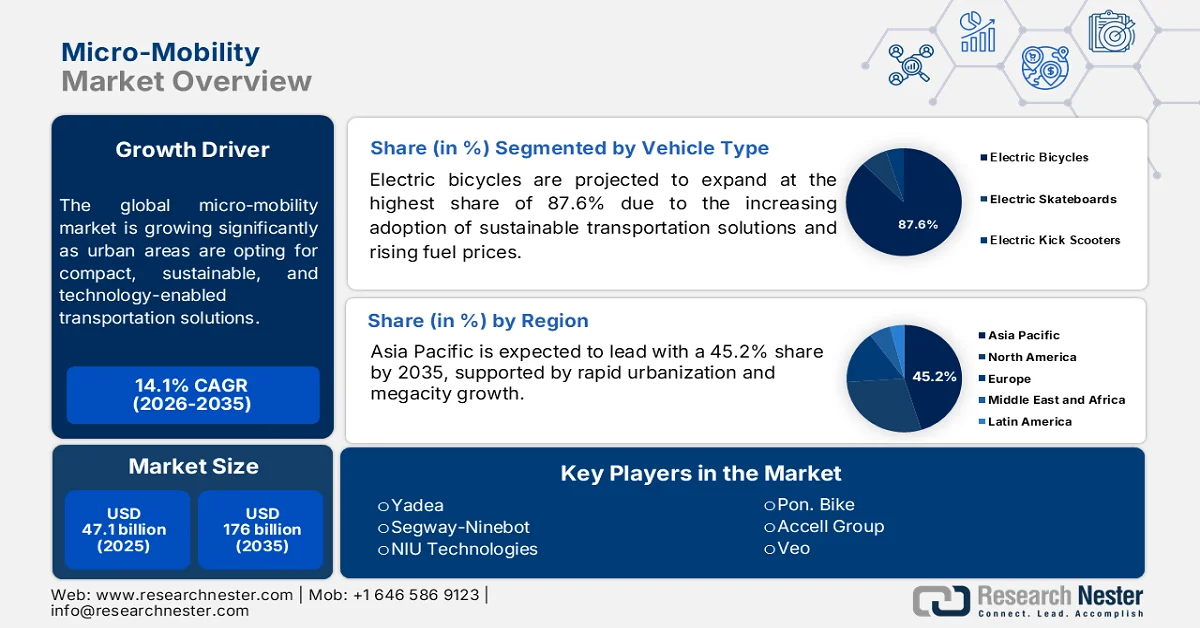
The micro-mobility market is positioned for strong growth as urban areas are opting for compact, sustainable, and technology-enabled transportation solutions which are for short-distance travel and last-mile connectivity. In addition to growing urbanization, rising demand for eco-friendly mobility options and the integration of digital platforms, smart connectivity, and shared mobility services are deliberately reshaping the future of the industry. In this context, IMC in December 2024 disclosed that the global micromobility industry is growing significantly, which is driven by urbanization, smart city initiatives, and rising demand for convenient transport options. Besides, it also mentioned that growth is supported by increased investments, shared mobility services, and advancements in electric vehicles.
In parallel, the market is being supported by substantial investments in terms of cycling infrastructure, improved battery technologies, and the shift toward flexible transportation models that complement the existing public transit systems. Furthermore, emerging opportunities in electric bikes, e-scooters, subscription-based mobility services, and connected fleet management enhance adoption across all major cities worldwide. The article, which was published by the University of California in April 2024, stated that local governments can strengthen shared micromobility systems, including bike-sharing and scooter-sharing, through improved infrastructure and planning approaches, thus contributing to the market’s progression.
Key Micro-Mobility Market Insights Summary:
Regional Highlights:
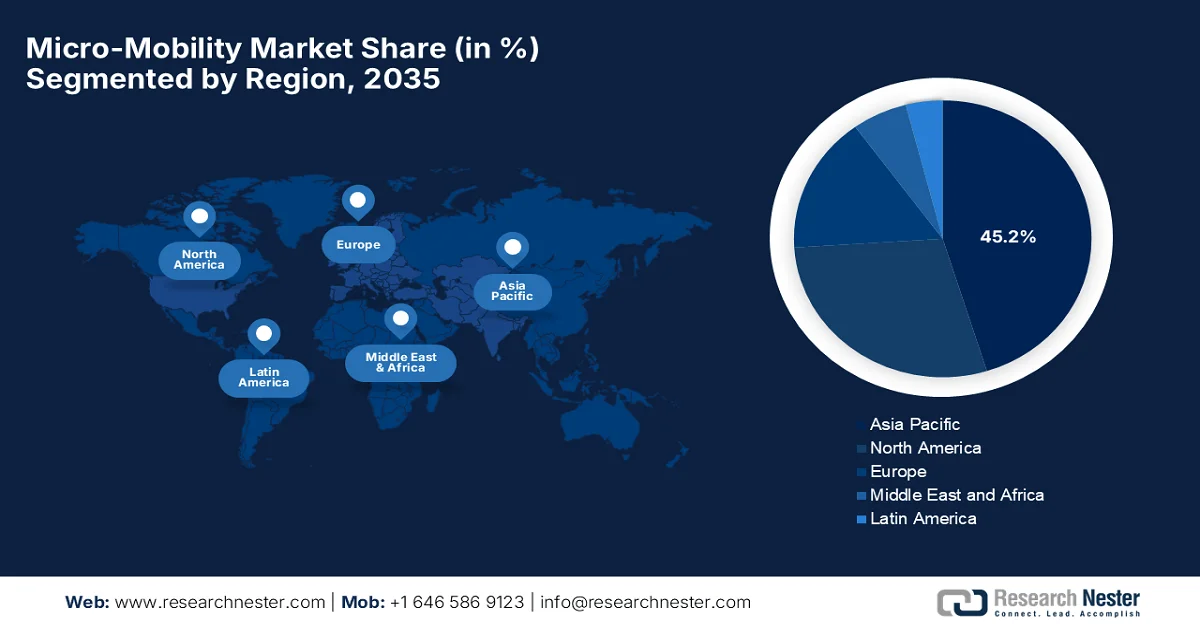
- Asia Pacific is expected to command 45.2% of the micro-mobility market by 2035, reinforced by dense urban populations, gridlocked megacities, and aggressive government initiatives to curb air pollution
- North America is poised to witness the fastest growth between 2026-2035, supported by shifting commuter habits and city efforts to reduce traffic gridlock
- The market in the U.S. accounts for 40.7% of the share in North America, which is driven by the increasing adoption of shared bicycles and e-scooters, and supportive government initiatives for sustainable urban transportation
Segment Insights:
- Electric bicycles are projected to capture 87.6% of the micro-mobility market by 2035, underpinned by increasing adoption of sustainable transportation solutions, rising fuel prices, and the need for affordable last-mile connectivity
- The sealed lead acid segment is anticipated to secure a substantial revenue share during 2026-2035, bolstered by its proven reliability, lower initial procurement cost, and established recycling infrastructure
Key Growth Trends:
- Environmental sustainability
- Rapid urbanization
Major Challenges:
- Regulatory and policy uncertainty
- Safety concerns and infrastructure limitations
Key Players: Yadea (China), Segway-Ninebot (China), NIU Technologies (China), Pon.Bike (Netherlands), Accell Group (Netherlands), Veo (U.S.), TIER Mobility (Germany), Dott (Netherlands).
Global Micro-Mobility Market Forecast and Regional Outlook:
Market Size & Growth Projections:
- 2025 Market Size: USD 47.1 billion
- 2026 Market Size: USD 53.7 billion
- Projected Market Size: USD 176 billion by 2035
- Growth Forecasts: 14.1% CAGR (2026-2035)
Key Regional Dynamics:
- Largest Region: Asia Pacific (45.2% share by 2035)
- Fastest Growing Region: North America
- Dominating Countries: China, United States, India, Germany, Japan
- Emerging Countries: Vietnam, Indonesia, Thailand, Singapore, Brazil
Last updated on : 6 August, 2026
Micro-Mobility Market - Growth Drivers and Challenges
Growth Drivers
- Environmental sustainability: Globally rising temperatures are encouraging cities to mandatorily reduce carbon footprints. In addition, governments across different nations promote electric scooters and bikes as zero-emission alternatives to gas-powered cars. Therefore, this structural shift aligns with strict municipal climate goals, thereby accelerating public adoption in the market. In this context, the National Institutes of Health (NIH) in January 2025 stated that micromobility offers benefits such as improved physical activity, reduced car dependency, environmental sustainability, and better connections to public transportation. The study also underscores the need for dedicated pathways, effective policies, safety measures, and improved data collection to support safer and more equitable micromobility systems.
- Rapid urbanization: Cities are growing denser, which causes severe traffic congestion and gridlocked roads. Micro-mobility provides a highly efficient solution for first-and-last-mile connectivity, allowing commuters to bypass gridlock entirely. This spatial efficiency saves valuable commuting time, making these lightweight electric vehicles a preferred choice for dense urban populations. In November 2025, Open Access Government reported that the continuous urban growth is causing cities to expand faster than population growth, which is leading to inefficient land use, environmental pressures, and increased demand for infrastructure. The report also states that future urban expansion will mainly occur in developing regions, requiring sustainable planning and better management of land resources, thus positively contributing to market expansion.
Challenges
- Regulatory and policy uncertainty: The market faces intense challenges which is due to evolving regulations and non-standardized policies in different cities and countries. Governments and municipal authorities impose changing rules related to vehicle speed limits, safety standards, licensing requirements, and operating permissions. Therefore, the existence of these regulatory differences increases compliance complexity for manufacturers and mobility operators expanding across regions. In addition, changing urban mobility policies can also impact business models, especially for shared micro-mobility providers which are dependent on city approvals. Limited standardization in regulations also ultimately slows the deployment of innovative vehicle designs and technologies.
- Safety concerns and infrastructure limitations: Safety is another major challenge that has been negatively affecting the adoption and expansion of micro-mobility solutions. Riders face risks due to limited dedicated cycling lanes, inadequate road infrastructure, interactions with motor vehicles, and absence of safety awareness among users. Apart from these concerns related to accidents, vehicle stability, and pedestrian conflicts can influence public acceptance and regulatory decisions. Most of the cities do not possess sufficient infrastructure to support large-scale adoption of e-bikes, electric scooters, and other compact mobility vehicles. Therefore, addressing these concerns requires investments in mobility lanes and improved urban planning, thus causing obstacles to the market.
Micro-Mobility Market Size and Forecast:
| Report Attribute | Details |
|---|---|
|
Base Year |
2025 |
|
Forecast Period |
2026-2035 |
|
CAGR |
14.1% |
|
Base Year Market Size (2025) |
USD 47.1 billion |
|
Forecast Year Market Size (2035) |
USD 176 billion |
|
Regional Scope |
|
Micro-Mobility Market Segmentation:
Vehicle Type Segment Analysis
Electric bicycles are projected to expand at the highest share of 87.6% in the vehicle type segment during the forecast period. The segment is holding a dominating position in the micro-mobility market, which is due to the increasing adoption of sustainable transportation solutions, rising fuel prices, and the need for affordable last-mile connectivity. In addition, electric bicycles are gaining significant traction due to their cost-effectiveness, low maintenance requirements, and suitability for short-distance commuting. In March 2024, the California Bicycle Coalition stated that California’s E-Bike incentive project aims to expand access to electric bicycles by providing financial support to eligible residents through a statewide voucher program. It also mentions that this initiative plans to distribute thousands of incentives, thereby focusing on equity, community outreach, and support for low-income applicants.
California E-Bike Incentive Program 2024: Eligibility Criteria and Maximum Voucher Amounts for Electric Bike Buyers
|
Qualified Applicants |
Maximum Incentive Amount |
|
Gross annual household income 226%–300% of Federal Poverty Level and purchasing a standard e-bike |
USD 1,000 |
|
Gross annual household income ≤225% of Federal Poverty Level and purchasing a standard e-bike |
USD 1,250 |
|
Resident of a disadvantaged community or low-income community purchasing a standard e-bike |
USD 1,250 |
|
Gross annual household income 226%–300% of Federal Poverty Level and purchasing a cargo or adaptive e-bike |
USD 1,750 |
|
Gross annual household income ≤225% of Federal Poverty Level and purchasing a cargo or adaptive e-bike |
USD 2,000 |
Source: CBC
Battery Segment Analysis
On the basis of battery, the sealed lead acid segment is anticipated to grow with a substantial revenue share in the market from 2026 to 2035. The sub-segment’s growth is largely attributable to its proven reliability, lower initial procurement cost, and established recycling infrastructure. In addition, sealed lead acid batteries are preferred in certain micro-mobility applications due to their performance standards under varying operating conditions and compatibility with existing vehicle designs. In September 2023, Mahindra introduced the e-Alfa Super electric rickshaw with improved range, enhanced performance, and features that are especially designed to support higher earnings for drivers. This vehicle offers over 95 km range on a single charge, improved charging support, strong safety features, and reliable after-sales service, thus positively benefiting the segment’s expansion.
Voltage Segment Analysis
The below 24V segment is expected to grow with lucrative opportunities in the market during the stipulated timeframe. The segment’s growth is largely driven by its suitability for compact, low-power mobility solutions, i.e., electric scooters, personal mobility devices, and lightweight electric assist vehicles. In these solutions, lower voltage architectures enable reduced system complexity, improved energy efficiency, and cost-effective vehicle design. In addition, the increasing adoption of small-scale urban mobility solutions and advancements in battery management systems are supporting the deployment of below 24V platforms across short-distance transportation applications. Hence, the presence of all of these factors allows the segment to grow significantly over the years ahead.
Our in-depth analysis of the micro-mobility includes the following segments:
|
Segment |
Subsegments |
|
Vehicle Type |
|
|
Battery |
|
|
Voltage |
|

Vishnu Nair
Head - Global Business DevelopmentCustomize this report to your requirements — connect with our consultant for personalized insights and options.
Micro-Mobility Market - Regional Analysis
APAC Market Insights
Asia Pacific micro-mobility market is projected to attain the highest share of 45.2% during the stipulated timeframe. The region’s upliftment is mainly propelled by dense urban populations, gridlocked megacities, and aggressive government initiatives to curb air pollution. The region benefits from a robust manufacturing ecosystem that lowers production costs for electric bikes and scooters, along with strong smartphone adoption that fuels on-demand sharing app usage. In March 2025, Singapore introduced updated regulations for personal mobility aids in order to improve path safety and ensure these devices are used primarily by individuals with mobility needs. These new rules include speed reductions and revised device size limits while providing alternative transport options for able-bodied users, thus positively benefiting the market’s expansion.
The nation’s position as a manufacturing hub for electric bikes and scooters is powering China micro-mobility market. This domestic supply chain provides operators with unparalleled access to low-cost hardware and rapid technological upgrades, which is fueling massive domestic deployment. In November 2023, Changing Transport Organization stated that China’s e-mobility strategy focuses on reducing emissions through supportive policies, advanced charging infrastructure, digital solutions, and improved fuel economy standards. In addition, the article also mentioned that collaboration between China and Vietnam reflects the importance of shared charging networks, technology integration, and phased approaches for adopting cleaner transportation systems.
The India micro-mobility market is gaining enhanced exposure, which is propelled by the urgent need to combat severe urban air pollution. The market is being efficiently reshaped by a strong preference for two-wheelers, making electric bikes, scooters, and low-cost electric rickshaws highly acceptable forms of daily transit. In this context, in March 2024, the PIB stated that the Electric Mobility Promotion Scheme was introduced by India’s Ministry of Heavy Industries with a total allocation of USD 60 million, with the main goal of accelerating electric vehicle adoption and thereby supporting domestic EV manufacturing. In addition, this scheme provides incentives for electric two-wheelers and three-wheelers, thus promoting affordable, cleaner transportation and the use of advanced battery technologies.
North America Market Insights
North America market is forecast to progress at the quickest rate from 2026 to 2035. The region’s leadership is largely driven by shifting commuter habits and city efforts to reduce traffic gridlock. The region is seeing a notable shift toward higher-end, personally owned electric bikes, along with a maturation of shared fleets that now emphasize longer vehicle lifespans and better city integration. In May 2026, the Massachusetts Municipal Association proposed the Ride Safe Bill to establish a proper regulatory framework for motorized micromobility devices, which includes e-bikes, scooters, and motorized skateboards. This particular legislation introduces speed-based classifications with different safety requirements, such as age limits, helmet rules, registration, and insurance for higher-speed devices, thus making it suitable for standard market growth.
The surge in personal electric bike ownership, along with highly sophisticated shared fleet operations that utilize geofencing to manage parking and speed limits, is uplifting the U.S. micro-mobility market. This industry is also supported by federal funding for green infrastructure and the expansion of protected bike networks, wherein cities are progressively viewing micro-mobility as an eco-friendly element of the modern public transportation grid. In this context, Rails to Trails Conservancy in April 2026 stated that micromobility devices such as e-bikes, e-scooters, and other electric vehicles are being used on multiuse trails, creating growth opportunities for sustainable and accessible transportation. In addition, the report underscores that low-speed, lightweight devices can safely share trails when supported by appropriate guidelines and regulations.
The Canada market has a strong opportunity to grow, driven by strong municipal climate action plans and a high concentration of tech-savvy urban commuters in major metropolitan areas. Cities are adapting through seasonal fleet deployments and heavily investing in winter-maintained, protected active transportation corridors. In May 2026, NABSA urged the country’s government to increase funding support for shared micromobility systems by including bikeshare and scooter share infrastructure in national transportation programs. In addition, shared micromobility has seen remarkable growth in Canada, wherein millions of trips contribute to reduced car dependency, lower emissions, and improved access to sustainable travel options, thus making it suitable for sustained market expansion.
Europe Market Insights
The Europe market is one of the most mature, influential landscapes, which is propelled by a well-established cycling culture and dense urban layouts that are suited for lightweight vehicles. The region possesses exceptional active transportation infrastructure, with extensive networks of protected lanes and integrated transit hubs allowing proper multi-modal journeys. MIM in June 2026 stated that cities in the region are transitioning from shared micromobility expansion toward structured integration through improved regulation, infrastructure, and public transport connectivity. On the other hand, the growth of e-scooters and bike-sharing has encouraged sustainable travel, reduced car dependency, and supported first- and last-mile connections.
EU Electric Bicycle Trade Statistics 2023: Export and Import Volume (Thousand Units) Overview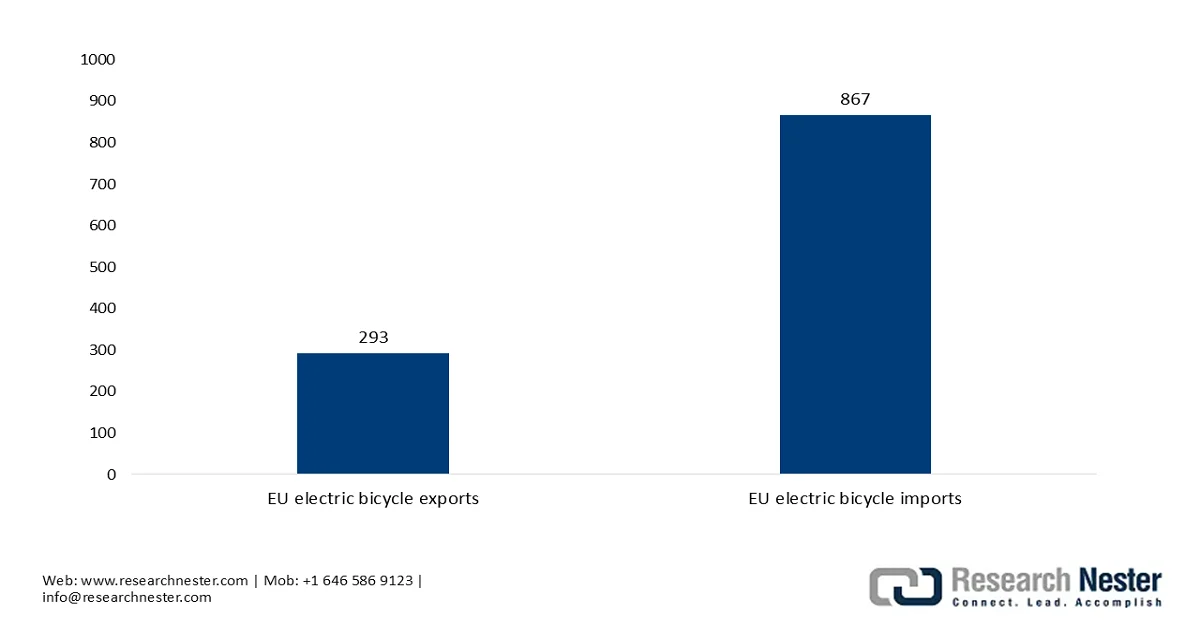
Source: Eurostat
Top Export Destinations for EU Electric Bicycles in 2023: Leading Markets by Export Share
|
Destination Country |
Share of Extra-EU Electric Bicycle Export Value |
|
Switzerland |
46% |
|
UK |
26% |
|
U.S. |
10% |
|
Norway |
9% |
Source: Eurostat
A structured approach with environmental sustainability and a stringent regulatory framework is driving the upliftment of the overall market in Germany. In addition, the market is supported by the country's public transit systems, wherein electric bikes and scooters are considered reliable extensions for first- and last-mile connectivity. Testifying to this, in January 2023 Deutsche Bahn introduced a Mobility Hub at Berlin Südkreuz station with the main goal of improving low-carbon travel by integrating shared bicycles, e-scooters, e-mopeds, and car-sharing services in one location. The company also stated that this hub supports convenient first- and last-mile connectivity by using digital parking management to ensure shared vehicles are parked responsibly.
The UK micro-mobility market is evolving with distinct growth opportunities, which include expanding government-backed rental trials and carefully regulating shared electric scooter schemes. In addition, the country’s market is supported by growing public funding for active travel infrastructure, such as dedicated low-traffic neighbourhoods and protected cycle lanes. In this context, the Motability Foundation in February 2023 commissioned TRL to conduct research that will support the development of inclusive regulations for micromobility and powered mobility aids in the UK. This particular project was focused on improving accessibility and safety for disabled people by combining technical evidence with stakeholder input and lived experiences.
Key Micro-Mobility Market Players:
- Yadea (China)
- Segway-Ninebot (China)
- NIU Technologies (China)
- Pon.Bike (Netherlands)
- Accell Group (Netherlands)
- Veo (U.S.)
- TIER Mobility (Germany)
- Dott (Netherlands)
- Company Overview
- Business Strategy
- Key Product Offerings
- Financial Performance
- Key Performance Indicators
- Risk Analysis
- Recent Development
- Regional Presence
- SWOT Analysis
- Yadea is one of the world’s largest manufacturers of electric two-wheelers, which is providing an extensive portfolio of electric scooters, e-bikes, and lightweight electric mobility vehicles for urban transportation. The company maintains a strong presence in this market through extensive manufacturing capabilities and technological innovation.
- Segway-Ninebot is a leading global manufacturer of personal electric mobility products. The company has established a strong position in consumer and shared micro-mobility sectors through its focus on intelligent vehicle technologies, IoT integration, and product reliability.
- NIU Technologies is also a prominent player in this sector, which specializes in smart electric mobility solutions, manufacturing electric scooters and e-bikes. In addition, the firm differentiates itself with the help of integrated smart technologies, mobile connectivity, and battery management systems.
- Pon. Bike is one of the largest bicycle and e-bike manufacturers globally which is operating a portfolio of established cycling brands. The company is highly focused on premium bicycles, electric bikes, and sustainable mobility solutions.
- Accell Group focuses on urban mobility, leisure cycling, and e-bike solutions, with strong market penetration in Europe. The firm competes mainly with its product range and focus on sustainable transportation trends.
Here is a list of key players operating in the global market:
The global micro-mobility market is witnessing severe competition, which is driven by manufacturers of finished electric scooters, e-bikes, shared mobility vehicles, and compact urban transportation solutions. Leading players in this market maintain such strong positions propelled by broad product portfolios, global distribution reach, proprietary vehicle designs, battery technologies, and smart connectivity features. Apart from this, the industry includes established two-wheeler manufacturers expanding into electric micro-mobility as well as specialized mobility companies focused on urban transport solutions. Regional manufacturers are being competitive due to localized product development, pricing strategies, and compliance with city-specific mobility requirements.
Corporate Landscape of the Market:
Recent Developments
- In July 2026, Veo introduced Rover, which is a shared electric trike, in Denver to expand accessible micromobility options for riders who are looking for enhanced stability, comfort, and cargo capacity. It was developed through collaboration with disability advocates, older adults, and community organizations.
- In October 2024, TIER officially transitioned to the Dott brand, bringing all shared electric scooters and e-bikes under one app across 427 cities in Europe and the Middle East. This merger combines the technology, vehicles, and operations of both companies to provide users with a simpler and more efficient micro-mobility experience.
- Report ID: 8730
- Published Date: Aug 06, 2026
- Report Format: PDF, PPT
- Explore a preview of key market trends and insights
- Review sample data tables and segment breakdowns
- Experience the quality of our visual data representations
- Evaluate our report structure and research methodology
- Get a glimpse of competitive landscape analysis
- Understand how regional forecasts are presented
- Assess the depth of company profiling and benchmarking
- Preview how actionable insights can support your strategy
Explore real data and analysis
Frequently Asked Questions (FAQ)
About this Report
Connect with our Expert


Report, 2026-2035



Copyright @ 2026 Research Nester. All Rights Reserved.
