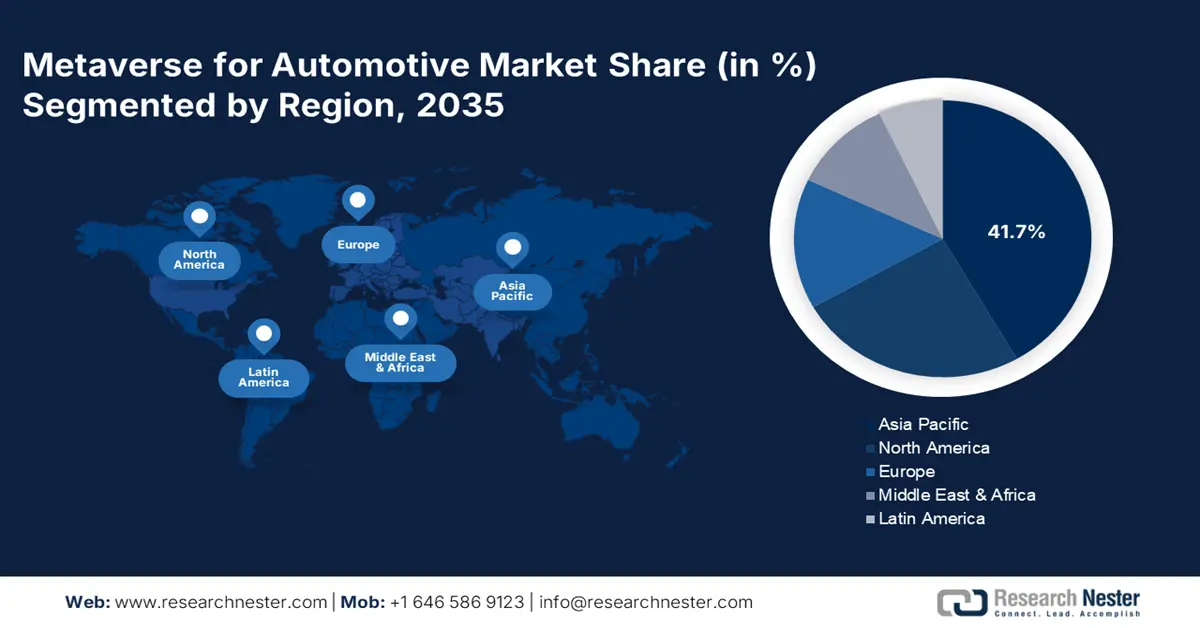
Metaverse for Automotive Market Regional Analysis:
Asia Pacific Market Insights
Asia Pacific industry is predicted to account for largest revenue share of 41.7% by 2035. The rapid digital transformation in countries such as China and India, combined with the increasing interest of consumers in electric vehicles and immersive virtual experiences, are acting as the main driving forces for the leadership of this region. The thriving automotive industry is highly focused on the integration of metaverse technologies into the sector, with government-backed initiatives for digital innovation.
The majority of automotive manufacturers in China have already begun providing rapid adoptions with AR and VR technologies to achieve improvements both at the levels of manufacturing and customer engagement. For instance, Raythink launched the next generation AR-HUD in June 2023, which had immersive 3D effects. Similarly, well-known Chinese players like NIO and BYD are already using metaverse platforms to provide interactive virtual test drives and car configurators.
India is also witnessing notable strides in the metaverse for automotive sector. In January 2023, Maruti Suzuki introduced ARENAVerse – which offers a way for users to experience their vehicles virtually and has shown the increasing importance of the metaverse in India automotive market. The emphasis of India on improving the digital infrastructure and adopting new technologies such as AR and VR provides an apt ecosystem for automotive companies to evaluate metaverse opportunities. All these technologies are also summed up and driven by the initiative of the government known as "Digital India," thereby driving growth in the industry.
North America Market Insights
By the end of 2035, North America metaverse for automotive market is poised to capture around 25.1% revenue share. This is due to strong technological infrastructure and rapid adoption of AR and VR technologies in automotive manufacturing and customer experiences. Robust investments in digitalization and metaverse technologies by leading automotive players, further propel growth in the region. Furthermore, the thrust on sustainable automotive practices by the government is likely to create more opportunities for applications of the metaverse in the production of electric vehicles.
The U.S. automotive manufacturers are leading in the metaverse revolution. For example, in March 2022, Acura opened a virtual showroom in Decentraland where one could virtually walk around its Integra model. Such trends are driving most U.S. automotive companies to increasingly shift their customer experiences to a virtual level, hence making the country the driver of metaverse adoption in the automotive industry.
Furthermore, Canada automotive companies are increasingly considering the application of the Metaverse to improve customer interactions and better production processes. In July 2023, the Government of Canada announced a new initiative to support the development of AI and metaverse manufacturing industries-including automotive-through tax incentives and grants. Such initiatives are expected to further accelerate the integration of Metaverse technologies within the automotive industry in Canada.