Metamaterials Market Outlook:
Metamaterials Market size was valued at USD 1.3 billion in 2025 and is anticipated to reach USD 5.9 billion by the end of 2035, expanding at around 16.6% CAGR during the forecast period, i.e., 2026-2035. In 2026, the industry size of metamaterials is estimated at USD 1.5 billion.
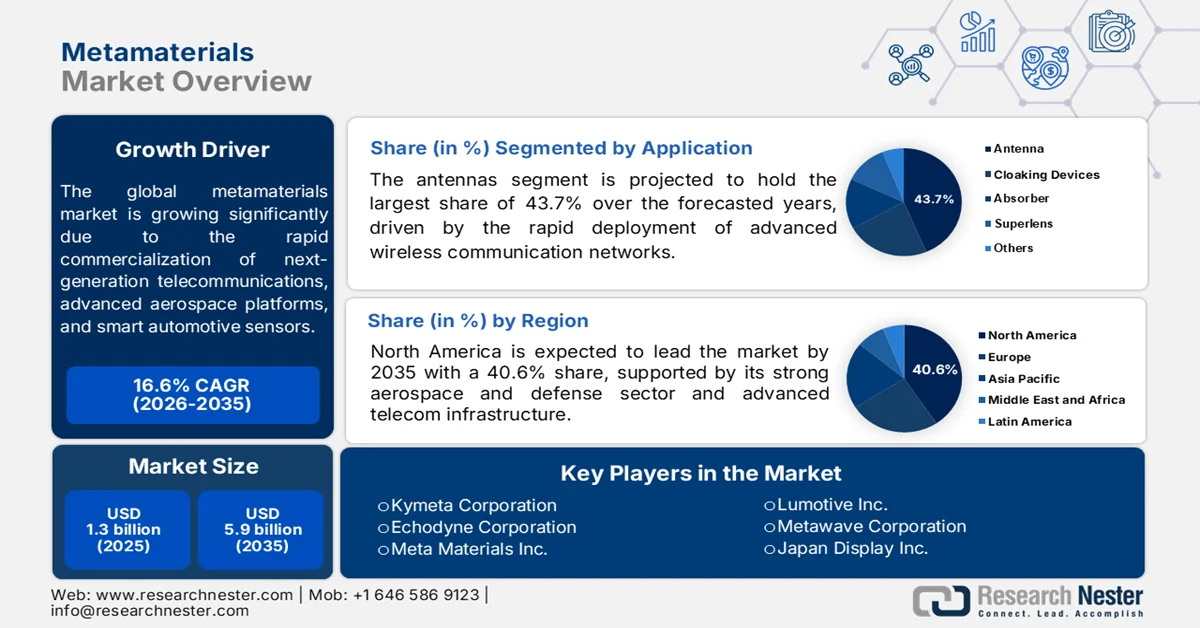
The global metamaterials market is entering a transformative phase of growth fueled effectively by the rapid commercialization of next-generation telecommunications, advanced aerospace platforms, and smart automotive sensors. The market's momentum is heavily fueled by the accelerating rollout of 5G-Advanced and early 6G infrastructure, where software-defined metasurfaces and reconfigurable intelligent surfaces are essential for managing high-frequency millimeter-wave signals and expanding network coverage. As per an article published by IMechE and the UK Metamaterials Network in December 2025, metamaterials are an enabling technology with advanced capabilities beyond conventional materials, and it offers benefits such as reduced size and weight and improved energy efficiency. It identifies key application areas in health, sustainability, space, and aviation, and thus recommends stronger research foundations, improved routes to market, and manufacturing scale-up to sustain growth in the UK along with global markets.
Furthermore, the defense sector continues to anchor market demand through substantial investments in stealth technologies, flat-panel satellite communications, and compact radar systems. The manufacturing techniques transition from laboratory-scale prototyping to automated, roll-to-roll fabrication, due to which production costs are steadily declining, thus providing encouraging growth opportunities in consumer electronics, medical imaging diagnostics, and autonomous vehicle lidar systems. As stated by Small Business Innovation Research (SBIR) in 2024, a reconfigurable intelligent spectrum-tailored hybrid meta-radome is a US Navy SBIR Phase I project awarded to JEM Engineering, LLC, with a total funding of USD 139,934. This project is highly focused on developing hybrid metamaterial-based radomes that enable dynamic control of electromagnetic spectrum response, improving antenna performance, bandwidth, polarization control, and protection against jamming and interference.
Key Metamaterials Market Insights Summary:
Regional Highlights:
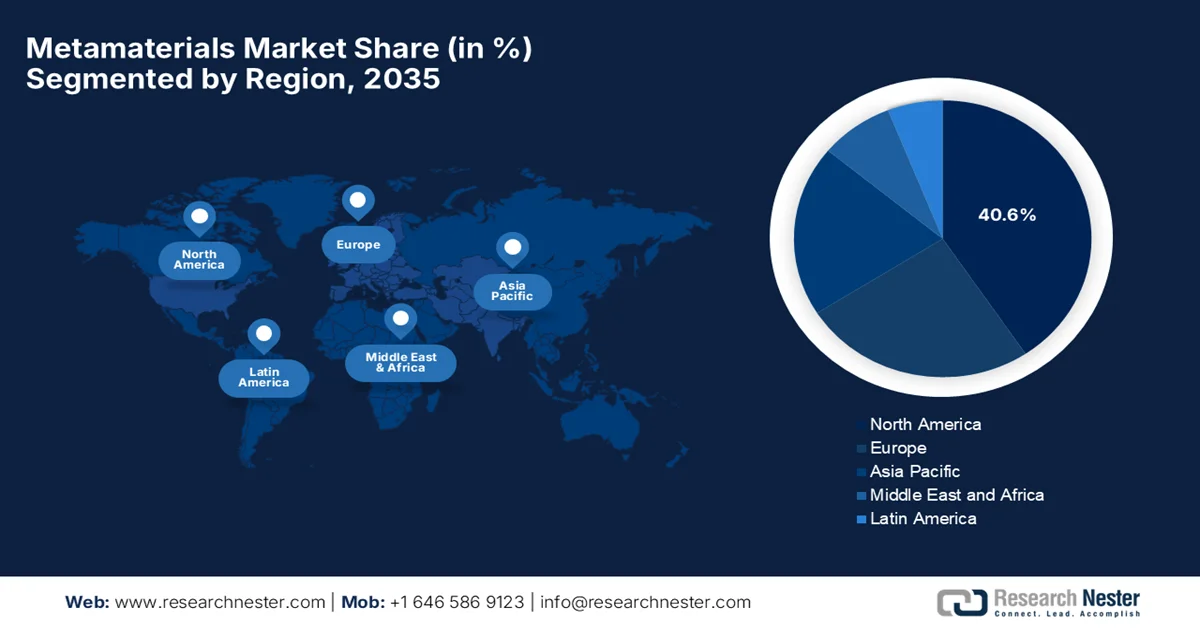
- The North America metamaterials market is anticipated to command 40.6% of global revenue by 2035, fostered by its advanced aerospace and defense ecosystem and extensive deployment of next-generation telecommunications infrastructure
- Asia Pacific is poised to witness the fastest expansion in the market throughout 2026-2035, spurred by large-scale infrastructure investments, strong electronics manufacturing capabilities, and proactive national technology initiatives
Segment Insights:
- The antennas segment is forecast to account for 43.7% of the metamaterials market by 2035, propelled by accelerating investments in advanced wireless communication networks, massive MIMO systems, and satellite-based connectivity
- The electromagnetic materials segment is expected to expand considerably during 2026-2035, underpinned by rising utilization in advanced communications, radar technologies, defense electronic warfare systems, and satellite applications requiring precise electromagnetic wave manipulation
Key Growth Trends:
- Expanding 5G and 6G infrastructure
- Surging military and aerospace modernization
Major Challenges:
- High manufacturing complexity and cost
- Limited commercialization and market adoption
Key Players: Kymeta Corporation (U.S.), Echodyne Corporation (U.S.), Meta Materials Inc. (Canada), Lumotive Inc. (U.S.), Metawave Corporation (U.S.), Japan Display Inc. (Japan).
Global Metamaterials Market Forecast and Regional Outlook:
Market Size & Growth Projections:
- 2026 Market Size: USD 1.3 billion
- 2027 Market Size: USD 1.5 billion
- Projected Market Size: USD 5.9 billion by 2035
- Growth Forecasts: 16.6% CAGR (2026-2035)
Key Regional Dynamics:
- Largest Region: North America (40.6% share by 2035)
- Fastest Growing Region: Asia Pacific
- Dominating Countries: United States, China, Japan, Germany, South Korea
- Emerging Countries: India, Singapore, United Arab Emirates, Saudi Arabia, Brazil
Last updated on : 17 July, 2026
Metamaterials Market - Growth Drivers and Challenges
Growth Drivers
- Expanding 5G and 6G infrastructure: The global expansion of high-frequency networks is the primary growth driver for the metamaterials market. Metamaterials enable reconfigurable intelligent surfaces that dynamically steer millimeter-wave and Terahertz signals around physical obstacles. This capability drastically reduces signal loss and provides the ultra-low latency required for telecommunications infrastructure. In February 2024, Qualcomm Technologies demonstrated advanced wireless innovations at MWC Barcelona 2024 by showcasing technologies that include Giga-MIMO, reconfigurable intelligent surfaces, AI-enabled wireless systems, digital twin networks, and sub-THz communications to support the transition from 5G toward 6G. Such innovative solutions propel heightened demand for metamaterials in the telecommunications sector.
- Surging military and aerospace modernization: Substantial spending on electronic warfare, stealth capabilities, and satellite communications is responsible for fueling market demand. Metamaterials play a highly important role in developing ultra-lightweight, flat-panel radar antennas, acoustic cloaking devices for submarines, and radar-absorbent coatings for military aircraft. In this context, DARPA in January 2024 reported that its Defense Sciences Office is advancing metamaterial-based optical technologies with programs such as enhanced night vision in eyeglass form, coded visibility, and accelerating discovery of tunable optical materials. These initiatives aim to develop lightweight advanced optics, adaptive materials, and tunable optical systems in order to enhance warfighter capabilities, battlefield visibility, and next-generation sensing technologies.
Challenges
- High manufacturing complexity and cost: One of the major challenges causing hindrance to growth of the market is the complexity which is involved in manufacturing these advanced materials. Metamaterials require accurate structural designs at micro- and nanoscale levels in order to achieve the required electromagnetic and acoustic properties. Therefore, producing such intricate structures mostly involves expensive fabrication techniques, advanced equipment, and highly skilled expertise. Apart from this, large-scale production is difficult because maintaining consistent quality and performance across batches is highly challenging. These high production costs limit the adoption of metamaterials in several commercial applications, especially in price-sensitive industries.
- Limited commercialization and market adoption: Even though there are significant research advancements, commercialization of metamaterials is a major obstacle owing to limited adoption across industries. Most of the metamaterial technologies are still in the development or testing phase, which is making it difficult to transition from laboratories to practical applications. Therefore, industries require proven reliability, long-term performance data, and cost-effective solutions before adopting these materials on a large scale. In addition, the absence of standardized testing methods and regulatory frameworks creates uncertainty for manufacturers and end users as well. Applications such as advanced antennas, sensors, and optical devices show strong potential, but widespread deployment is still gradual in the market.
Metamaterials Market Size and Forecast:
| Report Attribute | Details |
|---|---|
|
Base Year |
2025 |
|
Forecast Period |
2026-2035 |
|
CAGR |
16.6% |
|
Base Year Market Size (2025) |
USD 1.3 billion |
|
Forecast Year Market Size (2035) |
USD 5.9 billion |
|
Regional Scope |
|
Metamaterials Market Segmentation:
Application Segment Analysis
The antennas segment is projected to hold the largest share of 43.7% in the application category of the metamaterials market over the forecasted years. The segment’s dominating position is largely driven by the rapid deployment of advanced wireless communication networks. In the present market landscape, increasing investments in millimeter-wave infrastructure, massive MIMO systems, and satellite-based connectivity are accelerating demand for antenna solutions. In December 2025, Ericsson reported that its AIR 3255 Massive MIMO antenna-integrated radios became operational in NTT DOCOMO’s 5G network in Japan to support high-traffic areas with improved capacity and spectrum efficiency. The radios are powered by Ericsson Silicon, and they deliver 25% lower energy consumption, 20% lower embodied CO₂ footprint, and 20% reduced weight compared with the previous generation, simultaneously heightening demand for metamaterials.
Product Segment Analysis
Under the product segment, electromagnetic materials are anticipated to grow considerably in the market globally. The segment benefits from increasing adoption in advanced wireless communications, defense electronic warfare, radar systems, and satellite technologies, where precise manipulation of electromagnetic waves is needed. For instance, in April 2025, the Changchun Institute of Optics, Fine Mechanics and Physics, CAS reported that researchers discovered a Debye relaxation mechanism in metamaterials by introducing a missing component in their electromagnetic response theory. The team developed co-designed electromagnetic resonance structures to achieve ultra-broadband phase control, and it enables new possibilities for broadband electromagnetic applications in areas such as sensing, communications, and advanced optics.
End use Segment Analysis
Consumer electronics, which is under end use segment, is expected to exhibit lucrative growth opportunities under the market by the end of 2035. The segment’s growth is largely propelled by rising integration of compact electromagnetic components, advanced sensing technologies, and next-generation connectivity solutions in consumer devices. In addition, metamaterials are gaining attention in consumer electronics due to their ability to improve antenna efficiency, enable thinner device architectures, enhance electromagnetic shielding, and support emerging applications such as augmented reality devices, smart wearables, and high-performance wireless systems. As manufacturers across the globe focus on reducing component size while improving device functionality, the adoption of engineered electromagnetic materials is expected to increase across future consumer electronics designs.
Our in-depth analysis of the metamaterials includes the following segments:
|
Segment |
Subsegments |
|
Application |
|
|
Product |
|
|
End use |
|

Vishnu Nair
Head - Global Business DevelopmentCustomize this report to your requirements — connect with our consultant for personalized insights and options.
Metamaterials Market - Regional Analysis
North America Market Insights
North America metamaterials market is expected to capture the highest share of 40.6% during the discussed timeframe. The region’s leadership is largely attributable to a mature aerospace and defense ecosystem along with a highly advanced telecommunications infrastructure. The hefty research and development funding accelerates the deployment of metamaterial-based stealth coatings, low-profile radar systems, and flat-panel satellite communication antennas. For instance, in February 2026, Avisi Technologies raised a total amount of USD 10.7 million in Series A financing with the main aim of advancing the clinical development of its VisiPlate® glaucoma treatment device, which consists of a novel metamaterial-based design thinner than a human hair. The ultra-thin, biocompatible device uses microchannel technology and metamaterial engineering to improve glaucoma treatment outcomes.
The highly sophisticated defense, aerospace, and deep-tech ecosystems are powering the U.S. metamaterials market. The domestic technology innovators, such as Echodyne and Kymeta Corporation, drive commercial integration by deploying solid-state, electronically steerable beamforming antennas and advanced radar systems. In June 2025, the Aerospace Industries Association stated that the U.S. aerospace and defense industry continued to demonstrate strong economic performance, generating nearly USD 995 billion in total business activity in 2024. The sector is a major contributor to national security, innovation, and economic growth, supported by advanced manufacturing, digital transformation, and AI-driven workforce development, thus making it suitable for standard market growth.
Key Economic Statistics of the U.S. Aerospace and Defense Industry: Workforce Growth and Global Trade Performance 2024
|
Metric (2024 Data) |
Statistical Value |
|
Total A&D industry business activity |
USD 995 billion |
|
Direct output |
USD 556 billion |
|
Indirect supply chain contributions |
USD 439 billion |
|
Economic value contribution |
USD 443 billion |
|
Contribution to U.S. GDP |
1.5% |
|
Labor income generated |
USD 257 billion |
|
Total workforce supported |
2.2 million workers |
|
Direct industry employment |
914,000 workers |
|
Average labor income per A&D job |
USD 115,000 |
|
U.S. A&D exports |
USD 138.6 billion |
|
U.S. A&D imports |
USD 64.83 billion |
|
Trade surplus |
USD 73.9 billion |
Source: AIA
Canada metamaterials market is solidifying its position in North America, with a strong focus on optical engineering, nanotechnology research, and advanced hardware automation. The country’s market is backed by robust domestic academic partnerships, competitive scientific research tax incentives, and capital investments from provincial development agencies. Apart from this, the country serves as a critical testing ground for translating sub-wavelength material structures into viable commercial products. Furthermore, the market's trajectory is deeply integrated with Canada's expanding digital infrastructure, driving the collaborative development of next-generation optical lenses, medical imaging diagnostics, and high-resolution automotive radar systems optimized to be able to withstand severe northern climates.
APAC Market Insights
The Asia Pacific market is expected to expand at the fastest rate globally, driven by a combination of factors, i.e., massive infrastructure deployment, dominant electronics manufacturing hubs, and aggressive national technology policies. The region's growth is heavily anchored in manufacturing powerhouses including China, Japan, and South Korea, which leverage their existing semiconductor, display, and precision lithography ecosystems to pioneer high-volume metamaterial production. In October 2023, NEC Corporation developed a 150 GHz Antenna-on-Chip (AoC) transmitter IC for Beyond 5G and 6G radio systems, which achieves beam steering by integrating antenna elements, phase shifters, and amplifiers into a single chip. This 22-nm SOI-CMOS-based technology enables compact, cost-effective, and scalable high-frequency communication solutions, thus making it suitable for standard market growth.
High-tech development initiatives and substantial public funding are allowing China metamaterials market to build an integrated ecosystem that is structured from fundamental academic research to scaled industrial applications. The market's momentum is being primarily fueled by domestic defense modernization programs such as stealth fighter aircraft, advanced naval vessels, and long-range radar arrays. For instance, in April 2026, China Academy of Sciences and National University of Singapore researchers developed a scalable roll-to-roll additive nano-printing technology for manufacturing optical metamaterials by overcoming limitations in cost, production scale, and customization. This technology has the complete potential to accelerate applications in photonic information, anti-counterfeiting imaging, precision medical sensing, and green photonic energy systems.
In India, the market is gaining enhanced traction owing to national defense modernization and an accelerating digital telecommunications infrastructure. Simultaneously, the country’s booming automotive and electric vehicle manufacturing sectors provide a high-value market for integrating advanced metasurfaces into autonomous driving sensors and medical imaging diagnostics, positioning India as an emerging deep-tech engineering hub. In June 2025, the Technology Development Board, Department of Science and Technology, the country’s government, provided monetary assistance to Meta Tattva Systems Pvt. Ltd. for establishing an industrial facility with the main goal of manufacturing metamaterial-based multi-spectral camouflage systems for defense applications. Besides, this patented metamaterial surface cloaking system was developed by IIT Kanpur, and it enables concealment of military assets across the visual, UV, and infrared spectrums.
Europe Market Insights
The Europe market is projected to grow at a notable pace, which is supported by multi-national research frameworks such as the Horizon Europe program. The region’s development is also characterized by strict environmental regulations and a strong emphasis on energy efficiency, driving the integration of acoustic metamaterials for industrial noise reduction, architectural sound insulation, and lightweight aerospace structural damping. In March 2025, the European Commission reported that the META-SONIC project, which is funded under the Marie Skłodowska-Curie Actions programme with an EU contribution of USD 227,000, aims to develop metamaterial-based multifunctional panels for aerospace and automotive applications. This project focuses on lightweight, high-strength structures with advanced vibration attenuation and wave manipulation capabilities using elastic metamaterials and multi-objective optimization.
The nation's prominent automotive industry and advanced manufacturing capabilities are positioning Germany metamaterials market for sustained growth in the upcoming years. Domestic development is being accelerated by a robust collaboration between industrial manufacturers and elite academic bodies, most notably the Fraunhofer Society, to pioneer practical applications for smart surfaces, energy harvesting, and precision industrial acoustics. In July 2023, Fraunhofer Institute for Structural Durability and System Reliability LBF reported that it developed vibro-acoustic metamaterials to reduce vibrations and noise in lightweight structures used in automotive, aerospace, and other applications. It also mentioned that through engineered microstructures and resonators, these metamaterials create frequency-specific stop bands to block sound transmission and thereby achieve effective vibration damping with reduced weight.
The UK metamaterials market is growing exponentially, which is propelled by strong government-backed initiatives such as the UK Metamaterials Network. The country’s market growth is heavily accelerated by a robust defense and aerospace sector, where leading domestic and global contractors partner with university labs to develop low-profile satellite communications, acoustic dampening systems, and next-generation radar-absorbent coatings. In July 2025, the Henry Royce Institute announced the launch of a USD 1.3 million industrial collaboration programme to accelerate the scale-up and commercialization of metamaterials through partnerships between universities, research organizations, and industry. This initiative aims to translate advanced metamaterials research into real-world applications across sectors, including aerospace, energy, healthcare, telecommunications, and defense.
Key Metamaterials Market Players:
- Kymeta Corporation (U.S.)
- Echodyne Corporation (U.S.)
- Meta Materials Inc. (Canada)
- Lumotive Inc. (U.S.)
- Metawave Corporation (U.S.)
- Japan Display Inc. (Japan)
- Company Overview
- Business Strategy
- Key Product Offerings
- Financial Performance
- Key Performance Indicators
- Risk Analysis
- Recent Development
- Regional Presence
- SWOT Analysis
- Kymeta Corporation has registered itself as a leading manufacturer of metamaterial-based satellite communication terminals for defense, government, maritime, and enterprise applications. The company is well recognized for its electronically steered metasurface antennas that provide connectivity across satellite and cellular networks without mechanical moving parts.
- Echodyne Corporation is a specialized manufacturer of metamaterials electronically scanned array radar systems for defense, security, critical infrastructure, and autonomous applications. In addition, continuous product innovation and expanded manufacturing capacity have strengthened the firm's position in the market.
- Meta Materials Inc. develops and manufactures advanced metamaterial-enabled products for aerospace, automotive, consumer electronics, energy, and healthcare sectors. The company’s product portfolio includes transparent conductive materials, nanostructured optical films, electromagnetic shielding solutions, and holographic technologies.
- Lumotive Inc. manufactures programmable optical semiconductor solutions based on its proprietary Light Control Metasurface technology. The company’s products enable beam steering for LiDAR, 3D sensing, optical communications, and AI infrastructure without relying on mechanical components.
- Metawave Corporation designs and manufactures metamaterial-based smart radar and wireless communication systems for the automotive and telecommunications industries. In addition, the firm’s proprietary beamforming antennas and imaging radar technologies support advanced driver assistance systems, autonomous vehicles, and wireless networks.
Here is a list of key players operating in the global market:
The metamaterials market is moderately fragmented, wherein competition is mainly centered around manufacturers that commercialize finished metamaterial-enabled products for defense, satellite communications, radar, photonics, sensing, and advanced optics. Market leaders are gaining significant positions through proprietary metamaterial architectures, strong patent portfolios, and vertically integrated design and manufacturing capabilities. Apart from this, defense and aerospace applications currently dominate commercial adoption, whereas companies specializing in metasurface antennas, electronically scanned radars, LiDAR, and optical components are expanding into broader commercial markets. In this context, Echodyne, in September 2025, announced the launch of the EchoShield rapid deployment kit, thereby expanding its metamaterial-based MESA® radar portfolio with a rapidly deployable solution for defense and counter-UAS applications.
Corporate Landscape of the Market:
Recent Developments
- In July, 2026, Echodyne inaugurated a new Washington State manufacturing facility to scale production of its MESA® metamaterial radars. This USD 40 million facility can produce more than 30,000 radars annually, supporting growing demand for defense, counter-UAS, and critical infrastructure applications.
- In February 2026, Kymeta and Japan Display Inc. entered into a partnership to develop the industry's first multi-band Ku/Ka metasurface terminal for defense applications. This particular collaboration combines Kymeta’s metasurface technology with JDI’s manufacturing expertise to enable scalable next-generation satellite communications.
- Report ID: 8675
- Published Date: Jul 17, 2026
- Report Format: PDF, PPT
- Explore a preview of key market trends and insights
- Review sample data tables and segment breakdowns
- Experience the quality of our visual data representations
- Evaluate our report structure and research methodology
- Get a glimpse of competitive landscape analysis
- Understand how regional forecasts are presented
- Assess the depth of company profiling and benchmarking
- Preview how actionable insights can support your strategy
Explore real data and analysis
Frequently Asked Questions (FAQ)
About this Report
Connect with our Expert


Report, 2026-2035



Copyright @ 2026 Research Nester. All Rights Reserved.
