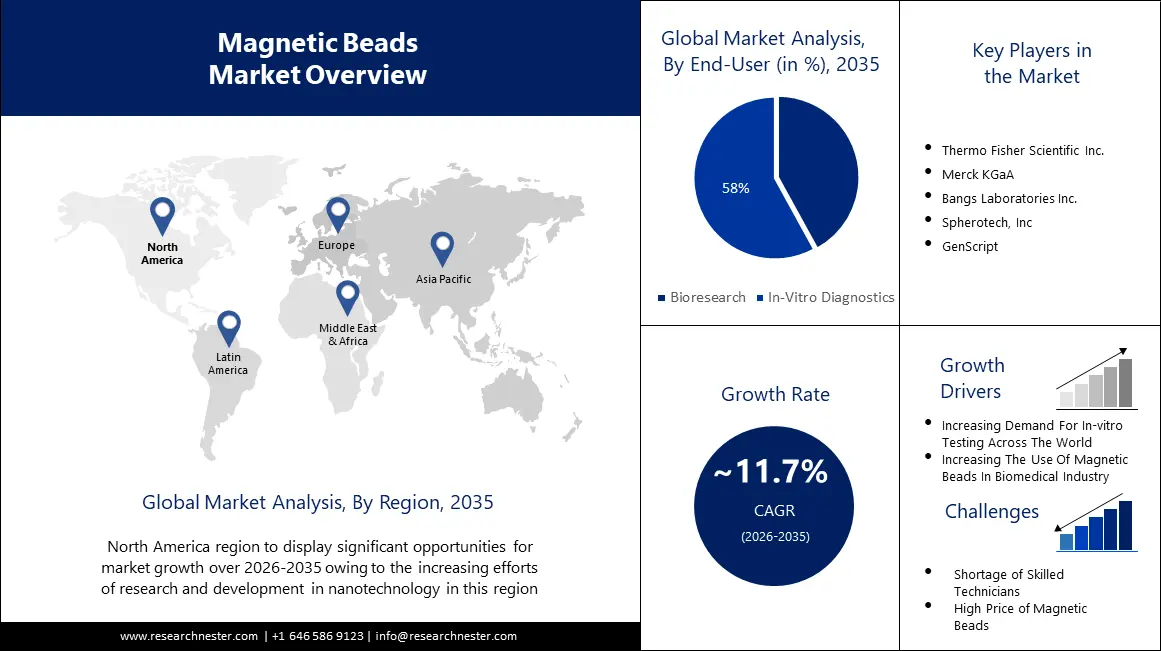
Magnetic Beads Market Outlook:
Magnetic Beads Market size was valued at USD 4.16 billion in 2025 and is set to exceed USD 12.58 billion by 2035, registering over 11.7% CAGR during the forecast period i.e., between 2026-2035. In the year 2026, the industry size of magnetic beads is estimated at USD 4.6 billion.
The market will have massive growth during the forecast period owing to the increasing demand for in-vitro testing worldwide. The in-vitro diagnostics sector globally is anticipated to touch an astonishing profit of USD 98.97 billion in 2024. This segment is projected to show a consistent yearly expansion rate (CAGR 2024-2028) of 2.72%, finally coming in a market volume of USD 110.20 billion by 2028. In vitro diagnostics (IVDs) can discover diseases, situations, and infections. In vitro easily signifies ‘in glass’, signifying these tests are typically executed in test tubes and equivalent gadgets, as opposed to in vivo tests, which are executed in the body itself.
Another reason behind the growth of the magnetic beads market is attributed to the increasing use of magnetic beads in the biomedical industry internationally. For instance, different immunomagnetic techniques dependent on magnetic beads have been researched to discover bacteria in samples. Escherichia coli (E.coli) bacteria have been secreted from ground beef samples implementing protein A-coated magnetic beads in the amalgamation of monoclonal antibodies for a technique of discovering the bacteria and in another example, a technique implementing polyclonal antibody-coated magnetic polystyrene beads in beach water had been verified. The most usual isolation technique for the isolation of cancer stem cells is with particular cell surface vaccines, like magnetic beads and fluorescence-enabled cell sorting. Spermatogonial stem cells were a subject enabled by five of the research papers, where different plating, particularly fluorescence-enabled cell sorting, and magnetic-enabled cell sorting emerged to be the foremost isolation techniques.