L-Lysine Sulfate (CAS 60343-69-3) Market Outlook:
L-Lysine Sulfate (CAS 60343-69-3) Market size was over USD 1.8 billion in 2025 and is expected to reach USD 3.1 billion by the end of 2035, growing at around 5.5% CAGR during the forecast period, i.e., 2026-2035. In 2026, the industry size of L-lysine sulfate (CAS 60343-69-3) is assessed at USD 1.9 billion.
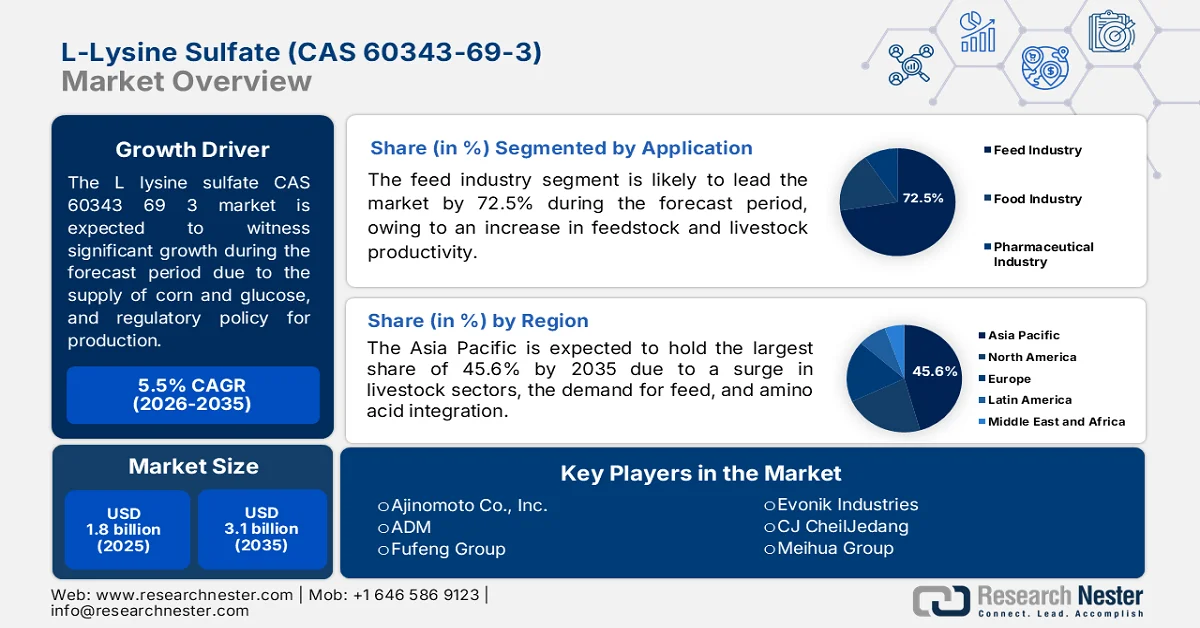
The worldwide L-lysine sulfate (CAS 60343-69-3) market operates significantly on several factors, including raw material aspects in terms of glucose and corn, and regulatory landscapes for lysine production. According to an article published by the Food and Agriculture Organization in December 2024, the global shipment of primary crops reached 9.9 billion tons as of 2023, indicating a surge of 3% since 2022. Besides, the production of cereals also increased by 61 million tons between 2022 and 2023 due to an increase in maize output. Simultaneously, there was an increase in sugar crops by 122 million tons during the same timeline, with sugarcane as the ultimate sugar crop, with over 2 billion tons as of 2023. Meanwhile, the shipment of corn across different countries is also responsible for bolstering the market growth and expansion.
Global Corn Shipment Capacity, 2025-2026
|
Economy |
Global Production % |
Total Production (Metric Tons) |
|
U.S. |
33 |
432.3 |
|
China |
23 |
301.2 |
|
Brazil |
10 |
138.0 |
|
Argentina |
5 |
61.0 |
|
Europe |
4 |
56.8 |
|
India |
4 |
55.0 |
|
Ukraine |
2 |
30.9 |
|
Mexico |
2 |
25.0 |
|
South Africa |
1 |
17.7 |
|
Canada |
1 |
14.8 |
Source: USDA Government
Furthermore, the multi-origin sourcing, supply chain decentralization, consistency risks in batch and quality, as well as a focus on specialty-grade product across mature economies are a few trends that are responsible for uplifting the L-lysine sulfate (CAS 60343-69-3) market globally. As per an article published by the American Feed Industry Association in March 2026, the Institute for Feed Education and Research noted that roughly 78% of U.S.-based vitamin imports originated from China, and it is highly reliant on 100% of the imported vitamin D3 and lysine utilized in livestock feed. Likewise, the U.S. is also dependent on China for approximately 85% to 90% of notable amino acids, such as methionine and threonine, along with 95% of a few vitamin B. Therefore, with such availability of vitamins and amino acids, there is a huge growth opportunity for the market globally.
Key L-Lysine Sulfate (CAS 60343-69-3) Market Insights Summary:
Regional Highlights:
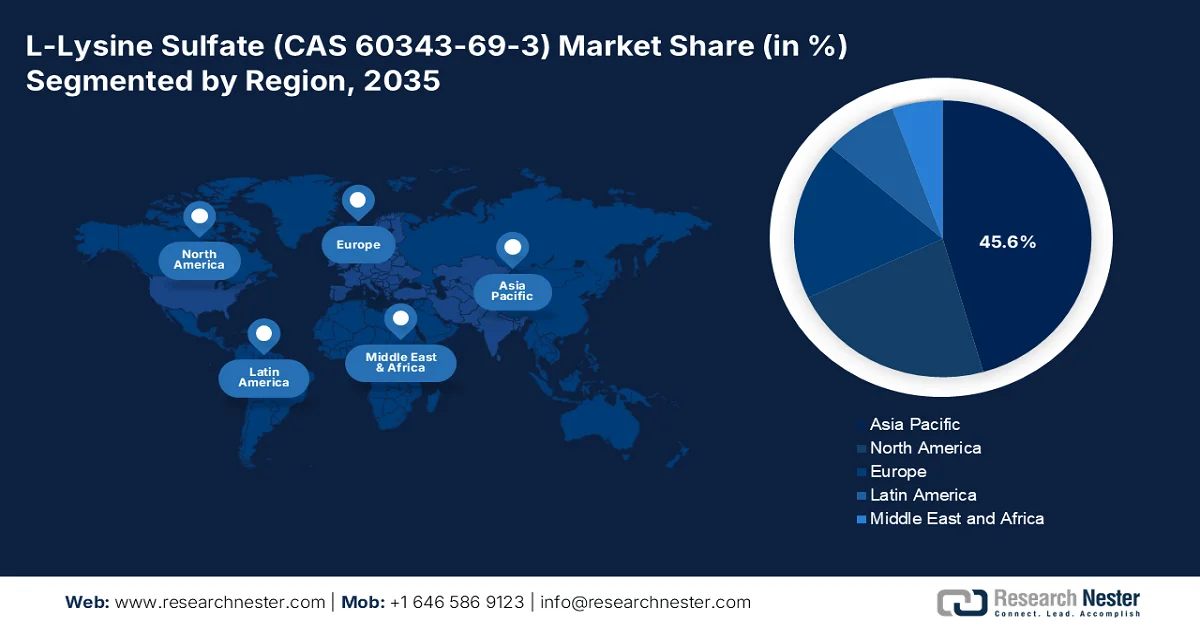
- The Asia Pacific L-lysine sulfate (CAS 60343-69-3) market is projected to command 45.6% of the market share by 2035, reinforced by expanding livestock and aquaculture industries, strong feed demand from poultry and swine sectors, and the adoption of precision amino acid solutions for efficiency and sustainability
- Europe is anticipated to secure an 18.5% share in the during the forecast period, stimulated by sustainability strategies, regulatory support for low-protein animal diets, rising import volumes, and increasing lysine production across the region
Segment Insights:
- The feed industry segment is expected to account for 72.5% of the L-lysine sulfate (CAS 60343-69-3) market by 2035, underpinned by its critical role in enhancing livestock productivity, supporting animal welfare through balanced nutrition, and ensuring a reliable supply of animal proteins
- The direct sales segment is forecast to hold 58.6% of the market share during 2026-2035, buoyed by growing preference among large-scale manufacturers and agricultural enterprises for cost-efficient procurement, stronger supply chain control, and customized purchasing solutions
Key Growth Trends:
- Tactical capacity expansion by producers
- Sustainability as a commercial imperative
Major Challenges:
- Production overcapacity and pricing pressures
- Raw material price volatility
Key Players: Evonik Industries (Germany), CJ CheilJedang (South Korea), Meihua Group (China), Ajinomoto Co., Inc. (Japan), ADM (U.S.), Fufeng Group (China).
Global L-Lysine Sulfate (CAS 60343-69-3) Market Forecast and Regional Outlook:
Market Size & Growth Projections:
- 2025 Market Size: USD 1.8 billion
- 2026 Market Size: USD 1.9 billion
- Projected Market Size: USD 3.1 billion by 2035
- Growth Forecasts: 5.5% CAGR (2026-2035)
Key Regional Dynamics:
- Largest Region: Asia Pacific (45.6% Share by 2035)
- Fastest Growing Region: Europe
- Dominating Countries: China, United States, Brazil, Germany, India
- Emerging Countries: Vietnam, Thailand, Indonesia, Poland, Turkey
Last updated on : 24 July, 2026
L-Lysine Sulfate (CAS 60343-69-3) Market - Growth Drivers and Challenges
Growth Drivers
- Tactical capacity expansion by producers: Notable manufacturers across different nations are strongly strengthening their production capacity to secure leadership in the L-lysine sulfate (CAS 60343-69-3) market globally. For instance, in November 2024, CJ CheilJedang escalated its Korea-based food expansion by deliberately adding overseas production capacity. The company created the latest food manufacturing hub, particularly in South Dakota and Hungary, with the objective of boosting its operations in Europe. This particular facility was developed on a site that covered an area of 115,000 square meters, which is roughly the size of 16 soccer fields, and equipped with cutting-edge automated production lines, thus driving market upliftment.
- Sustainability as a commercial imperative: Environmental performance has emerged as a centralized differentiator, with feed producers effectively favoring suppliers with low-carbon fermentation processes, which is positively fueling the L-lysine sulfate (CAS 60343-69-3) market. Based on an article published by the EPA Government in August 2025, almost 40% of food is wasted globally. Besides, the food supply chain is complicated and also generates emissions. Additionally, when food is wasted, the resources utilized to grow, harvest, process, transport, store, and cook food are equally wasted. Therefore, it essential to reduce wasted food products, which in turn save resources, diminishes greenhouse gas emissions, and lowers methane from landfills, thus enhancing the market exposure.
Challenges
- Production overcapacity and pricing pressures: The L-lysine sulfate (CAS 60343-69-3) market is grappling with significant production overcapacity, creating intense pricing pressures across the industry. China's dominant position in global production has led to supply outstripping demand, resulting in manufacturers operating with squeezed margins as they compete on price. This oversupply situation particularly affects smaller producers with less efficient fermentation processes, some of which struggle to maintain profitable operations. The imbalance between production capacity and actual market demand creates an environment where manufacturers must constantly seek cost reductions to remain competitive, limiting their ability to invest in innovation and quality improvements while destabilizing the overall market structure.
- Raw material price volatility: Manufacturers face substantial challenges from fluctuating raw material costs, particularly for agricultural feedstocks that form the foundation of fermentation-based production. Corn and glucose collectively represent a significant portion of total production expenses, and these commodity prices remain highly sensitive to weather disruptions, agricultural policies, biofuel competition, and global commodity market dynamics. This volatility creates pricing pressures that make long-term pricing strategies difficult for both producers and buyers. The unpredictability of input costs complicates production planning and budgeting, forcing manufacturers to adopt risk management strategies that add operational complexity and may ultimately be passed on to customers, thus restricting the L-lysine sulfate (CAS 60343-69-3) market growth.
L-Lysine Sulfate (CAS 60343-69-3) Market Size and Forecast:
| Report Attribute | Details |
|---|---|
|
Base Year |
2025 |
|
Forecast Period |
2026-2035 |
|
CAGR |
5.5% |
|
Base Year Market Size (2025) |
USD 1.8 billion |
|
Forecast Year Market Size (2035) |
USD 3.1 billion |
|
Regional Scope |
|
L-Lysine Sulfate (CAS 60343-69-3) Market Segmentation:
Application Segment Analysis
The feed industry, which is part of the application segment, is projected to account for the highest share of 72.5% in the L-lysine sulfate (CAS 60343-69-3) market by the end of 2035. The segment’s upliftment is primarily attributed to its emergence as the backbone of the worldwide food and agricultural system, driving livestock productivity, promoting animal welfare by delivering nutritional balanced diets, and ensuring a steady supply of safe animal proteins. According to an article by De Molenaar published in April 2026, worldwide animal feed production had surged to 1.4 billion tons as of 2025. In comparison to the previous year, this demonstrated a 2.9% growth, which constituted more than 40 million tons of extra production. Besides, Brazil, the U.S., and China significantly dominate the animal feed sector, thus positively boosting the segment’s growth.
Distribution Channel Segment Analysis
Based on the distribution channel, the direct sales segment is expected to garner the second-highest share of 58.6% in the L-lysine sulfate (CAS 60343-69-3) market during the forecast period. The sub-segment’s upliftment is highly driven by large-scale manufacturers and agricultural enterprises in the animal feed industry, who prefer direct procurement for the cost-efficiency, supply chain control, and customized solutions it offers. Moreover, direct sales facilitate stronger manufacturer-buyer relationships and bulk purchasing advantages, enabling better pricing and quality assurance. Therefore, this particular model is further expected to remain crucial as demand grows in emerging livestock markets, thus bolstering the segment’s exposure globally.
Type Segment Analysis
By the end of the stipulated timeline, the L-lysine sulphate 70% sub-segment under the type segment is anticipated to grab the third-highest share of 41.5% in the L-lysine sulfate (CAS 60343-69-3) market. The sub-segment’s development is primarily fueled by its importance as a severe feed-based amino acid supplement, which is primarily utilized in the agricultural sector for ruminant, poultry, and swine diets. As stated in an article published by NLM in May 2024, the worldwide industry for lysine has witnessed outstanding growth, with an almost 20-fold expansion and global production of lysine salts surpassing 2.2 million tons every year. Besides, lysine hydrochloride is considered a well-tolerated and safe dietary supplement for human beings with 3.0 grams of dose per day, thus indicating an optimistic outlook for the sub-segment’s development.
Our in-depth analysis of the L-lysine sulfate (CAS 60343-69-3) market includes the following segments:
|
Segment |
Subsegments |
|
Application |
|
|
Distribution Channel |
|
|
Type |
|

Vishnu Nair
Head - Global Business DevelopmentCustomize this report to your requirements — connect with our consultant for personalized insights and options.
L-Lysine Sulfate (CAS 60343-69-3) Market - Regional Analysis
APAC Market Insights
The Asia Pacific L-lysine sulfate (CAS 60343-69-3) market is anticipated to grab the largest share of 45.6% by the end of 2035. The market’s upliftment in the country is primarily driven by the existence of livestock and aquaculture industries, as well as a huge demand for feed, especially from poultry and swine sectors, along with the adoption of precision amino acid solutions for efficiency and sustainability, and affordable production. According to an article published by NLM in September 2023, the population in Southeast Asia has effectively reached 656 million and accounts for an estimated 9% of the worldwide population. Simultaneously, instability in both food supply and production has eventually left an estimated 126 million people severely or moderately food insecure, and meanwhile, 48.8 million people witness the threat of hunger, which constitutes roughly 6.4% of the starving population globally, thus enhancing the market demand.
The China L-lysine sulfate (CAS 60343-69-3) market is growing significantly, owing to poultry and colossal swine industries, expanded national fermentation manufacturing capacity, suitable sugar and corn supplies, and the government’s focus on achieving protein self-sufficiency and modernizing agriculture. As stated in an article published by the Observer Research Foundation in June 2024, agriculture in the country has significantly reduced the risk of feeding 1.4 billion people with 95% food self-sufficiency. Besides, as of 2022, the land utilization rights’ sale by localized bodies in the country amounted to USD 920 billion (RMB 6.6 trillion). This demonstrated a 23% decrease from the record USD 1.2 trillion (RMB 8.7 trillion) from the previous year. Meanwhile, 51% of the local governments’ revenue effectively derives from land sales, thus contributing to the market’s exposure.
The aspects of expansion in aquaculture and poultry industry, a rise in protein consumption, and governmental strategies for promoting modernized farming practices are a few trends that are responsible for bolstering the L-lysine sulfate (CAS 60343-69-3) market in India. As stated in an article published by CEEW in December 2025, the population in the country readily consumes an average of 55.6 grams of protein every day, with cereals accounting for almost 50% of the protein. Besides, the average regular per-capita protein intake surged from 60.7 grams to 61.8 grams across rural areas, along with 60.3 grams to 63.4 grams in urban locations. Moreover, the richest 10% of the population readily consumes 1.5 times more protein and has suitable accessibility to animal-specific sources, thus bolstering the market growth and demand.
Europe Market Insights
Europe L-lysine sulfate (CAS 60343-69-3) market is expected to emerge as the fastest-growing region with a 18.5% share during the forecast period due to sustainability strategies, the regulatory push for low-protein animal diets, an increase in import volume, and a surge in lysine production across different countries. According to an article published by the European Commission in July 2026, the region presently produces 67 million tons of plant-specific protein from fodder and arable crops, while utilizing almost 80 million tons for industrial, food, and feed purposes. In addition, the regional livestock industry utilizes 74 million tons of protein as animal feed every year. Besides, the region is highly dependent on imports for a suitable share of high-protein feed materials, such as protein crops and oilseeds. In this regard, 25% of protein from these materials was sourced in the overall region, thus boosting market development.
Regional Plant Protein Consumption and Production, 2025-2026
|
Protein Type |
Consumption (Million Tons) |
Production (Million Tons) |
|
Roughage |
30.4 |
30.6 |
|
Cereals |
27.1 |
29.4 |
|
Oilseeds |
7.5 |
5.0 |
|
Dry Pulses |
1.5 |
1.3 |
|
Soya Bean and Meals |
13.2 |
0.9 |
Source: European Commission
The Germany L-lysine sulfate (CAS 60343-69-3) market is gaining increased traction, owing to growth and innovation in the chemical industry, the presence of materials technology sectors, a high level of research activities, the adoption of feed additives, and strict environmental standards. As per an article published by the USDA Foreign Agricultural Service in March 2026, the food processing sector in the country is regarded as the 4th largest industrial sector. Besides, based on the Federation of German Food and Drink Industries, the nation effectively produced roughly USD 270.1 billion, particularly in processed beverages and food as of 2024. Meanwhile, the country is considered to remain an essential economy in the overall region for ensuring international suppliers, thereby demonstrating a huge growth opportunity for the market.
The strong poultry and livestock industries, the existence of a consumption base, which is combined with sustainability and efficiency in animal nutrition, as well as the integration of low-protein diets, are a few trends that are responsible for enhancing the L-lysine sulfate (CAS 60343-69-3) market in Spain. As per the December 2024 Alinnea Organization data report, the average livestock population for dairy cattle accounted for 813 thousand head as of 2022, along with 115,601 farms and 1.7% of the total share. Simultaneously, beef cattle and breeding catered to 5,792 livestock population, 54,160 farms, and 5.9% of the share, while poultry, including meat and eggs, accounted for 51,748 livestock population, 4,861 farms, and 0.5% of the overall share. Therefore, based on the development of all these sectors, there is a huge growth opportunity and increased demand for the market in the country.
North America Market Insights
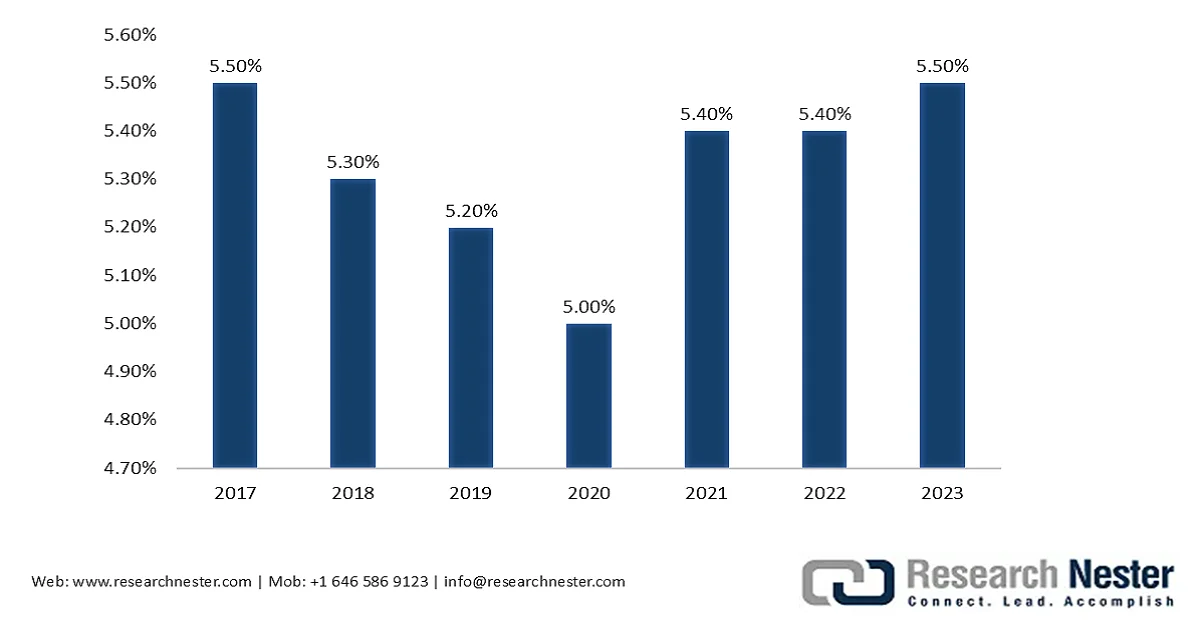
North America L-lysine sulfate (CAS 60343-69-3) market is projected to grab a considerable share of 22.4% by the end of the stipulated timeline. The market’s growth in the region is highly driven by federal government investments, substantial agriculture industry consumption, livestock production, and the strong integration of precision nutrition, particularly in poultry and swine industries. According to a data report published by the USDA Government in April 2026, food, agriculture, along with related industries, amounted to USD 1.5 trillion and contributed 5.5% to the U.S. gross domestic product (GDP), and U.S. consumers’ expenditures on food amount to 12.9% of household budgets. Additionally, the output of regional farms effectively contributed to USD 222.3 billion, which caters to almost 0.8% of U.S. GDP, thereby positively contributing to the market’s growth and demand.
Yearly Value Addition to U.S. GDP by Agriculture and Related Industries, 2017-2023
Source: USDA Government
The U.S. L-lysine sulfate (CAS 60343-69-3) market is gaining increased exposure, owing to the transition to low-protein and amino-acid-balanced diets, along with robust swine and poultry production, and innovations in feed efficiency. As stated in a data report published by the USDA Foreign Agricultural Service in April 2026, the share of domestic pork exports destined for both Central America and Mexico increased from 25% to 46% as of 2025. Likewise, exports to the Asia economy deliberately remained stable, averaging 27% of U.S. pork exports. Additionally, in February 2026, the export share to the Asia-based economy surged by 3%, with suitable growth across Taiwan, South Korea, and Japan, along with an increase in export share throughout Mexico and Asia, thereby making it suitable for fueling the market’s exposure in the country.
The rise in the demand for antibiotic-free feed solutions, suitable government regulations for promoting sustainable farming, and an expansion in the aquaculture industry are certain factors that are responsible for driving the L-lysine sulfate (CAS 60343-69-3) market in Canada. As per an article published by Agriculture and Agri-Food Canada in March 2026, agriculture is considered one of the main sources of the country’s overall methane emissions, which contribute approximately 30%. Besides, based on the Canadian Census of Agriculture, the agriculture industry accounts for 64 million hectares of farmland, along with 189,874 farms in rural areas. Meanwhile, British Columbia witnessed severe flooding, which impacted over 1,100 farms, 2.5 million livestock, and 15,000 hectares, thus enhancing the market’s exposure.
Key L-Lysine Sulfate (CAS 60343-69-3) Market Players:
- Evonik Industries (Germany)
- CJ CheilJedang (South Korea)
- Meihua Group (China)
- Ajinomoto Co., Inc. (Japan)
- ADM (U.S.)
- Fufeng Group (China)
- Company Overview
- Business Strategy
- Key Product Offerings
- Financial Performance
- Key Performance Indicators
- Risk Analysis
- Recent Development
- Regional Presence
- SWOT Analysis
- Evonik Industries positions itself as a sustainability leader in the L-lysine sulfate (CAS 60343-69-3) market through its Biolys® product, which emphasizes carbon footprint reduction and is produced using renewable energy at its Brazilian facility. The company differentiates through a strong focus on precision nutrition solutions and regulatory compliance, serving the European and Americas markets with a premium sustainability narrative.
- CJ CheilJedang is a global volume leader with a strong presence in both feed and food-grade lysine segments. The company invests heavily in bio-fermentation R&D and sustainability platforms, with its BestAmino product line serving major livestock markets across Asia, the Americas, and Europe.
- Meihua Group is the world's largest lysine producer by capacity, leveraging its integrated corn-processing value chain and advanced fermentation strains to achieve cost leadership. The company focuses on high-volume feed applications and has been expanding into pharmaceutical-grade and specialty lysine products to capture higher-margin segments.
- Ajinomoto Co., Inc. brings its heritage in amino acid science and high-quality manufacturing standards to the L-lysine sulfate (CAS 60343-69-3) market. The company focuses on premium feed, food, and pharmaceutical applications, leveraging its advanced fermentation technologies and strong brand reputation.
- ADM competes through its integrated agricultural supply chain, producing both liquid and dry lysine products for animal nutrition. The company differentiates through a diverse portfolio, including rumen-protected and aquaculture-specific formulations, and leverages its global grain origination network for cost-advantaged production.
Here is a list of key players operating in the global market:
The L-lysine sulfate (CAS 60343-69-3) market exhibits a consolidated competitive landscape dominated by vertically integrated global fermentation producers. Key differentiators include production scale, strain efficiency, and geographic footprint, with leading players leveraging bio-fermentation technology and integrated corn supply chains for cost leadership. Meihua Group and CJ CheilJedang are among the largest producers globally, while Evonik differentiates with its Biolys® product's market-leading sustainability profile. A tier of major players includes Ajinomoto and ADM, with ADM emphasizing liquid lysine delivery systems and rumen-protected formulations. Besides, in April 2025, Fufeng Group commenced the construction of an industrial park in Kazakhstan's Zhambyl region. The purpose of this was to initiate an investment of USD 800 million for a planned processing capacity of 1 million tons of corn yearly, thus boosting the L lysine sulfate CAS 60343 69 3 industry.
Corporate Landscape of the L-Lysine Sulfate (CAS 60343-69-3) Market:
Recent Developments
- In June 2026, Ajinomoto Co., Inc. generously invested in NEXT NEW WORLD Inc. to explore suitable opportunities to strengthen its very own functional materials business, which is based on its AminoScience capabilities.
- In May 2022, Evonik received the TÜV Rheinland certification, with the intention of accomplishing the carbon neutrality for its Biolys®, which is an additive for a modernized animal nutrition, production site in Castro, thereby ensuring low carbon emissions.
- Report ID: 8697
- Published Date: Jul 24, 2026
- Report Format: PDF, PPT
- Explore a preview of key market trends and insights
- Review sample data tables and segment breakdowns
- Experience the quality of our visual data representations
- Evaluate our report structure and research methodology
- Get a glimpse of competitive landscape analysis
- Understand how regional forecasts are presented
- Assess the depth of company profiling and benchmarking
- Preview how actionable insights can support your strategy
Explore real data and analysis
Frequently Asked Questions (FAQ)
About this Report
Connect with our Expert


Report, 2026-2035



Copyright @ 2026 Research Nester. All Rights Reserved.
