Isoflavones Market Outlook:
Isoflavones Market size was valued at USD 735.6 million in 2025 and is expected to reach USD 1.12 billion by the end of 2035, growing at around 4.3% CAGR during the forecast period, i.e., between 2026-2035. In 2026, the industry size of isoflavones is assessed at USD 767.2 million.
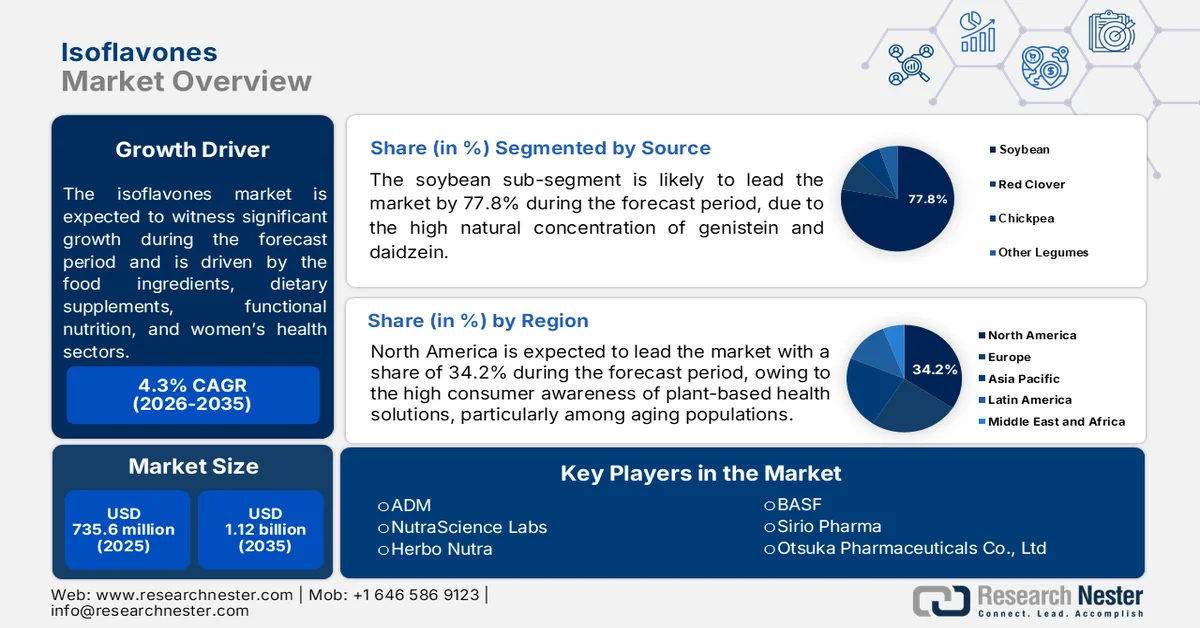
The isoflavones market supported by long-term demand from the food ingredients, dietary supplements, functional nutrition, and women’s health sectors. Commercial production remains closely linked to soybean availability because soybeans are the principal raw material for genistein, daidzein, and glycitein extraction. According to the USDA December 2025 data, global soybean production has exceeded 422.5 million metric tons in recent marketing years, providing a substantial agricultural base for ingredient manufacturers and processors. Demand is also supported by increasing incorporation of plant-derived ingredients into food and beverage formulations. The U.S. FDA continues to recognize the relationship between soy protein consumption and reduced risk of coronary heart disease when consumed as part of a diet low in saturated fat and cholesterol, supporting ongoing interest in soy-based ingredients across food manufacturing channels.
Growth prospects are also influenced by demographic and health-related factors that expand the addressable consumer base for isoflavone-containing products. The World Health Organization October 2024 data reports, 26% of the women are aged above 50 and older, increasing attention on nutritional strategies associated with healthy aging and menopause management. Research activity supported by public health and academic institutions continues to evaluate isoflavones in areas such as bone health, cardiovascular health, and menopausal symptom management, sustaining interest among ingredient suppliers and product developers. For B2B stakeholders, the market outlook is reinforced by the convergence of large-scale soybean production, expanding healthy-aging demographics, ongoing scientific evaluation, and continued demand for plant-based ingredient portfolios across food, supplement, and health-product manufacturing sectors.
Key Isoflavones Market Insights Summary:
Regional Highlights:
- North America is anticipated to capture 34.2% of the regional revenue share by 2035, bolstered by high consumer awareness of plant-based health solutions, a mature nutraceutical ecosystem, and strong regulatory support
- Asia Pacific is forecast to witness the fastest growth during 2026-2035 in the isoflavones market, propelled by deep-rooted soy-based dietary traditions, abundant soybean availability, and increasing demand for preventive healthcare and dietary supplements
Segment Insights:
- The isoflavones market soybean segment is projected to account for 77.8% share by 2035, underpinned by its high natural concentration of genistein and daidzein alongside well-established global cultivation infrastructure
- The Genistein segment is anticipated to secure the highest revenue share during the 2026-2035 forecast period, fueled by its potent estrogenic activity and strong clinical validation for managing vasomotor symptoms in menopausal women
Key Growth Trends:
- Increasing public healthcare spending on osteoporosis prevention
- Government-funded cardiovascular disease prevention programs
Major Challenges:
- High raw material dependency & supply chain volatility
- Stringent regulatory compliance
Key Players: ADM, NutriScience Innovations, LLC, Herbo Nutra, BASF, Sirio Pharma, Otsuka Pharmaceuticals Co., Ltd., DSM-Firmenich.
Global Isoflavones Market Forecast and Regional Outlook:
Market Size & Growth Projections:
- 2025 Market Size: USD 735.6 million
- 2026 Market Size: USD 767.2 million
- Projected Market Size: USD 1.12 billion by 2035
- Growth Forecasts: 4.3% CAGR (2026-2035)
Key Regional Dynamics:
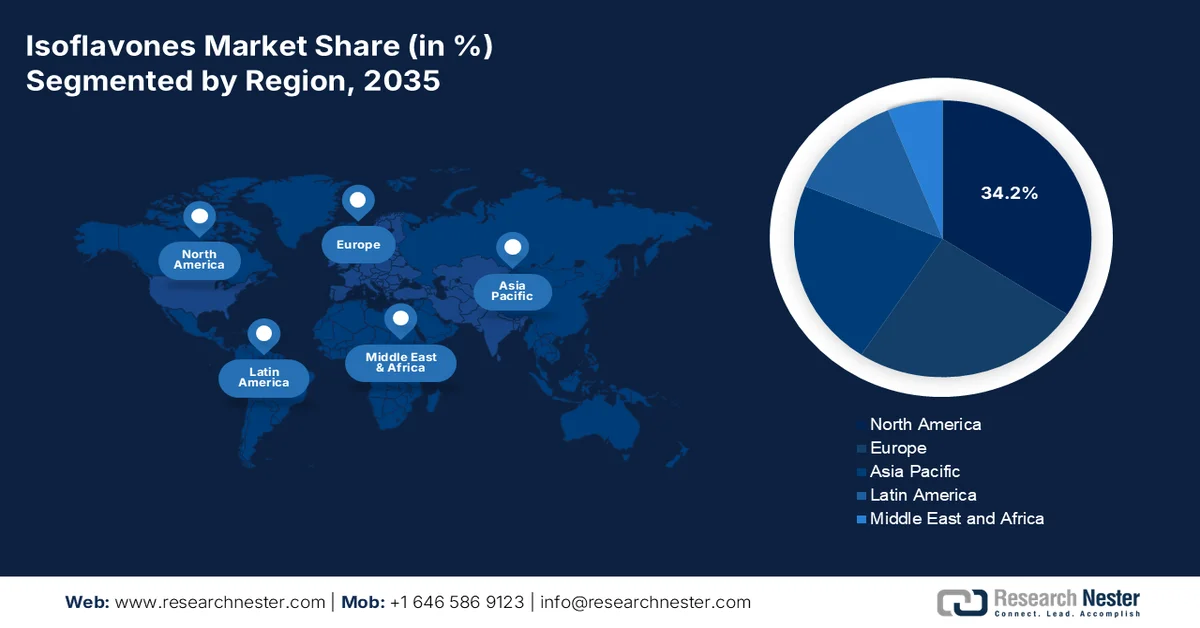
- Largest Region: North America (34.2% Share by 2035)
- Fastest Growing Region: Asia Pacific
- Dominating Countries: United States, China, Japan, Germany, South Korea
- Emerging Countries: India, Brazil, Vietnam, Indonesia, Mexico
Last updated on : 7 July, 2026
Isoflavones Market - Growth Drivers and Challenges
Growth Drivers
- Increasing public healthcare spending on osteoporosis prevention: Bone health management remains a significant application area for isoflavones. Governments face growing economic burdens from osteoporosis-related fractures, particularly among postmenopausal women. The AOFoundation April 2023 data estimates that worldwide osteoporosis causes more than 8.9 million fractures annually. Public health agencies increasingly support preventive nutrition and awareness programs aimed at reducing healthcare costs associated with bone disease. Isoflavones are widely utilized in supplements marketed for bone-health support because of their estrogen-like biological activity. As healthcare systems seek cost-effective preventive approaches to manage aging populations, demand for nutraceutical ingredients associated with bone health is expected to strengthen. This creates opportunities for ingredient manufacturers supplying pharmaceutical, supplement, and functional food producers.
- Government-funded cardiovascular disease prevention programs: Cardiovascular diseases remain the leading cause of mortality worldwide, prompting governments to invest heavily in prevention strategies. The WHO 2026 data reports approximately 17.9 million deaths annually from cardiovascular diseases. Public health agencies increasingly encourage dietary interventions that reduce risk factors associated with heart disease. As healthcare systems allocate more resources toward preventive care, manufacturers are expanding cardiovascular-focused nutritional products that incorporate soy-derived ingredients, including isoflavones. The combination of regulatory support, healthcare spending, and consumer interest in heart health continues to create favorable demand conditions across developed and emerging markets.
Challenges
- High raw material dependency & supply chain volatility: Soybean and red clover cultivation is highly susceptible to climate change, geopolitical tensions, and trade tariffs, creating erratic raw material availability and pricing. New entrants struggle to secure consistent, high-quality non-GMO or organic supplies without long-term farming contracts. ADM mitigates this through direct farmer partnerships and blockchain-tracked sourcing across the Americas, ensuring supply stability despite weather disruptions.
- Stringent regulatory compliance: Navigating complex global regulations requires substantial time and financial investment. Different regions have varying maximum permitted daily intake limits, delaying product launches. BASF maintains dedicated regulatory teams that proactively engage with EFSA and FDA, securing early approvals for their pharmaceutical-grade isoflavone derivatives, setting industry benchmarks for compliance.
Isoflavones Market Size and Forecast:
| Report Attribute | Details |
|---|---|
|
Base Year |
2025 |
|
Forecast Year |
2026-2035 |
|
CAGR |
4.3% |
|
Base Year Market Size (2025) |
USD 735.6 million |
|
Forecast Year Market Size (2035) |
USD 1.12 billion |
|
Regional Scope |
|
Isoflavones Market Segmentation:
Source Segment Analysis
In the isoflavones market, the source segment is overwhelmingly dominated by soybean and is poised to hold the share value of 77.8% by the end of 2035. The segment is driven due to its high natural concentration of genistein and daidzein, coupled with established global cultivation infrastructure. Soybean's leadership is reinforced by its cost-effectiveness, with extraction yields higher per ton compared to red clover or chickpea, making it the preferred raw material for mass-market nutraceutical and animal feed applications. The dominance of soybean is further underpinned by large-scale farming in the Americas and Asia, ensuring consistent supply chains for manufacturers. According to the USDA November 2024 data, soybean production in India reached 12.6 million metric tons, which directly supports the scalability and price stability of soy-derived isoflavones.
Type Segment Analysis
Genistein is the highest revenue share in the isoflavones market due to its potent estrogenic activity and robust clinical validation for managing vasomotor symptoms (VMS) such as hot flashes, sudden intense heat, sweating, and flushing – conditions linked to estrogen deficiency in menopausal women. The NLM October 2024 study administering 54 mg/day of genistein demonstrated significant reductions in daily hot flashes by 22%, 29%, and 24% at three, six, and twelve months, respectively. Furthermore, nearly 60% reduction in hot flashes at study conclusion, without adverse endometrial changes, reinforcing genistein's superior safety profile. Notably, postmenopausal Asian women exhibit lower VMS prevalence, attributed to their high-soy diets, further validating genistein's market dominance.
Application Segment Analysis
The dietary supplements and nutraceuticals sub-segment dominates the isoflavones market due to the global consumer shift toward preventive healthcare and plant-based wellness solutions. Isoflavones are extensively formulated into capsules, tablets, gummies, and powders, offering convenient and precise dosing for menopausal support, bone health, and cardiovascular wellness. The growing preference for non-prescription, self-care alternatives to synthetic drugs has amplified demand for phytoestrogen-rich supplements. Additionally, rising consumer awareness about the safety and efficacy of soy and red clover isoflavones has encouraged product innovation, including combination formulations with vitamins, minerals, and probiotics. This sub-segment thrives on robust retail and e-commerce channels, making isoflavone supplements widely accessible to health-conscious populations globally.
Our in-depth analysis of the isoflavones market includes the following segments:
|
Segment |
Subsegments |
|
Source |
|
|
Type |
|
|
Form |
|
|
Application |
|
|
Extraction Technology |
|
|
End user |
|

Vishnu Nair
Head - Global Business DevelopmentCustomize this report to your requirements — connect with our consultant for personalized insights and options.
Isoflavones Market - Regional Analysis
North America Market Insights
North America is dominating the isoflavones market and is expected to hold the regional revenue share of 34.2% by the end of 2035. The region is driven by the high consumer awareness of plant-based health solutions, particularly among aging populations seeking natural alternatives for menopausal symptom management and bone health. The region benefits from a well-established nutraceutical industry, robust dietary supplement infrastructure, and strong retail and e-commerce penetration. Regulatory clarity from FDA and Health Canada provides a stable framework for product innovation and market entry. Additionally, strategic partnerships between ingredient suppliers and finished-goods brands are accelerating formulation development, while clinical research continues to validate isoflavones for cardiovascular and metabolic health applications, sustaining long-term market growth.
The strong demand for dietary supplements, functional foods, and healthy-aging products, particularly those derived from soy is driving the isoflavones market in the U.S. Government health and nutrition initiatives continue to reinforce consumption of plant-based ingredients. According to the U.S. Department of Agriculture January 2024 data, U.S. soybean production reached 4.16 billion bushels, ensuring abundant raw material availability for isoflavone extraction and processing. In addition, the Centers for Disease Control and Prevention (CDC) January 2025 reported that approximately 40.1 million people were living with diabetes, highlighting growing interest in preventive nutrition and functional food solutions. As manufacturers increasingly develop products targeting cardiovascular health, metabolic wellness, and menopausal support, these agricultural and public health trends continue to strengthen demand for isoflavone-based ingredients across the U.S.
The increasing demand for plant-based nutrition, functional foods, and healthy-aging products, supported by the country’s focus on preventive healthcare and sustainable food systems is driving the isoflavones market in Canada. According to the Canadian Orthopaedic February 2024 data, the population aged 65 years and older reached approximately 7.8 million in 2024, accounting for nearly one-fifth of the national population and supporting demand for products targeting bone, cardiovascular, and menopausal health. Additionally, Statistics Canada December 2024 data reported that Canadian soybean production totaled approximately 6.8 million tonnes, providing a stable domestic source of soy-derived ingredients, including isoflavones. These demographic and agricultural factors are encouraging food, nutraceutical, and supplement manufacturers to expand isoflavone-containing product portfolios across the Canada market.
APAC Market Insights
The Asia Pacific is projected to emerge rapidly during the assessed period, 2026 to 2035 in the isoflavones market. The region is driven by the deep-rooted dietary traditions, particularly in Japan, China, and South Korea, where soy-based foods like tofu, miso, and tempeh are staples, creating inherent consumer familiarity with isoflavone-rich diets. The region benefits from abundant and cost-effective raw material sourcing, with China and India being leading soybean producers, ensuring supply chain efficiency for manufacturers. Rapid urbanization, rising disposable incomes, and growing awareness of preventive healthcare are driving demand for fortified foods and dietary supplements. Additionally, an aging demographic, especially in Japan and South Korea, fuels interest in isoflavones for bone health and menopause management.
The plant-based nutrition, functional foods, and preventive healthcare products is driving the isoflavones market in India. A strong agricultural base and increasing health awareness are supporting the adoption of soy-derived ingredients across food and nutraceutical applications. According to the ICAR October 2025 data, India produced approximately 15.1 million tonnes of soybeans, ensuring a substantial domestic supply of raw materials for isoflavone extraction and processing. Additionally, the PIB July 2024 data estimated India’s population at about 1.4 billion, creating a large consumer base for health and wellness products. These factors are encouraging manufacturers to expand isoflavone-based formulations targeting healthy aging, women’s health, and functional nutrition segments.
The large soybean-processing industry, growing healthy-aging population, and increasing focus on preventive nutrition is shaping the isoflavones market in China. Demand for soy-derived functional ingredients is expanding across dietary supplements, fortified foods, and health products. According to the UNDP December 2025 data, the population aged 60 years and above reached approximately 310.31 million, representing a substantial consumer base for products targeting bone, cardiovascular, and menopausal health. In addition, data from the NLM May 2022 study show that China produced approximately 17.1 million tons of soybeans, reflecting continued efforts to strengthen domestic soybean supply. These demographic and agricultural trends are encouraging manufacturers to increase investment in isoflavone-based ingredients and formulations for the China market.
Europe Market Insights
The isoflavones market in Europe is characterized by stringent regulatory oversight, with EFSA's Novel Food regulations and health claim substantiation requirements shaping product development and market entry. Consumer preference leans toward premium, organic, and sustainably sourced ingredients, driving demand for red clover-derived isoflavones over conventional soy extracts. The region's aging female population fuels interest in non-hormonal menopause management solutions, while growing vegan and plant-based movements expand isoflavone applications into functional foods and dairy alternatives. Western European nations, particularly Germany, France, and the UK, lead in clinical research and formulation innovation. Manufacturers increasingly invest in clean-label certifications and traceability systems to meet evolving consumer expectations. Additionally, strategic collaborations between academic institutions and nutraceutical companies are advancing bioavailability-enhancing technologies across the region.
The increasing demand for plant-based nutrition, healthy-aging products, and functional food ingredients is shaping the isoflavones market in Germany. The country’s aging population and strong focus on preventive healthcare continue to create opportunities for soy-derived ingredients in dietary supplements and wellness formulations. According to the GTAI October 2023 data, approximately 17.7 million people were aged 67 years, representing more than one-fifth of the population and driving demand for products targeting age-related health concerns. Additionally, GWS January 2026 data reported that organic farming covered approximately 1.9 million hectares, accounting for around 11.4% of agricultural land, reflecting growing consumer preference for plant-based and sustainably sourced ingredients. These trends support continued expansion of isoflavone applications across Germany’s food, nutraceutical, and health-product sectors.
The growing consumer interest in plant-based nutrition, healthy aging, and functional food products is shaping the isoflavones market in the UK. Demand is particularly strong for soy-derived ingredients used in dietary supplements and wellness formulations targeting cardiovascular and menopausal health. The growing aging population is supporting demand for preventive health and nutrition products. Additionally, the Government of UK May 2023 reported that the UK’s organic land area reached approximately 509,000 hectares, reflecting continued growth in consumer preference for sustainably sourced and plant-based food ingredients. These demographic and agricultural trends are encouraging manufacturers to expand isoflavone-containing product portfolios across the UK market.
Key Isoflavones Market Players:
- ADM (U.S.)
- NutriScience Innovations, LLC (U.S.)
- Herbo Nutra (India)
- BASF (Germany)
- Sirio Pharma (China)
- Otsuka Pharmaceuticals Co., Ltd (Japan)
- DSM-Firmenich (Netherlands)
- Company Overview
- Business Strategy
- Key Product Offerings
- Financial Performance
- Key Performance Indicators
- Risk Analysis
- Recent Development
- Regional Presence
- SWOT Analysis
- ADM is a dominant force in the isoflavones market, leveraging its massive global supply chain of non-GMO soybeans to produce high-purity isoflavone extracts for dietary supplements, functional foods, and animal nutrition.
- Herbo Nutra is a fast-growing Indian player in the isoflavones market, specializing in cost-effective, high-yield extraction of soy and red clover isoflavones using advanced counter-current chromatography. The company has significantly advanced the market by implementing AI-driven crop selection models that predict optimal harvest times for maximum daidzein and genistein content, directly linking agricultural data to extract purity.
- BASF is a global chemical and nutritional giant that has redefined the isoflavones market through its pharmaceutical-grade synthetic and semi-synthetic isoflavone derivatives, particularly for high-purity active pharmaceutical ingredients (APIs) used in prescription-strength menopausal therapies.
- Sirio Pharma is a leading Chinese CDMO (Contract Development and Manufacturing Organization) that has made substantial inroads into the isoflavones market by positioning itself as a one-stop solution for finished nutraceutical products containing isoflavones. The company utilizes real-time dissolution data from its in-house pharmacokinetic lab to design isoflavone delivery systems.
Here is a list of key players operating in the global isoflavones market:
The isoflavones market is moderately consolidated, with North America and Europe giants leveraging large-scale fermentation and soy-processing capacities, while Asia players dominate cost-effective raw material sourcing. Key strategies include vertical integration, portfolio diversification into nutraceuticals and animal feed, and heavy R&D on gut-microbiome bioavailability. Japanese firms focus on fermented food-derived isoflavones, while Australia and Malaysia players emphasize red clover and palm-derived extracts. Recent moves include DuPont’s clean-label launches, ADM’s acquisition of probiotic strains to pair with isoflavones, and Indian manufacturers gaining FDA-certified facilities to penetrate Western supplement supply chains. Sustainability certifications and clinical trial investments are now critical differentiators.
Corporate Landscape of the Market:
Recent Developments
- In June 2025, DSM-Firmenich, a leading innovator in nutrition, health, and beauty, begins construction on a new, state-of-the-art production facility in Parma, Italy. This marks a key milestone in the Taste, Texture & Health (TTH) business unit’s strategy to boost global flavor capacity and invest in advanced, sustainable technologies in high-growth markets such as sweet goods and savory products.
- In June 2024, Otsuka Pharmaceutical Co., Ltd. (Otsuka) and Korea Otsuka Pharmaceutical Co., Ltd. (KOP), a subsidiary of Otsuka, announced online sales of the whole-soy nutrition bar, " SOYJOY," in South Korea from May 2024.SOYJOY will gradually be on sale at Health and Beauty (H&B) stores and convenience stores.
- In May 2024, SIRIO, a global nutraceutical contract development and manufacturing organization, launched a personalized women’s health platform at Vitafoods Europe. The new 25 formulation-strong portfolio is personalized to women’s health needs and life stages with products covering puberty to post menopause.
- Report ID: 8659
- Published Date: Jul 07, 2026
- Report Format: PDF, PPT
- Explore a preview of key market trends and insights
- Review sample data tables and segment breakdowns
- Experience the quality of our visual data representations
- Evaluate our report structure and research methodology
- Get a glimpse of competitive landscape analysis
- Understand how regional forecasts are presented
- Assess the depth of company profiling and benchmarking
- Preview how actionable insights can support your strategy
Explore real data and analysis
Frequently Asked Questions (FAQ)
About this Report
Connect with our Expert


Report, 2026-2035



Copyright @ 2026 Research Nester. All Rights Reserved.
