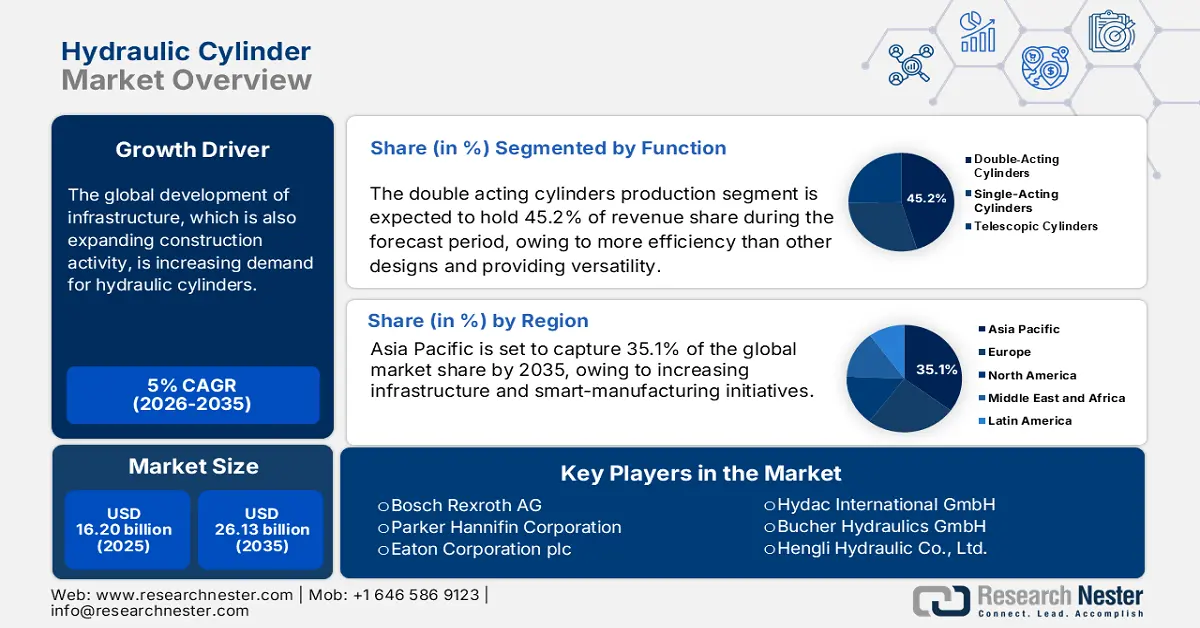
Hydraulic Cylinder Market Outlook:
Hydraulic Cylinder Market size was estimated at USD 16.20 billion in 2025 and is expected to reach USD 26.13 billion by 2035, rising at a CAGR of 5% during the forecast period, i.e., 2026-2035. In 2026, the industry size of hydraulic cylinder is assessed at USD 16.99 billion.
The global development of infrastructure, which is expanding construction activity, is increasing demand for hydraulic cylinders. The government has also put in place many supplementary mechanisms to enhance the speed of planning, clearances, and implementation of the projects. The National Infrastructure Pipeline (NIP) was unveiled with foresight, planning to have a projected infrastructure investment of approximately ₹111 lakh crore from FY20 to FY25. The main input and raw material commodity for hydraulic cylinders is steel tubing. Most manufacturers are likely to be able to import steel tubing duty-free from Australia and India, among other nations, and under Section 232 with an added industry capacity qualification.
Tariffs on steel have forced manufacturers to produce locally and have modified U.S. manufacturers' assembly lines from hydraulic system assembly into construction firms’ production of industrial cylinders. Burnside America received a funding proposal from the Department of Community and Economic Development (DCED) for a $3.3 million Pennsylvania Industrial Development Authority (PIDA) loan and a $20,000 workforce development grant to train workers.