Product Lifecycle Management Market Outlook:
Product Lifecycle Management Market size was valued at USD 28.3 billion in 2025 and is expected to grow to USD 57.5 billion by 2035, registering a CAGR of 8.2% over the forecast period, 2026-2035. In 2026, the industry size of product lifecycle management is estimated at USD 30.6 billion.
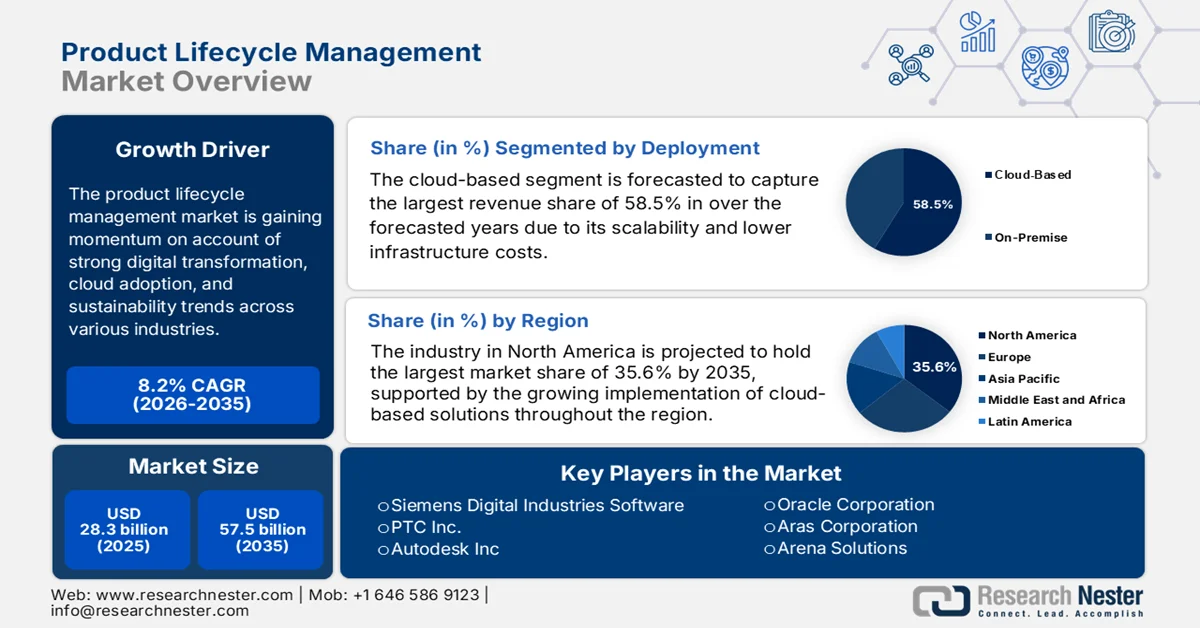
The product lifecycle management market is gaining momentum on account of strong digital transformation across various industries. Manufacturers across different nations are adopting PLM solutions with the main goal to streamline product development, enhance collaboration, and improve efficiency from design to end-of-life. In this context, the report published by the Organization for Economic Co-operation and Development (OECD) in June 2025 revealed that governments are placing digital transformation at the core of modernization efforts. Besides, the Digital Government Index (DGI) represented an average score of 0.61 in OECD countries, wherein the leaders, such as Korea 0.94, Denmark 0.81, and the UK 0.78 excelling in terms of digital strategies. Strong governance, digital infrastructure, and investments in data-driven systems are identified as key enablers of efficiency and innovation. Hence, the presence of this governmental focus on digitalization is boosting PLM adoption, thereby enabling manufacturers to use integrated platforms for lifecycle management.
Furthermore, the integrated PLM platforms are becoming central to managing complex product data in sectors such as pharmaceutical, automotive, aerospace, electronics, and industrial manufacturing. Pharmaceutical continuous manufacturing (CM) is emerging as a major driver for the PLM market, wherein the regulatory agencies are actively supporting the adoption of advanced technologies in managing the product’s lifecycle. International Society for Pharmaceutical Engineering (ISPE) in August 2023 reported that investments are rising, especially in biologics, with the CM drug industry reaching a value of USD 1.9 billion in 2022. It also stated that by 2022, 15 FDA-approved drugs were produced using CM elements, with companies such as Vertex, Pfizer, and GSK leading adoption, hence increasing the growth potential of the market in the years ahead.
Key Product Lifecycle Management Market Insights Summary:
Regional Highlights:
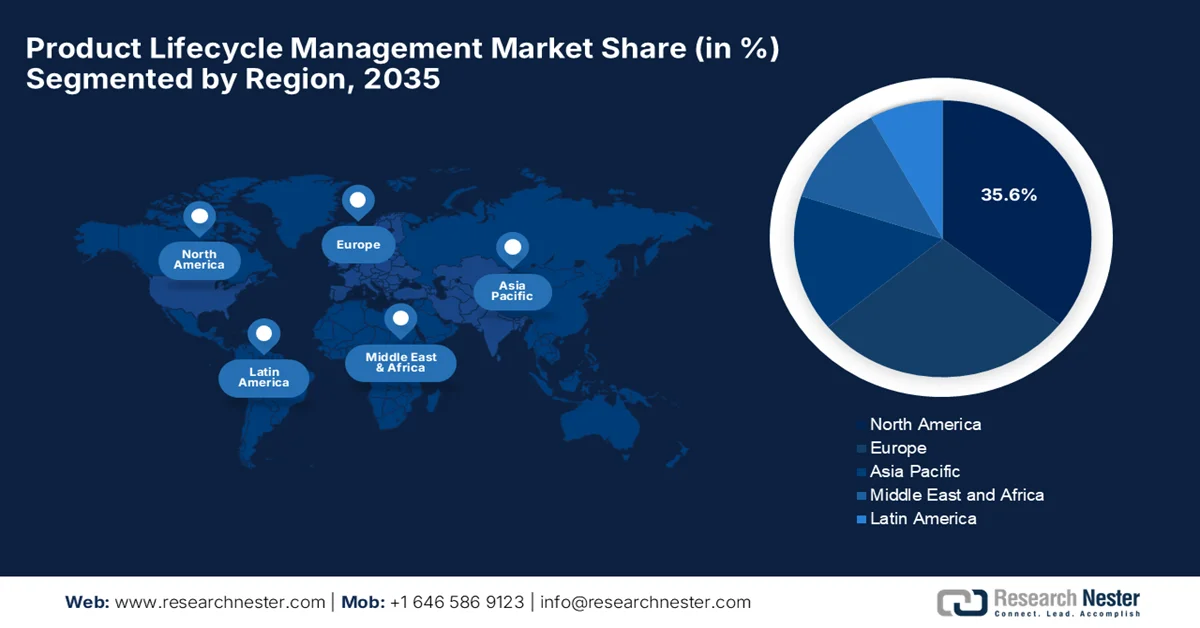
- North America is anticipated to hold a dominant 35.6% share by 2035 in the product lifecycle management market, bolstered by strong adoption of PLM solutions across aerospace, automotive, and advanced manufacturing sectors alongside rising digital transformation investments.
- Asia Pacific is projected to experience the fastest expansion in the forecast period 2026–2035, stimulated by accelerating industrialization and growing integration of AI, IoT, and digital twin technologies within manufacturing ecosystems.
Segment Insights:
- Cloud-based is expected to account for 58.5% share by 2035 in the product lifecycle management market, propelled by scalability advantages, remote collaboration capabilities, and lower infrastructure costs compared with on-premise systems.
- Automotive Industry is forecasted to dominate the end-use industry segment throughout 2026–2035, attributed to rising product complexity from electric vehicles, autonomous technologies, and software-defined vehicle architectures.
Key Growth Trends:
- Smart manufacturing
- Advanced technologies integration
Major Challenges:
- Collaboration and silos
- Version control and complexity
Key Players: Siemens Digital Industries Software (U.S.), PTC Inc. (U.S.), Autodesk Inc. (U.S.), Oracle Corporation (U.S.), Aras Corporation (U.S.), Arena Solutions (U.S.), Dassault Systèmes (France), SAP SE (Germany), PROSTEP AG (Germany), CONTACT Software (Germany), Siemens AG (Germany), NEC Corporation (Japan), Hitachi Ltd. (Japan), Fujitsu Limited (Japan), Tata Consultancy Services (India), HCLTech (India), Japan Aerospace Exploration Agency (Japan), Infosys Limited (India).
Global Product Lifecycle Management Market Forecast and Regional Outlook:
Market Size & Growth Projections:
- 2025 Market Size: USD 28.3 billion
- 2026 Market Size: USD 30.6 billion
- Projected Market Size: USD 57.5 billion by 2035
- Growth Forecasts: 8.2% CAGR (2026-2035)
Key Regional Dynamics:
- Largest Region: North America (35.6% Share by 2035)
- Fastest Growing Region: Asia Pacific
- Dominating Countries: United States, China, Germany, Japan, South Korea
- Emerging Countries: India, Mexico, Brazil, Vietnam, Indonesia
Last updated on : 12 March, 2026
Product Lifecycle Management Market - Growth Drivers and Challenges
Growth Drivers
- Smart manufacturing: The aspects of industry 4.0 initiatives and smart manufacturing are creating lucrative growth opportunities for the PLM market. These factors encourage integration of PLM with technologies and analytics in order to optimize product development. The article published by Press Information Bureau (PIB) in December 2024 revealed that the Ministry of Heavy Industries, under the SAMARTH Udyog Bharat 4.0 initiative, has established four Smart Advanced Manufacturing and Rapid Transformation (SAMARTH) Centres with an aim to promote Industry 4.0 adoption in manufacturing. These include C4i4 Lab Pune, IITD-AIA Foundation at IIT Delhi, I-4.0 India IISc Bengaluru, and the Smart Manufacturing Demo & Development Cell at CMTI Bengaluru. In addition, the centres support industries and MSMEs through training, awareness programs, digital maturity assessments, and the development of smart manufacturing solutions, thereby positively impacting market growth.
- Advanced technologies integration: The incorporation of AI and machine learning into PLM platforms readily enhances capabilities such as predictive analytics, design automation, and intelligent change management, which speeds up development cycles and reduces the timeline for a product’s market entry. In September 2025, Siemens notified that it had expanded its Teamcenter PLM software to include AI-powered sustainability lifecycle assessment capabilities, which allow designers and engineers to integrate predictive analytics and supply chain data into product development. It is developed with Makersite, and the solution embeds lifecycle intelligence directly into engineers’ workflows, allowing companies to make faster decisions across design, manufacturing, and materials selection. Hence, the growing adoption of AI, cloud-based PLM, and IoT is expanding accessibility and remote collaboration, positively impacting the market.
- Sustainability & eco‑compliance focus: Rising focus on sustainability from both the regulatory bodies and customers is encouraging companies to adopt PLM tools that support eco-friendly design and carbon footprint tracking. The solutions from the product lifecycle management (PLM) market help organizations meet safety regulatory requirements more efficiently, which is highly essential in automotive, aerospace, and consumer goods sectors. The Ecodesign for Sustainable Products Regulation (ESPR), which became effective from July 2024, aims to improve the sustainability of products in Europe by enhancing circularity, energy performance, recyclability, and durability. It applies to virtually all physical products and introduces measures such as Digital Product Passports and rules on carbon and environmental footprints. The regulation establishes a framework for developing product-specific eco-design requirements, thus making it suitable for the market’s growth and exposure.
Challenges
- Collaboration and silos: Effective product lifecycle management requires proper coordination in terms of engineering, design, manufacturing, supply chain, and service teams. Teams often work in silos, which can create fragmented data and inconsistent workflows, causing barriers to widespread adoption. Meanwhile, the disconnected communication delays decision-making and increases errors in product development. In this context, organizations can face challenges in terms of time zone differences and inconsistent documentation standards. Besides, a PLM system needs to provide role-based access and collaboration tools to unify teams. Due to the absence of proper adoption and process alignment, the platform may fail to improve efficiency or reduce errors, negatively impacting the growth of the market.
- Version control and complexity: Managing multiple product iterations, such as design changes and BOM updates, is a complex task. Manual tracking or inadequate tools can cause version control issues, which in turn can lead to rework and production errors. Also, the complexity is rising due to the extensive product portfolios, multiple suppliers, and global teams. Meanwhile, the inconsistent documentation and any type of delayed updates can reduce efficiency and product quality. Therefore, PLM platforms that are developed with automated versioning, change tracking, and approval workflows can address these risks, whereas misconfiguration can result in errors. Hence, continuous monitoring and effective user training are highly essential for maintaining proper product data and reducing operational risks in the market.
Product Lifecycle Management Market Size and Forecast:
| Report Attribute | Details |
|---|---|
|
Base Year |
2025 |
|
Forecast Year |
2026-2035 |
|
CAGR |
8.2% |
|
Base Year Market Size (2025) |
USD 28.3 billion |
|
Forecast Year Market Size (2035) |
USD 57.5 billion |
|
Regional Scope |
|
Product Lifecycle Management Market Segmentation:
Deployment Segment Analysis
The cloud-based segment in terms of deployment is forecasted to capture the largest revenue share of 58.5% in the product lifecycle management market over the forecasted years. Scalability, remote collaboration capabilities, and lower infrastructure costs compared with on-premise systems are identified as the key factors driving the dominance. Besides, the cloud platforms allow engineering teams across the globe to access product data in real time and support integrated supply chain collaboration. In April 2025, PTC reported that Schaeffler adopted its cloud-based Windchill+ PLM with the main aim of modernizing its product development and accelerating time to market. The transition enables faster deployment, upgrades, and enhanced collaboration across engineering teams. Hence, from a strategic perspective, such instances represent the cloud PLM adoption in organizations to improve efficiency, innovation, and competitiveness.
End use Industry Segment Analysis
The automotive industry is expected to lead the end use industry segment with a significant share throughout the discussed timeframe. The growth of this subtype in the PLM market is mainly attributed to increasing product complexity driven by electric vehicles, autonomous systems, and software-defined vehicles. PLM platforms help automakers manage complex data, regulatory compliance, and multi-tier supplier collaboration. According to the official statistics published by the International Energy Agency (IEA) in 2025, the electric car sales reached 17 million globally in 2024, which was led by China with more than 11 million units. It also notes that the global EV production remains dominated by China, with Mexico and other Asia Pacific countries growing output, whereas falling battery costs and competitive pricing are improving affordability. Therefore, these statistics underscore the strong requirement for advanced digital product development and lifecycle management systems in the automotive industry.
Global Electric Vehicle Sales 2024: Regional Growth, Market Share, and Emerging EV Trends
|
Market |
2024 Sales (Units) |
2024 Sales Share |
2025 Projection (Units) |
2025 Sales Share |
|
China |
11,000,000 |
50% |
- |
60% |
|
Europe |
- |
20% |
- |
25% |
|
U.S. |
- |
10% |
- |
11% |
|
Southeast Asia |
- |
9% |
- |
- |
|
Brazil |
125,000 |
>6% |
- |
- |
|
Emerging Markets (Other) |
600,000 |
- |
1,000,000 |
- |
|
Global EV Trade |
- |
- |
- |
+20% |
|
China Exports |
- |
40% of global |
- |
- |
Source: IEA
Organization Size Segment Analysis
The large enterprise segment is anticipated to grow at a considerable rate in the market during the forecast period. These organizations often operate in multiple regions and manage complex product portfolios, which creates an extensive need for integrated PLM systems that can manage workflows across different departments and geographies. By leveraging these solutions, large enterprises can optimize decision-making, reduce errors in product data, and accelerate the introduction of new products to the market. In addition, these product lifecycle management platforms enable better management of supplier relationships, facilitate compliance with international standards, and support scalable digital transformation initiatives. Therefore, the factors positioning these companies to respond quickly to evolving market demands and technological advancements, which position the subtype at the forefront of growth in this field.
Our in-depth analysis of the global market includes the following segments:
|
Segment |
Subsegments |
|
Deployment |
|
|
End use Industry |
|
|
Organization Size |
|
|
Component |
|
|
Software |
|
|
Service |
|

Vishnu Nair
Head - Global Business DevelopmentCustomize this report to your requirements — connect with our consultant for personalized insights and options.
Product Lifecycle Management Market - Regional Analysis
North America Market Insights
The product lifecycle management market in North America is expected to maintain the largest revenue share of 35.6% during the discussed timeframe. The region’s dominance is largely fueled by strong adoption of PLM platforms across aerospace, automotive, and advanced manufacturing sectors, supported by high digital transformation investments. In addition, the widespread adoption of cloud computing and the presence of key industry leaders are prompting a huge growth opportunity for the region. In October 2023, MxD partnered with the National Institute of Standards and Technology’s (NIST) Hollings Manufacturing Extension Partnership (MEP) to accelerate digital adoption among small and medium-sized manufacturers in the U.S. The collaboration is focused on enhancing digital manufacturing capabilities, including the integration of design, production, and product data, along with cybersecurity preparedness. Over five years, the initiative aims to strengthen the U.S. manufacturing base and support funding for technology adoption, hence driving market growth in the region.
The notable expansion in the automotive and healthcare sectors is driving the U.S. product lifecycle management (PLM) market. The need for quick product innovations, rising product complexity, and suitable federal grants are also driving the country’s market expansion and exposure. In January 2026, Siemens reported that it had launched Digital Twin Composer, which is a software that creates high-fidelity industrial metaverse environments by integrating digital twin data with real-time physical information. PepsiCo is using this solution to digitally transform select U.S. manufacturing and warehouse facilities, optimizing operations, identifying up to 90% of potential issues before physical changes, and reducing CapEx by 10% to 15%. Hence, from a strategic perspective, such innovations by the country’s players will accelerate product development cycles and solidify the position of the U.S. in complex and technology-driven markets.
Federal government investments and technology integrations are the major drivers for the market in Canada. The improved manufacturing processes have witnessed a rise in adoption, which is a major driver for technologies that support lifecycle data integration and product development processes. These processes help manufacturers in Canada to modernize operations and adopt tools that improve product design, production data flows, and cross-enterprise collaboration. Based on government data, which was published in June 2024, the Canada Digital Adoption Program helps small and medium-sized enterprises adopt digital technologies to improve efficiency and productivity. It also mentioned that as of early 2024, more than 20,000 grants totaling USD 47.8 million and more than 15,000 Boost Your Business Technology grants worth USD 229 million were released, along with nearly 5,000 loans from the Business Development Bank of Canada, hence suitable for standard market growth.
APAC Market Insights
The Asia Pacific product lifecycle management market is poised to witness the fastest growth from 2026 to 2035. The region’s prominence in this field is mainly attributable to rising industrialization in countries such as China, India, and Japan. Manufacturers in the region are entering into partnerships, adopting AI, IoT, and Digital Twins into their workflows to manage increasing product complexity and to maintain scalability. In August 2025, the National Reconstruction Fund (NRF), Bradfield Development Authority (BDA), and Advanced Manufacturing Readiness Facility (AMRF) together reported that they formed a strategic partnership to strengthen Australia’s advanced manufacturing sector. Besides, this collaboration aims to accelerate the growth of emerging manufacturing firms, support end-to-end supply chain development from R&D to commercialization, and create skilled jobs, hence suitable for bolstering the market’s upliftment.
The massive expansion of the electric vehicle and electronics sectors is the crucial growth catalyst for the market in China. In the electronic sector, the product complexity and shorter innovation cycles necessitate advanced collaborative design tools. The government-led digital transformation and industrial modernization efforts are also driving the continued growth of the country’s market. In May 2025, the country’s government reported that China is actively promoting the digital transformation of its electronic information manufacturing industry, thereby aiming for major enterprises to achieve a numerical control rate of more than 85% in key production processes by 2027. The plan emphasizes integrating the real and digital economies, advancing new industrialization, and fostering innovative productive forces. It also stated that by 2027, advanced computing and AI will be deeply incorporated in industry operations, supported by a new information infrastructure, thus driving the market’s growth in the overall country.
The strong government backing with suitable schemes is transforming the market in India. The Make in India and PLI (Production Linked Incentive) schemes are modifying the nation into a global manufacturing hub and necessitating a digital backbone for complex product development. This growth is readily accelerated by the shift toward electric vehicles and high-tech electronics, where shorter innovation cycles and design complexity demand advanced collaborative tools. In this context, PIB in February 2026 revealed that the PLI scheme, which has an outlay of USD 23 billion, is strengthening the country’s manufacturing base by incentivizing incremental production across 14 strategic sectors. It also notes that as of December 2025, it has mobilized over USD 26 billion in investments, generated more than 1.44 million jobs, and boosted domestic production and exports, particularly in electronics, automotive, pharmaceutical, and other high-tech sectors.
Europe Market Insights
The Europe product lifecycle management (PLM) market has acquired a prominent position in the entire global dynamics, effectively fueled by strong regional initiatives that are promoting sustainable manufacturing across industries. Manufacturing plays a central role in the region’s economy, generating a large share of private-sector R&D and innovation activity, which increases the need for integrated digital tools that manage product data, design collaboration, and production processes throughout the lifecycle. Under the European Commission’s Digital Europe Programme, the Data Space for Manufacturing call, which was opened in November 2025 and will close in March 2026, allocated a total of USD 9.7 million to support projects that collect large-scale industrial data for AI applications in manufacturing. The initiative is mainly focused on enabling generative AI development for areas such as product design, engineering, and product lifecycle management by pooling real-world manufacturing datasets, hence denoting a positive market outlook.
The strong industrial base and national push toward smart manufacturing are the main factors driving the market in Germany. Government-supported programs such as the manufacturing-X ecosystem aim to create open industrial data spaces that enable secure data sharing across supply chains, improve transparency in production processes, and support collaborative engineering among manufacturers, suppliers, and technology partners. The Federal Ministry for Economic Affairs and Energy in April 2024 reported that manufacturing-X, which is a joint initiative launched in 2023 to build secure, interoperable industrial data ecosystems, is crucial for Germany’s 15 million jobs associated with manufacturing out of a total of 45 million. This initiative supports digital cooperation across supply chains, thereby enabling companies to securely share product and manufacturing data to improve efficiency and data-driven services across the product lifecycle, thus contributing to wider market expansion.
The stronger emphasis on innovation-based industry strategies is the main factor responsible for uplifting the market in the UK. Government initiatives that support high-value manufacturing and research collaboration encourage manufacturers to adopt integrated tools that support production management. The UK’s strong ecosystem of aerospace, automotive, and engineering firms, combined with ongoing investment in industrial innovation programs, is deliberately encouraging companies to modernize product development workflows. Based on the government data from the country, in December 2023, the UK Department for Business and Trade published the advanced manufacturing plan with a main goal to strengthen the country’s advanced manufacturing ecosystem through investment, digitalisation, and supply-chain resilience. It also stated that the plan allocated about USD 5.7 billion to support sectors such as automotive, aerospace, and clean manufacturing by readily expanding digital adoption programs such as made smarter for SMEs.
Key Product Lifecycle Management Market Players:
- Siemens Digital Industries Software (U.S.)
- PTC Inc. (U.S.)
- Autodesk Inc. (U.S.)
- Oracle Corporation (U.S.)
- Aras Corporation (U.S.)
- Arena Solutions (U.S.)
- Dassault Systèmes (France)
- SAP SE (Germany)
- PROSTEP AG (Germany)
- CONTACT Software (Germany)
- Siemens AG (Germany)
- NEC Corporation (Japan)
- Hitachi Ltd. (Japan)
- Fujitsu Limited (Japan)
- Tata Consultancy Services (India)
- HCLTech (India)
- Japan Aerospace Exploration Agency (Japan)
- Infosys Limited (India)
- Samsung SDS (South Korea)
- OpenLearning Limited (Australia)
- Advanced Micro Devices (AMD) (U.S.)
- Nutanix (U.S.)
- Silverlake Axis (Malaysia)
- Company Overview
- Business Strategy
- Key Product Offerings
- Financial Performance
- Key Performance Indicators
- Risk Analysis
- Recent Development
- Regional Presence
- SWOT Analysis
- Siemens Digital Industries Software is one of the leading players in the market, that is offering an extensive range of PLM solutions. The company is mainly focused on integrating PLM with digital twin technology, industrial IoT, and improved simulation capabilities to support end-to-end product development.
- Dassault Systèmes is a significant player in this sector, which connects design, engineering, and product lifecycle processes in a unified digital environment. Besides, the firm especially focuses on innovation in virtual twin experiences, enabling organizations to simulate products and processes before physical production.
- PTC Inc. is considered to be a central player in this field, which is focused on combining PLM with IoT, augmented reality, and AI to improve product development efficiency. The company’s strategy highly emphasizes cloud-native PLM platforms and intelligent product lifecycle management solutions that enable real-time data integration in terms of design, manufacturing, and service operations.
- Autodesk Inc. is a prominent player in the PLM ecosystem with its fusion lifecycle platform that efficiently integrates product data management, engineering workflows, and collaboration tools. The company mainly focuses on cloud-based product development platforms that connect design, engineering, and manufacturing teams in real time.
- SAP SE provides PLM capabilities as part of its enterprise resource planning and digital supply chain ecosystem. Besides, the company’s PLM solutions concentrate on integrating product development with supply chain management, manufacturing, and enterprise operations.
Below is the list of some prominent players operating in the global market:
The product lifecycle management market is dominated by global enterprise software providers and digital engineering companies such as Siemens Digital Industries Software, Dassault Systèmes, PTC Inc., and Autodesk Inc. Leading vendors in this sector are focused on cloud-based PLM platforms, artificial intelligence integration, and digital twin technologies with the main goal to enhance product development and lifecycle visibility. Companies are also pursuing distinct strategies such as partnerships, acquisitions, and ecosystem collaborations to expand capabilities in terms of engineering, manufacturing, and supply chain operations. In October 2024, TXT e-solutions reported that it had acquired Focus PLM, which specializes in operational technology and advanced PLM solutions that are built on the ARAS Innovator platform to deliver advanced integration for data management, collaboration, and process optimization across the entire product lifecycle.
Corporate Landscape of the Product Lifecycle Management Market:
Recent Developments
- In February 2026, Advanced Micro Devices and Nutanix reported that they entered into a multi-year strategic partnership to develop an open, full-stack AI infrastructure platform for enterprise and service provider environments. It enables AI-driven product design and lifecycle optimization by processing large datasets efficiently.
- In January 2026, PTC Inc introduced new AI-powered capabilities in its FlexPLM retail product lifecycle management solution at NRF 2026 to automate tech pack creation and reduce manual work in retail product development.
- In April 2025, Tata Consultancy Services reported that it was recognized as a Leader in IDC MarketScape for Worldwide Discrete Manufacturing PLM Strategic Consulting and Systems Integration, which represents its deeper knowledge in optimizing product lifecycles across industries.
- In May 2024, the Japan Aerospace Exploration Agency issued a procurement notice for the construction of a PLM system on its aircraft digital transformation platform. The initiative aims to enhance digital management of aircraft development data, engineering processes, and lifecycle information across aerospace programs.
- Report ID: 98
- Published Date: Mar 12, 2026
- Report Format: PDF, PPT
- Explore a preview of key market trends and insights
- Review sample data tables and segment breakdowns
- Experience the quality of our visual data representations
- Evaluate our report structure and research methodology
- Get a glimpse of competitive landscape analysis
- Understand how regional forecasts are presented
- Assess the depth of company profiling and benchmarking
- Preview how actionable insights can support your strategy
Explore real data and analysis
Frequently Asked Questions (FAQ)
About this Report
Connect with our Expert


Report, 2026-2035



Copyright @ 2026 Research Nester. All Rights Reserved.
