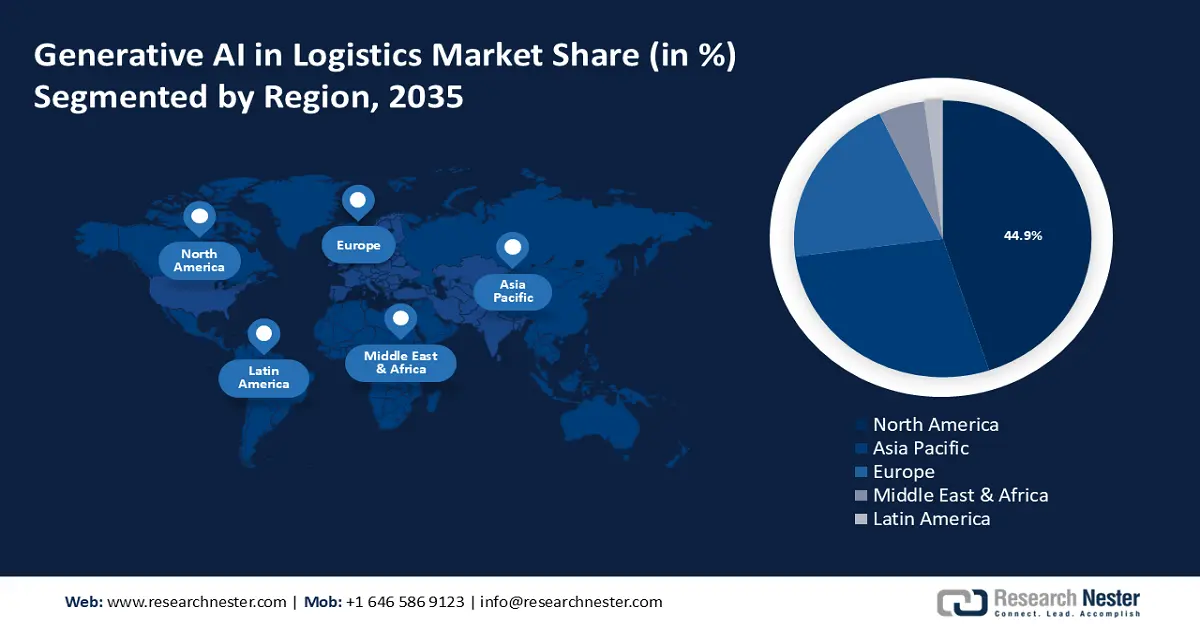
Generative AI in Logistics Market Regional Analysis:
North America Market Insights
North America industry is estimated to dominate majority revenue share of 44.9% by 2035. The increasing adoption of modern automation solutions for various industry operations and the growing use of technology in every sector is credited with the region's success. The major sectors' growing demand for supply chain management and logistics, along with the expanding industrial infrastructure, are driving up the need for generative AI in logistics throughout the region. By investing USD 40 billion in new machinery, United Parcel Service, Inc. was able to increase its daily processing capacity from 60 million packages in 2022 to 70 million packages in 2023.
The U.S.' supremacy in the logistics industry can be ascribed to its substantial investments in AI research and development, the country's robust tech giant presence, and its innovative culture. Furthermore, the sophisticated infrastructure in the area facilitates the smooth integration of IoT and AI technologies, augmenting operational effectiveness.
Asia Pacific Market Insights
Asia Pacific in generative AI in logistics market is expected to experience a stable CAGR during the forecast period due to the rise in the region’s population. Every other industry experiences a surge in demand for inventory owing to the growing need for lifestyle products ranging from everyday necessities to technical necessities. There will be a greater need for generative AI in the logistics business as supply chain and logistics management become more sophisticated.
Driven by rising disposable incomes and economic growth, China is gradually emerging as a center for generative AI in the logistics sector. China is leading the way in AI investment which propels advances in generative AI for logistics, including predictive maintenance and AI-driven route optimization.
The varied supply chain environment in India encourages the use of generative AI to improve supply chain visibility, expedite logistical procedures, and reduce risks. The country adopts cutting-edge technologies like blockchain and IoT and combines them with generative AI to build reliable logistics solutions that save costs and increase productivity. For instance, in June 2023, the logistics technology company Pidge, which has already offered its services in numerous large and medium-sized Indian cities, proclaimed the arrival of digital parity in the mostly unorganized logistics industry. With its first industry low-code and self-serve logistics (Software-as-a-services) technology platform, the launch will completely alter the logistics business.