Gas Analyzer Market Outlook:
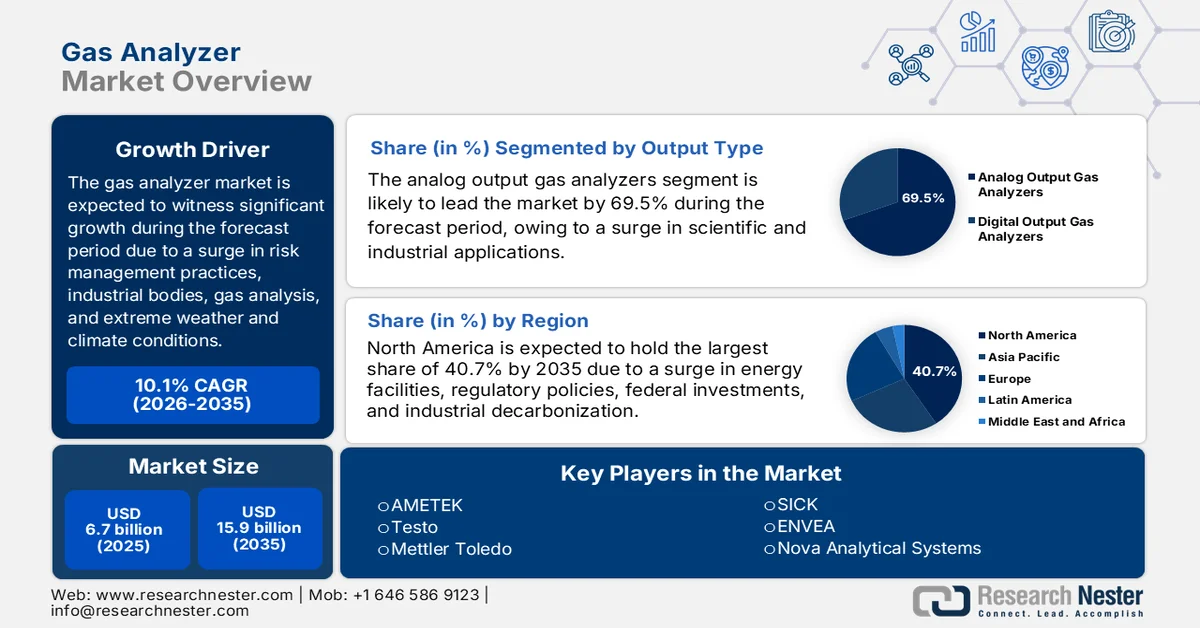
Gas Analyzer Market size was valued at USD 6.7 billion in 2025 and is projected to reach USD 15.9 billion by the end of 2035, gradually mounting at a 10.1% CAGR during the forecast period, i.e., 2026-2035. In 2026, the industry size of gas analyzer is estimated at USD 7.3 billion.
The worldwide gas analyzer market is significantly expanding, owing to workforce demographics, insurance and risk management practices, a rise in the frequency of extreme weather incidents, standardization efforts by industrial bodies, and the convergence of gas analysis with temperature and vibration sensing on unified IIoT platforms. According to official statistics published by the IEA Organization in 2025, almost 300 billion cubic meters per year of latest liquified natural gas export capacity is projected to be added globally by the end of 2030. Besides, the gas demand, particularly in the Asia Pacific, expanded by less than 1% as of 2024, which is positively impacting the gas analyzer market growth. Simultaneously, over 90 billion cubic meters per year of additional liquefied natural gas capacity has been readily sanctioned as of 2025 to proliferate the market expansion.
2024 Liquefied Natural Gas and Gaseous Natural Gas Export/Import Analysis
|
Countries/Component |
Liquefied Natural Gas |
Gaseous Natural Gas |
||
|
Export (USD) |
Import (USD) |
Export (USD) |
Import (USD) |
|
|
Australia |
47.4 billion |
- |
- |
- |
|
U.S. |
40.1 billion |
- |
- |
- |
|
Qatar |
38.1 billion |
- |
- |
- |
|
China |
- |
43.0 billion |
- |
21.3 billion |
|
Japan |
- |
40.2 billion |
- |
- |
|
South Korea |
- |
28.8 billion |
- |
- |
|
Norway |
- |
- |
50.7 billion |
- |
|
Belgium |
- |
- |
22.6 billion |
- |
|
Russia |
- |
- |
21.2 billion |
- |
|
Italy |
- |
- |
- |
23.2 billion |
|
Germany |
- |
- |
- |
22.3 billion |
|
Global Trade Valuation |
216 billion |
171 billion |
||
|
Global Trade Share |
0.9% |
0.7% |
||
Source: OEC
Furthermore, the decentralized analyzer intelligence with edge processing, the predictive replacement modeling rather than end-of-life alerts, and the multi-modal sensing integration beyond gas detection are certain trends that are responsible for fueling the gas analyzer market globally. As stated in a data report published by the Oxford Energy Organization in October 2024, the global gas demand is expected to grow by 613 bcm, demonstrating more than 15% growth by the end of 2035, and further indicating 45%, especially in China and the Middle East. In addition, the growth in demand during the duration is highly concentrated in the power generation, accounting for over 335 bcm and more than 155 bcm for the industrial sector. This concentration also effectively accounts for 80% of growth by the end of 2035, which is highly responsible for driving the gas analyzer market expansion.
Key Gas Analyzer Market Insights Summary:
Regional Highlights:
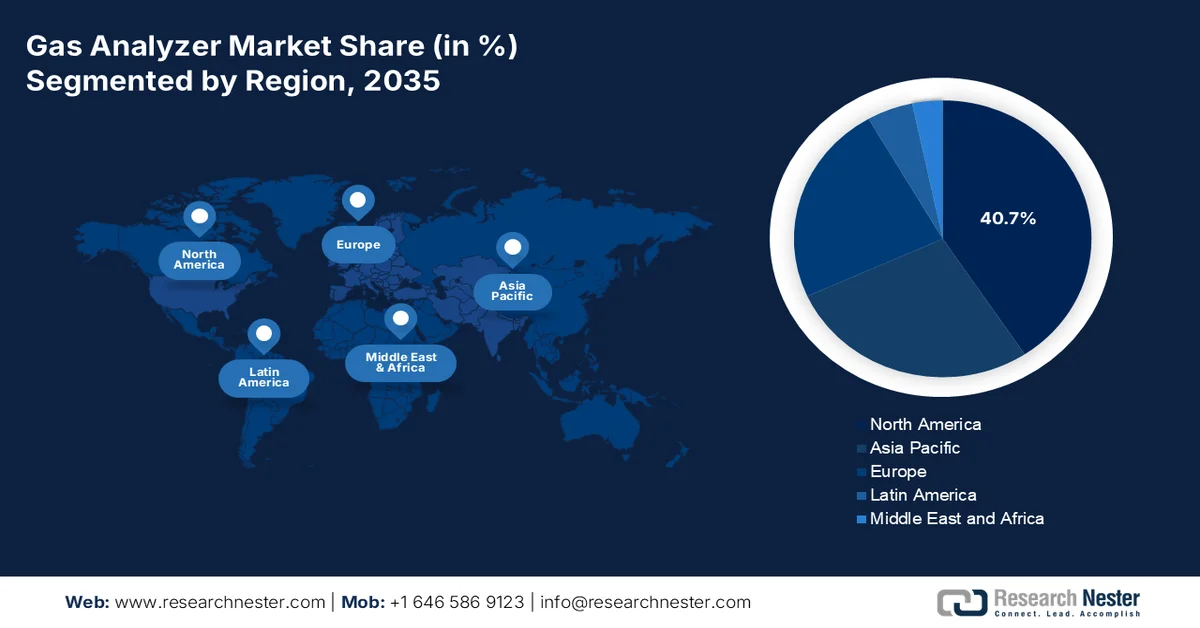
- North America is projected to secure a 40.7% share of the gas analyzer market by 2035, attributed to stringent environmental regulations, aging energy infrastructure, and strong investments in industrial decarbonization
- Europe is poised to register the fastest growth in the market during the forecast period, fueled by rapid transition toward hydrogen economies and expanding renewable gas infrastructure
Segment Insights:
- The analog output gas analyzers segment in the gas analyzer market is forecast to dominate with a 69.5% share by 2035, driven by increasing demand for real-time and continuous gas monitoring across industrial and scientific applications
- The wired gas analyzers segment is anticipated to capture the second-largest share over the forecast period, propelled by its high reliability and immunity to electromagnetic interference in critical industrial environments
Key Growth Trends:
- Repurposing decommissioned power plant analyzers
- Increase in natural gas pipeline
Major Challenges:
- Integration complexity with legacy grid infrastructure
- Calibration drift and environmental sensitivity
Key Players: ABB (Switzerland), Siemens (Germany), Emerson Electric (U.S.), Honeywell International (U.S.), Thermo Fisher Scientific (U.S.), Drägerwerk (Germany), MSA Safety (U.S.), Yokogawa Electric (Japan), Horiba Group (Japan), Shimadzu Corporation (Japan), Riken Keiki (Japan), Fuji Electric (Japan), Servomex (Spectris) (UK), AMETEK (U.S.), Testo (Germany), Mettler Toledo (Switzerland), Endress+Hauser (Switzerland), SICK (Germany), ENVEA (France), Nova Analytical Systems (Canada), Valmet (Finland), MSA Safety Incorporated (U.S.).
Global Gas Analyzer Market Forecast and Regional Outlook:
Market Size & Growth Projections:
- 2025 Market Size: USD 6.7 billion
- 2026 Market Size: USD 7.3 billion
- Projected Market Size: USD 15.9 billion by 2035
- Growth Forecasts: 10.1% CAGR (2026-2035)
Key Regional Dynamics:
- Largest Region: North America (40.7% Share by 2035)
- Fastest Growing Region: Europe
- Dominating Countries: United States, Germany, China, Japan, United Kingdom
- Emerging Countries: India, South Korea, Brazil, Mexico, Saudi Arabia
Last updated on : 30 April, 2026
Gas Analyzer Market - Growth Drivers and Challenges
Growth Drivers
- Repurposing decommissioned power plant analyzers: This particular growth driver caters to coal-based power plants, which positively impacts the gas analyzer market globally. According to official statistics published by the IEA Organization in 2025, there has been a growth in the worldwide coal demand by 1.2% as of 2024 in terms of energy, increasing by nearly 67 million tons of coal equivalent, which is 1.4% or 123 million tons based on physical terms. Besides, the coal power generation surged by almost 1% to 10,700 TWh, which is considered a new high. Therefore, the coal-power facilities decommissioned continuous emissions monitoring systems are spreading across biogas upgrading facilities, hydrogen blending stations, and landfill gas collection systems, thus fueling the gas analyzer market development.
- Increase in natural gas pipeline: Regulatory bodies across different jurisdictions have unveiled financial penalty structures for natural gas transmission operators that connect pipeline leak severity directly to gas analyzer readings. As stated in an article published by the IEA Organization in 2026, there has been an increase in the global gas demand by 2.8% as of 2024. Besides, the contribution of the building industry to the natural gas demand has effectively increased in 2025, reaching almost 70%. Simultaneously, the gas requirement in the power industry has also grown by less than 1% in the same year. Based on this, increased natural gas prices supported gas-to-coal switching in the U.S. for electricity generation, thereby denoting an optimistic outlook for the gas analyzer market expansion.
- Gas facility electronification requirements: The emerging floating fleet of gas facilities effectively processes natural gas directly from offshore wells without the need for land-specific infrastructures, which is positively driving the gas analyzer market worldwide. As per an article published by the Center for International Environmental Law in May 2025, in 2025, almost 29% of total oil and gas production was extracted offshore, thus comprising 85% of the latest worldwide discoveries. Besides, the global upliftment in liquefied natural gas production is significantly reshaping coastlines, and by the end of 2023, 772 gas vessels operated across different nations, with an additional 359 under construction in February 2024, thereby making it extremely suitable for bolstering the gas analyzer market exposure.
Challenges
- Integration complexity with legacy grid infrastructure: The primary roadblock for the gas analyzer market within the energy and power sector lies in the severe technological mismatch between modern smart gas analyzers and the legacy grid infrastructure still dominating global power transmission networks. Most installed transformers and substation equipment predate the Internet of Things (IoT) era, lacking standardized digital communication ports, power over Ethernet capabilities, or compatible data logging interfaces. Besides, retrofitting these aging assets with intelligent gas sensing devices often requires costly custom engineering, including additional signal converters, external power supplies, and proprietary middleware to translate modern Modbus or DNP3 protocols into something legacy controllers can recognize.
- Calibration drift and environmental sensitivity: The gas analyzer market deploys energy and power environments, resulting in relentless operational stress that compromises measurement reliability over time. Substations, transformer yards, and generator halls expose sensitive electronic components to extreme temperature fluctuations, high electromagnetic interference from switching operations, humidity, dust, and vibration. These conditions accelerate sensor degradation, causing calibration drift that directly undermines the device's core value proposition, which is accurate fault gas detection. A drifting baseline can trigger false alarms, eroding operator confidence and leading to ignored warnings, or worse, failing to detect genuine developing faults until catastrophic failure occurs.
Gas Analyzer Market Size and Forecast:
| Report Attribute | Details |
|---|---|
|
Base Year |
2025 |
|
Forecast Year |
2026-2035 |
|
CAGR |
10.1% |
|
Base Year Market Size (2025) |
USD 6.7 billion |
|
Forecast Year Market Size (2035) |
USD 15.9 billion |
|
Regional Scope |
|
Gas Analyzer Market Segmentation:
Output Type Segment Analysis
Based on the output type, the analog output gas analyzers segment is anticipated to account for the largest share of 69.5% in the gas analyzer market by the end of 2035. The segment’s upliftment is primarily attributed to its importance in scientific and industrial applications since there is the provision of ongoing and real-time monitoring, unlike digitalized systems offering a smooth and direct representation of gas concentration modifications. According to official statistics published by NLM in November 2024, the hydrogel-specific sensor exhibited ultrahigh sensitivity of 1.9%, along with an ultralow detection limit of 0.1 ppb. Besides, hydrogen-based gas sensors are in huge demand for safety management during hydrogen utilization due to their low ignition energy and comprehensive explosive limits, ranging between 4% to 75%, thus boosting the segment’s growth and development globally.
Connectivity Segment Analysis
During the forecast period, the wired gas analyzers sub-segment, part of the connectivity segment, is expected to grab the second-largest share in the gas analyzer market. The sub-segment’s growth is highly driven by safety, environmental, and industrial applications for offering high-accuracy, continuous, and dependable measurement of gas concentrations. This particular sub-segment is the backbone of industrial safety and emissions monitoring despite the proliferation of wireless alternatives, primarily due to their inherent reliability, immunity to electromagnetic interference, and uninterrupted power delivery. In high-voltage substations, power generation facilities, and chemical processing plants where electrical noise from switchgear and rotating machinery can corrupt wireless signals, physical cabling ensures deterministic communication with zero latency or packet loss.
Product Type Segment Analysis
The stationary/fixed gas analyzers segment, which is part of the product type, is projected to garner the third-largest share in the gas analyzer market by the end of the stipulated timeline. The segment’s growth is highly propelled by the aspect that industrial facilities require continuous, unattended monitoring rather than intermittent walkaround checks. These permanently installed devices bolt directly into process streams, sample handling systems, or stack ducts, operating around the clock without human intervention. Their fixed nature allows for integration with plant-wide alarm management platforms, automated shutdown systems, and emissions reporting databases. Unlike portable units that must be carried, calibrated daily, and tracked across a facility, stationary analyzers live at their measurement point, responding instantly to process upsets or fugitive releases.
Our in-depth analysis of the gas analyzer market includes the following segments:
|
Segment |
Subsegments |
|
Output Type |
|
|
Connectivity |
|
|
Product Type |
|
|
Form Factor |
|
|
End user Industry |
|
|
Technology |
|

Vishnu Nair
Head - Global Business DevelopmentCustomize this report to your requirements — connect with our consultant for personalized insights and options.
Gas Analyzer Market - Regional Analysis
North America Market Insights
North America in the gas analyzer market is anticipated to grab the highest share of 40.7% by the end of 2035. The market’s upliftment in the region is primarily attributed to strict environmental regulations, aging energy infrastructure requiring ongoing monitoring, and strong federal investments in industrial decarbonization. According to official statistics published by the Department of Energy in April 2026, the Biden-Harris Administration’s objective of a net-zero economy by the end of 2050 is poised to demand between USD 700 billion and USD 1 trillion of private and public sector investments in industrial decarbonization, along with ensuring a robust demand for low-carbon products. Besides, emissions from 8 industrial sectors, such as glass, aluminum, pulp and paper, cement, food and beverage, iron and steel, refining, and chemicals, altogether account for 14% of overall emissions in the U.S., thus positively impacting the gas analyzer market demand in the region.
The gas analyzer market in the U.S. is growing significantly, owing to clean air act enforcement and CEMS mandates, renewable natural gas and biogas qualification under RFS, and the increased focus on industrial decarbonization and hydrogen blending verification. As stated in an article published by the Department of Energy in 2026, the aspect of biogas potential in the country accounts for nearly 1 cubic foot of digester gas per 100 gallons of wastewater. Besides, energy generated in domestic wastewater treatment facilities tends to potentially meet 12% of the national electricity demand. Besides, the country comprises over 16,000 wastewater treatment plants, and only 1,200 anaerobic digesters, of which 860 constitute the suitable equipment to utilize biogas on site. Therefore, with the presence of such facilities, the market is gaining increased importance in the overall country.
The methane measurement and federal provincial frameworks, modernization in upstream oil and gas instrumentation, along with the presence of remote operations and low-connectivity monitoring requirements, are certain factors that are driving the gas analyzer market in Canada. As per an article published by the Canada Energy Regulator in April 2026, there has been an overall growth in the end use demand in the country by 11%, especially in Current Measures by the end of 2050, in comparison to more than 50% growth in real gross domestic product (GDP). Therefore, this significantly implies domestic energy intensity, which is expected to be measured as energy utilization per USD of real GDP. Besides, in relation to current measures, the end use demand is expected to be 12.05 by 2050 in the higher scenario, as well as 10% lower in the lower scenario, thus boosting the market expansion.
Europe Market Insights
Europe in the gas analyzer market is expected to emerge as the fastest-growing region during the forecast period. The market’s development in the region is highly propelled by an accelerated shift to hydrogen economies, the presence of renewable natural gas infrastructure, the integration of IoT connectivity for portable and fixed gas analyzers, the rapid extension of biomethane injection stations, and generous funding into clean energy manufacturing. According to official statistics published by the Europe Commission in 2025, hydrogen accounted for less than 2% of the region’s energy consumption as of 2022 for the primary utilization of producing chemical products, including fertilizers and plastics. Additionally, 96% of this hydrogen was readily produced with natural gas, leading to significant amounts of carbon dioxide emissions, thereby driving the market exposure.
The gas analyzer market in Germany is gaining increased exposure, owing to the largest industrial base, an increase in the demand for gas analyzers that are capable of hydrogen purity analysis, the presence of national laws, organizational contributions, and an expansion in emissions monitoring requirements. As stated in an article published by the DGAP Organization in November 2023, 45% of the overall natural gas was imported in the overall region. In this regard, gas readily catered to more than 20% of the country's energy supply. Besides, domestic industrial processes highly depend on gas, with industry consumption accounting for 27% of the overall regional gas utilization. Likewise, the domestic industry significantly consumed 36% of the overall sales of natural gas in the country and is interconnected with different suppliers, which is deliberately enhancing the market expansion.
The dependency on coal-fired power generation, upgrading programs for air quality directives, the aspect of modernized facilities to meet domestic compliance, specific allocations for industrial digitalization and environmental monitoring equipment procurement, modernization of gas analyzers, and an escalation in collaborative innovation are a few trends that are fueling the gas analyzer market in Poland. As per an article published by the ITA in April 2026, the coal share in electricity generation was 56.2% as of 2024 in the country. Based on this, the planned amount of spending for the green transformation in the country is projected to be around USD 192.7 billion and USD 220.3 billion by the end of 2030, which is equivalent to an allocation worth USD 33 billion and USD 41.3 billion, thus proliferating the market growth in the overall country.
APAC Market Insights
The Asia Pacific in the gas analyzer market is projected to experience suitable growth and expansion by the end of the stipulated timeline. The market’s growth in the region is highly driven by rapid industrialization, strict environmental regulations, huge infrastructure investments, an expansion in domestic manufacturing capacity, and the adoption of wireless connectivity and data analytical capabilities. According to official statistics published by the UNESCAP Organization in January 2026, an average 81% of young people in the region readily utilize the Internet, in comparison to 64% of the youth population in the rest of the world. This has deliberately resulted in a surge in smartphone utilization through modular integration. This particular integration focuses on the increased utilization of phones that readily act as the ultimate data display, processing, and communication facility for specialized sensing hardware, thus proliferating the market growth in the region.
Urban and Rural Utilization of Smartphones Among Young Population in the Asia Pacific, 2022
|
Countries |
Urban |
Rural |
|
China |
79% |
64% |
|
Mongolia |
62% |
51% |
|
Turkey |
57% |
40% |
|
Vietnam |
52% |
42% |
|
Thailand |
49% |
36% |
|
Malaysia |
44% |
29% |
|
India |
22% |
12% |
|
Indonesia |
13% |
10% |
Source: UNESCAP Organization
The gas analyzer market in China is gaining increased traction, owing to real-time emissions enforcements through national grid integration, hydrogen blending, new quality productivity mandates, and petrochemical complex safety upgradation. As stated in an article published by the CKGSB in January 2026, the country’s power grid accounted for 17% of the global population, which is 1.4 billion people, significantly improving accessibility to power. Besides, more than 99% of the population has suitable accessibility to electricity, which is continuing to grow rapidly, and has successfully reached 9,852 TWh of the overall energy consumption as of 2024. Additionally, this significantly accounts for 6.8% YoY increase, which is gradually enhancing the market growth and expansion in the overall nation.
The aspects of prioritizing domestic chemical manufacturing, generous fund provision for gas analyzer adoption, the identification of modernized approaches for gas detection, and an expansion in petrochemical and refining capacity are a few factors that are responsible for bolstering the gas analyzer market in India. Based on government estimates published by the PIB in April 2026, the Petroleum and Explosives Safety Organization (PESO) received a total of 467 applications for compressed natural gas (CNG) as well as compressed biogas (CBG) dispensing stations. Of these applications, 157 cases were granted finalized licenses, and 38 prior approvals were granted for the development of the newest CNG and CBG dispensing stations. Moreover, in March 2026, 41 bio gas cylinder filling and storage facilities were granted approval and significantly license was issued to 14 facilities, thus enhancing the market growth in the country.
Key Gas Analyzer Market Players:
- ABB (Switzerland)
- Siemens (Germany)
- Emerson Electric (U.S.)
- Honeywell International (U.S.)
- Thermo Fisher Scientific (U.S.)
- Drägerwerk (Germany)
- MSA Safety (U.S.)
- Yokogawa Electric (Japan)
- Horiba Group (Japan)
- Shimadzu Corporation (Japan)
- Riken Keiki (Japan)
- Fuji Electric (Japan)
- Servomex (Spectris) (UK)
- AMETEK (U.S.)
- Testo (Germany)
- Mettler Toledo (Switzerland)
- Endress+Hauser (Switzerland)
- SICK (Germany)
- ENVEA (France)
- Nova Analytical Systems (Canada)
- Valmet (Finland)
- MSA Safety Incorporated (U.S.)
- Company Overview
- Business Strategy
- Key Product Offerings
- Financial Performance
- Key Performance Indicators
- Risk Analysis
- Recent Development
- ABB leverages its deep expertise in industrial automation to integrate gas analyzers directly into substation control ecosystems, enabling real-time fault gas detection without separate middleware layers. The company continues to advance its laser-based sensing portfolio for natural gas and biomethane quality monitoring, positioning itself as a key supplier for pipeline operators transitioning to renewable energy feeds.
- Siemens maintains a strong legacy position in process gas chromatography within the energy sector, having supplied integrated gas analysis solutions for combined cycle power plants and hydrogen-ready infrastructure. While the company divested its process gas chromatography business to focus on digital automation, its broader portfolio continues to influence gas analyzer architectures through standardized industrial communication protocols.
- Emerson Electric addresses the growing need for renewable and low-carbon gas measurement through its Rosemount gas chromatograph platform, which handles hydrogen, biogas, and landfill gas alongside conventional natural gas applications. The company designs its analyzers with modular, field-swappable components specifically to minimize downtime in remote pipeline and power generation installations.
- Honeywell International ties gas analyzer functionality directly to its broader emissions management software suite, creating an integrated workflow from sensor-level measurement to regulatory reporting dashboards. The company's hardened gas detectors and analyzers are specifically certified for hazardous offshore environments, where traditional electronics face corrosion and explosive atmosphere challenges.
- Thermo Fisher Scientific specializes in ultra-high-sensitivity gas analysis using Fourier Transform Infrared technology, capable of detecting trace-level contaminants in power plant emissions and semiconductor fabrication exhaust streams. The company's instruments are widely deployed in environmental compliance monitoring for energy utilities facing tightening air quality permits.
Here is a list of key players operating in the global gas analyzer market:
The gas analyzer market is moderately consolidated, with Europe and U.S.-headquartered corporations holding the largest market share in high-end process and emissions monitoring segments, while Japan-based manufacturers dominate portable and specialty analyzer niches. Key strategic initiatives include aggressive IoT-edge integration, where companies embed predictive analytics directly into fixed analyzers for smart grid applications. Moreover, the majority of players are shifting toward monitoring-as-a-service models to secure recurring revenue from utilities. Besides, in April 2024, Valmet completed acquiring the Process Gas Chromatography & Integration business from Siemens AG. The purpose was to strengthen the organization’s automation industry and process automation, providing process industry gas chromatograph and process analyzer systems, thus fueling the gas analyzer industry globally.
Corporate Landscape of the Market:
Recent Developments
- In December 2025, ABB introduced Sensi+ NG, which is the newest evolution of its advanced multi-gas containment analyzer for the natural gas and biogas industries for enabling ongoing and real-time monitoring of critical gas components within a single device.
- In May 2025, MSA Safety Incorporated acquired M&C TechGroup in a transaction valued at approximately USD 200 million to expand the company’s detection solutions and also add capabilities in the gas analysis and process safety economies.
- In August 2024, SICK and Endress+Hauser agreed on a tactical partnership to successfully take over SICK’s process analyzers and gas flowmeters, along with a joint venture for establishing the production and further development.
- Report ID: 8547
- Published Date: Apr 30, 2026
- Report Format: PDF, PPT
- Explore a preview of key market trends and insights
- Review sample data tables and segment breakdowns
- Experience the quality of our visual data representations
- Evaluate our report structure and research methodology
- Get a glimpse of competitive landscape analysis
- Understand how regional forecasts are presented
- Assess the depth of company profiling and benchmarking
- Preview how actionable insights can support your strategy
Explore real data and analysis
Frequently Asked Questions (FAQ)
About this Report
Connect with our Expert


Report, 2026-2035



Copyright @ 2026 Research Nester. All Rights Reserved.
