Food Packaging Market Outlook:
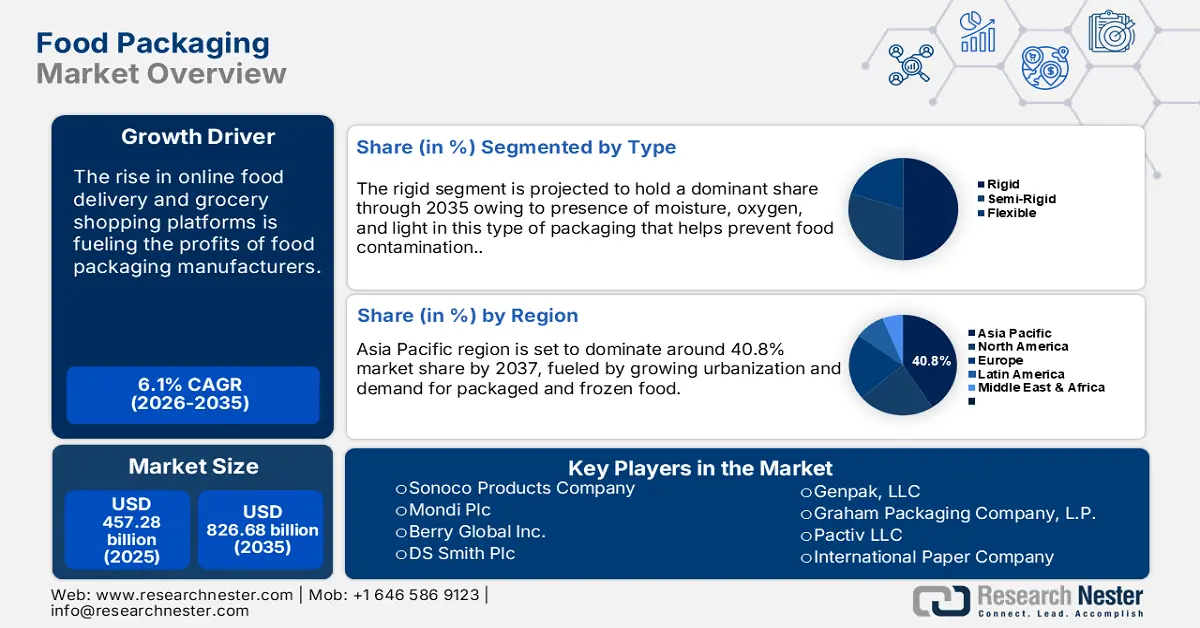
Food Packaging Market size was over USD 457.28 billion in 2025 and is poised to exceed USD 826.68 billion by 2035, witnessing over 6.1% CAGR during the forecast period i.e., between 2026-2035. In the year 2026, the industry size of food packaging is estimated at USD 482.38 billion.
The growth of the market can primarily be ascribed to the globally changing lifestyles of people, and their rising preference for packaged and processed foods. Moreover, owing to the hectic lifestyle, people usually don’t have time to prepare their own food before going to office, so they opt for packed food that is easy to access. Therefore, it is anticipated to boost the market’s growth in the upcoming years. For instance, the global consumption of ultra-processed foods has hugely increased. These foods now account for 27-62% of a person's daily energy needs.
Food packaging is significant for keeping food items fresh and ensuring that they reach their destination without losing any of their original flavor or quality. It shields the food from contaminants and moisture, guards against spills and tampering, and aids in maintaining the products' shape and quality. The importance of food packaging as a means of transmitting information, such as the nutritional value, expiration date, cost, and country of origin of the packaged goods, has increased. Additionally, packaging serves as a contemporary marketing tool used by retailers to attract more customers. The rising count of novel and efficient food processing techniques that need a quality packaging of food after processing is fueling up the demand for packaging market over the forecast period. For instance, the concept of nanotechnology for food processing has opened the door for the processing and formulation of colorants, sensors, flavors, additives, preservatives, and food supplements in both animal and plant-based products (nanoencapsulation and nanoemulsion). Nanomaterials have demonstrated a variety of electrochemical and optical properties in various sauces, beverages, oils, and juices. Unique properties have demonstrated excellent qualities in the field of food processing as ingredients and supplements. Oxide chemicals such as magnesium oxide and silicon dioxide are able to flavor, color, and bake foods. Titanium dioxide has also been approved for use as an ingredient in gums, sauces, and cakes.