Flow Battery Market Outlook:
Flow Battery Market size was valued at USD 1.9 billion in 2025 and is anticipated to reach USD 5.6 billion by the end of 2035, expanding at around 11.7% CAGR during the forecast period i.e., between 2026-2035. In 2026, the industry size of flow battery is assessed at USD 2.1 billion.
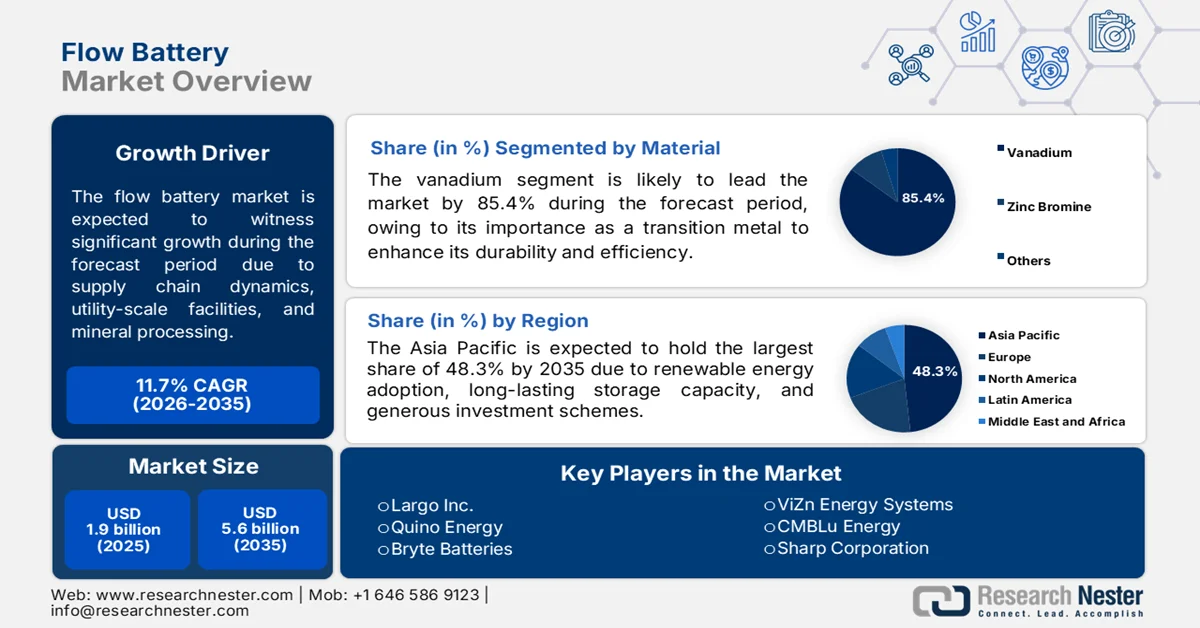
The worldwide flow battery market is effectively shaped by different foundational factors, including battery manufacturing, the presence of established players, supply chain accessibility, massive project development cycles for utility-scale storage, and mineral processing. According to a data report published by the IEA Organization in 2026, the pricing strategy for base metals, such as tin, copper, and aluminum, increased by 1/3rd between January 2025 and April 2026, with copper prices reaching a record-high valuation. Besides, lithium prices doubled due to demand from energy storage applications, while cobalt prices increased by 130%. Based on this growth, there was continuous shipment of minerals in terms of export and import across different nations, which created an optimistic outlook for the market’s upliftment.
Global Mineral Shipment Analysis, 2023
|
Region/Country |
Export Production (USD) |
Export Share (%) |
Import Production (USD) |
Import Share (%) |
|
East Asia and Pacific |
269,528,620.2 |
4.0 |
164,983,192.3 |
2.0 |
|
China |
207,204, 833.1 |
9.5 |
5,560,161.0 |
0.1 |
|
Europe and Central Asia |
62,867,188.5 |
0.6 |
58,033,560.1 |
0.6 |
|
Japan |
23,573,843.4 |
3.4 |
1,400,910.1 |
0.1 |
|
Korea |
18,303,767.9 |
3.1 |
821,111.7 |
0.1 |
|
North America |
14,781,029.6 |
0.3 |
29,650,965.2 |
1.1 |
|
Middle East, North Africa, and Afghanistan |
13,192,389.3 |
0.9 |
19,520,178.8 |
1.4 |
|
Germany |
10,231,397.5 |
0.7 |
4,263,225.0 |
0.2 |
|
South Asia |
9,416,296.6 |
1.4 |
7,195,096.6 |
1.5 |
|
U.S. |
9,162,536.8 |
0.2 |
14,828,320.4 |
0.7 |
Source: WITS
Furthermore, the shift toward alternative chemistries beyond vanadium, the presence of scalable and modular system architectures, and a focus on circular economy, recycling, and sustainability are other trends that are responsible for boosting the market globally. Based on an article published by the International Council on Clean Transportation in 2026, the battery production on a renewable-specific electricity grid in place of a high-carbon electricity grid has the ability to reduce a battery’s carbon footprint by 30% to 40%. Besides, battery processing and refining minerals, such as cobalt, nickel, and lithium, are usually very energy intensive and significantly account for 5 to 50 times more emissions in comparison to mining similar minerals. Moreover, lowering the demand for new batteries through optimized battery recycling and durability is also an effective way for diminishing emissions, thus fueling the market’s growth.
Key Flow Battery Market Insights Summary:
Regional Highlights:
- The flow battery market in Asia Pacific is projected to capture 48.3% of the market by 2035, bolstered by renewable energy capacity expansion, demand for long-duration storage, investment schemes, vanadium production, and supply chain advantages
- North America is expected to secure 16.4% market share during 2026-2035, stimulated by robust policy support, renewable integration reforms, grid modernization, cumulative installed capacity, and domestic manufacturing provisions
Segment Insights:
- The vanadium sub-segment of the flow battery market is anticipated to account for 85.4% of the market by 2035, supported by its role as an essential transition-based metal that enhances alloy durability, heat resistance, and strength
- The redox sub-segment is forecast to hold 77.2% market share during 2026-2035, underpinned by decoupled power and energy ratings that provide operational flexibility for long-duration and high-cycling applications
Key Growth Trends:
- Increase in renewable integration
- Escalated industrial and commercial adoption
Major Challenges:
- Technology maturity and reliability
- Regulatory and policy uncertainty
Key Players: Invinity Energy Systems (UK), Sumitomo Electric Industries (Japan), Enerox GmbH (CellCube) (Austria), VRB Energy (China/Canada), Largo Inc. (U.S.), Quino Energy (U.S.), Bryte Batteries (Norway), Lockheed Martin (U.S.), ViZn Energy Systems (U.S.), CMBLu Energy (Germany), Sharp Corporation (Japan), Stryten Energy LLC (U.S.).
Global Flow Battery Market Forecast and Regional Outlook:
Market Size & Growth Projections:
- 2025 Market Size: USD 1.9 billion
- 2026 Market Size: USD 2.1 billion
- Projected Market Size: USD 5.6 billion by 2035
- Growth Forecasts: 11.7% CAGR (2026-2035)
Key Regional Dynamics:
- Largest Region: Asia Pacific (48.3% share by 2035)
- Fastest Growing Region: North America
- Dominating Countries: China, United States, Japan, Australia, Germany
- Emerging Countries: India, Canada, South Korea, United Kingdom, Singapore
Last updated on : 5 August, 2026
Flow Battery Market - Growth Drivers and Challenges
Growth Drivers
- Increase in renewable integration: An upsurge in the global deployment of wind and solar capacity has created the need for long-lasting energy storage capacity, which has boosted the market globally. According to an article published by the U.S. Environmental Protection Agency in June 2026, wind capacity accounted for 45% and solar for 28% of the total renewable electricity. Besides, almost 42% of energy storage capacity originated from battery storage and the remaining from pumped hydroelectric storage. Meanwhile, battery storage usually charges when power prices are extremely low, which assists in reducing total emissions, optimizing system reliability, and lowering peak prices, thereby making it suitable for bolstering market growth.
- Escalated industrial and commercial adoption: These two industries are emerging as a tactical growth engine for the market, highly attributed to backup power requirements, energy arbitrage opportunities, and change reduction. As per an article published by Renewable and Sustainable Energy Reviews in November 2025, lithium-ion batteries readily account for almost 40% of the industrial share globally and are continuing to be the most notable option for energy storage. However, environmental risks from increased battery waste and mining can hinder comprehensive lithium-ion battery adoption, which readily highlights the requirement for sustainable energy storage. Besides, mining raw materials for manufacturing this battery type has been continuously increasing, thereby positively driving the market upliftment.
Challenges
- Technology maturity and reliability: The presence of energy and power solutions, particularly those involving novel chemistries or hybrid configurations, suffers from insufficient operational track records. Besides, uncertainties around long-term performance, degradation rates, and system longevity create skepticism among end-users and investors alike. Moreover, field data remains sparse for newer technologies, making it difficult to validate laboratory claims under real-world conditions. Maintenance protocols are often underdeveloped, leading to unplanned downtime and reduced system availability. Furthermore, interoperability issues between different components and legacy infrastructure introduce additional failure points, thus restricting the flow battery market’s growth.
- Regulatory and policy uncertainty: The existence of inconsistent policy frameworks across jurisdictions poses a major roadblock for the market. Frequent changes in subsidy schemes, tax incentives, and emission reduction targets create an unstable planning environment for project developers. Besides, lengthy permitting processes and bureaucratic delays add further friction, inflating project timelines and costs. Grid interconnection standards often lag behind technological advancements, resulting in technical mismatches and additional compliance burdens. Moreover, the absence of harmonized international standards complicates cross-border trade and technology transfer. This regulatory patchwork discourages long-term strategic investments, as stakeholders struggle to forecast policy directions, ultimately stifling innovation and market expansion in critical regions.
Flow Battery Market Size and Forecast:
| Report Attribute | Details |
|---|---|
|
Base Year |
2025 |
|
Forecast Period |
2026-2035 |
|
CAGR |
11.7% |
|
Base Year Market Size (2025) |
USD 1.9 billion |
|
Forecast Year Market Size (2035) |
USD 5.6 billion |
|
Regional Scope |
|
Flow Battery Market Segmentation:
Material Segment Analysis
The vanadium sub-segment, which is part of the material segment, is anticipated to grab the largest share of 85.4% in the flow battery market by the end of 2035. The sub-segment’s upliftment is primarily fueled by its role as an essential transition-based metal, which is well-known for its capability to significantly increase alloy durability, heat resistance, and strength. According to official statistics published by the African Development Bank Group in November 2025, vanadium-specific ore deposits comprise vanadiferous titanomagnetite, accounting for 75% of the worldwide production. Likewise, shale-based vanadium also accounts for 10% to 15% of the production, standstone uranium-vanadium for less than 5% of production, and vanadate deposits with negligible production. Besides, the end-of-life recycling rate for vanadium is predicted to be roughly 5%, while the input rate is estimated to be almost 10% globally, thus driving the sub-segment’s growth.
Type Segment Analysis
Based on the type segment, the redox sub-segment is projected to account for the second-largest share of 77.2% in the flow battery market during the forecast period. The sub-segment’s growth is effectively driven by decoupled power and energy ratings, offering operational flexibility that appeals to long-duration and high-cycling applications. Redox systems are particularly valued for their deep discharge capability, minimal degradation over time, and enhanced safety profiles compared to solid-state alternatives. Their modularity enables scalable deployments across diverse settings, from utility-scale projects to commercial facilities. However, higher system complexity and pumping parasitic losses remain technical considerations. Overall, the redox sub-segment continues to attract interest for its durability and lifecycle advantages in stationary storage.
Application Segment Analysis
By the end of the stipulated timeline, the utilities sub-segment, part of the application segment, is expected to grab the third-largest share of 58.5% in the flow battery market. The sub-segment’s development is highly propelled by its importance for modernized electrical grids that ensure the dispatch and capture of renewable energy, offer critical backup power, and maintain grid stability. As per an article published by the IEA Organization in 2026, 108 GW of the newest battery storage capacity was readily deployed globally as of 2025, indicating an increase of more than 40% from 2024. Besides, lithium-ion phosphate batteries currently account for almost 90% of deployments since these are cheap and suited for frequent cycling. Moreover, the recent addition of battery storage capacities is also responsible for boosting the sub-segment’s growth and demand.
Global Battery Storage Capacity Additions, 2020-2025
|
Year |
Utility-Scale (GW) |
Behind-the-Meter (GW) |
|
2020 |
3.8 |
2.3 |
|
2021 |
6.4 |
3.1 |
|
2022 |
12.2 |
6.1 |
|
2023 |
32.2 |
11.8 |
|
2024 |
63.2 |
14.1 |
|
2025 |
86.8 |
20.9 |
Source: IEA Organization
Our in-depth analysis of the flow battery market includes the following segments:
|
Segment |
Subsegments |
|
Material |
|
|
|
|
Application |
|

Vishnu Nair
Head - Global Business DevelopmentCustomize this report to your requirements — connect with our consultant for personalized insights and options.
Flow Battery Market - Regional Analysis
APAC Market Insights
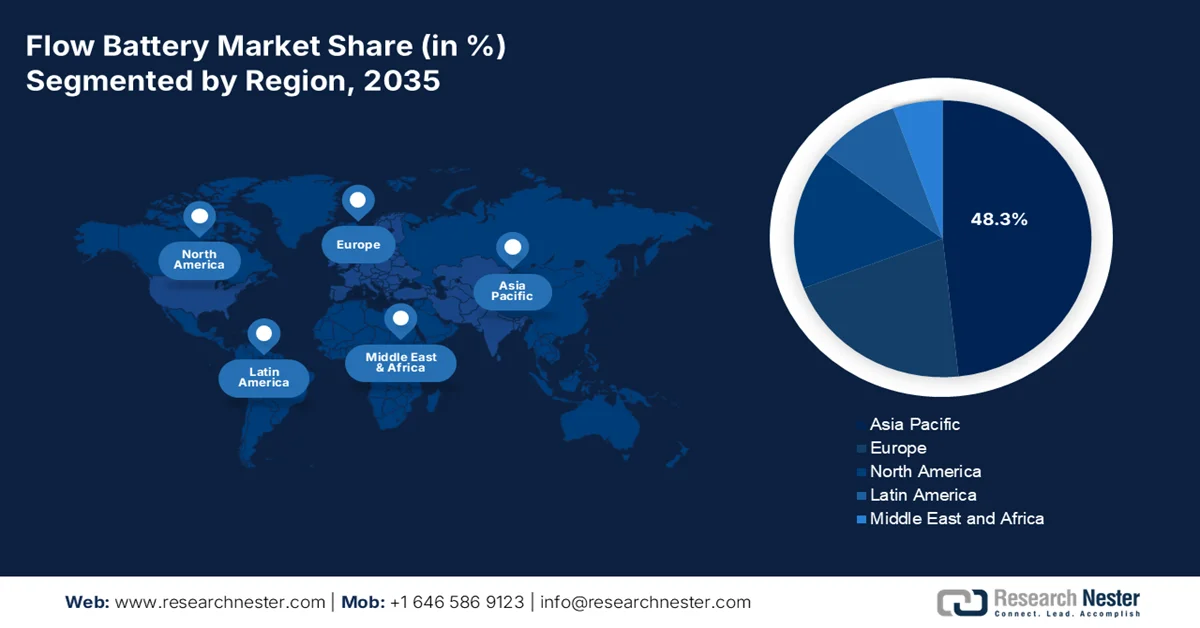
The Asia Pacific flow battery market is anticipated to garner the highest share of 48.3% by the end of 2035. The market’s upliftment in the region is primarily attributed to renewable energy capacity, the demand for long-term storage, the presence of investment schemes, the production of vanadium, and supply chain benefits. According to an article published by MDPI in June 2026, China significantly offers a large-scale and policy-driven case by readily commissioning suitable energy storage, which reached an estimated 136 GW to 351 GWh as of 2025. Likewise, Australia also offers a high-growth case with multiple GW utility-scale construction expansion and a battery investment pipeline. Simultaneously, Singapore constitutes a selective deployment case, wherein projects such as the Sembcorp ESS demonstrated technological feasibility with limited replication, thus proliferating market upliftment in the region.
The China market is growing significantly, owing to storage installations, project investment, provincial government initiatives, long-lasting renewable storage facilities, domestic supply chain system, and manufacturing dominance. As stated in an article published by Energy Storage and Saving in June 2023, the country has aimed to boost its primary energy share from renewable energy sources from 16.6% to 25% by the end of 2030. Therefore, to achieve this, energy storage has emerged as the ultimate promising solution for catering to renewable intermittency risks by balancing electricity demand and supply. Moreover, the deployment of energy storage is poised to provide an opportunity for accelerating the energy shift from coal by offering reliability and flexibility to the power grid, thus ensuring an increased penetration of renewable sources and driving market expansion.
The aspects of governmental funding and policy support, as well as renewable adoption, grid reliability, supply chain security, and technical advantages from lithium-ion are certain factors that are responsible for bolstering the market in Australia. As per an article published by the Climate Council Organization in August 2025, there is continuous growth in home and solar batteries, with over 1 in 3 households presently comprising a rooftop-based solar system. This has been readily possible with generous support from governmental programs that include the Cheaper Home Batteries Program. Besides, the Australian Energy Market Operator (AEMO) predicted a 21% surge in operational electricity consumption, which is fueled by data center project expansion and business electrification escalation, thus positively contributing to the market expansion.
North America Market Insights
North America flow battery market is expected to emerge as the fastest-growing region with a share of 16.4% during the forecast period. The market’s development is highly propelled by robust policy support, renewable integration reforms, grid modernization, cumulative installed capacity, and domestic manufacturing provisions. According to official statistics published by the Renewable Energy Institute in 2026, renewable energy sources significantly accounted for 28.6% of electricity generation in the U.S. in the 2026 first quarter. In addition, output from renewable sources significantly increased by over 11%, with a rise in utility-scale solar generation by 23.9%, 21.9% of hydropower, 11.9% of small-scale solar, and 2.1% of wind. Therefore, these figures tend to reflect the ongoing momentum in the clean energy transition, thus driving market growth and development in the region.
The U.S. market is gaining increased traction, owing to support provision from state and federal policies, grid resilience and modernization, diversified applications, corporate demand, and the existence of favorable regulatory frameworks. As stated in an article published by the Department of Energy in July 2026, the Office of Electricity administered a USD 10.5 billion Grid Resilience and Innovation Partnerships (GRIP) program for enhancing grid flexibility and optimizing power system resilience. This program escalated the deployment of transformative projects for enabling the reliability of the power industry’s infrastructure. Besides, this is possible by gaining pressure from evolving cybersecurity threats, an increase in load demand, and aging infrastructure, thus positively impacting the market’s development in the country.
GRIP Funding Mechanisms in the U.S., 2026
|
Funding Type |
Amount (USD Billion) |
Purpose |
|
Grid Resilience Utility and Industry Grants |
2.5 |
Modernizing the electric grid for diminishing natural disasters and critical weather. |
|
Smart Grid Grants |
3.0 |
Increasing reliability, efficiency, and flexibility for the electric power system. |
|
Grid Innovation Program |
5.0 |
Financial assistance to public utility commissions, local governments, tribes, and multiple states by partnering with electric sector operators and owners. |
Source: Department of Energy
The presence of federal climate commitments, provincial renewable targets, unique climatic and geographic demands, critical mineral strategy, government funding, and an increase in emerging industrial and commercial demand are a few trends that are responsible for driving the market in Canada. As per an article published by the IEA Organization in February 2026, mining of graphite, nickel, copper, lithium, and cobalt is already widespread across different territories and provinces, with 56 active projects as of 2024. Besides, the national federal budget effectively proposed the provision of the First and Last Mile Fund, which is expected to offer USD 1.1 billion (CAD 1.5 billion) between 2029 and 2030. Additionally, the present budget also proposed to develop a USD 1.4 billion (CAD 2 billion) Critical Minerals Sovereign Fund, thus expanding market development in the nation.
Mine Production and Reserves Mineral Share in Canada, 2024
|
Minerals |
Mine Production (kt and %) |
Reserves (kt and %) |
|
Copper |
450 and 2.0 |
8,300 and 0.8 |
|
Cobalt |
4.5 and 1.6 |
220 and 2.0 |
|
Lithium |
4.3 and 1.8 |
1,200 and 4.0 |
|
Nickel |
190 and 5.1 |
2,200 and 1.7 |
|
Graphite |
20 and 1.3 |
5,900 and 2.0 |
Source: IEA Organization
Europe Market Insights
Europe flow battery market is predicted to witness a considerable share of 20.9% by the end of the stipulated timeline. The market’s growth in the region is effectively driven by renewable integration demands, long-lasting energy storage policies, an increase in renewable penetration, coal-phaseout timelines, and net-zero technological eligibility. According to an article published by SolarPower Europe in May 2025, 21.9 GWh of battery energy storage systems were significantly installed in the region as of 2024. Additionally, this marked a record-breaking installation, which brought the overall regional battery fleet to 616.1 GWh. Besides, the storage system industry is continuously growing, with 29.7 GWh of battery storage installations in the region, indicating a 36% yearly growth. In this regard, a 6-fold increase is expected to reach 120 GWh, thus boosting the overall capacity to 400 GWh, thereby enhancing the market growth.
Battery Deployment Growth in Europe, 2024
|
Year |
Deployment (GWh) |
|
2020 |
2.3 |
|
2021 |
4.2 |
|
2022 |
10.4 |
|
2023 |
19.1 |
|
2024 |
21.9 |
Source: Solar Power Europe
The Germany flow battery market is gaining increased exposure, owing to renewable energy integration, grid infrastructure modernization, favorable regulatory frameworks for supporting deployment, and aggressive industrial and research collaboration. As stated in an article published by Clean Energy Wire Organization in July 2026, privileged grid accessibility is one of the key drivers in the country for renewable expansion, which presently covers almost 60% of the electrical demand. Besides, a redispatch provision has been steered, wherein over 5% of electricity generation was unable to be fed into the grid, with renewable investors granted an immediate grid connection. Meanwhile, the volume of uncompensated curtailed electricity is poised to be capped between 10% and 20% of the yearly production, thereby making it suitable for fueling the market expansion.
The focus on solar integration requirements, green hydrogen synergies, generous financing opportunities, government incentives, the presence of a lower base effect, and grid infrastructure opportunities are also responsible for fueling the market in Spain. As per an article published by ICEX-Invest in Spain in October 2024, the country is deliberately focused on climate neutrality objectives for 2050, along with 100% renewable energy in the electricity mix and 97% in the overall energy mix. Besides, the country has proclaimed water electrolysis projects for producing 20% of the total green hydrogen. In addition, the overall region accounts for 25% of declared projects, which caters to the production of low-emission hydrogen by the end of 2030. Based on this, the region has the ability to produce nearly 8 million tons of hydrogen every year at the end of this decade, thus demonstrating a huge growth opportunity for the market.
Key Flow Battery Market Players:
- Invinity Energy Systems (UK)
- Sumitomo Electric Industries (Japan)
- Enerox GmbH (CellCube) (Austria)
- VRB Energy (China/Canada)
- Largo Inc. (U.S.)
- Quino Energy (U.S.)
- Bryte Batteries (Norway)
- Lockheed Martin (U.S.)
- ViZn Energy Systems (U.S.)
- CMBLu Energy (Germany)
- Sharp Corporation (Japan)
- Stryten Energy LLC (U.S.)
- Company Overview
- Business Strategy
- Key Product Offerings
- Financial Performance
- Key Performance Indicators
- Risk Analysis
- Recent Development
- Regional Presence
- SWOT Analysis
- Invinity Energy Systems focuses on modular, long-duration energy storage solutions for utility and commercial-industrial applications, with a strong track record in large-scale project deployments across multiple continents.
- Sumitomo Electric Industries leverages decades of R&D expertise to deliver reliable, large-scale storage systems primarily for grid stabilization and renewable integration, particularly in its home market and select international projects.
- Enerox GmbH (CellCube) specializes in fully containerized vanadium flow battery systems, emphasizing robust performance and long cycle life for off-grid, microgrid, and renewable firming applications across Europe and beyond.
- VRB Energy advances its proprietary Gen 3 vanadium redox technology, targeting gigawatt-scale deployments for utility and renewable energy projects in Asia and North America.
- Largo Inc. is a vertically integrated energy transition company that leverages its upstream vanadium production to supply VRFB systems through its subsidiary, Largo Clean Energy, and further positioned itself as a key player in the North American long-duration storage market.
Here is a list of key players operating in the global market:
The flow battery market remains moderately consolidated, dominated by a handful of established players with significant operational track records. Invinity Energy Systems positions itself as the largest vanadium flow battery supplier globally, while Sumitomo Electric Industries maintains a strong presence through utility-scale deployments. The competitive environment is characterized by regional specialization, with Europe-based manufacturers such as Enerox (CellCube) and emerging players such as Bryte Batteries focusing on niche applications, while North American firms leverage proprietary electrolyte chemistries. Besides, in December 2024, Invinity Energy Systems introduced ENDURIUM™, which is the next-generation modular vanadium flow battery by integrating the VS3 product platform, thus proliferating the flow battery industry globally.
Corporate Landscape of the Market:
Recent Developments
- In February 2026, CMBLu Energy successfully delivered 5 GWH of solid flow battery storage systems, particularly to Uniper, by signing a conditional framework agreement for storage system delivery.
- In October 2025, Sharp Corporation signed a memorandum of understanding with ESI Asia Pacific Ltd and collaborated on the creation of zinc-air flow batteries with the Support of the Ministry of Environment’s technology development and demonstration project in Japan.
- In December 2024, Stryten Energy LLC signed an agreement with Stryten Critical E-Storage LLC, which is a subsidiary of Largo Inc., for the formation of Storion Energy, LLC to combat battery-based entry for manufacturers.
- Report ID: 8718
- Published Date: Aug 05, 2026
- Report Format: PDF, PPT
- Explore a preview of key market trends and insights
- Review sample data tables and segment breakdowns
- Experience the quality of our visual data representations
- Evaluate our report structure and research methodology
- Get a glimpse of competitive landscape analysis
- Understand how regional forecasts are presented
- Assess the depth of company profiling and benchmarking
- Preview how actionable insights can support your strategy
Explore real data and analysis
Frequently Asked Questions (FAQ)
About this Report
Connect with our Expert


Report, 2026-2035



Copyright @ 2026 Research Nester. All Rights Reserved.
