Fault Current Limiter Market Outlook:
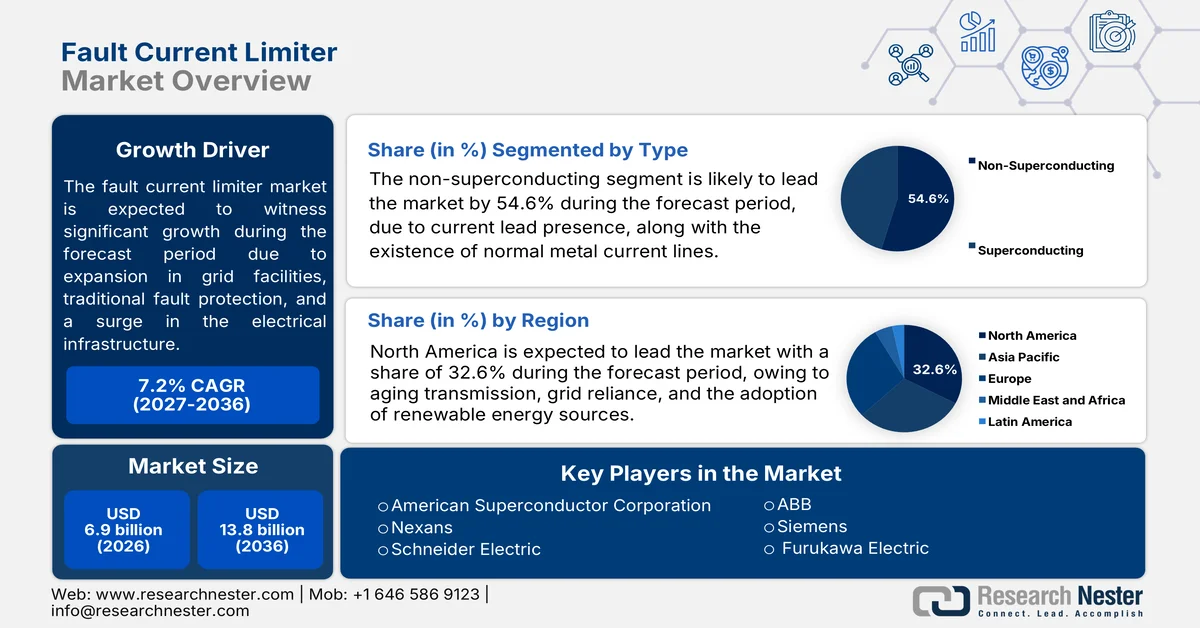
Fault Current Limiter Market size was over USD 6.9 billion in 2026 and is poised to cross USD 13.8 billion by the end of 2036, witnessing more than 7.2% CAGR during the forecast period i.e., between 2027-2036. In 2027, the industry size of fault current limiter is evaluated at USD 7.4 billion.
The worldwide fault current limiter market is continuously undergoing a fundamental transformation based on factors such as modern grid architecture, the demand for conventional fault protection, electrical and thermal stress, and the existence of aging grid infrastructure. According to an article published by the IEA Organization in 2026, more than 2,500 GW of renewable, storage, and large-load projects are presently stalled in grid queues globally. Besides, effectively meeting the electricity demand by the end of 2030 is poised to demand yearly grid investment to increase by roughly 50% from the present USD 400 billion. This additionally caters to upscaling grid supply chains and also ensures effective management of challenges. Besides, the adoption of grid-enhancing technology can unlock capacity with short lead duration and relatively low expenses, thus positively impacting the market’s upliftment.
Global Grid Hosting Capacity Through Technology Upgradation, 2025
|
Technology Type |
Low Case (GW) |
High Case (GW) |
|
Voltage Uprating |
357 |
84 |
|
Reconductoring |
253 |
55 |
|
APFC |
165 |
83 |
|
DLR |
165 |
56 |
|
SATA |
91 |
41 |
|
TO |
73 |
37 |
|
DTR |
73 |
37 |
|
Combined |
450 |
257 |
Source: IEA Organization
Moreover, the manufacturing localization, supply chain regionalization, digital monitoring integration, the presence of MVDC applications, platform flexibility, and technological convergence towards hybrid architectures are a few trends that are bolstering the fault current limiter market globally. As stated in an article published by Energy Conversion and Management: X in January 2026, petroleum-specific products, including natural gas, oil, and coal, significantly account for 78% to 80% of the commercial energy utilization globally. Besides, the worldwide renewable energy installed capacity surged by 50% as of 2024. In addition, renewables, such as biogas, marine, geothermal, hydropower, wind, and solar, effectively reached nearly 4,448.1 GW from 1,021 GW for wind energy and 1,600 GW for photovoltaic solar energy systems, thus making it suitable for enhancing the market’s upliftment.
Key Fault Current Limiter Market Insights Summary:
Regional Highlights:
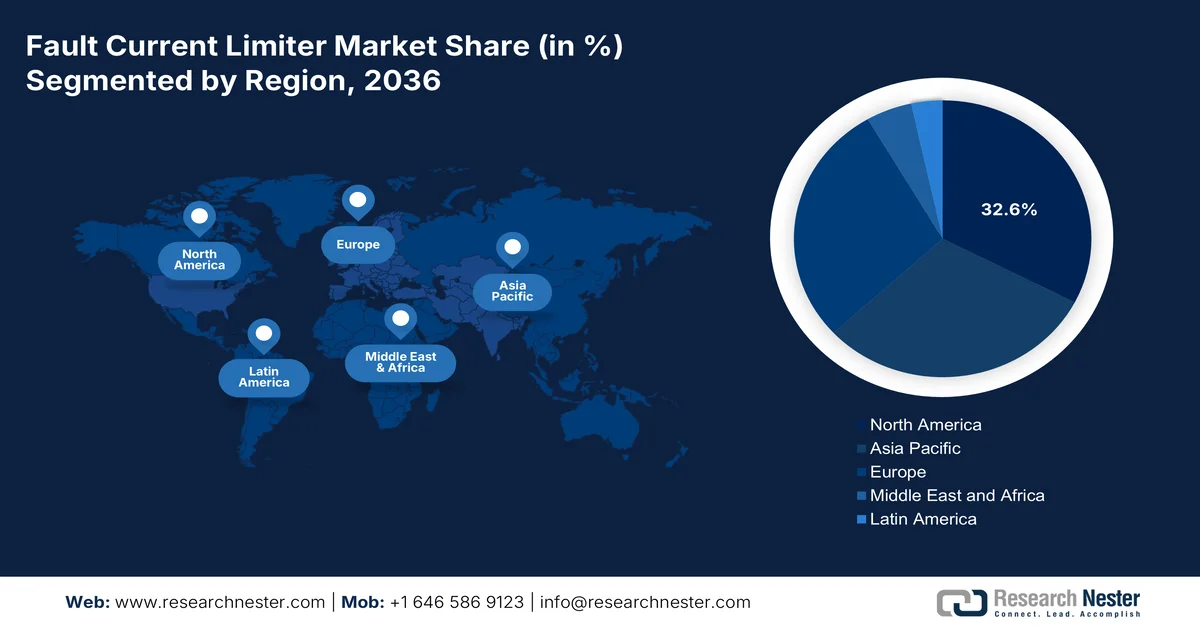
- North America is set to account for a 32.6% share by 2036 in the fault current limiter market, with expansion stemming from regulatory emphasis on grid resilience, distribution infrastructure, aging transmission, and renewable energy interconnection
- Europe is poised to register a 28.5% share during 2027-2036, with market development arising from the carbon reduction policy framework, green transformation, and increasing demand for power reliability
- The fault current limiter market in Japan accounts for 6.5% of the global share, which is driven by an expansion in the power infrastructure, along with compact solutions, upgradation in aging facilities, and the integration of renewable energy
Segment Insights:
- Non-superconducting sub-segment is anticipated to command a 54.6% share by 2036 in the fault current limiter market, with its expansion encouraged by the use of current leads, co-wound stabilizers, and normal metal lines
- Medium-voltage range (1-40 kV) segment is forecast to secure a 49.3% share during 2027-2036, with its adoption reinforced by applications across distribution networks, industrial facilities, and renewable energy collector systems
Key Growth Trends:
- Surge in data center construction
- Expansion in rapid grid capacity
Major Challenges:
- Technical complexity and reliability concerns
- Space requirements and integration constraints
Key Players: Nexans, Schneider Electric, Furukawa Electric, Wilson Transformer Company.
Global Fault Current Limiter Market Forecast and Regional Outlook:
Market Size & Growth Projections:
- 2026 Market Size: USD 6.9 billion
- 2027 Market Size: USD 7.4 billion
- Projected Market Size: USD 13.8 billion by 2036
- Growth Forecasts: 7.2% CAGR (2027-2036)
Key Regional Dynamics:
- Largest Region: North America (32.6% Share by 2036)
- Fastest Growing Region: Europe
- Dominating Countries: United States, China, Japan, Germany, India
- Emerging Countries: South Korea, Australia, Canada, France, United Kingdom
Last updated on : 25 September, 2026
Fault Current Limiter Market - Growth Drivers and Challenges
Growth Drivers
- Surge in data center construction: This particular growth driver has readily created a distinctive demand for the fault current limiter market, which further drives strict safety regulations and electricity loads. According to an article published by the Institute for Energy Research Organization in February 2026, the electricity demand is projected to increase by more than 3.5% per year on average, owing to electric vehicles, industry, air conditioning, and data centers. Besides, as per the February 2026 World Resources Institute Organization article, there exist more than 3,900 data centers across the U.S., which cater to almost 37% of the total globally. Based on this, a single modern artificial intelligence (AI)-based data center tends to utilize the power of 100,000 homes, thus positively driving the market’s demand.
Data Centers Presence in the U.S., 2021
|
States |
Number of Data Centers |
|
Virginia |
566 |
|
Texas |
391 |
|
California |
287 |
|
Illinois |
195 |
|
Georgia |
195 |
|
Ohio |
194 |
|
Arizona |
146 |
|
New York |
133 |
|
Oregon |
121 |
|
Florida |
107 |
Source: World Resources Institute Organization
- Expansion in rapid grid capacity: Regulators across different regions have readily mandated standard transmission capacity expansions, which is also responsible for driving the fault current limiter market globally. As stated in an article published by Advances in Climate Change Research in April 2026, the worldwide electricity consumption increased by an estimated 4%, which eventually surpassed growth rates of both the global economy and overall energy consumption. In addition, the worldwide electrification rate also reached almost 20%, with total installed generation capacity exceeding 9.4 TW. Likewise, the overall length of power grid lines also surpassed 80 million kilometers, while the installed energy storage capacity also reached roughly 290 GW. Besides, the ongoing electrical energy shipment through exports across different countries is also fueling the market’s growth and demand.
Country-Wise Electrical Energy Shipment-Based Exports, 2024
|
Country |
Trade Value (USD 1,000) |
Quantity (KW/H 1,000) |
|
European Union |
7,930,263.9 |
107,847,000 |
|
France |
6,398,575.0 |
80,989,600 |
|
Germany |
4,852,284.9 |
57,365,300 |
|
Switzerland |
4,446,590.0 |
45,236,500 |
|
Austria |
3,085,052.4 |
39,048,900 |
|
Slovak Republic |
2,541,163.2 |
17,408,200 |
|
Canada |
2,290,804.6 |
35,651,000 |
|
Poland |
2,082,700.3 |
14,198,500 |
|
Spain |
2,071,636.4 |
32,150,800 |
|
Czech Republic |
2,070,454.0 |
18,865,100 |
Source: WITS
Challenges
- Technical complexity and reliability concerns: The fault current limiter market presents significant technical challenges that undermine its attractiveness for utility deployment. In this regard, solid-state FCLs suffer from high power losses during normal operation, necessitating careful thermal management and complex control strategies. Besides, bridge-type configurations may experience switching overvoltages that lead to high voltage stresses on components, increasing failure risk. Similarly, resonant-type FCLs consist of multiple components whose proper operation is essential for overall reliability, while some configurations require additional components for fault detection and startup, making operation more complex and decreasing reliability compared to self-starting designs.
- Space requirements and integration constraints: The aspect of physical footprint and integration challenges limits the fault current limiter market deployment, particularly in space-constrained urban substations. Superconducting FCLs require extensive space for cryogenic equipment and may be impractical for retrofit applications. Likewise, air-core reactors, while commercially available, require large amounts of wire compared to coils wound on ferromagnetic material, increasing size and cost. These reactors must be placed at safe distances from other substation equipment to avoid magnetic interaction, often making installation space unavailable. Besides, for SFCLs, the custom-build approach tailored to specific installation sites limits opportunities, thus causing a hindrance in fault current limiter market growth.
Fault Current Limiter Market Size and Forecast:
| Report Attribute | Details |
|---|---|
|
Base Year |
2026 |
|
Forecast Period |
2027-2036 |
|
CAGR |
7.2% |
|
Base Year Market Size (2026) |
USD 6.9 billion |
|
Forecast Year Market Size (2036) |
USD 13.8 billion |
|
Regional Scope |
|
Fault Current Limiter Market Segmentation:
Type Segment Analysis
The non-superconducting sub-segment is anticipated to garner the largest share of 54.6% in the fault current limiter market by the end of 2036. The sub-segment’s upliftment is primarily driven by its recognition as current lead, co-wound stabilizers, and normal metal lines. According to an article published by the United Nations Organization in June 2026, 655 million people continue to be devoid of electricity, while 2 billion utilize polluting technologies and fuels for cooking and putting life at risk. Besides, Sub-Saharan Africa tends to bear a disproportionate share of these barriers, with more than 560 million residing without electricity and 970 million lacking access to clean cooking. This electricity gap demonstrates that non-superconducting wires and infrastructure do not exist in this location, thereby indicating a huge demand for the fault current limiter market and growth.
Voltage Range Segment Analysis
The medium-voltage range (1-40 kV) segment is predicted to effectively account for the second-largest share of 49.3% in the fault current limiter market during the forecast period. The segment’s growth is effectively fueled by spanning distribution networks, industrial facilities, and renewable energy collector systems. This voltage band captures the broadest array of applications where fault current levels have risen due to distributed generation, network interconnection, and aging infrastructure. Both superconducting and non-superconducting technologies compete actively in this space, with selection driven by fault current magnitudes, physical space constraints, and economic considerations. The segment benefits from alignment with standard industrial and utility distribution voltages, making integration more straightforward than at high-voltage levels and enabling broader adoption across diverse end-user categories.
End user Segment Analysis
By the end of the stipulated timeline, the utilities sub-segment under the end user segment is expected to grab the third-largest share of 36.4% in the fault current limiter market. The sub-segment’s development is highly propelled by the pressing need to manage rising fault currents in transmission and distribution networks without undertaking costly and disruptive infrastructure upgrades. This sub-segment encompasses investor-owned utilities, municipal utilities, and cooperative networks, all facing similar challenges from renewable integration, aging switchgear, and increasing electrical demand. Besides, utilities prioritize solutions that extend existing equipment lifespan, defer major capital expenditures, and maintain protection coordination across complex network topologies.
Our in-depth analysis of the fault current limiter market includes the following segments:
|
Segment |
Subsegments |
|
Type |
|
|
Voltage Range |
|
|
End user |
|

Vishnu Nair
Head - Global Business DevelopmentCustomize this report to your requirements — connect with our consultant for personalized insights and options.
Fault Current Limiter Market - Regional Analysis
North America Market Insights
North America fault current limiter market is anticipated to garner the highest share of 32.6% by the end of 2036. The market’s upliftment is primarily driven by regulatory emphasis on grid resilience, distribution infrastructure, aging transmission, and renewable energy interconnection. According to a data report published by the World Resources Institute Organization in February 2024, 90% of the newest energy capacity was added in the U.S. from clean sources as of 2025. Besides, there was a rise in electricity demand by 2% in 2024 and 9% above the 2020 level. Additionally, utilities in the country projected that energy requirements have the ability to rise by 32%, with data centers poised to consume 9% to 17% of domestic electricity by the end of 2030. Moreover, there has been a rise in average residential electricity prices by 7% between 2204 and 2025, thus contributing to the market’s upliftment in the region.
Increased Energy Utility Rate in the U.S., 2022-2025
|
Year |
Utility Rate (USD Billion) |
|
2022 |
16.7 |
|
2023 |
18.1 |
|
2024 |
15 |
|
2025 |
30.5 |
Source: World Resources Institute Organization
The fault current limiter market in the U.S. is growing significantly, owing to continuous growth in data centers and the provision of massive and generous funding for grid modernization. As stated in an article published by the Department of Energy (DOE) in March 2026, there was an announcement of an estimated USD 1.9 billion as a suitable funding opportunity for escalating the urgent upgradation of the national power grid. This particular fund is also focused on meeting a rise in electricity demand and resource adequacy needs, while reducing electricity expenses for businesses and households. Besides, the funding opportunity for projects that are selected through the Speed to Power through Accelerated Reconductoring and other Key Advanced Transmission Technology Upgrades (SPARK) tends to deliver durable and rapid upgradation to the grid, thus bolstering the fault current limiter market.
The expansion in interprovincial transmission, the presence of a grid doubling mandate and a national electricity approach, along with the integration of high-voltage direct current, are certain factors that are boosting the fault current limiter market in Canada. As per an article published by the Government of Canada in June 2026, the federal government readily prioritized regulatory and financial support through various transmission projects. This includes the British Columbia–Yukon Grid Connect project, which is roughly 800 kilometers and more than 200 kV, a direct and high-voltage current transmission line that connects Yukon’s grid to British Columbia. Additionally, this particular project supported economic and industrial development in Yukon, which comprised the critical minerals industry. This has been significantly supported by a USD 40 million investment from Natural Resources Canada, thus proliferating the market growth.
Europe Market Insights
Europe fault current limiter market is expected to emerge as the fastest-growing region with a share of 28.5% during the forecast period. The market’s development in the region is highly propelled by the existence of the carbon reduction policy framework, the promotion of green transformation, and an increase in the demand for power reliability. According to an article published by the European Environment Agency in April 2026, renewables effectively accounted for 25.2% of finalized energy consumption in the region as of 2204, which is almost 1 percentage point more than in 2023. This particular increase was mainly fueled by wind and solar power, which is followed by supportive energy independence and heat pumps. Besides, the renewable share is predicted to rise and is further poised to achieve the regional minimum target of 42.5% by the end of 2030, thereby making it suitable for the market to expand.
Europe’s Progress to Renewable Energy Source Targets, 2020-2030
|
Year |
Renewable Energy Share % |
|
2020 |
22.0 |
|
2021 |
21.9 |
|
2022 |
23.0 |
|
2023 |
24.6 |
|
2024 |
25.2 |
|
2025 |
28.1 |
|
2026 |
31.0 |
|
2027 |
33.9 |
|
2028 |
36.8 |
|
2029 |
39.6 |
|
2030 |
42.5 |
Source: European Environment Agency
The fault current limiter market in Germany is gaining increased traction, owing to strict grid reliability standards and modernization in aging power infrastructure through investments in renewable energy sources. As stated in an article published by BMWE in May 2025, a generous investment of USD 16.8 billion (€14.6 billion) was offered as of 2021, which further increased to USD 26.0 billion (€22.6 billion) in 2022 and USD 43.9 billion (€38.1 billion) in 2023, and slightly reduced to USD 36.9 billion (€32.0 billion) in 2024. Additionally, these investments were suitable for photovoltaic solar installations and the construction of renewable installations. Therefore, renewable energy is considered the ultimate cornerstone of the energy transition in the country, with an increase in its economic weight, thereby demonstrating a huge growth opportunity for the market’s development.
The aspects of grid stability and reliability, the demand for diminishing carbon emissions, the need for sustainable energy sources, and the push towards smart grid technologies are certain trends that are enhancing the fault current limiter market in the UK. These trends collectively create a favorable environment for fault current limiter adoption as the nation transitions toward a cleaner, more resilient energy system. In addition, utilities and industrial operators increasingly recognize that effective fault current management is essential for maintaining operational continuity while accommodating distributed generation and electrification. This convergence of regulatory, environmental, and technological imperatives positions the country as a dynamic market for fault current limiting solutions.
APAC Market Insights
The Asia Pacific fault current limiter market is predicted to account for a share of 30.5% by the end of the stipulated timeline. The market’s growth in the region is effectively driven by the reduction in power electronics to benefit solid-state technology, chemical upgradation, and grid modernization. According to an article published by the ADB Organization in April 2025, there has been growth in clean energy investment by more than 900% and effectively reached USD 729.4 billion as of 2023, which comprises almost 45% of worldwide investment. Meanwhile, China significantly accounted for a majority of this investment and was further joined by India and 7 other nations, wherein there was an increase in renewables by 75% of the latest national energy capacity addition in 2022. Therefore, with such an increase in renewables and clean energy, the market is continuously expanding in the region.
The fault current limiter market in Japan is gaining increased exposure, owing to the presence of renewable integration mandates, government-based grid modernization, and requirements for extreme power reliability. As stated in a data report published by the U.S. Energy Information Administration (EIA) in May 2024, the Green Transformation Decarbonization Power Supply Bill and the 6th Strategic Energy Plan in the country targeted an upsurge in the share of non-fossil fuel generation sources to 59% of the total generation mix by the end of 2030, in comparison to 31% as of 2022. Besides, domestic policies readily target a surge in renewable generation share, which includes biomass, geothermal, hydropower, wind, and solar, from 26% as of 2022 to ranging between 36% and 38% by 2030, thereby making it suitable for positively impacting the market’s demand in the country.
The presence of mandatory policies, renewable development programs, current management, the government’s commitment to industrial decarbonization, and massive renewable capacity in the grid are a few factors that are responsible for driving the fault current limiter market in China. As per an article published by the State Council in July 2026, the Ministry of Industry and Information Technology (MIIT) has effectively aimed to increase the utilization of green energy in industry and also expand the competitiveness of low- and green-carbon sectors. In addition, the 5-year plan proposed by the government set the objective for reducing energy consumption per unit of value added by different industrial enterprises by over 10% and also establishing 500 zero-carbon facilities between 2026 and 2030, thus positively contributing to the market’s upliftment.
Key Fault Current Limiter Market Players:
- ABB (Switzerland)
- Siemens (Germany)
- American Superconductor Corporation (U.S.)
- Nexans (France)
- Schneider Electric (France)
- Furukawa Electric (Japan)
- Wilson Transformer Company (Australia)
- Company Overview
- Business Strategy
- Key Product Offerings
- Financial Performance
- Key Performance Indicators
- Risk Analysis
- Recent Development
- Regional Presence
- ABB manufactures fault current limiters as part of its medium-voltage grid components portfolio, offering solutions that protect electrical networks from excessive short-circuit currents. The company serves utility and industrial customers with devices designed to interrupt fault currents rapidly and extend the operational life of existing switchgear.
- Siemens offers current limiting devices within its industrial control and protection product range, targeting applications where fault current limitation is essential for equipment safety. The company leverages its broad electrification portfolio to integrate fault current limiters into comprehensive power distribution solutions for diverse end-user segments.
- American Superconductor Corporation manufactures superconducting fault current limiters based on its proprietary high-temperature superconductor wire technology. The company targets utility and industrial applications where fast, self-triggering fault current limitation is required to enhance grid reliability and protect critical infrastructure.
- Nexans produces superconducting fault current limiters, with deployments in rail infrastructure and power grid applications. The company focuses on leveraging superconducting technology to deliver compact, high-performance fault current limitation solutions for challenging installation environments.
- Schneider Electric manufactures current limiting devices designed for motor protection and industrial circuit protection applications. The company integrates fault current limitation functionality into its broader electrical distribution and control offerings for commercial and industrial end-users.
Here is a list of key players operating in the global market:
The global fault current limiter market features a competitive landscape where established multinational corporations compete alongside specialized technology firms. Key manufacturers focus on developing both superconducting and non-superconducting solutions for medium and high-voltage applications. Moreover, competitive differentiation centers on response time, voltage range capabilities, and integration flexibility with existing grid infrastructure. Besides, in April 2026, Schneider Electric unveiled TeSys™ Tera, which is a next-generation intelligent motor management system designed for demanding industrial environments. This is readily built on motor management, along with unified monitoring, control, and protection for reducing equipment risks, thus positively contributing to the fault current limiter industry.
Corporate Landscape of the Market:
Recent Developments
- In March 2026, Siemens Smart Infrastructure initiated significant innovations in its very own portfolio of industrial protection and control devices and expanded functionalities of its semiconductor-based SENTRON Electronic Circuit Protection Device (ECPD), along with launching the SIRIUS 3RW5 -Z R11 refurbished soft starter.
- In July 2022, LS Cable & System and LS Electric entered into a cooperation and launched the first-ever superconductivity solution for internet data centers in Vietnam and Korea, and enabled large-scale 154 kV-class power transmissions at the low voltage of 22.9 kV.
- In July 2022, Yaskawa Environmental Energy and Corvus Energy signed a 3-year memorandum of understanding and successfully developed its smart and advanced Battery Short-Circuit Limiter (BSCL) device.
- Report ID: 8767
- Published Date: Sep 25, 2026
- Report Format: PDF, PPT
- Explore a preview of key market trends and insights
- Review sample data tables and segment breakdowns
- Experience the quality of our visual data representations
- Evaluate our report structure and research methodology
- Get a glimpse of competitive landscape analysis
- Understand how regional forecasts are presented
- Assess the depth of company profiling and benchmarking
- Preview how actionable insights can support your strategy
Explore real data and analysis
Frequently Asked Questions (FAQ)
About this Report
Connect with our Expert


Report, 2027-2036



Copyright @ 2026 Research Nester. All Rights Reserved.
