Emollients Market Outlook:
Emollients Market size was valued at USD 2.2 billion in 2026 and is projected to reach USD 3.5 billion by the end of 2036, registering around 4.9% CAGR during the forecast period, i.e., between 2027-2036. In 2027, the industry size of emollients is evaluated at USD 2.3 billion.

The global emollients market is growing at a notable pace and is defined by a profound transition toward bio-based innovation, reshaping everything from upstream sourcing to international trade logistics. The market is primarily propelled by expanding multi-industry applications, i.e., personal care, pharmaceuticals, industrial lubricants, and plastics. In October 2023, the U.S. Library of Congress reported that the U.S. beauty and cosmetics retail sector comprises over 184,000 establishments, whereas global cosmetics and personal care sales exceed USD 529 billion annually. Skincare represents about 20.9% of U.S. industry sales, along with cosmetics, haircare, and other personal care categories capturing significant shares, thus expanding growth opportunities for emollients in the global as well as U.S. landscape.
U.S. Cosmetic Industry Sales by Product Category: Market Share Breakdown
|
Product Category |
Share of Domestic Industry Sales |
|
Cosmetics |
37.9% |
|
Haircare Products |
27.1% |
|
Skincare Products |
20.9% |
|
Nail Products, Deodorants & Other Products |
14.1% |
Source: U.S. Library of Congress
Furthermore, the raw material landscape in the market is diversifying, wherein chemical producers are moving away from volatile crude oil derivatives to secure plant-based lipids, agricultural co-products, and fermented feedstocks. This shift impacted global supply chains, which forces suppliers to redesign their logistics networks to ensure full ingredient traceability. In this context, in November 2025 BASF expanded its Alkyl Polyglucosides production capacity in Bangpakong, Thailand, to strengthen sustainable surfactant supply across Asia. This expansion deliberately supports rising demand from personal care, home care, cleaning, industrial, and agricultural markets, thus indicating a positive market outlook.
Key Emollients Market Insights Summary:
Regional Highlights:
- Asia Pacific is projected to account for a 36.6% share by 2036 in the emollients market, with its leadership reinforced by rapid urbanization, rising disposable incomes, and expanding personal care and manufacturing sectors.
- North America is expected to register the fastest growth from 2027 to 2036, with market expansion propelled by high consumer spending power and an institutional focus on sustainable chemical alternatives.
Segment Insights:
- Liquid is anticipated to lead the emollients market with a 68.7% share during 2027-2036, reflecting its superior formulation flexibility, ease of incorporation, and broad applicability across personal care formulations.
- Ester is projected to attain a notable share from 2027 to 2036, owing to increasing development and adoption of bio-based alternatives to silicone and petrolatum in clean beauty and sustainability-oriented formulations.
Key Growth Trends:
- Accelerating growth in the global pharmaceutical industry
- Industrial applications and bio-based lubricant shifts
Major Challenges:
- Stringent regulatory frameworks and compliance burdens
- Technical hurdles in formulating green alternatives
Key Players: BASF SE, Evonik Industries AG, The Lubrizol Corporation, Clariant AG, Stepan Company, Gattefosse.
Global Emollients Market Forecast and Regional Outlook:
Market Size & Growth Projections:
- 2026 Market Size: USD 2.2 billion
- 2027 Market Size: USD 2.3 billion
- Projected Market Size: USD 3.5 billion by 2036
- Growth Forecasts: 4.9% CAGR (2027-2036)
Key Regional Dynamics:
- Largest Region: Asia Pacific (36.6% Share by 2036)
- Fastest Growing Region: North America
- Dominating Countries: China, United States, Japan, South Korea, Germany
- Emerging Countries: India, Vietnam, Indonesia, Brazil, Mexico
Last updated on : 4 September, 2026
Emollients Market - Growth Drivers and Challenges
Growth Drivers
- Accelerating growth in the global pharmaceutical industry: The rising incidence of dermatological conditions, such as eczema and psoriasis, is an important factor that significantly propels emollient demand within healthcare. Other than topical medical ointments, advanced lipid-based emollients are utilized in transdermal drug delivery systems, thus benefiting the overall emollients market. In this context, the article published by the National Institutes of Health (NIH) in February 2023 stated that around 6% of children and adolescents had current eczema symptoms across 27 centers in 14 countries. It also mentioned that Eczema prevalence increased by 0.98% per decade in adolescents and 1.21% per decade in children, with the existence of substantial regional and income-related differences.
- Industrial applications and bio-based lubricant shifts: The strict environmental mandates are forcing industrial sectors to adopt eco-friendly chemical alternatives. Marine, automotive, and manufacturing industries use bio-synthetic emollients as sustainable lubricants, plasticizers, and processing aids, thus creating new business opportunities for pioneers in the market. In July 2024, Emery Oleochemicals introduced DEHYLUB® ester base stocks and components for developing fluids which are used in electric vehicles, including thermal, transmission, and motor oils. These ester solutions offer lubricity, thermal management, oxidative stability, low-temperature performance, dielectric protection, and compatibility with various base stocks, thus indicating a positive market outlook.
Challenges
- Stringent regulatory frameworks and compliance burdens: The environmental and safety standards implemented across different nations are posing a major challenge for chemical manufacturers who are operating in the market. Regulatory bodies tighten restrictions on synthetic ingredients, mostly microplastics and specific silicone derivatives such as cyclomethicones. Therefore, complying with these shifting global standards requires exhaustive, costly safety testing and documentation. Multinational brands need to be consistent in reformulating existing, profitable product lines in order to maintain market access in different jurisdictions. This fragmented regulatory landscape forces companies to allocate huge budgets toward legal compliance rather than proactive product development, ultimately slowing down commercialization.
- Technical hurdles in formulating green alternatives: Consumers across different nations are preferring sustainable, bio-based emollients; therefore, duplicating the performance of traditional synthetics remains a major technical challenge. Legacy ingredients such as mineral oils and silicones offer unmatched skin feel, excellent spreadability, and precise viscosity control at a very low production cost. Natural alternatives, which are derived from plant waxes or fermented lipids, suffer from rapid oxidation, which in turn leads to rancidity and shorter product lifespans. Formulators in this sector struggle with undesirable sensory profiles, such as excessive stickiness, heavy greasiness, or some unpleasant natural odors that mask premium fragrances. Overcoming these deficits requires complex, expensive chemical procedures and stabilization techniques, thus negatively impacting market growth.
Emollients Market Size and Forecast:
| Report Attribute | Details |
|---|---|
|
Base Year |
2026 |
|
Forecast Period |
2027-2036 |
|
CAGR |
4.9% |
|
Base Year Market Size (2026) |
USD 2.2 billion |
|
Forecast Year Market Size (2036) |
USD 3.5 billion |
|
Regional Scope |
|
Emollients Market Segmentation:
Form Segment Analysis
The liquid sub-segment, which is a part of the form category, is anticipated to lead with the highest share of 68.7% during the discussed timeframe. The segment’s dominance in the emollients market is largely supported by its superior formulation flexibility, ease of incorporation, and applicability across skincare, haircare, sun care, and color cosmetic formulations. Liquid emollients can be readily dispersed and blended into oil-in-water and water-in-oil emulsions, whereas their ability to provide moisturization, spreadability, and desirable sensory properties makes them suitable for a huge range of personal care products. In addition, the increasing preference for lightweight, fast-spreading products is encouraging formulators to favor liquid oils and ester-based emollients over more rigid or solid formats.
Type Segment Analysis
On the basis of type, ester sub-type is projected to attain a notable share in the market from 2027 to 2036. This growth is efficiently supported by increasing development of ester-based alternatives to conventional petroleum-derived and silicone-based ingredients. On the other hand, ester chemistry enables manufacturers to tailor molecular structures to achieve specific performance characteristics while also incorporating renewable feedstocks such as vegetable oils and other naturally derived raw materials. In particular, the growing adoption of bio-based esters as alternatives to silicones and petrolatum is creating additional demand across clean beauty and sustainability-oriented formulations. Furthermore, innovations in ester-based formulations will expand their use across skincare, haircare, and color cosmetics, thus strengthening demand for bio-based emollient solutions.
Application Segment Analysis
In terms of application, the skin care sub-segment is projected to grow with a considerable share in the market during the assessed timeframe. The rising demand for moisturizing, nourishing, and skin-conditioning formulations, coupled with increasing consumer preference for multifunctional personal care products, is positioning the sub-segment for extensive growth. In this context, Conscious Planet in February 2026 stated that the global cosmetics market is projected to grow from USD 335.9 billion in 2024 to USD 556.2 billion by 2032, with skincare among its fastest-growing segments. Rising demand for natural and sustainable beauty products is considered to be the main fueling factor for this growth. In addition, growing consumer awareness regarding skin health and the increasing adoption of clean-label ingredients are expected to accelerate the demand for emollients in skincare applications.
Our in-depth analysis of the market includes the following segments:
|
Segment |
Subsegments |
|
Form |
|
|
Type |
|
|
Application |
|

Vishnu Nair
Head - Global Business DevelopmentCustomize this report to your requirements — connect with our consultant for personalized insights and options.
Emollients Market - Regional Analysis
APAC Market Insights
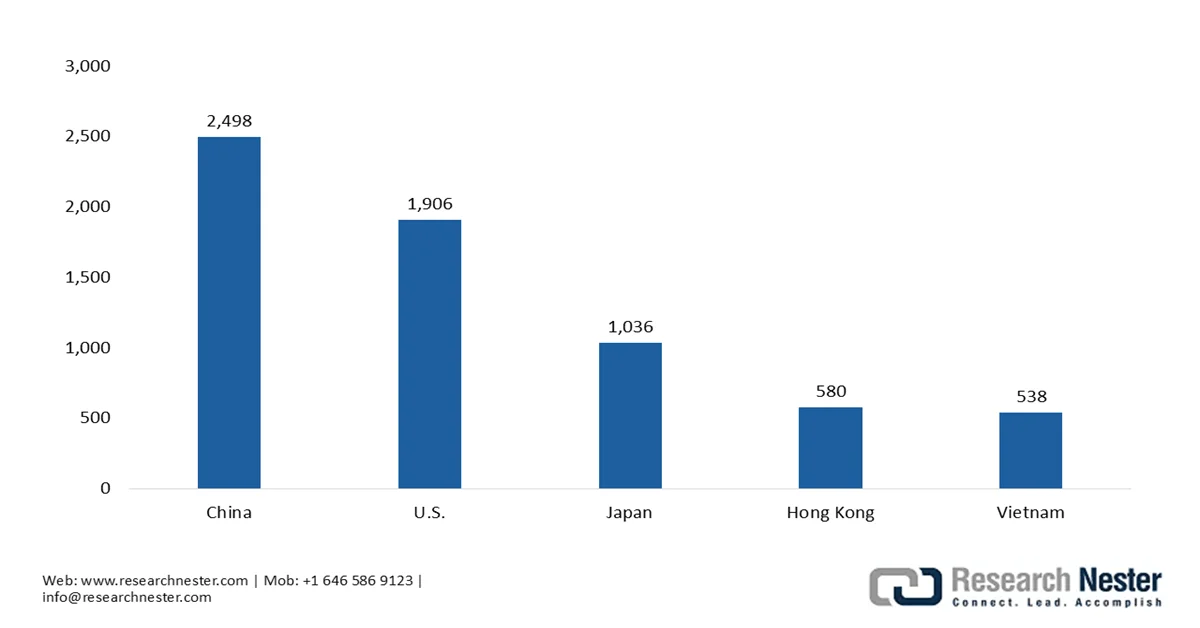
Asia Pacific emollients market is anticipated to dominate with the highest share of 36.6% during the forecast period. The region’s dominance is largely propelled by rapid urbanization, rising disposable incomes, and the booming expansion of domestic personal care and manufacturing sectors across China, India, and Southeast Asia. A dominant trend reshaping the region is the convergence of traditional herbal beauty concepts, such as Ayurvedic and K-beauty formulations, thus boosting the demand for high-performance lipids. Korea Economic Institute of America in January 2026 stated that South Korea’s K-beauty industry has evolved into a major export sector, in which cosmetics exports rose 35% from USD 7.5 billion in 2020 to USD 10.2 billion in 2024. U.S. exports grew sharply, highlighting Korea’s successful diversification into markets such as the U.S., Japan, and Vietnam, thus strengthening market demand.
Top K-Beauty Export Markets: South Korea Cosmetic Exports by Country 2024
Source: Korea Economic Institute of America
A booming domestic consumer base, strict regulatory frameworks, and the structural transformation of its chemical manufacturing sector toward high-value ingredients are driving growth of the market in China. A primary driver is the heightening demand for premium skincare and functional cosmetics, particularly driven by local C-beauty brands that require high-quality emollient bases to compete with international luxury labels. Based on the government data published in October 2024, China’s NMPA has strengthened cosmetics regulation through a framework covering registration, manufacturing, labeling, safety evaluation, and online sales. It states that by July 2024, China had 20,152 cosmetics registrants, 5,846 manufacturers, and nearly 1.82 million registered cosmetic products, thus positively driving demand in this market.
The India emollients market is witnessing strong growth, which is powered by a massive young population, expanding disposable incomes, and the rapid premiumization of the domestic personal care and pharmaceutical industries. The country is witnessing the integration of Ayurvedic botanicals with high-performance emollient bases to deliver familiar yet highly efficacious products. On the supply side, India’s rich agricultural landscape provides a robust foundation for raw materials, with domestic producers processing locally sourced feedstocks such as mustard, sesame, castor, and rice bran oils into specialized bio-based lipids. In this context, Invest India states that the country’s beauty & personal care industry is expected to expand from USD 21 billion in 2023 to USD 34 billion by 2028, at a 10% to 11% CAGR. Growth is driven primarily by rising incomes, e-commerce, social media influence, premiumization, and increasing demand for natural and Ayurvedic products.
North America Market Insights
The North America market is expected to rise at the fastest rate from 2027 to 2036. The region primarily benefits from high consumer spending power and an intense institutional focus on sustainable chemical alternatives. Research and development across North America are focused on sensory profile optimization, advanced molecular stabilization, and the creation of multifunctional emollients. In September 2024, P2 Science launched Citropol® DE-4 and Citropol® V6, which are sustainable polymeric emollients made from upcycled forest-derived terpenes for beauty and personal care. Citropol® DE-4 provides rich textures and hair-conditioning benefits, whereas Citropol® V6 offers a lightweight, non-greasy feel as a biodegradable alternative to cyclomethicone.
The robust retail infrastructure and an accelerating consumer demand for scientifically backed, high-performance formulations are driving growth of the U.S. emollients market. On the raw material front, the market leverages a powerful domestic agricultural supply chain of soybean, corn, and sunflower oils. The country’s beauty and personal care formulators respond to growing demand for high-performance, multifunctional, and more sustainable ingredients. In January 2025, for instance, TRI-K introduced TRIsol™ KCP, which is a high-performance emulsifier especially designed for sustainable applications in suncare, skincare, and color cosmetics. This solvent-free technology improves SPF stability, moisturization, pigment stability, and performance in high-emollient formulations.
The Canada market is expanding steadily which is driven by unique environmental demands that necessitate deeply hydrating skincare solutions. A primary catalyst for growth is the high-volume consumer demand for advanced barrier-repair creams, therapeutic body lotions, and specialized dermatological ointments. Apart from this, stringent cosmetic labelling and safety requirements encourage manufacturers to provide transparent product information. Based on the government data published in April 2026, the country’s cosmetic labelling is regulated mainly by the Food and drugs act/cosmetic regulations and the Consumer Packaging and labelling act/regulations. It states that labels must clearly provide product identity, net quantity, contact/dealer information, ingredients, and required safety warnings.
Europe Market Insights
The Europe market is forecasted to grow at a considerable rate, which is primarily catalyzed by the rising skincare concerns, the world's most prominent institutional push toward environmental circularity, and the mainstreaming of biotechnology. A defining driver for Europe’s market is the strict enforcement of the regional Green Deal and evolving chemical safety mandates, which compel manufacturers to completely decouple their production from fossil fuels. In this context, NIH in May 2025 disclosed that the 2025 EuroGuiDerm update is expanding treatment options for atopic eczema, including biologics and JAK inhibitors. On the other hand, this evolving treatment landscape enhances the importance of supportive topical skin care, including emollients, in long-term eczema management.
A powerful domestic infrastructure in industrial biotechnology, expansion of production capabilities, and an institutional shift toward zero-emission production are driving growth of Germany emollients market. A primary catalyst for growth is the highly developed medical-grade skin health sector, where an aging demographic and strict clinical standards fuel the demand for hyper-pure, biocompatible lipids that accelerate skin barrier recovery. In October 2023, BASF expanded its Düsseldorf facility to increase production of specialty emollients used in skin-care and sun-protection products. This investment includes a new reactor and upgraded distillation units, thus supporting rising demand for silicone-free and octocrylene-free formulations, thus indicating a positive market outlook.
The France emollients market is reaping growth opportunities from its dominance in the global luxury cosmetics, high-end perfumery, and dermo-cosmetic industries. A primary growth catalyst is the concentration of multinational beauty pioneers and prestigious aesthetic laboratories that require hyper-customized, high-end emollient bases to maintain their premium brand equity. Testifying to this, WITS stated that in 2024, France exported beauty, make-up and skin-care products worth USD 9.85 billion, with a total export quantity of 288.78 million kg. China was the largest destination, which was followed by the U.S. and Singapore. Other major markets included Germany, Spain, Italy, the UK, the Netherlands and Hong Kong, reflecting France’s strong position in the global beauty and cosmetics trade.
France Beauty & Skincare Exports by Country in 2024: Top Markets, Export Value & Volume
|
Export Destination |
Export Value (USD million) |
Quantity (kg) |
|
China |
1,340,347.26 |
29,693,100 |
|
U.S. |
997,646.89 |
23,297,100 |
|
Singapore |
885,616.30 |
18,919,000 |
|
Germany |
664,850.70 |
20,628,000 |
|
Spain |
563,528.77 |
18,859,500 |
|
Italy |
483,505.17 |
17,133,300 |
|
UK |
424,309.52 |
15,491,200 |
|
Netherlands |
406,421.54 |
5,125,120 |
|
Hong Kong, China |
310,668.08 |
5,708,690 |
Source: WITS

Key Emollients Market Players:
- BASF SE (Germany)
- Evonik Industries AG (Germany)
- The Lubrizol Corporation (U.S.)
- Clariant AG (Switzerland)
- Stepan Company (U.S.)
- Gattefossé (France)
- SEPPIC (France)
- TRI-K Industries (U.S.)
- Inolex Inc. (U.S.)
- Company Overview
- Business Strategy
- Key Product Offerings
- Financial Performance
- Key Performance Indicators
- Risk Analysis
- Recent Development
- Regional Presence
- SWOT Analysis
- BASF SE is considered to be a leading emollient manufacturer that benefits from a broad personal-care portfolio. Its Cetiol® CC is a fast-spreading emollient that offers a velvet, dry skin feel, with strong suitability for sun-care formulations.
- Evonik Industries AG is a foundational player in this sector, which offers specialty cosmetic emollients such as TEGOSOFT® CT MB, a universal emollient providing pleasant skin feel and oxidation stability. The company’s strengths include specialty formulations and sustainable ingredient solutions.
- The Lubrizol Corporation manufactures specialty emollients, i.e., Glucam™ P-20, a naturally derived ingredient providing moisturization without a heavy or greasy feel. In addition, the firm primarily differentiates through specialty technologies and naturally derived solutions.
- Clariant AG provides emollient solutions such as Genapol G 260 for creams and lotions. The company’s products mainly offer multifunctional benefits, i.e., emolliency, solubilization, and dispersion, supported by its specialty-chemical expertise.
- Stepan Company manufactures personal-care emollients including NEOBEE® M-5 COSMETIC, which is an MCT used as an emollient, lubricant, and solubilizing agent. The company is highly focused on multifunctional, naturally derived ingredients for skincare, haircare, and lip-care applications.
Here is a list of key players operating in the global market:
The global emollients market consists of large multinational specialty-ingredient manufacturers that are intensely competing alongside regional and specialized producers. Leading companies in this sector primarily differentiate through broad portfolios, i.e., ester, triglyceride, alkane, and naturally derived emollients, efficiently supported by formulation expertise, sustainability credentials, and global technical service. Competition is reshaped by heightened demand for bio-based, biodegradable, lightweight, and silicone-alternative ingredients. In September 2024, Evonik inaugurated a new plant in Steinau, Germany, with the main aim of expanding production of sustainable cosmetic emollients by using enzymatic esterification. Besides, this process can cut the climate footprint of emollient manufacturing by more than 60%, thereby supporting lower-impact beauty formulations.
Corporate Landscape of the Market:
Recent Developments
- In July 2026, BASF inaugurated a new Düsseldorf plant to expand production of specialty emollients for skincare and sun-care products. This investment strengthens supply capacity for Europe and global cosmetics markets.
- In September 2024, TRI-K Industries introduced Fision® EcoSil, which is a 100% naturally derived and upcycled emollient made from olives for hair and skin care. It is designed as an alternative to traditional silicones, and it delivers D5-like hair performance and a skin feel.
- Report ID: 5946
- Published Date: Sep 04, 2026
- Report Format: PDF, PPT
- Explore a preview of key market trends and insights
- Review sample data tables and segment breakdowns
- Experience the quality of our visual data representations
- Evaluate our report structure and research methodology
- Get a glimpse of competitive landscape analysis
- Understand how regional forecasts are presented
- Assess the depth of company profiling and benchmarking
- Preview how actionable insights can support your strategy
Explore real data and analysis
Frequently Asked Questions (FAQ)
About this Report
Connect with our Expert


Report, 2027-2036



Copyright @ 2026 Research Nester. All Rights Reserved.
