Dewatering Aids for Mining Market Outlook:
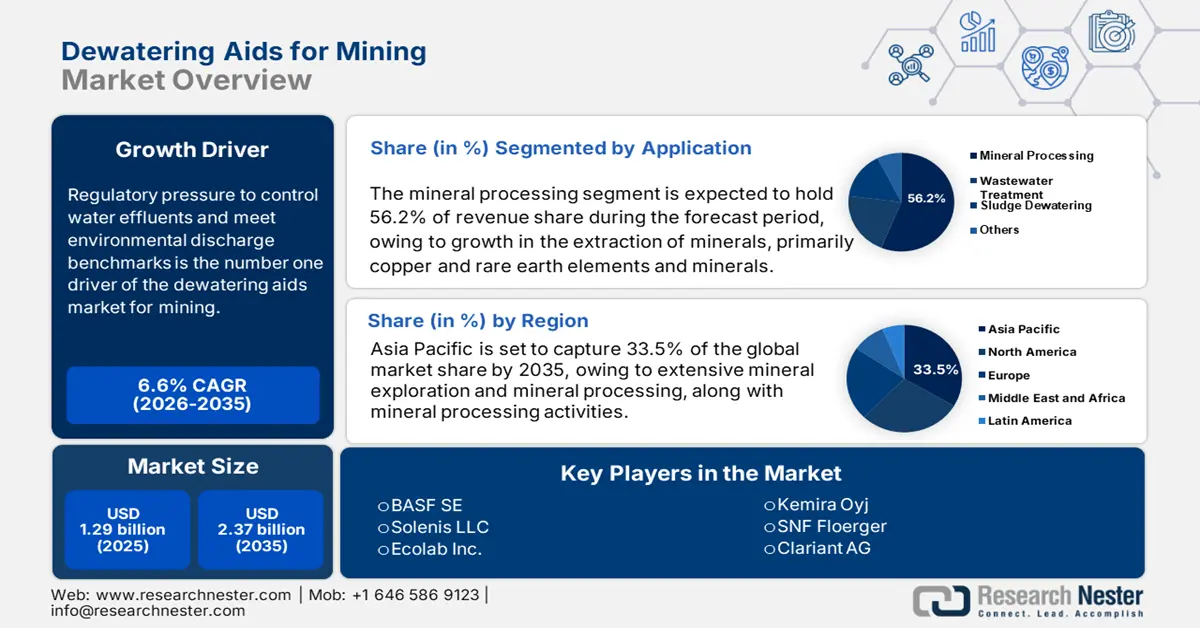
Dewatering Aids for Mining Market size was estimated at USD 1.29 billion in 2025 and is expected to surpass USD 2.37 billion by the end of 2035, rising at a CAGR of 6.6% during the forecast period, i.e., 2026-2035. In 2026, the industry size of dewatering aids for mining is assessed at USD 1.37 billion.
Regulatory pressure to control water effluents and meet environmental discharge benchmarks is the number one driver of the dewatering aids for mining market. The Environmental Protection Agency (EPA) regulations state the use of advanced chemical and mechanical dewatering systems to meet the effluent limitations for the releases of storm and mine waters. This means that the mining operator will have to integrate high-performance flocculants, coagulants, filter systems, and monitoring solutions into their process. This demand for highly efficient and effective dewatering will increase mining operators' demand, as stated by the EPA in the Producer Price Index for Chemicals and Allied Products, which includes the dewatering aid formulations, has increased above the index value of 201 points (1983=100) for the past couple of years as part of increasing compliance demand of mining, biomass and other industries.
The supply chain of dewatering aids relies on specialty Chemicals and Polymers that are domestically supplied and also imported. EPA's recent analyses of the water treatment Chemical market indicate that there is a track record of stable domestic manufacturing with limited chemical expansions (restart capacity) on occasion to meet demand. In 2022, US exports of environmental technology (dewatering systems are included) were $7.8 billion. The US manufacturers have established assembly lines in the US, Mexico, and other countries to support their global customer base in mining. Currently, there are federal R&D grants funded to improve mine water treatment and polymer function, but no dollar figures are available as investments are private to firms. However, continuing R&D and increasing capacity will likely need to be completed to comply with future stricter regulations.