Demulsifier Market Outlook:
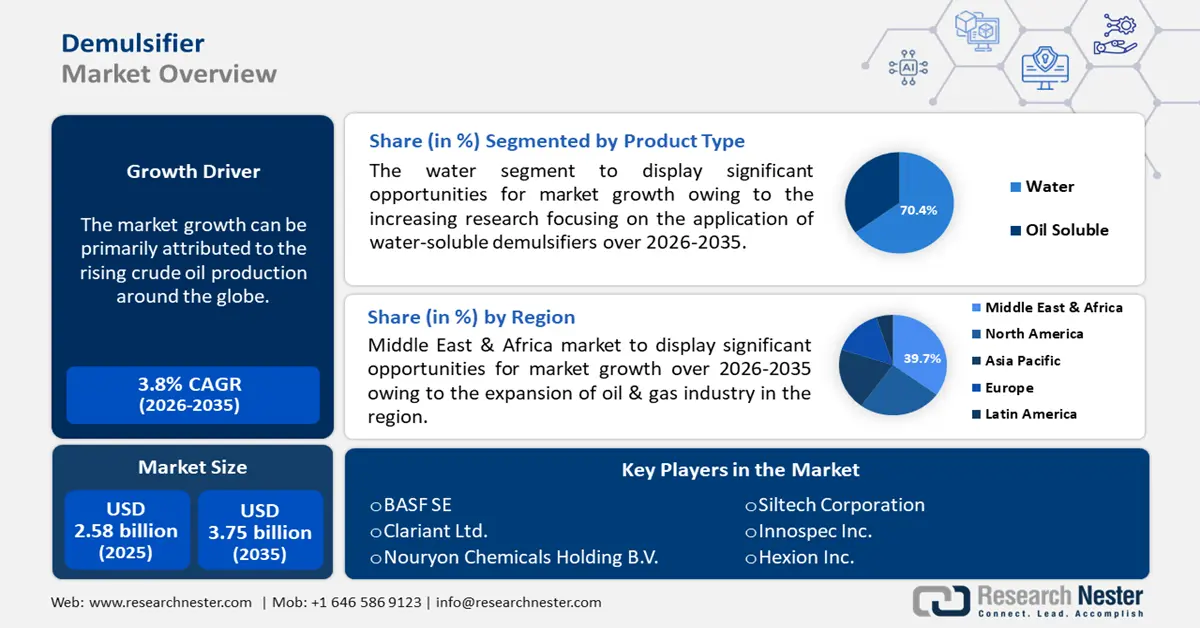
Demulsifier Market size was over USD 2.58 billion in 2025 and is anticipated to cross USD 3.75 billion by 2035, growing at more than 3.8% CAGR during the forecast period i.e., between 2026-2035. In the year 2026, the industry size of demulsifier is assessed at USD 2.67 billion.
The market is witnessing robust growth, driven by the increasing global demand for oil and gas. In 2025, the U.S. Energy Information Administration reported a rise in global oil production by 1.4 billion barrels per day, indicative of heightened exploration and production efforts, particularly in areas like the U.S., the Middle East, and offshore locations. As oilfield operators strive to maximize yields and improve processing efficiency, demulsifiers play a vital role by enabling effective separation of water from crude oil, an essential process in enhancing overall recovery rates.
Amid this growing demand, the demulsifier market is undergoing a notable transformation toward sustainability. The environmental drawbacks of traditional chemical demulsifiers have prompted a shift toward biodegradable and non-toxic alternatives. Increasing awareness of environmental issues and stricter regulatory frameworks are compelling manufacturers to innovate and develop eco-friendly formulations that align with sustainability goals without compromising performance. These advanced demulsifiers are engineered to operate across diverse pressure and temperature ranges, making them suitable for challenging environments such as deep-water and offshore drilling operations.
The U.S. Environmental Protection Agency (EPA) reported a reduction in offshore chemical discharge limits by 2023, further pushing the adoption of green technologies. In response, companies like Clariant have developed environmentally friendly demulsifier solutions that comply with global environmental standards while maintaining high separation efficiency. Their sustainable product line showcases how innovation is aligning operational efficiency with ecological responsibility, setting new benchmarks in oilfield chemical applications. This shift underscores a broader industry trend toward environmentally sound operations, where performance and sustainability are increasingly intertwined in product development and oilfield practices.