Demountable Partitions Market Outlook:
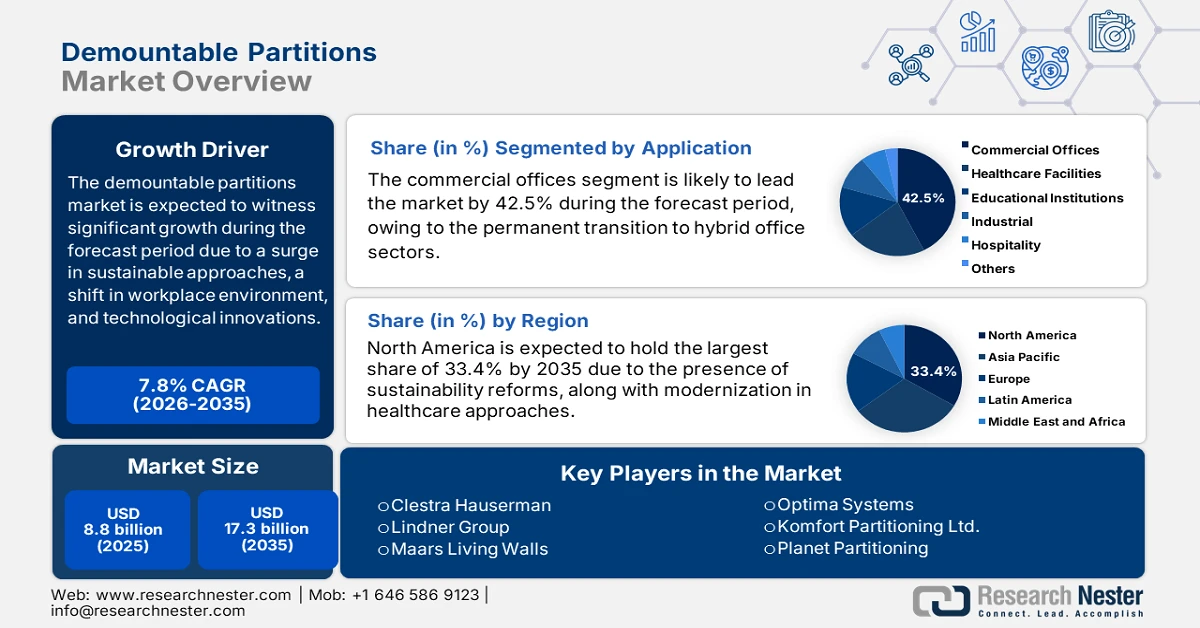
Demountable Partitions Market size was over USD 8.8 billion in 2025 and is estimated to reach USD 17.3 billion by the end of 2035, expanding at a CAGR of 7.8% during the forecast timeline, i.e., 2026-2035. In 2026, the industry size of demountable partitions is assessed at USD 9.4 billion.
The worldwide demountable partitions market is rapidly evolving, effectively shaped by sustainability imperatives, a shift in workplace dynamics, and technological advancements. According to official statistics published by the World Economic Forum in January 2026, there has been the perspective of more than 1,000 notable international employers, jointly demonstrating over 14 million workers across 22 industrial clusters as well as 55 economies from across nations. Besides, the aspect of broadening digitalized accessibility is projected to emerge as the most transformative trend, both across technology-based trends and overall, with 60% of employers anticipating transforming workplaces by the end of 2030. Moreover, advancements in technologies, especially 86% of information processing and artificial intelligence, 58% of automation and robotics, and 41% of distribution and storage, thus making it suitable for the market’s upliftment.
Projected Impact of Macrotrends on Business and Workplace Transformation (2026)
|
Macrotrends |
Impact (%) |
|
Broadened Digital Access |
60 |
|
Rising Living Expenses, Higher Prices or Inflation |
50 |
|
Increased Investments and Efforts to Reduce Carbon Emissions |
47 |
|
Increased Focus on Labor and Social Issues |
46 |
|
Slow Economic Growth |
42 |
|
Increased Efforts and Investments for Adapting to Climate Change |
41 |
Source: World Economic Forum
Furthermore, the integration of smart technologies, circular economy adoption, and hybrid work adaptation are other drivers uplifting the demountable partitions market. As per an article published by the CIPD Organization in July 2025, 91% of the majority of employers are suitable across flexible working arrangements, and employees are likely to make the utilization of working from home in 50% of normal working hours and 38% of flexi-time. Besides, 45%s of employees readily prefer a 4-day work week for working, with 25% of compressed hours and 20% of flexi-time. Moreover, 61% of employers believe that the provision of flexible working is one of the options for advertising employment options to attract staff, which is positively impacting the market’s upliftment internationally.
Key Demountable Partitions Market Insights Summary:
Regional Highlights:
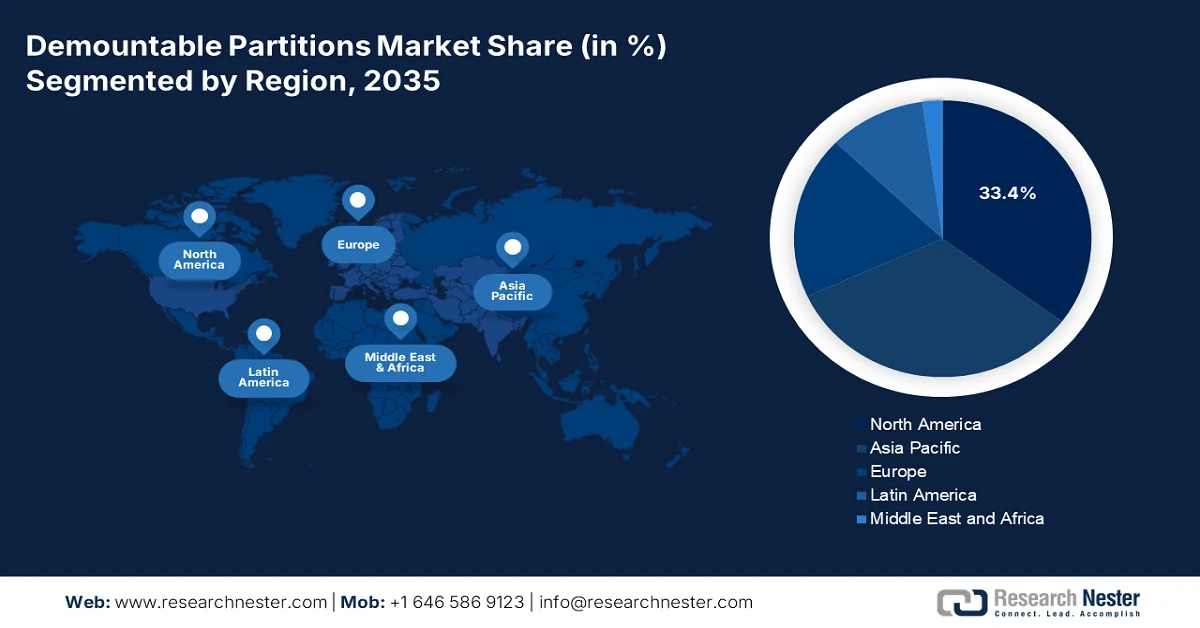
- North America in the demountable partitions market is projected to command the highest 33.4% share by 2035, underpinned by sustainability mandates, large-scale healthcare infrastructure upgrades, and intensive corporate workspace optimization aligned with federal clean energy objectives
- Europe is anticipated to register the fastest growth during the 2026–2035 forecast period, accelerated by aggressive building renovation targets, workplace modernization initiatives, and stringent energy performance regulations under regional sustainability mandates
Segment Insights:
- Commercial offices application in the demountable partitions market is expected to secure a leading 42.5% share by 2035, supported by the accelerating adoption of hybrid work models that prioritize rapidly reconfigurable, acoustically efficient, and space-optimized office environments
- Glass partitions product type is projected to hold the second-highest share during the 2026–2035 forecast period, benefiting from the rising focus on natural daylight penetration, energy-efficient building design, and contemporary aesthetics across commercial and institutional spaces
Key Growth Trends:
- Expansion in non-office sectors
- Advances in manufacturing technologies
Major Challenges:
- Regulatory and compliance complexities
- Supply chain disruptions
Key Players: Steelcase Inc. (U.S.), Haworth Inc. (U.S.), Herman Miller Inc. (U.S.), Knoll Inc. (U.S.), DIRTT Environmental Solutions Ltd. (Canada), Clestra Hauserman (France), Lindner Group (Germany), Maars Living Walls (Netherlands), Optima Systems (UK), Komfort Partitioning Ltd. (UK), Planet Partitioning (UK), Triplan International (Denmark), Paroc Group (Finland), Nitto Boseki Co., Ltd. (Japan), Nihon Acoustic Co., Ltd. (Japan), JEB International Ltd. (Hong Kong), Hufcor Inc. (Australia), Samwon Partition Co., Ltd. (South Korea), Godrej Interio (India), Kim Hoe Thye Industries Sdn Bhd (Malaysia).
Global Demountable Partitions Market Forecast and Regional Outlook:
Market Size & Growth Projections:
- 2025 Market Size: USD 8.8 billion
- 2026 Market Size: USD 9.4 billion
- Projected Market Size: USD 17.3 billion by 2035
- Growth Forecasts: 7.8% CAGR (2026-2035)
Key Regional Dynamics:
- Largest Region: North America (33.4% Share by 2035)
- Fastest Growing Region: Europe
- Dominating Countries: United States, Germany, China, United Kingdom, Japan
- Emerging Countries: India, Canada, South Korea, France, Italy
Last updated on : 27 January, 2026
Demountable Partitions Market - Growth Drivers and Challenges
Growth Drivers
- Expansion in non-office sectors: Beyond corporate offices, the demand for the demountable partitions market is gradually surging in education, hospitality, and healthcare. This is where partitions offer adaptability, privacy, and hygiene, which is proliferating the market’s exposure across different regions. Based on government estimates published by the PIB Government in October 2025, there has been a rise in employment in India to 64.3 crore between 2023 and 2024 from 47.5 crore, denoting a net additional 16.8 crore employment opportunities for the upcoming 6 years. Besides, there has been a reduction in the employment rate from 6.0% to 3.2% within the timeline. Therefore, this has readily made expansions in non-office sectors, which is uplifting the market’s exposure globally.
- Advances in manufacturing technologies: The utilization of robotics and 3D printing in the demountable partitions market diminishes expenses and boosts customization. As per an article published by the IFR Organization in September 2024, there has been an availability of 4,281,585 units operating in factories globally, denoting an increase by 10%. Besides, there has been a surge in yearly installations by half a million units for the third consecutive year. Moreover, in terms of region, 70% of all the latest deployed robots have been installed as of 2023, especially in Asia, which is followed by 17% in Europe and 10% in America. Therefore, with the continuous increase in robotics, there is a huge growth opportunity for the market across different locations.
- Increase in green construction: The policies of promoting low-carbon building materials as well as energy-efficient designs are escalating the adoption of eco-friendly partitions, which is fueling the demountable partitions market internationally. As stated in an article published by the World Economic Forum in June 2024, there has been the identification of 11 approaches that have the ability to abate developing emissions by 80% and deliberately unlock USD 1.8 trillion in international market opportunities by the end of 2030. Buildings account for 37% of international carbon dioxide emissions, along with 34% of the Earth’s species readily enduring habitat loss due to urban development, thereby denoting an optimistic outlook for the demountable partitions market’s growth.
Challenges
- Regulatory and compliance complexities: The demountable partitions market faces challenges from stringent building codes, fire safety regulations, and acoustic performance standards that vary across regions. For instance, Europe-based directives emphasize recyclability and low-carbon materials, while U.S. OSHA standards prioritize workplace safety and noise reduction. Manufacturers must adapt products to meet diverse compliance requirements, which increases costs and complicates global expansion. In healthcare and educational facilities, partitions must meet hygiene and fire-resistance standards, adding further layers of regulation. These compliance hurdles often delay project approvals and increase certification expenses.
- Supply chain disruptions: Global supply chain volatility in the demountable partitions market poses another major challenge. Demountable partitions rely on materials such as aluminum, steel, and specialty glass, all of which are subject to price fluctuations and geopolitical risks. For instance, trade restrictions, tariffs, or raw material shortages can significantly increase costs and delay deliveries. The COVID-19 pandemic highlighted vulnerabilities in global logistics, with shipping delays and rising freight costs impacting construction timelines. In addition, reliance on imported components in regions, such as the Asia Pacific and Latin America creates exposure to foreign exchange risks. Manufacturers must also contend with sustainability pressures, as regulators and customers demand transparency in sourcing and carbon footprint reduction.
Demountable Partitions Market Size and Forecast:
| Report Attribute | Details |
|---|---|
|
Base Year |
2025 |
|
Forecast Year |
2026-2035 |
|
CAGR |
7.8% |
|
Base Year Market Size (2025) |
USD 8.8 billion |
|
Forecast Year Market Size (2035) |
USD 17.3 billion |
|
Regional Scope |
|
Demountable Partitions Market Segmentation:
Application Segment Analysis
The commercial offices segment in the application is anticipated to garner the highest share of 42.5% in the demountable partitions market by the end of 2035. The segment’s upliftment is highly driven by the permanent shift toward hybrid work models, which require adaptable office layouts that can be reconfigured quickly. Demountable partitions provide flexibility by allowing companies to create collaborative zones, private offices, and meeting spaces without the cost and disruption of traditional construction. Corporate real estate strategies are increasingly focused on space optimization and sustainability, with partitions offering a cost-effective solution for reducing renovation waste. In addition, acoustic performance is a critical driver, as open-plan offices demand noise reduction solutions to improve employee productivity and well-being.
Product Type Segment Analysis
Based on the product type, the glass partitions segment in the demountable partitions market is projected to hold the second-highest share during the forecast period. The segment’s growth is highly fueled by its popularity stemming from the growing emphasis on natural light utilization, energy efficiency, and modern aesthetics in both commercial and institutional environments. Unlike solid partitions, glass solutions enhance transparency and collaboration while maintaining privacy through acoustic and frosted options. The U.S. Department of Energy (DOE) highlights that maximizing daylight penetration reduces reliance on artificial lighting and lowers HVAC loads, making glass partitions a key component of energy-efficient buildings. Additionally, Europe-specific directives on sustainable construction encourage the use of recyclable glass materials, aligning with circular economy practices.
Material Segment Analysis
By the end of the stipulated timeline, the aluminum sub-segment, which is part of the material segment, is expected to account for the third-largest share in the demountable partitions market. The sub-segment’s development is highly propelled by its importance, owing to its high-strength-to-weight ratio and lightweight, permitting easy transport, reconfiguration, and installation. According to official statistics published by the International Aluminium in January 2026, the international demand for aluminium is projected to increase by nearly 40% by the end of 2030. In addition, this particular sector is required to produce an additional 33.3 million tons to meet the demand growth across different industrial sectors, specifically from 86.2 million tons to 119.5 million tons by the end of 2030. Therefore, with this projected surge, there is a huge expansion opportunity for the sub-segment globally.
Our in-depth analysis of the demountable partitions market includes the following segments:
|
Segment |
Subsegments |
|
Application |
|
|
Product Type |
|
|
Material |
|
|
Distribution Channel |
|
|
Partition Style |
|
|
End use Industry |
|

Vishnu Nair
Head - Global Business DevelopmentCustomize this report to your requirements — connect with our consultant for personalized insights and options.
Demountable Partitions Market - Regional Analysis
North America Market Insights
North America demountable partitions market is anticipated to garner the highest share of 33.4% by the end of 2035. The market’s upliftment in the region is highly driven by the presence of sustainability mandates, healthcare infrastructure modernization, and corporate workspace optimization. Based on government estimates published by the Department of Energy (DOE) in December 2024, data centers consumed almost 4.4% of the overall electricity in the U.S. as of 2023, and are further projected to consume an estimated 6.7% to 12.0% of the U.S.-based electricity by the end of 2028. In addition, the overall data center electricity utilization soared from 58 TWh to 176 TWh in the same year and is predicted to surge between 325 TWh and 580 TWh by the end of the same year. Therefore, this significantly aligns with federal clean energy objectives, thus making it suitable for uplifting the demountable partitions market in the region.
The demountable partitions market in the U.S. is growing significantly due to energy efficiency and green building mandates, acoustic and workplace safety standards, an increase in federal investment for sustainable chemicals, and corporate real estate optimization. As per an article published by the USGBC Organization in 2026, green buildings diminish regular expenses year-over-year (YoY), with 20% lower maintenance expenses than traditional commercial buildings. Meanwhile, green building retrofits usually decrease operation expenses by nearly 10% within a year. Besides, conventional buildings receive an average of USD 2.1/ft2, and tenants usually pay USD 2.9/ft2 for LEED-based space. Moreover, domestic green construction generated USD 167.4 billion in gross domestic product (GDP), while over 720,000 employment opportunities in Texas were suitable for green construction, thus creating a huge growth opportunity for the demountable partitions market.
The demountable partitions market in Canada is also growing, owing to government funding for sustainable construction, green building and LEED certification push, an expansion in the healthcare infrastructure, as well as urban office renovation programs. As stated in a data report published by Nova Scotia Federation of Municipalities in 2023, the latest Administrative Agreement denotes a 10-year investment of approximately USD 679 million, particularly for Nova Scotia municipalities. In addition, municipalities in this location have also received USD 553.5 million, which is readily suitable for ensuring renovation. Besides, according to the September 2025 Housing Infrastructure Canada article, the country’s government invested more than USD 180 billion over 12 years in infrastructure projects throughout the nation. Meanwhile, the government has ensured different investment plans for such projects that are driving the market’s growth.
Canada Mortgage and Housing Corporation Investment Plans Analysis (2025)
|
Program Name |
Overall Program Allocation |
Approved Program Spending |
Value of Funding Flowed |
Number of Approved Projects |
|
Aboriginal Capacity and Skills Development |
USD 10,000,000 |
USD 10,000,000 |
USD 10,000,277 |
464 |
|
Increasing Affordable Housing for Seniors |
USD 200,700,000 |
USD 200,700,000 |
USD 200,100,000 |
1,679 |
|
Investment in Affordable Housing |
USD 504,400,000 |
USD 501,600,000 |
USD 501,600,000 |
5,231 |
|
Northern Housing |
USD 97,700,000 |
USD 97,700,000 |
USD 96,700,000 |
98 |
|
Renovation and Retrofit of Social Housing |
USD 574,000,000 |
USD 575,762,664 |
USD 575,762,664 |
2,577 |
|
Renovation and Retrofit on Reserve |
USD 127,700,000 |
USD 127,700,000 |
USD 119,961,661 |
3,137 |
Source: Housing Infrastructure Canada
Europe Market Insights
Europe demountable partitions market is expected to emerge as the fastest-growing region during the forecast period. The market’s development in the region is highly propelled by chemical industry innovation, workplace modernization, and sustainability mandates. According to official statistics published by Europe Commission in December 2024, the renovation of existing buildings in the region is highly responsible for almost 40% of domestic energy utilization, along with 36% of carbon emissions. This can significantly diminish emissions, optimize living conditions, and conserve resources. Besides, the Energy Performance of Buildings Directive (EPBD) has unveiled compulsory minimum energy performance requirements to gain 60% to 90% energy savings by upgrading the 75% of current and energy-efficient buildings, thus proliferating the market’s expansion.
The demountable partitions market in Germany is gaining increased traction due to a sudden turnover in the domestic chemical sector, as well as advancements in sustainable materials and the existence of innovative modular systems. As per an article published by the Clean Energy Wire Organization in September 2024, the country readily invests EUR 120 billion in energy-based modernization measures and effectively come forward to ensure that its public buildings are climate neutral by the end of 2045. Moreover, the provision of additional investments deliberately led to saving EUR 45 billion by the end of the same year. Besides, municipal, state, and federal properties constitute a finalized energy consumption of 70 TWh every year, with nearly 3 quarters utilization for heating purposes. Therefore, with all these investment plans, there is a huge growth opportunity for the market in the country.
The aspect of modular construction, along with robust government investments in sustainable chemicals are main drivers for fueling the demountable partitions market in the UK. Based on government estimates published by the UK Government in November 2024, the aspect of accountability and liability is suitable for detecting associated risks, while standard contracts have been developed in the country for conventional construction that do not permit for 70% of the valuation to be part of the manufacturing package. Besides, the country’s government has successfully set out a program to reform the housing industry by including a yearly target of building 300,000 homes every year. Therefore, with the availability of standard mandates and a generous objective of developing buildings, the market is poised to gain exposure in the country.
APAC Market Insights
The Asia Pacific demountable partitions market is projected to witness considerable growth by the end of the stipulated timeline. The market’s growth in the region is highly fueled by an increase in urbanization, government-based sustainability strategies, and corporate workspace modernization. According to official statistics published by the ESCAP Organization in March 2025, the overall region is home to more than 2.2 billion urban dwellers, which makes it the world’s most populous urban region. Additionally, its urban population is expected to surge by 50% by the end of 2050, demanding an increase in tactical urban development. Moreover, urban areas in the region are increasingly vulnerable to social, environmental, and economic risks, and despite these, cities effectively generate more than 80% of the region’s gross domestic product (GDP), thus denoting an optimistic outlook for the market.
Urban Evolution Shaping the Future Cities in the Asia Pacific (2024-2100)
|
Regions |
2024 |
2030 |
2050 |
2100 |
|
East and North-East Asia |
260 million |
313 million |
456 million |
338 million |
|
South-East Asia |
56 million |
72 million |
126 million |
186 million |
|
South and South-West Asia |
148 million |
186 million |
355 million |
689 million |
|
North and Central Asia |
32 million |
37 million |
48 million |
69 million |
|
Pacific |
6 million |
7 million |
11 million |
18 million |
Source: ESCAP Organization
The demountable partitions market in China is gaining increased exposure due to industrial modernization, strong government expenditure, and an increased priority over sustainable construction materials. Based on government estimates published by the State Council in September 2025, the country has deliberately set an objective for the green building materials industry to surpass a revenue, amounting to 300 billion yuan (approximately 42.2 billion) by the end of 2026. This particular objective has been introduced by 6 governmental departments, including the Ministry of Industry and Information Technology, which has successfully outlined goals to readily consolidate recovery, optimize profitability, and effectively strengthen technological advancement. Therefore, the aspect of governmental initiatives is extremely suitable for boosting the market in the country.
The presence of robust governmental investments in modular construction and sustainable chemicals, as well as prioritizing chemical adoption are highly responsible for driving the demountable partitions market in India. Based on government estimates published by the PIB Government in March 2025, the bioeconomy in the country has readily grown from USD 10 billion to USD 165.7 billion as of 2024, with further target of USD 300 billion by the end of 2030. Additionally, the industry significantly contributes 4.2% to the GDP, along with a 17.9% growth rate since the past 4 years. In this aspect, the country’s government has effectively aimed to make the nation an international bio-manufacturing facility, highly driven by inclusive development, sustainability, and innovation. Therefore, with such continuous developments, the market is gradually gaining increased exposure.
Key Demountable Partitions Market Players:
- Steelcase Inc. (U.S.)
- Haworth Inc. (U.S.)
- Herman Miller Inc. (U.S.)
- Knoll Inc. (U.S.)
- DIRTT Environmental Solutions Ltd. (Canada)
- Clestra Hauserman (France)
- Lindner Group (Germany)
- Maars Living Walls (Netherlands)
- Optima Systems (UK)
- Komfort Partitioning Ltd. (UK)
- Planet Partitioning (UK)
- Triplan International (Denmark)
- Paroc Group (Finland)
- Nitto Boseki Co., Ltd. (Japan)
- Nihon Acoustic Co., Ltd. (Japan)
- JEB International Ltd. (Hong Kong)
- Hufcor Inc. (Australia)
- Samwon Partition Co., Ltd. (South Korea)
- Godrej Interio (India)
- Kim Hoe Thye Industries Sdn Bhd (Malaysia)
- Company Overview
- Business Strategy
- Key Product Offerings
- Financial Performance
- Key Performance Indicators
- Risk Analysis
- Recent Development
- Regional Presence
- Steelcase Inc. is a global leader in office furniture solutions, with strong investments in modular and flexible workspace systems. Its demountable partitions are widely adopted in corporate offices, driven by sustainability and acoustic performance standards.
- Haworth Inc. emphasizes adaptable workspace solutions, offering demountable partitions that integrate seamlessly with modern office layouts. The company leverages eco-friendly materials and design innovation to capture demand in North America and global markets.
- Herman Miller Inc. is known for its design-driven approach, incorporating demountable partitions into collaborative and hybrid work environments. Its focus on ergonomic and sustainable solutions strengthens its position in the premium office segment.
- Knoll Inc. combines modern aesthetics with functionality, offering demountable partitions that align with architectural design trends. The company’s emphasis on high-end office interiors makes it a strong player in the commercial real estate sector.
- DIRTT Environmental Solutions Ltd. specializes in modular interior construction, with demountable partitions forming a core part of its product portfolio. Its technology-driven approach, including digital design integration, positions it as a leader in sustainable and customizable workspace solutions.
Here is a list of key players operating in the global demountable partitions market:
The international demountable partitions market is highly competitive, with leading players from the U.S., Europe, and the Asia Pacific driving innovation and sustainability. Companies are focusing on eco-friendly materials, acoustic performance, and modular flexibility to capture market share. Strategic initiatives include mergers and acquisitions, partnerships with real estate developers, and investments in advanced manufacturing technologies. Europe-based firms emphasize circular economy practices, while Asia-specific manufacturers leverage government-backed sustainability programs. Besides, in January 2025, Toyota Motor Corporation notified the successful completion of Phase I of the Toyota Woven City, unveiling the Woven City concept by collaborating with Woven by Toyota. This is suitable for demonstrating Toyota’s long-lasting commitment to shaping the future of mobility, thus proliferating the demountable partitions industry globally.
Corporate Landscape of the Demountable Partitions Market:
Recent Developments
- In January 2026, Fletcher Building announced that it has strategically entered into a binding agreement to sell its Construction Division to the global construction group VINCI Construction (VINCI) for USD 315.6 million.
- In November 2025, Amazon declared an investment of almost USD 50 billion to make the expansion of its supercomputing capabilities and artificial intelligence for Amazon Web Services (AWS) for government-based customers, particularly in the U.S.
- In September 2025, OCI Global and Orascom Construction PLC jointly notified their plan to pursue a potential merger to establish a scalable infrastructure and investment platform, which has been anchored in Abu Dhabi, as well as ensure international reach.
- Report ID: 8365
- Published Date: Jan 27, 2026
- Report Format: PDF, PPT
- Explore a preview of key market trends and insights
- Review sample data tables and segment breakdowns
- Experience the quality of our visual data representations
- Evaluate our report structure and research methodology
- Get a glimpse of competitive landscape analysis
- Understand how regional forecasts are presented
- Assess the depth of company profiling and benchmarking
- Preview how actionable insights can support your strategy
Explore real data and analysis
Frequently Asked Questions (FAQ)
About this Report
Connect with our Expert


Report, 2026-2035



Copyright @ 2026 Research Nester. All Rights Reserved.
