Global Commercial Vehicle Leasing Market
1. An Outline of the Global Commercial Vehicle Leasing Market
1.1. Market Definition and Segmentation
1.2. Study Assumptions and Abbreviations
2. Research Methodology & Approach
2.1. Primary Research
2.2. Secondary Research
2.3. Data Triangulation
2.4. SPSS Methodology
3. Executive Summary
4. Growth Drivers
5. Major Roadblocks
6. Opportunities
7. Prevalent Trends
8. Government Regulation
9. Growth Outlook
10. Competitive White Space Analysis – Identifying Untapped Market Gaps
11. Risk Overview
12. SWOT
13. Technological Advancement
14. Technology Maturity Matrix for the Commercial Vehicle Leasing Market: Recent News
15. Regional Demand
16. Global Commercial Vehicle Leasing by Geography – Strategic Comparative Analysis
17. Strategic Segment Analysis: Commercial Vehicle Leasing Demand Landscape
18. Commercial Vehicle Leasing Demand Trends Driven by the expansion of logistics networks, growth of urban commercial mobility, and increasing fleet outsourcing. (2027-2036)
19. Root Cause Analysis (RCA) for discovering problems of the Commercial Vehicle Leasing Market
20. Porter Five Forces
21. PESTLE
22. Comparative Positioning
23. Global Commercial Vehicle Leasing – Key Player Analysis (2036)
24. Competitive Landscape: Key Suppliers/Players
25. Competitive Model: A Detailed Inside View for Investors
26. Company Market Share, 2036 (%)
26.1. AB Volvo
26.2. Arval (BNP Paribas Group)
26.3. Asset Alliance Group
26.4. Ayvens Group
26.5. Daimler Truck AG
26.6. Element Fleet Management Corp.
26.7. Enterprise Holdings, Inc.
26.8. Holman
26.9. PACCAR Financial
26.10. Penske
26.11. Ryder System, Inc.
26.12. TIP Group
27. Global Commercial Vehicle Leasing Market Outlook
27.1. Market Overview
27.1.1. Market Revenue by Value (USD Million), by Volume (Thousand Units), and Compound Annual Growth Rate (CAGR)
27.2. Commercial Vehicle Leasing Market Segmentation Analysis (2027-2036)
27.2.1. By Vehicle Type
27.2.1.1. LCV (Light Commercial Vehicle), Market Value (USD Million), and CAGR, 2027-2036F
27.2.1.2. MCV (Medium Commercial Vehicle), Market Value (USD Million), and CAGR, 2027-2036F
27.2.1.3. HCV (Heavy Commercial Vehicle), Market Value (USD Million), and CAGR, 2027-2036F
27.2.2. By Propulsion
27.2.2.1. ICE, Market Value (USD Million), and CAGR, 2027-2036F
27.2.2.2. Electric, Market Value (USD Million), and CAGR, 2027-2036F
27.2.3. By Leasing Duration
27.2.3.1. Short Term (Less than 24 Months), Market Value (USD Million), and CAGR, 2027-2036F
27.2.3.2. Mid Term (25-50 Months), Market Value (USD Million), and CAGR, 2027-2036F
27.2.3.3. Long Term (60 Months or More), Market Value (USD Million), and CAGR, 2027-2036F
27.2.4. By Application
27.2.4.1. Enterprise Leasing, Market Value (USD Million), and CAGR, 2027-2036F
27.2.4.2. Personal Leasing, Market Value (USD Million), and CAGR, 2027-2036F
27.2.5. By Service Model
27.2.5.1. Full Service Lease, Market Value (USD Million), and CAGR, 2027-2036F
27.2.5.2. Maintenance Only Lease, Market Value (USD Million), and CAGR, 2027-2036F
27.2.6. By End user
27.2.6.1. Corporate & Institutional, Market Value (USD Million), and CAGR, 2027-2036F
27.2.6.2. Individual/Owner Operators, Market Value (USD Million), and CAGR, 2027-2036F
27.2.6.3. Government/Public Sector, Market Value (USD Million), and CAGR, 2027-2036F
27.2.6.4. Others, Market Value (USD Million), and CAGR, 2027-2036F
27.2.7. Regional Synopsis, Value (USD Million), 2027-2036
27.2.7.1. North America Market Value (USD Million) and CAGR & Y-o-Y Growth Trend, 2027-2036F
27.2.7.2. Europe Market Value (USD Million) and CAGR & Y-o-Y Growth Trend, 2027-2036F
27.2.7.3. Asia Pacific, excluding Japan Market Value (USD Million) and CAGR & Y-o-Y Growth Trend, 2027-2036F
27.2.7.4. Latin America Market Value (USD Million) and CAGR & Y-o-Y Growth Trend, 2027-2036F
27.2.7.5. Middle East and Africa Market Value (USD Million) and CAGR & Y-o-Y Growth Trend, 2027-2036F
28. North America Market
28.1. Overview
28.1.1. Market Value (USD Million), Current and Future Projections, 2027-2036
28.1.2. Increment $ Opportunity Assessment, 2027-2036
28.2. Segmentation (USD Million), 2027-2036, By
28.2.1. By Vehicle Type
28.2.1.1. LCV (Light Commercial Vehicle), Market Value (USD Million), and CAGR, 2027-2036F
28.2.1.2. MCV (Medium Commercial Vehicle), Market Value (USD Million), and CAGR, 2027-2036F
28.2.1.3. HCV (Heavy Commercial Vehicle), Market Value (USD Million), and CAGR, 2027-2036F
28.2.2. By Propulsion
28.2.2.1. ICE, Market Value (USD Million), and CAGR, 2027-2036F
28.2.2.2. Electric, Market Value (USD Million), and CAGR, 2027-2036F
28.2.3. By Leasing Duration
28.2.3.1. Short Term (Less than 24 Months), Market Value (USD Million), and CAGR, 2027-2036F
28.2.3.2. Mid Term (25-50 Months), Market Value (USD Million), and CAGR, 2027-2036F
28.2.3.3. Long Term (60 Months or More), Market Value (USD Million), and CAGR, 2027-2036F
28.2.4. By Application
28.2.4.1. Enterprise Leasing, Market Value (USD Million), and CAGR, 2027-2036F
28.2.4.2. Personal Leasing, Market Value (USD Million), and CAGR, 2027-2036F
28.2.5. By Service Model
28.2.5.1. Full Service Lease, Market Value (USD Million), and CAGR, 2027-2036F
28.2.5.2. Maintenance Only Lease, Market Value (USD Million), and CAGR, 2027-2036F
28.2.6. By End user
28.2.6.1. Corporate & Institutional, Market Value (USD Million), and CAGR, 2027-2036F
28.2.6.2. Individual/Owner Operators, Market Value (USD Million), and CAGR, 2027-2036F
28.2.6.3. Government/Public Sector, Market Value (USD Million), and CAGR, 2027-2036F
28.2.6.4. Others, Market Value (USD Million), and CAGR, 2027-2036F
28.2.7. Country Level Analysis, Value (USD Million)
28.2.7.1. U.S. Market Value (USD Million) and CAGR & Y-o-Y Growth Trend, 2027-2036F
28.2.7.2. Canada Market Value (USD Million) and CAGR & Y-o-Y Growth Trend, 2027-2036F
29. Europe Market
29.1. Overview
29.1.1. Market Value (USD Million), Current and Future Projections, 2027-2036
29.1.2. Increment $ Opportunity Assessment, 2027-2036
29.2. Segmentation (USD Million), 2027-2036, By
29.2.1. By Vehicle Type
29.2.1.1. LCV (Light Commercial Vehicle), Market Value (USD Million), and CAGR, 2027-2036F
29.2.1.2. MCV (Medium Commercial Vehicle), Market Value (USD Million), and CAGR, 2027-2036F
29.2.1.3. HCV (Heavy Commercial Vehicle), Market Value (USD Million), and CAGR, 2027-2036F
29.2.2. By Propulsion
29.2.2.1. ICE, Market Value (USD Million), and CAGR, 2027-2036F
29.2.2.2. Electric, Market Value (USD Million), and CAGR, 2027-2036F
29.2.3. By Leasing Duration
29.2.3.1. Short Term (Less than 24 Months), Market Value (USD Million), and CAGR, 2027-2036F
29.2.3.2. Mid Term (25-50 Months), Market Value (USD Million), and CAGR, 2027-2036F
29.2.3.3. Long Term (60 Months or More), Market Value (USD Million), and CAGR, 2027-2036F
29.2.4. By Application
29.2.4.1. Enterprise Leasing, Market Value (USD Million), and CAGR, 2027-2036F
29.2.4.2. Personal Leasing, Market Value (USD Million), and CAGR, 2027-2036F
29.2.5. By Service Model
29.2.5.1. Full Service Lease, Market Value (USD Million), and CAGR, 2027-2036F
29.2.5.2. Maintenance Only Lease, Market Value (USD Million), and CAGR, 2027-2036F
29.2.6. By End user
29.2.6.1. Corporate & Institutional, Market Value (USD Million), and CAGR, 2027-2036F
29.2.6.2. Individual/Owner Operators, Market Value (USD Million), and CAGR, 2027-2036F
29.2.6.3. Government/Public Sector, Market Value (USD Million), and CAGR, 2027-2036F
29.2.6.4. Others, Market Value (USD Million), and CAGR, 2027-2036F
29.2.7. Country Level Analysis, Value (USD Million)
29.2.7.1. UK Market Value (USD Million) and CAGR & Y-o-Y Growth Trend, 2027-2036F
29.2.7.2. Germany Market Value (USD Million) and CAGR & Y-o-Y Growth Trend, 2027-2036F
29.2.7.3. France Market Value (USD Million) and CAGR & Y-o-Y Growth Trend, 2027-2036F
29.2.7.4. Italy Market Value (USD Million) and CAGR & Y-o-Y Growth Trend, 2027-2036F
29.2.7.5. Spain Market Value (USD Million) and CAGR & Y-o-Y Growth Trend, 2027-2036F
29.2.7.6. Netherlands Market Value (USD Million) and CAGR & Y-o-Y Growth Trend, 2027-2036F
29.2.7.7. Russia Market Value (USD Million) and CAGR & Y-o-Y Growth Trend, 2027-2036F
29.2.7.8. Switzerland Market Value (USD Million) and CAGR & Y-o-Y Growth Trend, 2027-2036F
29.2.7.9. Poland Market Value (USD Million) and CAGR & Y-o-Y Growth Trend, 2027-2036F
29.2.7.10. Belgium Market Value (USD Million) and CAGR & Y-o-Y Growth Trend, 2027-2036F
29.2.7.11. Rest of Europe Market Value (USD Million) and CAGR & Y-o-Y Growth Trend, 2027-2036F
30. Asia Pacific excluding Japan Market
30.1. Overview
30.1.1. Market Value (USD Million), Current and Future Projections, 2027-2036
30.1.2. Increment $ Opportunity Assessment, 2027-2036
30.2. Segmentation (USD Million), 2027-2036, By
30.2.1. By Vehicle Type
30.2.1.1. LCV (Light Commercial Vehicle), Market Value (USD Million), and CAGR, 2027-2036F
30.2.1.2. MCV (Medium Commercial Vehicle), Market Value (USD Million), and CAGR, 2027-2036F
30.2.1.3. HCV (Heavy Commercial Vehicle), Market Value (USD Million), and CAGR, 2027-2036F
30.2.2. By Propulsion
30.2.2.1. ICE, Market Value (USD Million), and CAGR, 2027-2036F
30.2.2.2. Electric, Market Value (USD Million), and CAGR, 2027-2036F
30.2.3. By Leasing Duration
30.2.3.1. Short Term (Less than 24 Months), Market Value (USD Million), and CAGR, 2027-2036F
30.2.3.2. Mid Term (25-50 Months), Market Value (USD Million), and CAGR, 2027-2036F
30.2.3.3. Long Term (60 Months or More), Market Value (USD Million), and CAGR, 2027-2036F
30.2.4. By Application
30.2.4.1. Enterprise Leasing, Market Value (USD Million), and CAGR, 2027-2036F
30.2.4.2. Personal Leasing, Market Value (USD Million), and CAGR, 2027-2036F
30.2.5. By Service Model
30.2.5.1. Full Service Lease, Market Value (USD Million), and CAGR, 2027-2036F
30.2.5.2. Maintenance Only Lease, Market Value (USD Million), and CAGR, 2027-2036F
30.2.6. By End user
30.2.6.1. Corporate & Institutional, Market Value (USD Million), and CAGR, 2027-2036F
30.2.6.2. Individual/Owner Operators, Market Value (USD Million), and CAGR, 2027-2036F
30.2.6.3. Government/Public Sector, Market Value (USD Million), and CAGR, 2027-2036F
30.2.6.4. Others, Market Value (USD Million), and CAGR, 2027-2036F
30.2.7. Country Level Analysis, Value (USD Million)
30.2.7.1. China Market Value (USD Million) and CAGR & Y-o-Y Growth Trend, 2027-2036F
30.2.7.2. India Market Value (USD Million) and CAGR & Y-o-Y Growth Trend, 2027-2036F
30.2.7.3. South Korea Market Value (USD Million) and CAGR & Y-o-Y Growth Trend, 2027-2036F
30.2.7.4. Australia Market Value (USD Million) and CAGR & Y-o-Y Growth Trend, 2027-2036F
30.2.7.5. Indonesia Market Value (USD Million) and CAGR & Y-o-Y Growth Trend, 2027-2036F
30.2.7.6. Malaysia Market Value (USD Million) and CAGR & Y-o-Y Growth Trend, 2027-2036F
30.2.7.7. Vietnam Market Value (USD Million) and CAGR & Y-o-Y Growth Trend, 2027-2036F
30.2.7.8. Thailand Market Value (USD Million) and CAGR & Y-o-Y Growth Trend, 2027-2036F
30.2.7.9. Singapore Market Value (USD Million) and CAGR & Y-o-Y Growth Trend, 2027-2036F
30.2.7.10. New Zealand Market Value (USD Million) and CAGR & Y-o-Y Growth Trend, 2027-2036F
30.2.7.11. Rest of Asia Pacific Excluding Japan Market Value (USD Million) and CAGR & Y-o-Y Growth Trend, 2027-2036F
31. Latin America Market
31.1. Overview
31.1.1. Market Value (USD Million), Current and Future Projections, 2027-2036
31.1.2. Increment $ Opportunity Assessment, 2027-2036
31.1.3. Year-on-Year Growth Forecast (%)
31.2. Segmentation (USD Million), 2027-2036, By
31.2.1. By Vehicle Type
31.2.1.1. LCV (Light Commercial Vehicle), Market Value (USD Million), and CAGR, 2027-2036F
31.2.1.2. MCV (Medium Commercial Vehicle), Market Value (USD Million), and CAGR, 2027-2036F
31.2.1.3. HCV (Heavy Commercial Vehicle), Market Value (USD Million), and CAGR, 2027-2036F
31.2.2. By Propulsion
31.2.2.1. ICE, Market Value (USD Million), and CAGR, 2027-2036F
31.2.2.2. Electric, Market Value (USD Million), and CAGR, 2027-2036F
31.2.3. By Leasing Duration
31.2.3.1. Short Term (Less than 24 Months), Market Value (USD Million), and CAGR, 2027-2036F
31.2.3.2. Mid Term (25-50 Months), Market Value (USD Million), and CAGR, 2027-2036F
31.2.3.3. Long Term (60 Months or More), Market Value (USD Million), and CAGR, 2027-2036F
31.2.4. By Application
31.2.4.1. Enterprise Leasing, Market Value (USD Million), and CAGR, 2027-2036F
31.2.4.2. Personal Leasing, Market Value (USD Million), and CAGR, 2027-2036F
31.2.5. By Service Model
31.2.5.1. Full Service Lease, Market Value (USD Million), and CAGR, 2027-2036F
31.2.5.2. Maintenance Only Lease, Market Value (USD Million), and CAGR, 2027-2036F
31.2.6. By End user
31.2.6.1. Corporate & Institutional, Market Value (USD Million), and CAGR, 2027-2036F
31.2.6.2. Individual/Owner Operators, Market Value (USD Million), and CAGR, 2027-2036F
31.2.6.3. Government/Public Sector, Market Value (USD Million), and CAGR, 2027-2036F
31.2.6.4. Others, Market Value (USD Million), and CAGR, 2027-2036F
31.2.7. Country Level Analysis, Value (USD Million)
31.2.7.1. Brazil Market Value (USD Million) and CAGR & Y-o-Y Growth Trend, 2027-2036F
31.2.7.2. Argentina Market Value (USD Million) and CAGR & Y-o-Y Growth Trend, 2027-2036F
31.2.7.3. Mexico Market Value (USD Million) and CAGR & Y-o-Y Growth Trend, 2027-2036F
31.2.7.4. Rest of Latin America Market Value (USD Million) and CAGR & Y-o-Y Growth Trend, 2027-2036F
32. Middle East & Africa Market
32.1. Overview
32.1.1. Market Value (USD Million), Current and Future Projections, 2027-2036
32.1.2. Increment $ Opportunity Assessment, 2027-2036
32.1.3. Year-on-Year Growth Forecast (%)
32.2. Segmentation (USD Million), 2027-2036, By
32.2.1. By Vehicle Type
32.2.1.1. LCV (Light Commercial Vehicle), Market Value (USD Million), and CAGR, 2027-2036F
32.2.1.2. MCV (Medium Commercial Vehicle), Market Value (USD Million), and CAGR, 2027-2036F
32.2.1.3. HCV (Heavy Commercial Vehicle), Market Value (USD Million), and CAGR, 2027-2036F
32.2.2. By Propulsion
32.2.2.1. ICE, Market Value (USD Million), and CAGR, 2027-2036F
32.2.2.2. Electric, Market Value (USD Million), and CAGR, 2027-2036F
32.2.3. By Leasing Duration
32.2.3.1. Short Term (Less than 24 Months), Market Value (USD Million), and CAGR, 2027-2036F
32.2.3.2. Mid Term (25-50 Months), Market Value (USD Million), and CAGR, 2027-2036F
32.2.3.3. Long Term (60 Months or More), Market Value (USD Million), and CAGR, 2027-2036F
32.2.4. By Application
32.2.4.1. Enterprise Leasing, Market Value (USD Million), and CAGR, 2027-2036F
32.2.4.2. Personal Leasing, Market Value (USD Million), and CAGR, 2027-2036F
32.2.5. By Service Model
32.2.5.1. Full Service Lease, Market Value (USD Million), and CAGR, 2027-2036F
32.2.5.2. Maintenance Only Lease, Market Value (USD Million), and CAGR, 2027-2036F
32.2.6. By End user
32.2.6.1. Corporate & Institutional, Market Value (USD Million), and CAGR, 2027-2036F
32.2.6.2. Individual/Owner Operators, Market Value (USD Million), and CAGR, 2027-2036F
32.2.6.3. Government/Public Sector, Market Value (USD Million), and CAGR, 2027-2036F
32.2.6.4. Others, Market Value (USD Million), and CAGR, 2027-2036F
32.2.7. Country Level Analysis, Value (USD Million)
32.2.7.1. Saudi Arabia Market Value (USD Million) and CAGR & Y-o-Y Growth Trend, 2027-2036F
32.2.7.2. UAE Market Value (USD Million) and CAGR & Y-o-Y Growth Trend, 2027-2036F
32.2.7.3. Israel Market Value (USD Million) and CAGR & Y-o-Y Growth Trend, 2027-2036F
32.2.7.4. Qatar Market Value (USD Million) and CAGR & Y-o-Y Growth Trend, 2027-2036F
32.2.7.5. Kuwait Market Value (USD Million) and CAGR & Y-o-Y Growth Trend, 2027-2036F
32.2.7.6. Oman Market Value (USD Million) and CAGR & Y-o-Y Growth Trend, 2027-2036F
32.2.7.7. South Africa Market Value (USD Million) and CAGR & Y-o-Y Growth Trend, 2027-2036F
32.2.7.8. Rest of Middle East & Africa Market Value (USD Million) and CAGR & Y-o-Y Growth Trend, 2027-2036F
33. Japan Market
33.1. Overview
33.1.1. Market Value (USD Thousand), Current and Future Projections, 2026-2036
33.1.2. Increment $ Opportunity Assessment, 2026-2036
33.1.3. Year-on-Year Growth Forecast (%)
33.2. Segmentation (USD Thousand), 2026-2036, By
33.2.1. By Vehicle Type
33.2.1.1. LCV (Light Commercial Vehicle), Market Value (USD Million), and CAGR, 2027-2036F
33.2.1.2. MCV (Medium Commercial Vehicle), Market Value (USD Million), and CAGR, 2027-2036F
33.2.1.3. HCV (Heavy Commercial Vehicle), Market Value (USD Million), and CAGR, 2027-2036F
33.2.2. By Propulsion
33.2.2.1. ICE, Market Value (USD Million), and CAGR, 2027-2036F
33.2.2.2. Electric, Market Value (USD Million), and CAGR, 2027-2036F
33.2.3. By Leasing Duration
33.2.3.1. Short Term (Less than 24 Months), Market Value (USD Million), and CAGR, 2027-2036F
33.2.3.2. Mid Term (25-50 Months), Market Value (USD Million), and CAGR, 2027-2036F
33.2.3.3. Long Term (60 Months or More), Market Value (USD Million), and CAGR, 2027-2036F
33.2.4. By Application
33.2.4.1. Enterprise Leasing, Market Value (USD Million), and CAGR, 2027-2036F
33.2.4.2. Personal Leasing, Market Value (USD Million), and CAGR, 2027-2036F
33.2.5. By Service Model
33.2.5.1. Full Service Lease, Market Value (USD Million), and CAGR, 2027-2036F
33.2.5.2. Maintenance Only Lease, Market Value (USD Million), and CAGR, 2027-2036F
33.2.6. By End user
33.2.6.1. Corporate & Institutional, Market Value (USD Million), and CAGR, 2027-2036F
33.2.6.2. Individual/Owner Operators, Market Value (USD Million), and CAGR, 2027-2036F
33.2.6.3. Government/Public Sector, Market Value (USD Million), and CAGR, 2027-2036F
33.2.6.4. Others, Market Value (USD Million), and CAGR, 2027-2036F
34. Global Economic Scenario
34.1. World Economic Outlook
35. About Research Nester
35.1. Our Global Clientele
35.2. We Serve Clients Across World
Commercial Vehicle Leasing Market Outlook:
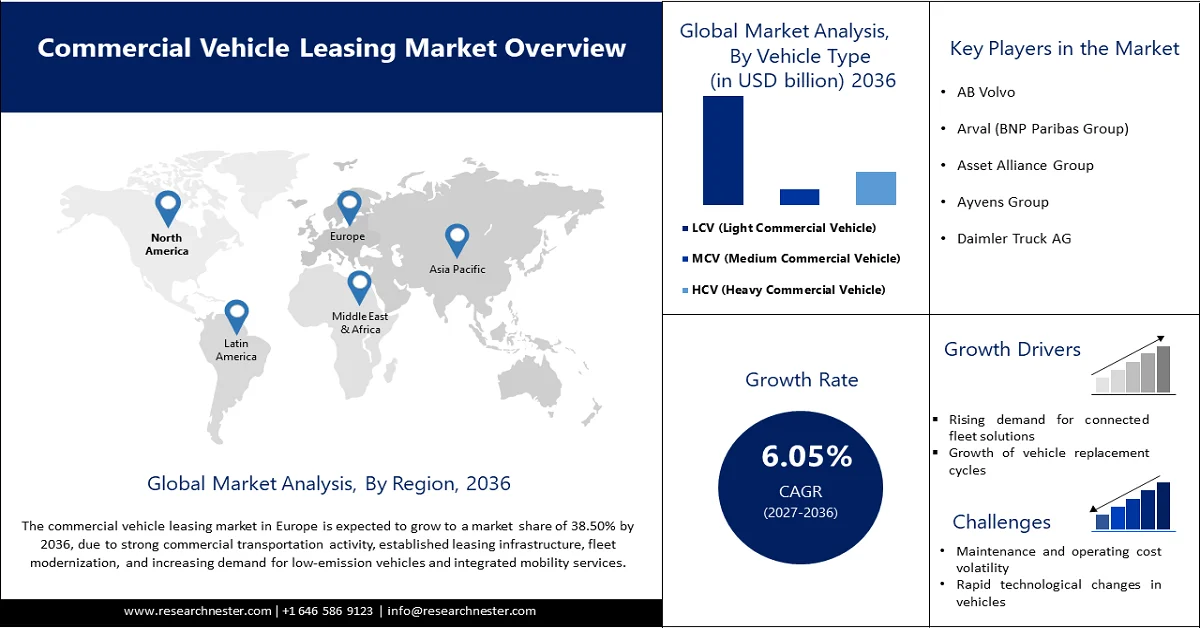
Commercial Vehicle Leasing Market size was valued at USD 57.58 billion in 2026 and is expected to cross USD 104.72 billion by the end of 2036, expanding at more than 6.05% CAGR during the forecast period, i.e., between 2027-2036. In 2027, the industry size of commercial vehicle leasing is evaluated at USD 61.74 billion.
The increasing expansion of electric vehicle leasing solutions is projected to drive the market growth during the forecast period. Investment in electric vans and trucks requires substantial initial purchase costs, which makes leasing an attractive approach for companies. In the case of leasing companies, investing in EVs in turn is the most cost-effective choice. These vehicles aid in meeting sustainable corporate goals and also reduce fuel costs. The International Energy Agency (IEA) disclosed that global car sales approached 80 million in 2024, with electric and hybrid models making up roughly 30% of purchases. These vehicles drove all market growth, while petrol and diesel car sales fell 30% from their 2017 peak. Over the same period, electric-car sales rose more than fourteenfold and accounted for over one in five cars sold worldwide.
Key Commercial Vehicle Leasing Market Insights Summary:
Regional Highlights:
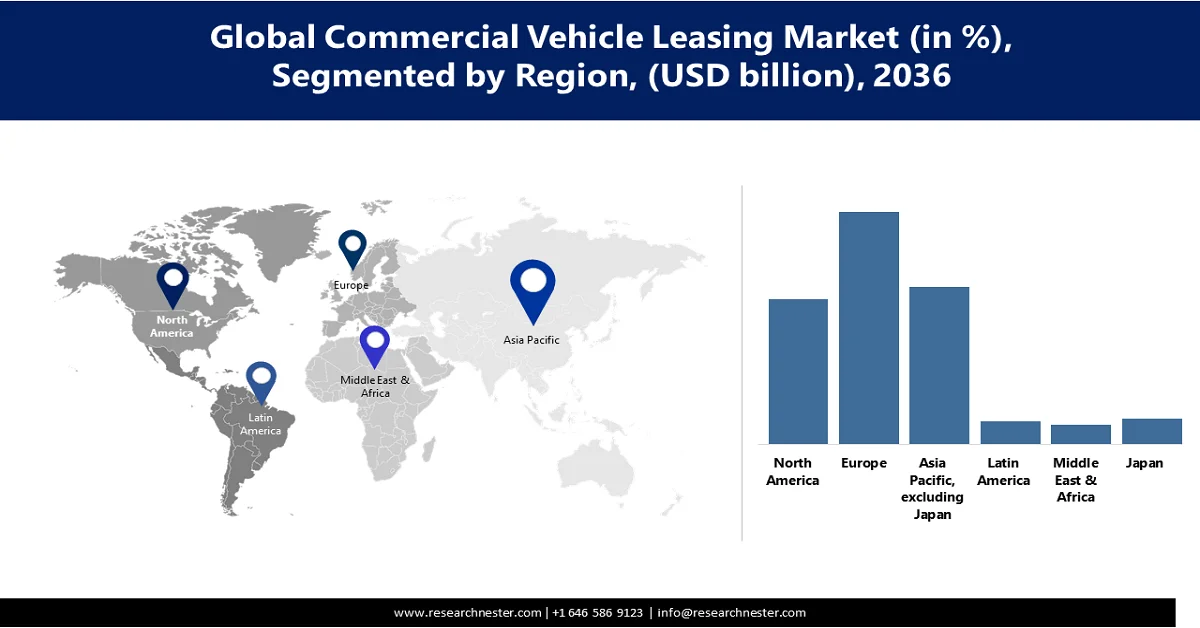
- Europe is projected to command a 38.50% share of the commercial vehicle leasing market by 2036, with strong logistics activity, expanding e-commerce, and rising urban delivery requirements accelerating leasing demand.
- Asia Pacific Excluding Japan is expected to secure a 25.99% market share throughout the forecast period, supported by expanding logistics networks, e-commerce growth, rapid urbanization, and increasing manufacturing activity.
- The U.S. is projected to account for 88.99% of the North America market share through 2036, mainly owing to the extensive freight transportation, e-commerce, construction, manufacturing, retail distribution, and service-sector activity.
- The Japan commercial vehicle leasing market volume is expected to be calculated at 307.59 thousand units in 2027, due to its mature automotive industry, established financial services sector, sophisticated logistics infrastructure, and high demand for reliable transportation.
Segment Insights:
- The light commercial vehicles (LCVs) segment is projected to account for 67.68% of the commercial vehicle leasing market by 2036, reflecting strong demand from operational flexibility, lower acquisition costs, and broad applicability across industries.
- The internal combustion engine (ICE) vehicles segment is anticipated to retain a 76.96% share throughout the forecast period, with established infrastructure and broad vehicle availability underpinning its dominance in the market.
Key Growth Trends:
- Expansion of logistics and transportation activities
- Subscription-based commercial mobility
Major Challenges:
- Rapid technological changes in vehicles
- Maintenance and operating cost volatility
Key Players: AB Volvo (Sweden), Arval (BNP Paribas Group) (France), Asset Alliance Group (UK), Ayvens Group (Netherlands), Daimler Truck AG (Germany), Element Fleet Management Corp. (Canada), Enterprise Holdings, Inc. (U.S.), Holman (U.S.), PACCAR Financial (United States), Penske (U.S.), Ryder System, Inc. (U.S.), TIP Group (Netherlands).
Global Commercial Vehicle Leasing Market Forecast and Regional Outlook:
Market Size & Growth Projections:
- 2026 Market Size: USD 57.58 billion
- 2027 Market Size: USD 61.74 billion
- Projected Market Size: USD 104.72 billion by 2036
- Growth Forecasts: 6.05% CAGR (2027-2036)
Key Regional Dynamics:
- Largest Region: Europe (38.50% Share by 2036)
- Fastest Growing Region: Asia Pacific Excluding Japan
- Dominating Countries: United States, China, Germany, Japan, India
- Emerging Countries: India, China, Canada, South Korea, United Kingdom
Last updated on : 21 August, 2026
Commercial Vehicle Leasing Market - Growth Drivers and Challenges
Growth Drivers
- Expansion of logistics and transportation activities: The expansion of logistics and transportation activities is a major growth driver for the market. Businesses increasingly require reliable fleets without committing large amounts of capital to vehicle ownership, which directly doubles the revenues of key leasing companies. According to the Bureau of Transportation Statistics, the producer price index for transportation equipment rose 2.4% between July 2025 and July 2026. Transportation accounted for 12.7% of the overall rise in the producer price index for all services. The expansion of third-party logistics providers is another important factor driving the overall market growth.
- Subscription-based commercial mobility: Subscription-based commercial mobility is creating lucrative opportunities for commercial vehicle leasing companies. Businesses operating in sectors such as construction, event services, and field operations may experience significant fluctuations in vehicle requirements. Subscription models allow these businesses to access commercial vehicles for shorter or more adaptable periods. The service providers are also consistently launching attractive models to earn more. In June 2026, Waymo introduced Waymo Premier, an invite-only membership for regular riders in San Francisco, Los Angeles, and Phoenix, priced at USD 29.99 per month. It offers faster pickup priority, 10% ride-credit rewards, early access to new cities, and up to five free cancellations each month.
- Expansion of e-commerce and last-mile delivery: The expansion of e-commerce and last-mile delivery is generating sustained demand for commercial vehicles. The consumers' increasing purchase of products through online channels drives companies to manage larger volumes of parcels and provide faster delivery services through leasing vehicles. According to the International Trade Administration, global business-to-business online sales have risen consistently over the past decade and are projected to reach USD 36 trillion by 2026. The growth of same-day and next-day delivery is further encouraging logistics companies to expand localized fleets.
Challenges
- Rapid technological changes in vehicles: One of the key restraining factors for commercial vehicle leasing sales is swift technological developments. The incorporation of new electric drivetrains, battery technologies, and advanced driver-assistance systems shortens the economic and technological lifecycle of commercial vehicles. This further makes it more difficult for leasing companies to accurately estimate the valuation of a vehicle at the end of its lease contract.
- Maintenance and operating cost volatility: The growth of the market is hampered by maintenance and operating cost volatility. When the cost of these services increases unexpectedly, providers often face pressure on margins, especially when contracts have fixed monthly payments. Insurance premiums further increase the overall cost of operating leased fleets. To manage and overcome these risks, some companies are investing in digital technologies and predictive analytics.
Commercial Vehicle Leasing Market Size and Forecast:
| Report Attribute | Details |
|---|---|
|
Base Year |
2026 |
|
Forecast Period |
2027-2036 |
|
CAGR |
6.05% |
|
Base Year Market Size (2026) |
USD 57.58 billion |
|
Forecast Year Market Size (2036) |
USD 104.72 billion |
|
Regional Scope |
|
Commercial Vehicle Leasing Market Segmentation:
Vehicle Type Segment Analysis
The light commercial vehicles (LCVs) segment is expected to capture 67.68% of the commercial vehicle leasing market through 2036. The strong combination of operational flexibility, lower acquisition costs, and broad applicability across industries increases the demand for light commercial vehicles. These types of vehicles are widely used for last-mile delivery, retail distribution, field services, and more. Thus, their versatility directly contributes to the overall segmental growth. According to the Federal Reserve Bank of St. Louis, U.S. sales of cars and light trucks reached an annualized, seasonally adjusted rate of 16.326 million units in July 2026. Increasing production volume reflects lucrative opportunities for vehicle leasing companies.
Propulsion Segment Analysis
The internal combustion engine (ICE) vehicles segment is projected to hold 76.96% of the market share throughout the forecast period. The established infrastructure and broad vehicle availability fuel the demand for internal combustion engine vehicles. Technological innovations and expansion are also contributing to the segmental growth. In December 2025, Johnson Matthey opened its first hydrogen internal-combustion engine testing facility in Gothenburg, Sweden. The center is set to evaluate advanced emission-control systems and strengthen testing for heavy-duty hydrogen engines.
End user Segment Analysis
The corporate and institutional organizations segment is estimated to account for 76.95% of the market share by the end of 2036. Corporate organizations are key end users of commercial vehicles as they are required for employee transportation, goods movement, and more. Large organizations also benefit from fleet leasing agreements that combine financing with maintenance and insurance. The expanding corporate sector in developing countries is anticipated to propel the sales of commercial vehicles in the years ahead.
Our in-depth analysis of the commercial vehicle leasing includes the following segments:
|
Segments |
Subsegments |
|
Vehicle Type |
|
|
Propulsion |
|
|
Leasing Duration |
|
|
Application |
|
|
Service Model |
|
|
End user |
|

Vishnu Nair
Head - Global Business DevelopmentCustomize this report to your requirements — connect with our consultant for personalized insights and options.
Commercial Vehicle Leasing Market - Regional Analysis
Europe Market Insights
Europe is estimated to capture 38.50% of the global commercial vehicle leasing market share through 2036. The market is supported by strong logistics activities and expanding e-commerce. Growth in urban delivery requirements and the growing preference among businesses for asset-light fleet management are propelling the commercial vehicle leasing demand. The market is also benefiting from the expansion of cross-border freight and distribution networks within the EU. According to the European Automobile Manufacturers’ Association (ACEA), Europe accounts for 21% of global car registrations, with more than 15.5 million new cars. In the first half of 2026, new commercial vehicle registrations rose by 1.9% for vans, 9.8% for trucks, and 22.7% for buses.
The UK market is projected to reach USD 6,671.93 million by 2036. The commercial leasing vehicles witness strong demand across logistics, construction, retail distribution, field services, and e-commerce organizations. Electric vans are also gaining traction owing to emissions-reduction objectives and restrictions affecting higher-emission vehicles in urban areas.
The Germany commercial vehicle leasing market is estimated at USD 5,471.66 million in 2026. The country’s large industrial base and extensive logistics sector are pushing the demand for commercial vehicle leasing. The International Organization of Motor Vehicle Manufacturers (OICA) disclosed that Germany’s motor vehicle manufacturing in Q1 2026 totaled 1,068,952 units. The robust production directly contributes to the market growth.
Asia Pacific Excluding Japan Market Insights
Asia Pacific excluding Japan is projected to capture 25.99% of the global market throughout the forecast period. The region’s expanding logistics networks and e-commerce are propelling the demand for commercial vehicle leasing. The swift rise in urbanization and manufacturing activities is propelling the trade of commercial vehicles. China, India, and South Korea are some of the key marketplaces for commercial vehicle leasing companies.
China’s market is anticipated to increase from USD 4,819.64 million in 2026 to USD 11,708.54 million by the end of 2036. The extensive manufacturing activities and rise in domestic freight transportation are propelling the market growth. The booming e-commerce trade and expanding large-scale logistics networks are pushing the demand for commercial vehicle leasing. According to the International Trade Administration, China’s e-commerce market increased by 11.9% in 2023, reaching USD 2.2 trillion. The continued expansion of online commerce is set to strengthen the demand for vans and light commercial vehicles serving last-mile delivery operations.
The India market is projected to reach USD 4,220.52 by the end of 2036. The rapid urbanization and infrastructure development projects are propelling commercial vehicle leasing sales. According to India Brand Equity Foundation (IBEF), India’s fast-growing direct-to-consumer market is forecast to expand at a 40% annual rate and reach USD 60 billion by 2030. India’s overall e-commerce market is expected to exceed USD 145 billion in 2025. Thus, the e-commerce expansion and the growth of third-party transportation services are propelling the overall market growth.
Japan Commercial Vehicle Leasing Market Insights
The Japan market is estimated to grow from USD 2,728.27 million in 2026 to USD 4,503.29 million by 2036. The country has a well-developed commercial vehicle leasing ecosystem supported by its mature automotive industry, established financial services sector, and sophisticated logistics infrastructure. The high demand for reliable transportation also propels commercial vehicle leasing demand. Commercial vehicles are widely used across retail distribution, manufacturing, and service industries.
Japan's aging workforce and labor shortages are also increasing the importance of fleet efficiency and vehicle utilization. According to Japan’s Ministry of Economy, Trade and Industry, the domestic B2C e-commerce market reached about USD 175 billion (JPY 26.1 trillion) in 2024. B2B online transactions totaled roughly USD 3.45 trillion (JPY 514.4 trillion). Thus, the continued expansion of parcel delivery and e-commerce is supporting demand for light commercial vehicles.
Japan Commercial Vehicle Leasing Market Size and Forecast
|
Report Attribute |
Details |
|
Base Year Market Size; Volume Size (2026) |
USD 2,728.27 million; 293.06 thousand units |
|
Forecast Year Market Size; Volume Size (2036) |
USD 4,503.29 million; 459.21 thousand units |
|
CAGR (2026-2036) |
5.02% |
North America Market Insights
North America is anticipated to hold 24.00% of the global market share by the end of 2036. The region’s strong freight transportation and e-commerce activities are propelling the trade of commercial vehicle leasing. Vehicle electrification is emerging as another important market growth factor. Fleet operators are evaluating electric vans and trucks to reduce fuel consumption and meet corporate sustainability objectives. Both the U.S. and Canada are the most lucrative markets for commercial vehicle leasing companies.
The US commercial vehicle leasing market is projected to reach USD 22,369.81 million by 2036. The market is driven by extensive freight transportation and service-sector activities. E-commerce, construction, manufacturing, and retail distribution are some of the key end users of commercial vehicle leasing services. According to the Bureau of Transportation Statistics, the new light truck leases stood at 2,694 units in 2024.
Canada's market was valued at USD 1,499.42 million in 2026. The market is supported by a rise in freight transportation, natural-resource industries, and construction activities. The country's large geographic area and dispersed population centers create significant requirements for commercial transportation. Further, the expansion of online retail and parcel delivery is creating additional demand for light commercial vehicles in major metropolitan areas.
Key Commercial Vehicle Leasing Market Players:
- AB Volvo (Sweden)
- Arval (BNP Paribas Group) (France)
- Asset Alliance Group (UK)
- Ayvens Group (Netherlands)
- Daimler Truck AG (Germany)
- Element Fleet Management Corp. (Canada)
- Enterprise Holdings, Inc. (U.S.)
- Holman (U.S.)
- PACCAR Financial (United States)
- Penske (U.S.)
- Ryder System, Inc. (U.S.)
- TIP Group (Netherlands)
- Company Overview
- Business Strategy
- Key Product Offerings
- Financial Performance
- Key Performance Indicators
- Risk Analysis
- Recent Development
- Regional Presence
- SWOT Analysis
- AB Volvo maintains a strong position in the commercial vehicle ecosystem through its broad portfolio of trucks, buses, construction equipment, and related financial and fleet services. The company supports customers through Volvo Financial Services, which provides financing and leasing solutions for commercial vehicles across multiple markets. Volvo's strategy increasingly emphasizes electrification, connected vehicles, autonomous technologies, and lifecycle services. Its strong global manufacturing and distribution network enables it to serve large fleet operators and transportation companies. In the leasing landscape, Volvo benefits from its ability to combine vehicle manufacturing, financing, maintenance, and digital fleet-management capabilities, creating integrated solutions for commercial customers.
- Arval (BNP Paribas Group) operates as a major vehicle leasing and mobility company within the BNP Paribas Group, offering full-service vehicle leasing and fleet-management solutions. Its corporate strategy focuses on providing businesses with flexible mobility solutions while supporting fleet electrification and lower-emission transportation. Arval serves corporate customers, small and medium-sized enterprises, and individuals through a broad international network. The company increasingly integrates consulting, fleet management, telematics, maintenance, and alternative mobility services into its offerings. Its relationship with BNP Paribas provides access to substantial financial resources and supports international expansion. Arval's focus on sustainable mobility and flexible fleet solutions strengthens its competitive position in commercial vehicle leasing.
- Asset Alliance Group is a UK-based specialist in commercial vehicle finance and leasing, with a strong focus on trucks, trailers, vans, and other fleet assets. The company provides tailored financing solutions designed around the operational requirements of transportation and logistics businesses. Its offerings include vehicle leasing, contract hire, asset finance, and fleet-related services. Asset Alliance Group differentiates itself through industry specialization and customized financing structures rather than relying solely on standardized leasing products. The company serves businesses across transportation, logistics, construction, and related sectors. Its understanding of commercial vehicle operations enables it to provide flexible solutions for customers seeking fleet expansion, replacement, or asset refinancing.
- Ayvens Group is a major global mobility company formed through the combination of ALD Automotive and LeasePlan, with BNP Paribas Group as its principal shareholder. The company provides vehicle leasing, fleet management, and mobility services to corporate customers across numerous markets. Its strategy focuses strongly on sustainable mobility, including the transition toward electric and low-emission fleets. Ayvens combines vehicle financing with maintenance, fleet management, digital tools, and mobility services, allowing businesses to outsource significant portions of fleet administration. Its large international customer base and extensive vehicle portfolio provide scale advantages. The company is also expanding digital fleet solutions and flexible mobility offerings to address changing corporate transportation requirements.
- Daimler Truck AG is a major global commercial vehicle manufacturer with a strong presence across trucks, buses, and related transportation technologies. Through its financial services activities, the company supports customers with financing and leasing solutions that facilitate commercial vehicle acquisition. Daimler Truck's competitive strategy increasingly centers on electrification, connected vehicle technologies, autonomous driving, and integrated fleet solutions. Its established brands and global dealer network provide access to major transportation and logistics customers. The company's combination of vehicle manufacturing, financing, after-sales support, and digital fleet technologies strengthens its position across the commercial vehicle value chain. Its growing focus on zero-emission vehicles also creates opportunities within the evolving market.
Below is the list of the key players, among several others, operating in the global market:
The commercial vehicle leasing market is characterized by the presence of both regional and international players. Leading companies are investing heavily in R&D activities to introduce modern solutions. They are also collaborating with others to enhance their product offerings. Some gigantic companies are exploring opportunities in high-potential markets to earn more lucrative returns. Both the organic and inorganic marketing strategies are expected to double their revenue shares in the years ahead.
Corporate Landscape of the Global Market:
Recent Developments
- In May 2026, Penske Truck Leasing named Allison Transmission Holdings a Best Performing Supplier in the heavy- and medium-duty transmission category. The biennial award recognizes suppliers that consistently deliver dependable, high-quality service.
- In September 2025, Pioneer Clean Fleet Solutions began offering low-carbon truck leasing, initially focused on next-generation CNG heavy-duty vehicles. Its all-in-one service combines trucks, fueling, maintenance, and fleet management to help operators lower costs and emissions without affecting productivity.
- Report ID: 8744
- Published Date: Aug 21, 2026
- Report Format: PDF, PPT
- Explore a preview of key market trends and insights
- Review sample data tables and segment breakdowns
- Experience the quality of our visual data representations
- Evaluate our report structure and research methodology
- Get a glimpse of competitive landscape analysis
- Understand how regional forecasts are presented
- Assess the depth of company profiling and benchmarking
- Preview how actionable insights can support your strategy
Explore real data and analysis
Frequently Asked Questions (FAQ)
About this Report
Connect with our Expert


Report, 2027-2036



Copyright @ 2026 Research Nester. All Rights Reserved.
