Car Air Purifier Market Outlook:
Car Air Purifier Market size was valued at USD 2.6 billion in 2025 and is projected to reach USD 7 billion by the end of 2035, rising at a CAGR of 11.7% during the forecast period, i.e., 2026-2035. In 2026, the industry size of car air purifier is assessed at USD 2.9 billion.
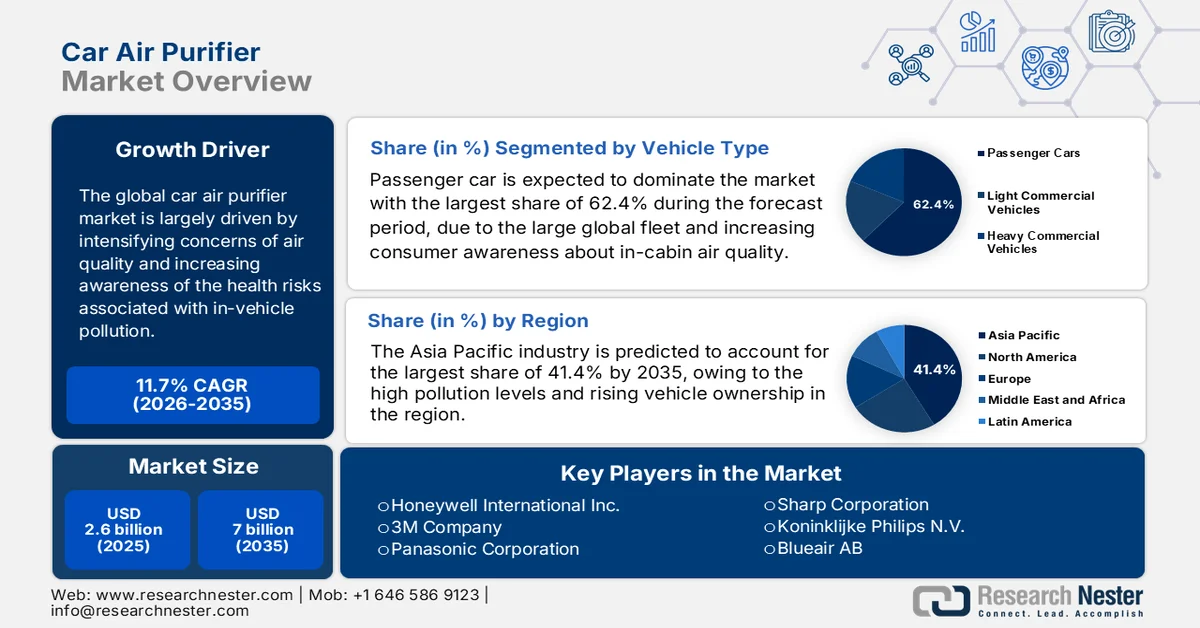
The global car air purifier market is poised for extensive growth, effectively fueled by intensifying concerns regarding air quality across different nations and increasing awareness of the health risks associated with in-vehicle pollution. As per an article published by the International Energy Agency (IEA) in July 2023, transport CO2 emissions rebounded in 2022, rising 3% when compared to the previous year and nearly returning to pre-pandemic levels. The transport sector is heavily dependent on oil for 91% of its energy, and emissions have grown faster than most other sectors over the past three decades. In order to align with the net-zero emissions by 2050 scenario, reductions of more than 3% yearly basis to 2030 are required, thereby necessitating strong regulations, fiscal incentives, and infrastructure investment, thus driving lucrative growth opportunities for car air purifiers.
Furthermore, the rising urbanization, traffic congestion, and the prevalence of respiratory illnesses are accelerating demand for advanced filtration, particularly HEPA and activated carbon technologies. As consumers have an increased priority towards health, wellness, and comfort during their commutes, the car air purifier market is expected to witness extensive growth. According to the article published by the Institute for Health Metrics and Evaluation in October 2025, air pollution is one of the leading environmental risk factors for death worldwide, which caused around 7.9 million deaths in 2023, whereas 86% were linked to noncommunicable diseases such as heart disease, stroke, and COPD. The report highlights that dementia related to pollution caused over 600,000 deaths and nearly 12 million healthy years of life lost. Moreover, the low- and middle-income countries are witnessing the greatest burden, with high exposure to PM2.5 and limited healthcare access, thus reflecting the huge need for car air purifiers.
Key Car Air Purifier Market Insights Summary:
Regional Highlights:
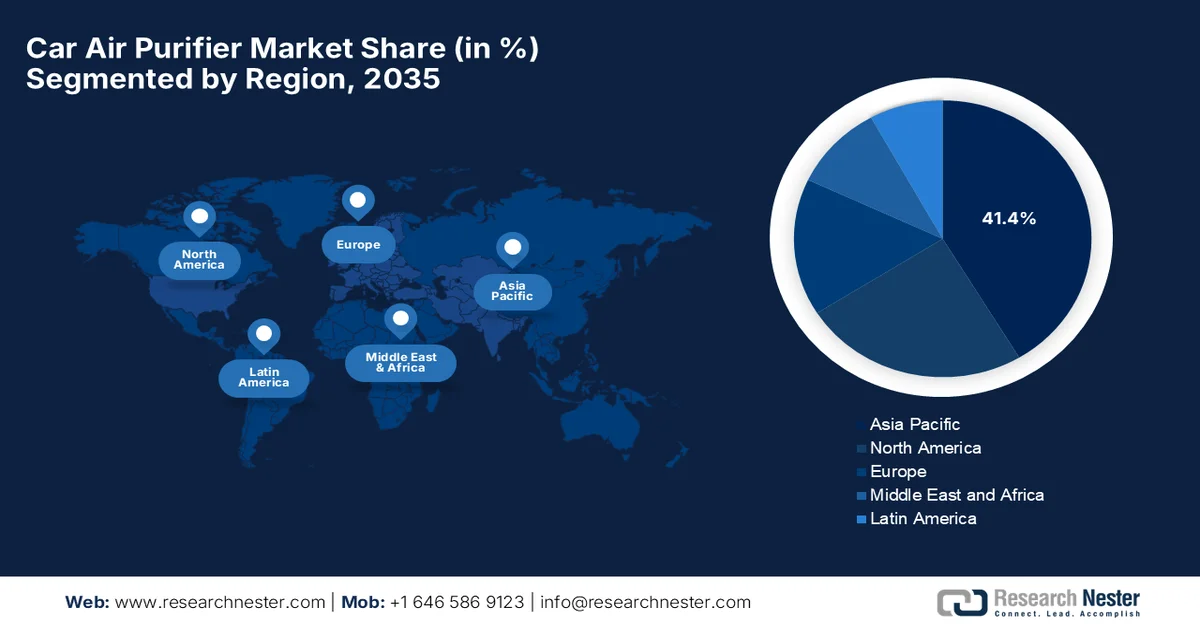
- Asia Pacific is projected to command a leading 41.4% share by 2035, supported by escalating pollution levels and rising vehicle ownership across the region
- North America is expected to witness notable growth in the car air purifier market during the forecast period 2026–2035, propelled by increasing prevalence of respiratory disorders and heightened consumer focus on in-car air quality
Segment Insights:
- Passenger cars segment in the car air purifier market is projected to account for a dominant 62.4% share by 2035, attributed to the expanding global vehicle fleet and rising consumer awareness regarding in-cabin air quality
- HEPA filters segment is anticipated to secure a substantial revenue share by 2035, fueled by superior efficiency in capturing fine particulate pollutants and strong preference for reliable cabin air filtration performance
Key Growth Trends:
- Rising air pollution levels
- Increase in vehicle ownership & commute time
Major Challenges:
- Technological complexity
- Consumer awareness and perceived value
Key Players: Honeywell International Inc., 3M Company, Panasonic Corporation, Sharp Corporation, Koninklijke Philips N.V., Blueair AB, Coway Co., Ltd., Samsung Electronics Co., Ltd., Denso Corporation, Eureka Forbes Ltd., Livpure Private Limited, Kent RO Systems Ltd., IQAir AG, Dyson Ltd., Panasonic Automotive Systems Co., Ltd., Daikin Industries, Ltd., JSW MG Motor India, Purafil, CabinAir, Rensa Filtration, Air Filtration Co., Inc., Agcen Air Purifier, Xiamen Airbus Electronic Technology Co. Ltd., Olansi Healthcare Co., Ltd., Ambrane AeroBliss.
Global Car Air Purifier Market Forecast and Regional Outlook:
Market Size & Growth Projections:
- 2025 Market Size: USD 2.6 billion
- 2026 Market Size: USD 2.9 billion
- Projected Market Size: USD 7 billion by 2035
- Growth Forecasts: 11.7% CAGR (2026-2035)
Key Regional Dynamics:
- Largest Region: Asia Pacific (41.4% Share by 2035)
- Fastest Growing Region: North America
- Dominating Countries: United States, China, Japan, Germany, India
- Emerging Countries: Brazil, South Korea, Mexico, Indonesia, Vietnam
Last updated on : 6 April, 2026
Car Air Purifier Market - Growth Drivers and Challenges
Growth Drivers
- Rising air pollution levels: The car air purifier market is primarily driven by rising traffic congestion and industrial emissions, which are degrading air quality globally. The in-car air can be more polluted when compared to outdoor air, especially in terms of dense cities. As a result, consumers are looking for in-cabin air purification solutions. According to the article published by the World Health Organization (WHO) in October 2024, it covered more than 6,000 cities in 117 countries and compiled annual mean concentrations of PM10, PM2.5, and NO2. It aims to raise awareness and guide public health responses, not to rank cities, and it shows that most urban areas exceed WHO’s guideline levels, with the poorest air quality in the Eastern Mediterranean, South-East Asia, and Africa. More than half of the urban population resides where fine particulate matter crosses recommended limits by six times, whereas only 17% live in cities that meet WHO standards. This denotes that there is an urgent need for stronger policies and interventions to reduce air pollution positively impacting car air purifier market growth.
- Increase in vehicle ownership & commute time: Rapid growth in passenger vehicles and ride-sharing fleets boosts usage of the car air purifiers. Besides, the aspect of longer commuting hours increases exposure to pollutants, increasing the need for clean air. Based on the government data published in August 2024, the number of commuters in Canada rose to 16.5 million, which is up from 585,000 in the previous year, reflecting employment growth and fewer people working from home in May 2024. Besides, cars are identified to be the dominant commuting mode, which is 81.5%, though public transit use increased to 11.4% and active transportation held steady at 6%. Furthermore, hybrid workers had longer commutes and were more likely to use transit, thus supporting the overall car air purifier market’s growth.
- Integration in premium & electric vehicles: Luxury vehicles offer built-in air purification systems. EV manufacturers emphasize healthy cabin features; therefore, air purification is becoming a standard or differentiating feature. In September 2025, CabinAir reported that patented particle charging technology is featured in the new Polestar 5, launched at the IAA Mobility event in Munich, offering advanced in-cabin air purification. The company notes that this system efficiently combines active particle charging with mechanical filtration to effectively trap ultrafine particles, allergens, soot, and pollutants. Therefore, these continued innovations from the leading pioneers denote that air purification is becoming a standard and differentiating attribute in terms of premium and electric vehicles. Thus, reflecting a broader industry shift toward prioritizing healthy, high-quality cabin environments as a highly important aspect, thus benefiting the car air purifier market.
Challenges
- Technological complexity: This is a major obstacle hindering the growth of the car air purifier market. Most of the improved systems consist of multiple purification mechanisms, i.e., HEPA, UV, ionization, photocatalytic oxidation, sensors, and connectivity attributes, but there is limited industry standardization of performance measurement or certification. At the same time, the absence of globally accepted standards allows manufacturers to utilize varying test criteria, making it hard for consumers to compare real air quality improvement across products. The integration with automotive HVAC systems requires engineering alignment with different vehicle platforms, thereby increasing R&D complexity and time‑to‑market. Besides, smaller players find it challenging to make investments in testing and certification. Therefore, this lack of standardized norms hinders buyer confidence and slows OEM partnerships.
- Consumer awareness and perceived value: The reduced consumer awareness of in‑car air quality issues and the tangible benefits of air purifiers negatively impact the growth of the car air purifier market. Most of the drivers do not fully understand the health impacts of particulate matter, VOCs, allergens, and microbial contaminants while traveling, especially in urban or high‑pollution environments. This lack of awareness reduces perceived value, making air purifiers seem like a luxury rather than a health‑essential product. Therefore, marketing efforts from the pioneers often struggle to clearly communicate long‑term health benefits, which are intangible when compared to more visible automotive accessories. In terms of emerging markets, consumers may showcase a higher priority towards basic car maintenance over additional devices without immediate, visible results. Hence, educating customers through targeted campaigns and transparent performance data is highly essential but cost‑intensive for manufacturers.
Car Air Purifier Market Size and Forecast:
| Report Attribute | Details |
|---|---|
|
Base Year |
2025 |
|
Forecast Period |
2026-2035 |
|
CAGR |
11.7% |
|
Base Year Market Size (2025) |
USD 2.6 billion |
|
Forecast Year Market Size (2035) |
USD 7 billion |
|
Regional Scope |
|
Car Air Purifier Market Segmentation:
Vehicle Type Segment Analysis
Under the vehicle type, passenger cars are expected to dominate the car air purifier market with the largest share of 62.4% during the forecast period. The dominance of the segment is largely attributable to the large global fleet and increasing consumer awareness about in-cabin air quality. As per the article published by Invest India, government data, India’s automobile sector is booming, wherein the domestic production is rising nearly 9% in FY 2024-25 to 31 million units, and exports crossing 5.3 million vehicles. The article highlighted that strong FDI inflows of USD 37.8 billion and 100% FDI allowance under the automatic route make it a global investment hub. Besides, the EV is forecasted to reach a significant 40% share by 2030, supported by government schemes such as FAME, PLI, and PM E-Drive, hence driving strong demand for car air purifiers.
Technology Segment Analysis
Based on the technology segment, HEPA filters are anticipated to attain a lucrative revenue share in the car air purifier market by the end of 2035. The growth of the segment is largely propelled by their high efficiency in capturing fine particulate matter such as dust, pollen, and PM2.5 pollutants. On the other hand, these systems are extensively preferred for their reliability and proven performance in enclosed cabin environments. In April 2025, UFI Filters announced that its HEPA and activated carbon cabin air filters used for the Tesla Model Y are now available in the SOFIMA and UFI aftermarket catalogues. The company added that HEPA filters achieve 99.975% efficiency for particles smaller than 0.3 µm, capturing fine dust, spores, bacteria, and viruses, while the activated carbon filters remove gas molecules and unpleasant odors, hence denoting a wider segment scope.
Sales Channel Segment Analysis
The aftermarket, which is a part of the sales channel segment, is predicted to capture a significant revenue share in the car air purifier market during the discussed timeframe. The growth of the segment is propelled by consumers opting to install air purifiers in existing vehicles rather than purchasing new cars with built-in systems. This segment benefits from easy product availability, a wide price range, and minimal installation complexity. At the same time, the segment allows vehicle owners to upgrade existing cars with air purification systems, making it suitable for growing health and air quality concerns without the need to purchase new vehicles. Its growth is supported by rising retail and online availability by offering products across varied price points to suit different consumer budgets. Besides minimal installation requirements and compatibility with most car models, enhance adoption. Furthermore, as awareness of in-cabin air quality rises, the aftermarket segment is expected to remain a crucial part of overall car air purifier market expansion.
Our in-depth analysis of the global car air purifier market includes the following segments:
|
Segment |
Subsegments |
|
Vehicle Type |
|
|
Technology |
|
|
Sales Channel |
|
|
Power Source |
|
|
Type |
|
|
Coverage Area |
|

Vishnu Nair
Head - Global Business DevelopmentCustomize this report to your requirements — connect with our consultant for personalized insights and options.
Car Air Purifier Market - Regional Analysis
APAC Market Insights
The Asia Pacific car air purifier market is anticipated to lead the sector with the largest share of 41.4% by the end of 2035. The region benefits from high pollution levels and rising vehicle ownership across major countries. As air quality continues to deteriorate across much of the region, consumers are increasingly looking for ways to enhance the air quality inside their vehicles. As per the article published by the World Health Organization in February 2026, air pollution remains a leading cause of disease and premature death across the region, which is affecting both outdoor and household environments and placing heavy pressure on health systems. Besides, the report stated that rapid urbanization, industrial growth, and vehicle emissions contribute to rising pollutant levels in major cities. Governments in the region are strengthening air quality monitoring, regulating vehicle emissions, and implementing clean air policies to protect public health, hence denoting a huge opportunity for the car air purifier market to grow in this region.
In China, the car air purifier market is growing, which is effectively propelled by heightened health awareness, rising urban pollution levels, and rising consumer demand for superior in-vehicle air quality. The country’s strong focus on advanced technologies such as HEPA filtration, active carbon, and ionizers to tackle fine particles and harmful gases is benefiting the overall market growth. Based on the government data, which was published in December 2023, China’s new action plan aimed to cut PM2.5 levels by around 10% and limit heavy pollution days to under 1% annually. Besides, it emphasizes cleaner energy, banning new steel capacities, and boosting green industries by making sure that non-fossil energy makes up 20% of consumption. In addition, Beijing-Tianjin-Hebei and the Yangtze River Delta will see stricter measures, including widespread adoption of new energy vehicles in public transport, thus driving huge adoption of car air purifiers.
The escalating consumer adoption of in-cabin air cleaning technology is responsible for uplifting the overall car air purifier market in India. The country’s market is readily propelled with both aftermarket accessories and increasing OEM integration of advanced filtration systems. In September 2024, the Press Information Bureau (PIB) in September 2024 reported that the country has strengthened its focus on clean air through initiatives such as Swachh Vayu Diwas and the National Clean Air Programme by targeting reductions in PM10 levels by up to 40% by 2025‑26 across 131 cities. Besides, the government has implemented city-specific action plans, expanded air quality monitoring networks, and established early warning systems to manage pollution and protect public health. At the same time, programs such as Nagar Van Yojana, ethanol-blended fuels, and sustainable urban transport further support air quality improvement, thus denoting a huge car air purifier market opportunity for car air purifiers.
North America Market Insights
The North America car air purifier market is witnessing noteworthy growth, largely driven by the rising burden of respiratory issues such as asthma, COPD, and allergies. The region’s consumers are highly health-conscious, and they are seeking quality products to maintain air quality in cars. As per an article published by the National Institute of Health (NIH) in April 2024, Asthma is considered a widespread respiratory condition in the U.S., which is affecting around 8.7% of the population based on NHANES data analysis. The study highlights that prevalence is higher among females, older adults, especially those who are aged above 60, and certain racial groups, including non-Hispanic Whites and non-Hispanic Blacks. In this context, these findings underscore the need for targeted public health strategies, thus boosting overall adoption of the car air purifiers in the region.
Factors such as long commuting hours, heavy traffic congestion, and rising pollution levels in major cities are boosting demand in the U.S. car air purifier market. The growing integration of solutions that can filter pollutants, allergens, and airborne viruses and smart technologies in vehicles is encouraging the adoption of advanced purifiers with enhanced filtration and connectivity attributes. As per the article published by the U.S. Environmental Protection Agency (EPA) in April 2025, transportation is the largest contributor to U.S. greenhouse gas emissions, which is accounting for about 28% of the total, mainly from burning fossil fuels. In order to tackle this, the EPA has set strict emissions standards for cars, trucks, and aircraft, thereby promoting renewable fuels and greener federal fleets. Programs such as SmartWay improve freight efficiency, and consumer tools such as fuel economy labels and the Green Vehicle Guide help drivers make eco-friendly choices, thus making it suitable for bolstering the country’s market.
Canada car air purifier market has gained enhanced exposure, which is propelled by growing concerns regarding wildfire smoke during seasonal events and seasonal allergies (pollen). These are boosting the demand for advanced, in-vehicle health protection solutions. The market is seeing a notable shift toward high-efficiency solutions, encouraging more players to establish their footprint in the country. In November 2022, the government of Canada stated that exposure to pollutants inside a vehicle is influenced by factors such as ventilation settings, surrounding traffic conditions, and whether windows are open or closed. Besides, it also stated that vehicle exhaust releases numerous harmful pollutants, which contribute to traffic-related air pollution. Therefore, the government encourages maintaining a properly functioning cabin air filter, as it helps reduce the entry of fine particulate matter and other external pollutants into the vehicle.
Europe Market Insights
Europe car air purifier market has acquired a prominent position, which is fueled by strict vehicle emission regulations and a heightened focus on environmental sustainability and health. Governments across the region are having an increased priority towards clean air initiatives, which is increasing the demand for in-car air purification solutions. As per an article published by NIH in October 2024, ambient air pollution is identified as a major public health concern in Europe, even if ongoing improvements in air quality levels exist. At the same time, a large proportion of monitoring stations still exceed the latest WHO air quality guidelines, particularly for pollutants such as PM2.5 and nitrogen dioxide, especially in high-traffic urban areas. These pollution levels contribute significantly to health risks, including cardiovascular and respiratory diseases. In this context, new regulatory measures and policies are being developed to address these challenges, thus denoting a huge opportunity for the car air purifier market to grow in the upcoming years.
The booming automotive sector, coupled with a strong focus on sustainable mobility, is responsible for uplifting the car air purifier market in Germany. Consumers in these countries are adopting air purifiers with eco-friendly attributes, thus encouraging both domestic and foreign players to establish their footprint in the country. In January 2025, the article published by Clean Air Fund noted that the country has made considerable progress in improving air quality, largely influenced by regional regulations, but challenges still exist in meeting updated standards for particulate matter and nitrogen dioxide. It also mentioned that transport is considered to be the biggest hurdle, with rising car numbers, limited electrification, underscoring the urgent need for effective measures. Meanwhile, the strong civil society advocacy ensures clean air and climate action remain central both domestically and internationally, positively impacting the car air purifier industry.
In the UK, the car air purifier market is unfolding remarkable growth opportunities owing to the huge concern regarding urban air quality and consistent government efforts to curb pollution. Increasing traffic emissions are encouraging consumers to seek protective solutions against harmful pollutants, thereby contributing to the growing popularity of car air purifiers. In May 2022, Volvo Cars reported that its advanced in-car air purification technology is especially designed to improve cabin air quality and reduce exposure to pollutants, allergens, and fine particulates. Also, its advanced air cleaner system is certified by Allergy Standards Limited and it can remove up to 99.9% of pollen allergens and up to 95% of PM2.5 particles from incoming air. Therefore, such instances by the leading players in the country denote the growing industry focus on integrating air purification technologies with a prime goal to enhance in-cabin air quality and address consumer health concerns.
Key Car Air Purifier Market Players:
- Honeywell International Inc. (U.S.)
- 3M Company (U.S.)
- Panasonic Corporation (Japan)
- Sharp Corporation (Japan)
- Koninklijke Philips N.V. (Netherlands)
- Blueair AB (Sweden)
- Coway Co., Ltd. (South Korea)
- Samsung Electronics Co., Ltd. (South Korea)
- Denso Corporation (Japan)
- Eureka Forbes Ltd. (India)
- Livpure Private Limited (India)
- Kent RO Systems Ltd. (India)
- IQAir AG (Switzerland)
- Dyson Ltd. (UK)
- Panasonic Automotive Systems Co., Ltd. (Japan)
- Daikin Industries, Ltd. (Japan)
- JSW MG Motor India (India)
- Purafil (U.S.)
- CabinAir (UK)
- Rensa Filtration (U.S.)
- Air Filtration Co., Inc. (U.S.)
- Agcen Air Purifier (China)
- Xiamen Airbus Electronic Technology Co. Ltd. (China)
- Olansi Healthcare Co., Ltd. (China)
- Ambrane AeroBliss (India)
- Company Overview
- Business Strategy
- Key Product Offerings
- Financial Performance
- Key Performance Indicators
- Risk Analysis
- Recent Development
- Regional Presence
- SWOT Analysis
- Honeywell International Inc. is a predominant leader that has a strong presence in air quality solutions, including automotive air purifiers. Besides, the company leverages its deep knowledge in HEPA and activated carbon filtration as well as smart sensor integration to deliver products that are suitable for both OEM and aftermarket needs.
- 3M Company is yet another prominent player in advanced materials and filtration technologies, with a substantial role in the automotive air purifier segment. The firm is best known for high‑performance filter media and multi‑stage purification systems, and it combines its material science knowledge with global distribution networks.
- Panasonic Corporation is identified as one of the major electronics and automotive components suppliers that benefits from the growing footprint in ‑vehicle air purification systems. The company’s strategy concentrates on advanced purification technologies such as nano-ion-based systems that integrate seamlessly with vehicle HVAC platforms.
- Koninklijke Philips N.V. is a dominant force in consumer health and advanced air purification technology, which includes automotive purifiers. Besides, this firm is highly focused on smart, connected products that combine HEPA, activated carbon, and sensor‑based air quality monitoring to deliver real‑time performance data.
- Sharp Corporation is a central player in this field whose product lineup includes compact, energy‑efficient purifiers that are aimed at both OEM integration and aftermarket retrofit segments. The company’s strategy revolves around localized collaborations with regional automotive manufacturers, continuous investment in ionization and filter science.
Below is the list of some prominent players operating in the global car air purifier market:
The global car air purifier market is extremely competitive, which consists of large multinational corporations and agile regional players who are intensely competing in terms of technology, brand recognition, and distribution breadth. At the same time, legacy industrial and consumer electronics firms such as Honeywell International Inc, 3M Company, Koninklijke Philips N.V., and Panasonic Corporation are dependent on strong R&D and established channels to push advanced filtration and smart connectivity features. Strategic initiatives adopted by the leading pioneers are partnerships with automotive OEMs and expansion into emerging markets. In January 2025, Rensa Filtration announced the acquisition of Air Filtration Co., Inc., which operates facilities in California and Iowa. Air Filtration Co. has years of experience in spray booth filtration products for industries such as automotive, wood finishing, and general manufacturing.
Corporate Landscape of the Car Air Purifier Market:
Recent Developments
- In December 2025, CabinAir achieved the Volvo Car Sustainability Long-Term Partnership Award 2025 due to its role in advancing clean mobility solutions. The award highlights CabinAir’s innovative air purification technologies as it develops advanced cabin air systems that capture ultrafine pollutants and viruses.
- In October 2025, JSW MG Motor India reported that all its vehicles are equipped with PM 2.5 air filters and purifiers to address rising pollution. Models such as the Astor, Gloster, Windsor, Comet, and ZS EV feature advanced filters, whereas the Hector offers a purifier with an AQI display for cabin air quality updates.
- In January 2023, Panasonic Automotive introduced its nanoe X portable in-vehicle air purifier, which is especially designed to improve cabin air quality and passenger wellbeing. The device reduces odors and inhibits viruses, bacteria, mold, and allergens.
- Report ID: 4431
- Published Date: Apr 06, 2026
- Report Format: PDF, PPT
- Explore a preview of key market trends and insights
- Review sample data tables and segment breakdowns
- Experience the quality of our visual data representations
- Evaluate our report structure and research methodology
- Get a glimpse of competitive landscape analysis
- Understand how regional forecasts are presented
- Assess the depth of company profiling and benchmarking
- Preview how actionable insights can support your strategy
Explore real data and analysis
Frequently Asked Questions (FAQ)
About this Report
Connect with our Expert


Report, 2026-2035



Copyright @ 2026 Research Nester. All Rights Reserved.
