Biodegradable Chelating Agents Market Outlook:
Biodegradable Chelating Agents Market size was valued at USD 5.5 billion in 2025 and is projected to cross USD 11.7 billion by the end of 2035, expanding at more than 7.9% CAGR during the forecast period, i.e., 2026-2035. In 2026, the industry size of biodegradable chelating agents is evaluated at USD 5.9 billion.
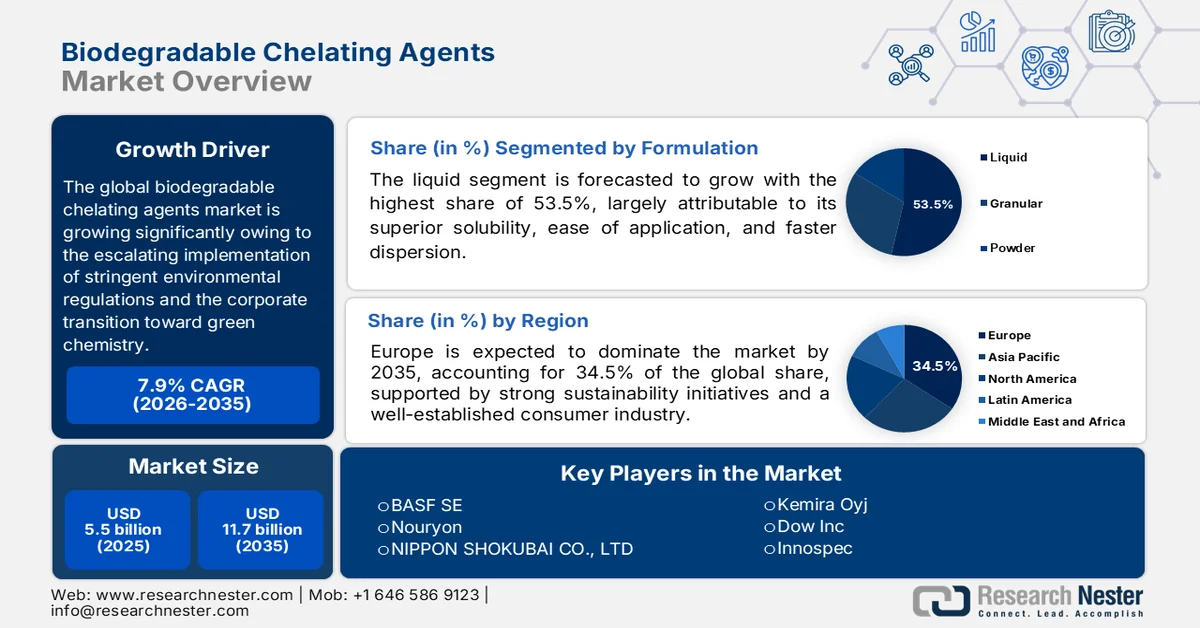
The global biodegradable chelating agents market is poised for strong growth, which is primarily driven by the escalating implementation of stringent environmental regulations and the corporate transition toward green chemistry. As governments across most nations restrict persistent synthetic chemicals due to groundwater contamination and ecotoxicity concerns, major industries such as cleaning, household detergents, oil, gas, personal care, and agriculture are reforming their product lines. As per an article published by the National Institutes of Health (NIH) in October 2025, it studied biodegradable chelating agents MGDA and GLDA as sustainable alternatives for removing calcium sulfate scales in oil and gas operations. This research showed that MGDA delivered superior scale dissolution performance when compared with regular chelators such as DTPA and HEDP, achieving high removal efficiency under elevated temperature and optimized pH conditions. It also mentioned that these biodegradable agents offer effective scale control, thus benefiting the overall market’s exposure.
Furthermore, the market is dependent on a range of bio-based raw materials, i.e., amino acids, organic acids, carbohydrates, and fermentation-derived intermediates. In this context, feedstocks such as glutamic acid, citric acid, gluconic acid, and sugar-based derivatives are being utilized due to their renewable origin and biodegradability characteristics. As per an article published by NIH in November 2025, citric acid-assisted electrokinetic remediation was assessed as a sustainable approach for removing toxic metals and arsenic from acidic mine pond sediments. This biodegradable chelating agent improved contaminant mobility and achieved higher removal efficiencies for aluminum, arsenic, manganese, and iron when compared with conventional water-based treatment, thus making it suitable for standard market growth.
Top Citric Acid Exporting Countries in 2023: Export Value and Shipment Volume by Country
|
Exporting Country/Region |
Export Value (USD thousand) |
Quantity (Kg) |
|
China |
982,522.84 |
1,173,290,000 |
|
Thailand |
204,934.58 |
110,957,000 |
|
Belgium |
155,591.30 |
80,855,800 |
|
Europe |
93,255.34 |
29,700,300 |
|
Germany |
78,208.14 |
35,276,700 |
|
Netherlands |
53,910.48 |
30,664,300 |
|
Colombia |
52,654.32 |
25,804,000 |
|
U.S. |
45,433.35 |
- |
|
Ireland |
34,299.20 |
10,436,600 |
|
Poland |
25,201.00 |
17,848,700 |
|
Turkey |
24,275.31 |
15,253,000 |
Source: WITS
Key Biodegradable Chelating Agents Market Insights Summary:
Regional Highlights:
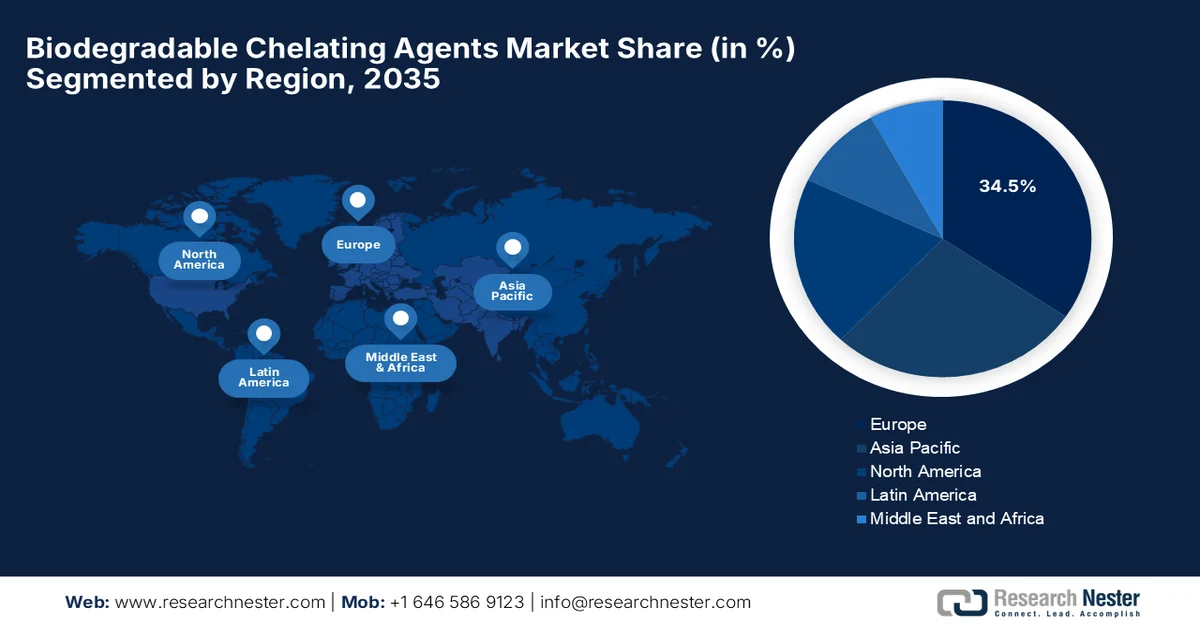
- Europe is anticipated to capture 34.5% of the biodegradable chelating agents market by 2035, underpinned by stringent environmental regulations and strong raw material supply capabilities
- Asia Pacific is projected to witness the fastest growth during 2026-2035, fueled by industrial expansion, urban development, and intensifying nature conservation efforts
Segment Insights:
- The liquid segment in the biodegradable chelating agents market is expected to account for 53.5% of the market by 2035, propelled by superior solubility, ease of application, faster dispersion, and increasing demand for environmentally friendly formulations
- The amino acid segment is forecast to dominate the market by 2035, bolstered by rising demand for sustainable and bio-based alternatives across multiple industries
Key Growth Trends:
- Tightening environmental regulations
- Growing adoption in agriculture
Major Challenges:
- Performance gaps and technical limitations
- Supply chain complexity and feedstock volatility
Key Players: BASF SE (Germany),Nouryon (Netherlands),NIPPON SHOKUBAI CO., LTD. (Japan),Kemira Oyj (Finland),Dow Inc (U.S.),Innospec (U.S.).
Global Biodegradable Chelating Agents Market Forecast and Regional Outlook:
Market Size & Growth Projections:
- 2025 Market Size: USD 5.5 billion
- 2026 Market Size: USD 5.9 billion
- Projected Market Size: USD 11.7 billion by 2035
- Growth Forecasts: 7.9% CAGR (2026-2035)
Key Regional Dynamics:
- Largest Region: Europe (34.5% Share by 2035)
- Fastest Growing Region: Asia Pacific
- Dominating Countries: Germany, United States, China, Japan, France
- Emerging Countries: India, South Korea, Brazil, Italy, Canada
Last updated on : 6 August, 2026
Biodegradable Chelating Agents Market - Growth Drivers and Challenges
Growth Drivers
- Tightening environmental regulations: Government bans on persistent usage of synthetic chemicals are efficiently accelerating the adoption of eco-friendly alternatives, which is driving growth of the biodegradable chelating agents market. Regulatory frameworks impose penalties on the use of high chemical usage, and this compels worldwide manufacturers to substitute aging agents with degradable green substitutes to be legally compliant. In this context, in June 2024, the Council of the EU advanced new detergent regulations which are focused on improving product safety, environmental protection, and transparency through updated labelling and digital product passports. Therefore, these proposed rules need stronger biodegradability requirements, controls on microbial detergents, clearer bulk-sale information, and alignment with chemical safety legislation, thus increasing uptake of biodegradable chelating agents.
- Growing adoption in agriculture: Increasing use of biodegradable chelating agents in agriculture is deliberately supported by the need for proper micronutrient delivery and soil improvement. These agents enhance nutrient availability, thereby minimizing metal accumulation risks in crops and ecosystems. Apart from this, rising organic farming practices are creating encouraging growth opportunities for the biodegradable chelating agents market globally. In October 2023, NIH stated that IGSA, a novel biodegradable chelating agent, was developed as a sustainable alternative to EDTA-based micronutrient fertilizers in agriculture. It was produced through a green chemistry process using nonhazardous materials and water as a solvent; IGSA-based fertilizers showed higher biodegradability and improved nutrient uptake when compared with conventional EDTA products, thus positively benefiting the market’s growth.
Challenges
- Performance gaps and technical limitations: Biodegradable chelating agents might showcase lower performance rates in case of severe industrial conditions, which is due to their lower chemical stability when compared to others. Chelants such as EDTA form highly stable, rigid bonds with heavy metal ions across different temperatures and pH levels. On the other hand, alternatives, i.e., EDDS and amino acid derivatives, exhibit lower binding affinities, poorer thermal stability, and a tendency to premature degradation. In demanding environments, such as high-temperature textile processing, pulp bleaching, and automated alkaline dishwashing, these green alternatives frequently break down before completing sequestration. Therefore, to compensate for this, formulators need to increase product dosages, thus exacerbating manufacturing costs and hindering the growth of the market.
- Supply chain complexity and feedstock volatility: This factor creates operational challenges for the manufacturers who are trying to scale up the production of bio-based chelants. Most of the premium biodegradable agents depend heavily on natural, plant-derived precursors and organic amino acids rather than stable petroleum byproducts. Hence, the availability of these essential bio-feedstocks is directly vulnerable to seasonal harvest cycles, changing weather conditions, and regional agricultural disruptions. This dependence creates supply chain disruptions, thereby leaving chemical producers unable to guarantee steady output volumes for massive global industries. In addition, intense competition for land triggers severe feedstock price fluctuations, negatively impacting the market growth.
Biodegradable Chelating Agents Market Size and Forecast:
| Report Attribute | Details |
|---|---|
|
Base Year |
2025 |
|
Forecast Year |
2026-2035 |
|
CAGR |
7.9% |
|
Base Year Market Size (2025) |
USD 5.5 billion |
|
Forecast Year Market Size (2035) |
USD 11.7 billion |
|
Regional Scope |
|
Biodegradable Chelating Agents Market Segmentation:
Formulation Segment Analysis
Liquid, which is under formulation, is forecasted to grow with the highest share of 53.5% in the biodegradable chelating agents market by the end of 2035. The segment’s commendable position is largely attributable to its superior solubility, ease of application, faster dispersion, and growing preference among end users who are looking for efficient and environmentally friendly formulations. In addition, increasing adoption across industries such as agriculture, water treatment, and personal care is strengthening the demand for liquid biodegradable chelating agents during the forecast period. Moreover, liquid formulations offer enhanced compatibility with various processing systems, which enables manufacturers to achieve improved performance and operational efficiency, thus denoting a wider segment scope.
Type Segment Analysis
By the conclusion of 2035, the amino acid segment is projected to lead the type category of the market. The sub-segment is highly supported by the rising demand for sustainable and bio-based alternatives across various industries. Amino acid-based chelating agents offer excellent biodegradability, low toxicity, and strong metal-binding efficiency, which makes them suitable for applications in agriculture, water treatment, food processing, as well as personal care. For instance, Nouryon in October 2023 introduced Berol® Nexxt surfactant and dissolvine® GL Premium, which is a highly concentrated GLDA-based biodegradable chelating agent to support sustainable cleaning formulations. Besides, the company also notes that dissolvine® GL Premium is derived from bio-based glutamic acid, thereby offering high solubility and strong chelation performance.
End user Industry Segment Analysis
Household and institutional cleaning on the basis of end user industry is anticipated to grow with a substantial revenue share in the global industry. The sub segment’s growth in the market is effectively driven by the increasing incorporation of biodegradable ingredients in modern detergent and cleaning formulations to improve product sustainability profiles. The preference for concentrated cleaning products, advanced formulations with improved water hardness control, and compatibility with diverse surfactant systems is encouraging manufacturers to adopt eco-friendly chelating solutions. Based on the U.S. EPA data of April 2026, greener cleaning products have the potential to reduce risks to human health and the environment through safer ingredients, lower toxicity, and improved sustainability practices. Also, eco-label programs such as Safer Choice and Design for the Environment help consumers to identify products that meet strict safety as well as environmental standards.
Our in-depth analysis of the biodegradable chelating agents includes the following segments:
|
Segment |
Subsegments |
|
Formulation |
|
|
Type |
|
|
End user Industry |
|

Vishnu Nair
Head - Global Business DevelopmentCustomize this report to your requirements — connect with our consultant for personalized insights and options.
Biodegradable Chelating Agents Market - Regional Analysis
Europe Market Insights
Europe biodegradable chelating agents market is forecasted to garner the highest share of 34.5% during the forecast period. The region’s leadership is largely attributable to stringent regional environmental frameworks and a highly mature consumer market. The acceleration is also structured around strict mandates for organic substances in detergents, which effectively phase out bioaccumulative chemicals such as EDTA. In addition, strong raw material supply capabilities position the region as a predominant leader in this field. In this context, the article published by World Integrated Trade Solution (WITS) reported that in 2023, the region exported glutamic acid and its salts valued at USD 25.89 million, with total shipments reaching around 9.20 million kg. This export trend highlights the region's significant role as a major supplier of amino acid derivatives to the global market.
European Union Glutamic Acid and Its Salts Exports by Country in 2023: Trade Value, Export Volume, and Key Global Markets
|
Export Destination |
Trade Value (USD Thousand) |
Quantity (Kg) |
|
UK |
13,481.23 |
5,952,040 |
|
U.S. |
4,011.32 |
753,852 |
|
Turkey |
2,492.47 |
450,093 |
|
Switzerland |
1,740.14 |
561,834 |
|
Senegal |
587.38 |
256,134 |
|
Morocco |
506.45 |
379,973 |
|
Norway |
396.08 |
151,825 |
|
Saudi Arabia |
336.27 |
140,189 |
Source: WITS
A highly advanced industrial manufacturing base and a strong commitment to ecological sustainability are responsible for driving the biodegradable chelating agents market in Germany. In addition, the country's pioneering advancements in agricultural biotechnology and bio-fermentation processes are propelling a stable supply of domestic amino acid feedstocks. In this context, in November 2024, BASF partnered with Acies Bio with the main goal of advancing sustainable fermentation technology for producing fatty alcohols used in personal and home care ingredients. This collaboration leverages Acies Bio’s OneCarbonBio synthetic biology platform, which converts renewable methanol from captured CO₂ into chemical raw materials, thus strengthening supply chain resilience and supporting the development of lower-carbon specialty chemicals.
The France biodegradable chelating agents market is growing continuously on account of its prominent position in the global cosmetics, personal care, and high-end consumer goods sectors. A key market driver for this country is the strong consumer demand for natural, clean-label formulations, allowing luxury cosmetics brands and personal care manufacturers to replace standard stabilizers with more advanced biodegradable amino acid variants. In addition, France's extensive organic agricultural landscape and wine-producing regions deliberately support the integration of eco-friendly chelates into specialty micronutrient fertilizers, thus denoting a positive market outlook.
APAC Market Insights
The Asia Pacific market is anticipated to progress at the fastest rate from 2026 to 2035. The region’s market is largely driven by industrial expansion and urban development with intensifying nature conservation efforts. This structural shift is especially evident across major economic hubs, in which industrial sectors such as textile dye fixatives, pulp processing, and commercial laundry services are upgrading their formulations to comply with localized eco-friendly chemical mandates. In August 2024, Toyota Tsusho America and Integrity Biochemicals partnered to expand the distribution of sustainable bio-based surfactants in major markets of Asia. Under this agreement, Toyota Tsusho became the distributor and marketer of IBC’s Tegrasurf™ and Edensurf™ product lines, thereby offering renewable, high-performance liquid and dry surfactants with lower carbon footprints.
The central government's strict ecological restoration mandates, along with a nationwide push for industrial modernization, are the main factors which are driving the growth of the biodegradable chelating agents market in China. Under intensive national water safety initiatives, large-scale manufacturing sectors such as textile printing, pulp bleaching, and automated chemical plating are actively phasing out persistent synthetic stabilizers to prevent hazardous heavy metals from accumulating in public waterways. Domestic consumer goods companies are also restructuring their supply chains, replacing additives with degradable organic alternatives to satisfy an expanding urban middle class that prefers eco-labeled home care products, thus encouraging more players to make investments in this sector.
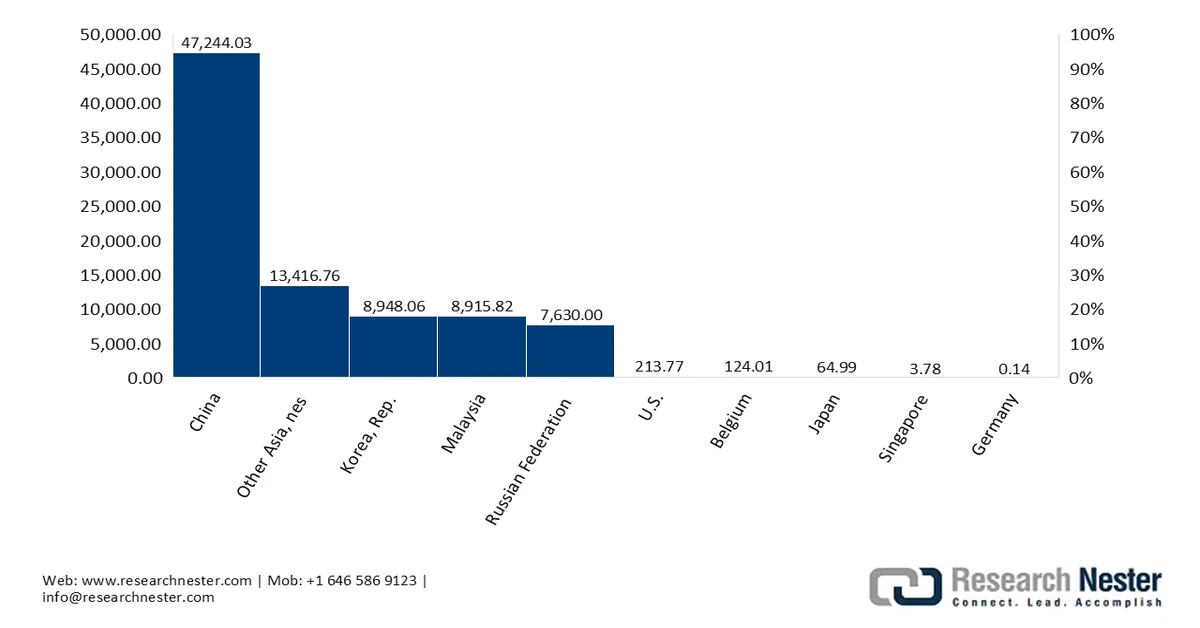
In India, the market is gaining enhanced traction, which is catalyzed by expanding industrial manufacturing capacities and national initiatives that are targeting river rejuvenation and water resource preservation. This market is dependent on a combination of domestic chemical production capabilities and strategic imports of key intermediates to strengthen the availability of raw materials and support the development of a more stable as well as sustainable chemical supply chain. In this context, WITS stated that India’s maleic anhydride import landscape in 2023 indicates strong dependence on Asia -based suppliers, with China being the dominant source. Total imports reached 90.67 million kg valued at USD 86.56 million, with China accounting for more than half of the imported volume.
India Maleic Anhydride Import Statistics by Country in 2023: Top Suppliers & Import Value Analysis
Source: WITS
North America Market Insights
The North America market is experiencing notable growth, which is fueled by strong corporate sustainability efforts and increasing consumer demand for eco-friendly products. The regional market also benefits from heavy industrial sectors, i.e., pulp and paper manufacturing and specialized oilfield water management, that deploy these green chelates to control scale formation. America Association for the Advancement of Science in November 2024 stated that researchers developed a sustainable CO₂ storage method using biobased biodegradable chelating agents and seawater. It also outlined that GLDA-based solutions improved basalt porosity and permeability, enhanced CO₂ capture, and enabled controlled mineralization while reducing freshwater demand. The approach offers a more efficient pathway for geological carbon storage, thus making it suitable for standard market growth.
The U.S. biodegradable chelating agents market is growing exponentially as major consumer packaged goods corporations and heavy industrial sectors match their operations with changing consumer preferences. In the domestic agricultural sector, commercial growers utilize eco-friendly organic complexes with a main goal to optimize trace mineral distribution in high-efficiency liquid fertilizers without triggering toxic chemical accumulation in surrounding soil or groundwater systems. In this context, CHS Inc. in August 2024 introduced Trivar® EZ, which is a granular micronutrient fertilizer blend that consists of a patented Levesol® chelating agent to improve micronutrient and phosphate availability for crops. The company also notes that this EDDHA-based chelate enhances nutrient uptake by preventing phosphorus binding and increasing access to essential elements.
The presence of proactive corporate transitions toward sustainable manufacturing practices is the main factor reshaping the growth dynamics of the market in Canada. In addition, the growing emphasis on green manufacturing, circular economy practices, and the adoption of bio-based ingredients is encouraging manufacturers to develop advanced formulations with improved biodegradability and application efficiency. Based on government data published in June 2023, Canada enacted Bill S-5 to modernize the country’s Environmental Protection Act for the first time in over two decades. Besides, this legislation strengthens chemicals management by recognizing the right to a healthy environment, enhancing cumulative chemical risk assessments, thus promoting safer chemical alternatives and non-animal testing.
Key Biodegradable Chelating Agents Market Players:
- BASF SE (Germany)
- Nouryon (Netherlands)
- NIPPON SHOKUBAI CO., LTD. (Japan)
- Kemira Oyj (Finland)
- Dow Inc (U.S.)
- Innospec (U.S.)
- Company Overview
- Business Strategy
- Key Product Offerings
- Financial Performance
- Key Performance Indicators
- Risk Analysis
- Recent Development
- Regional Presence
- SWOT Analysis
- BASF SE is considered to be the leading player in this industry which is offering bio-based chelating agents for home care and industrial cleaning applications. The company benefits from global manufacturing capabilities, strong R&D, and sustainable chemistry expertise.
- Nouryon is a major manufacturer of biodegradable chelating agents benefiting from its Dissolvine® portfolio, including GLDA and MGDA solutions. The firm’s products serve cleaning, water treatment, textiles, pulp and paper, agriculture, and personal care applications.
- NIPPON SHOKUBAI CO., LTD. is based in Japan, and it offers HIDS™, which is a biodegradable chelating agent designed for detergents, industrial cleaning, water treatment, pulp and paper, and specialty applications. The company is highly focused on advanced specialty chemicals and environmentally friendly solutions.
- Kemira Oyj provides biodegradable chelating solutions under its FennoBio™ range, which is mainly for pulp and paper applications. The firm is concentrating on sustainable process chemicals supported by strong industrial application expertise.
- Dow Inc. manufactures chelating solutions under the VERSENE™ brand, which is suitable for food, pharmaceutical, personal care, and industrial applications. The company benefits from an extensive global manufacturing network and strong technical capabilities.
Here is a list of key players operating in the global market:
The biodegradable chelating agents market exhibits a moderately consolidated competitive landscape, which is being dominated by global specialty chemical manufacturers. These manufacturers possess advanced formulation capabilities, broad manufacturing networks, and strong technical support across different applications. Market leaders are highly focused on biodegradable chelants such as GLDA, MGDA, and IDS for detergents, industrial cleaning, water treatment, agriculture, and personal care applications. For instance, Jungbunzlauer in September 2025 agreed to acquire IFF’s multipurpose manufacturing facility in Thomson, Illinois, marking its entry into the U.S. production landscape and strengthening its North America-based supply capabilities. This acquisition will enhance regional production capacity and help Jungbunzlauer expand its sustainable ingredient solutions.
Corporate Landscape of the Market:
Recent Developments
- In April 2025, BASF introduced Trilon® G, which is a GLDA-based chelating agent that improves cleaning performance by softening water and enhancing surfactant efficiency in home care and industrial cleaning applications. This product offers a partially biobased formulation with almost 56% renewable carbon content.
- In January 2025, Nouryon achieved ISCC PLUS certification for its Herkenbosch, Netherlands manufacturing site, enabling the production of biodegradable green chelating agents using biobased and bio-circular feedstocks with up to 100% renewable carbon index.
- Report ID: 8728
- Published Date: Aug 06, 2026
- Report Format: PDF, PPT
- Explore a preview of key market trends and insights
- Review sample data tables and segment breakdowns
- Experience the quality of our visual data representations
- Evaluate our report structure and research methodology
- Get a glimpse of competitive landscape analysis
- Understand how regional forecasts are presented
- Assess the depth of company profiling and benchmarking
- Preview how actionable insights can support your strategy
Explore real data and analysis
Frequently Asked Questions (FAQ)
About this Report
Connect with our Expert


Report, 2026-2035



Copyright @ 2026 Research Nester. All Rights Reserved.
