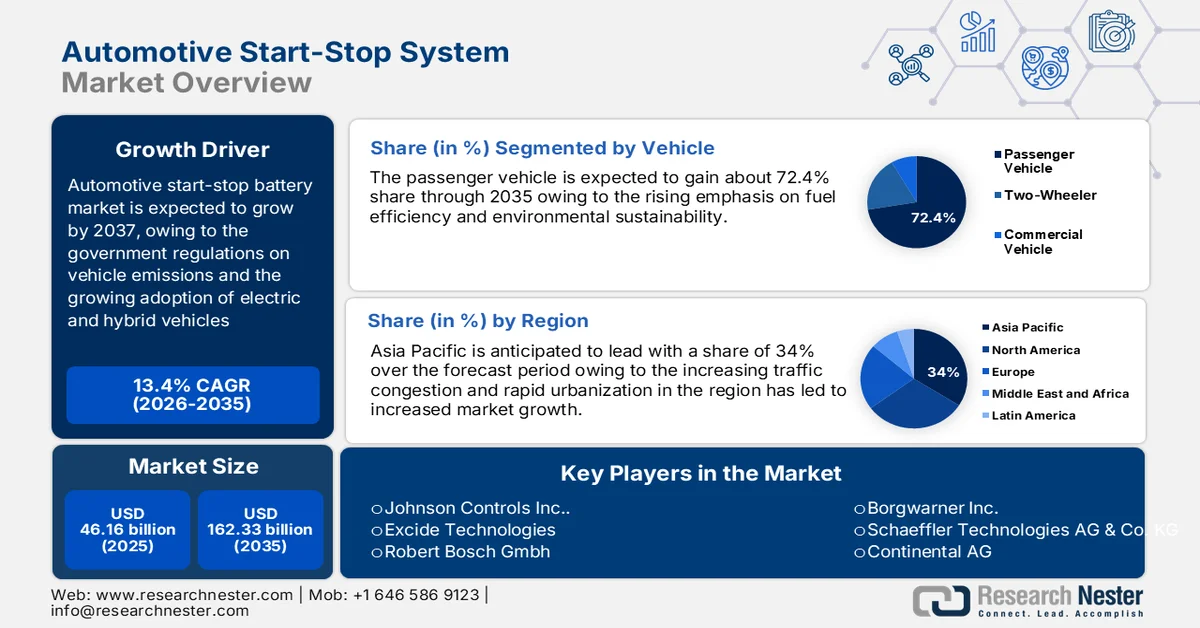
Automotive Start-Stop System Market Outlook:
Automotive Start-Stop System Market size was over USD 46.16 billion in 2025 and is projected to reach USD 162.33 billion by 2035, growing at around 13.4% CAGR during the forecast period i.e., between 2026-2035. In the year 2026, the industry size of automotive start-stop system is assessed at USD 51.73 billion.
Technological advancements play an important role in driving the automotive start-stop system market, as they address the technical demands associated with frequent engine restarts and cycling capabilities. Smart-stop systems which automatically turn off the engine when the vehicle is stationary and restart it when the driver is ready to move, place exclusive stains on batteries. Traditional lead acid batteries were primarily ill-suited to handle the high number of charging and discharging cycles that start-stop systems require leading to earlier degradation.
Nevertheless, recent technological advancements in battery technology have led to the development of Absorbent Glass Mat (AGM) and Enhanced Flooded Batteries (EFBs) batteries which provide improved cycle life and durability making them more appropriate for start-stop applications. For example, in September 2024, Robert Bosch GmbH introduced S5 AX auxiliary battery to operate new safety systems which help to satisfy the rising demand for convenience functions, and run start-stop systems, as passenger cars need much more power.
Integrating mostly powerful and reliable AGM technology, the backup batteries have been specially developed for combustion engine vehicles highlighting dual battery systems. Similarly, in February 2020, Bosch accelerated the development of electric vehicles with customized solutions including a 48V hybrid system that enables continued powertrain electrification for small passenger cars with complete charging through recuperation. The system helps functions such as advanced start-stop, regenerative braking, and coasting while improving efficiency and driving experience.