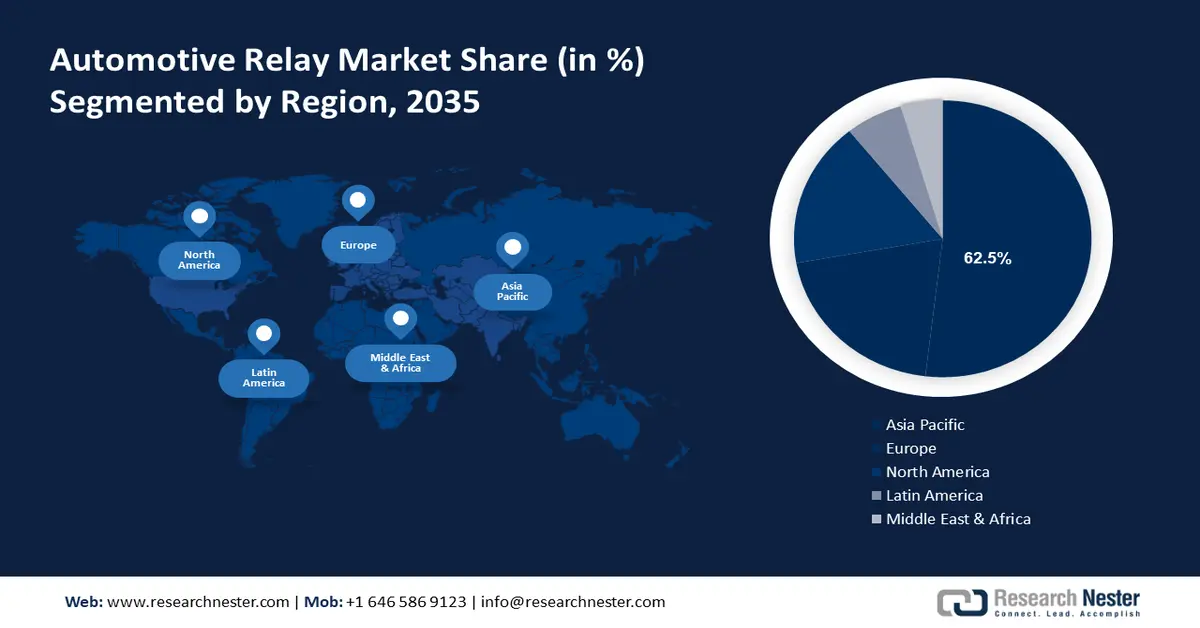
Automotive Relay Market Regional Analysis:
Asia Pacific Market Insights
Asia Pacific industry is set to account for largest revenue share of 62.5% by 2035. It is projected that the market in various Asian countries including China, India, Japan, and South Korea will grow as safety regulations are adopted. The widespread use of automobiles in developing nations is boosting market growth. According to a report by Research Nester, the automobile industry produced a total of 28.43 million vehicles, comprising passenger cars, commercial vehicles, three-wheelers, two-wheelers, and quadricycles between April 2023 to March 2024.
China has great economic potential, driven by the expanding requirement for automobiles. As of 2022, 319 million cars were registered in China. Over the past ten years, China's parking lot has expanded significantly, increasing by more than 132%.
In India, rising demand for connection and the digitalization of cars will positively affect automotive relay market growth during the forecast period. Additionally, the small passenger car segment's growth potential has significantly pushed the demand for auto wire harnesses due to space constraints. There are opportunities for market expansion provided by strict government rules requiring specific electronic safety systems, including the Electronic Stability Program (ESP) and Anti-locking Braking System (ABS), to prevent dangerous fuel emissions.
North America Market Insights
North America automotive relay market is expected to experience a stable CAGR during the forecast period due to rising connectivity demand, vehicle digitization, and rising sales of all types of automobiles. Furthermore, the strong growth potential of the tiny car market due to space constraints has raised the demand for automotive relays dramatically.
In the U.S., insurance companies provide customers discounts on insurance contracts, and utility companies provide low energy costs. Furthermore, very few states compensate manufacturers and buyers of electric vehicles for their costs as well as the infrastructure costs associated with charging them. The federal government offers tax credits of up to USD 7,500 for plug-in electric cars.