Global Automotive Gas Spring Market
1. An Outline of the Global Automotive Gas Spring Market
1.1. Market Definition and Segmentation
1.2. Study Assumptions and Abbreviations
2. Research Methodology & Approach
2.1. Primary Research
2.2. Secondary Research
2.3. Data Triangulation
2.4. SPSS Methodology
3. Executive Summary
4. Growth Drivers
5. Major Roadblocks
6. Opportunities
7. Prevalent Trends
8. Government Regulation
9. Growth Outlook
10. Competitive White Space Analysis – Identifying Untapped Market Gaps
11. Risk Overview
12. SWOT
13. Technological Advancement
14. Technology Maturity Matrix for the Automotive Gas Spring Market: Recent News
15. Regional Demand
16. Global Automotive Gas Spring by Geography – Strategic Comparative Analysis
17. Strategic Segment Analysis: Automotive Gas Spring Demand Landscape
18. Automotive Gas Spring Demand Trends Driven by the expansion of global vehicle production, rising adoption of SUVs and crossovers, and growing demand for vehicle convenience features. (2027-2036)
19. Root Cause Analysis (RCA) for discovering problems of the Automotive Gas Spring Market
20. Porter Five Forces
21. PESTLE
22. Comparative Positioning
23. Global Automotive Gas Spring – Key Player Analysis (2036)
24. Competitive Landscape: Key Suppliers/Players
25. Competitive Model: A Detailed Inside View for Investors
26. Company Market Share, 2036 (%)
26.1. SUNPREIN Co., Ltd.
26.2. Shanghai Zhenyuan Auto Parts Co., Ltd.
26.3. WAN DER FUL Co., Ltd
26.4. Changzhou Longxiang Gas Spring Co., Ltd.
26.5. LST Gas Springs
26.6. OneMonroe (Monroe Engineering)
26.7. Bansbach Easylift GmbH
26.8. SUSPA GmbH
26.9. Stabilus SE
26.10. Lucas Automotive Aftermarket
26.11. Normont
26.12. Struts Africa
26.13. GAYSAN Gas Springs.
27. Global Automotive Gas Spring Market Outlook
27.1. Market Overview
27.1.1. Market Revenue by Value (USD Million), by Volume (Thousand Units), and Compound Annual Growth Rate (CAGR)
27.2. Automotive Gas Spring Market Segmentation Analysis (2027-2036)
27.2.1. By Product
27.2.1.1. Compression Gas Springs, Market Value (USD Million), and CAGR, 2027-2036F
27.2.1.2. Lockable Gas Springs, Market Value (USD Million), and CAGR, 2027-2036F
27.2.1.3. Traction (Tension) Gas Springs, Market Value (USD Million), and CAGR, 2027-2036F
27.2.1.4. Dampers & Motion Control Gas Springs, Market Value (USD Million), and CAGR, 2027-2036F
27.2.1.5. Others, Market Value (USD Million), and CAGR, 2027-2036F
27.2.2. By Force Capacity
27.2.2.1. Below 200 N, Market Value (USD Million), and CAGR, 2027-2036F
27.2.2.2. 200–400 N, Market Value (USD Million), and CAGR, 2027-2036F
27.2.2.3. 401–600 N, Market Value (USD Million), and CAGR, 2027-2036F
27.2.2.4. 601–800 N, Market Value (USD Million), and CAGR, 2027-2036F
27.2.2.5. Above 800 N, Market Value (USD Million), and CAGR, 2027-2036F
27.2.3. By Mounting Orientation
27.2.3.1. Vertical Mounting, Market Value (USD Million), and CAGR, 2027-2036F
27.2.3.2. Horizontal Mounting, Market Value (USD Million), and CAGR, 2027-2036F
27.2.3.3. Angled Mounting, Market Value (USD Million), and CAGR, 2027-2036F
27.2.4. By Material
27.2.4.1. Carbon Steel, Market Value (USD Million), and CAGR, 2027-2036F
27.2.4.2. Stainless Steel, Market Value (USD Million), and CAGR, 2027-2036F
27.2.4.3. Aluminum Alloy, Market Value (USD Million), and CAGR, 2027-2036F
27.2.4.4. Others, Market Value (USD Million), and CAGR, 2027-2036F
27.2.5. By Vehicle
27.2.5.1. Hatchback, Market Value (USD Million), and CAGR, 2027-2036F
27.2.5.2. Sedan, Market Value (USD Million), and CAGR, 2027-2036F
27.2.5.3. SUV Alloy, Market Value (USD Million), and CAGR, 2027-2036F
27.2.5.4. Others, Market Value (USD Million), and CAGR, 2027-2036F
27.2.6. By Powertrain
27.2.6.1. Internal Combustion Engine (ICE), Market Value (USD Million), and CAGR, 2027-2036F
27.2.6.2. Hybrid Electric Vehicle (HEV), Market Value (USD Million), and CAGR, 2027-2036F
27.2.6.3. Battery Electric Vehicle (BEV), Market Value (USD Million), and CAGR, 2027-2036F
27.2.6.4. Others, Market Value (USD Million), and CAGR, 2027-2036F
27.2.7. By Application
27.2.7.1. Tailgate/Liftgate, Market Value (USD Million), and CAGR, 2027-2036F
27.2.7.2. Trunk Lid/Boot, Market Value (USD Million), and CAGR, 2027-2036F
27.2.7.3. Engine Hood (Bonnet), Market Value (USD Million), and CAGR, 2027-2036F
27.2.7.4. Others, Market Value (USD Million), and CAGR, 2027-2036F
27.2.8. By Sales Channel
27.2.8.1. Original Equipment Manufacturer (OEM), Market Value (USD Million), and CAGR, 2027-2036F
27.2.8.2. Aftermarket, Market Value (USD Million), and CAGR, 2027-2036F
27.2.9. Regional Synopsis, Value (USD Million), 2027-2036
27.2.9.1. North America Market Value (USD Million) and CAGR & Y-o-Y Growth Trend, 2027-2036F
27.2.9.2. Europe Market Value (USD Million) and CAGR & Y-o-Y Growth Trend, 2027-2036F
27.2.9.3. Asia Pacific, excluding Japan Market Value (USD Million) and CAGR & Y-o-Y Growth Trend, 2027-2036F
27.2.9.4. Latin America Market Value (USD Million) and CAGR & Y-o-Y Growth Trend, 2027-2036F
27.2.9.5. Middle East and Africa Market Value (USD Million) and CAGR & Y-o-Y Growth Trend, 2027-2036F
28. North America Market
28.1. Overview
28.1.1. Market Value (USD Million), Current and Future Projections, 2027-2036
28.1.2. Increment $ Opportunity Assessment, 2027-2036
28.2. Segmentation (USD Million), 2027-2036, By
28.2.1. By Product
28.2.1.1. Compression Gas Springs, Market Value (USD Million), and CAGR, 2027-2036F
28.2.1.2. Lockable Gas Springs, Market Value (USD Million), and CAGR, 2027-2036F
28.2.1.3. Traction (Tension) Gas Springs, Market Value (USD Million), and CAGR, 2027-2036F
28.2.1.4. Dampers & Motion Control Gas Springs, Market Value (USD Million), and CAGR, 2027-2036F
28.2.1.5. Others, Market Value (USD Million), and CAGR, 2027-2036F
28.2.2. By Force Capacity
28.2.2.1. Below 200 N, Market Value (USD Million), and CAGR, 2027-2036F
28.2.2.2. 200–400 N, Market Value (USD Million), and CAGR, 2027-2036F
28.2.2.3. 401–600 N, Market Value (USD Million), and CAGR, 2027-2036F
28.2.2.4. 601–800 N, Market Value (USD Million), and CAGR, 2027-2036F
28.2.2.5. Above 800 N, Market Value (USD Million), and CAGR, 2027-2036F
28.2.3. By Mounting Orientation
28.2.3.1. Vertical Mounting, Market Value (USD Million), and CAGR, 2027-2036F
28.2.3.2. Horizontal Mounting, Market Value (USD Million), and CAGR, 2027-2036F
28.2.3.3. Angled Mounting, Market Value (USD Million), and CAGR, 2027-2036F
28.2.4. By Material
28.2.4.1. Carbon Steel, Market Value (USD Million), and CAGR, 2027-2036F
28.2.4.2. Stainless Steel, Market Value (USD Million), and CAGR, 2027-2036F
28.2.4.3. Aluminum Alloy, Market Value (USD Million), and CAGR, 2027-2036F
28.2.4.4. Others, Market Value (USD Million), and CAGR, 2027-2036F
28.2.5. By Vehicle
28.2.5.1. Hatchback, Market Value (USD Million), and CAGR, 2027-2036F
28.2.5.2. Sedan, Market Value (USD Million), and CAGR, 2027-2036F
28.2.5.3. SUV Alloy, Market Value (USD Million), and CAGR, 2027-2036F
28.2.5.4. Others, Market Value (USD Million), and CAGR, 2027-2036F
28.2.6. By Powertrain
28.2.6.1. Internal Combustion Engine (ICE), Market Value (USD Million), and CAGR, 2027-2036F
28.2.6.2. Hybrid Electric Vehicle (HEV), Market Value (USD Million), and CAGR, 2027-2036F
28.2.6.3. Battery Electric Vehicle (BEV), Market Value (USD Million), and CAGR, 2027-2036F
28.2.6.4. Others, Market Value (USD Million), and CAGR, 2027-2036F
28.2.7. By Application
28.2.7.1. Tailgate/Liftgate, Market Value (USD Million), and CAGR, 2027-2036F
28.2.7.2. Trunk Lid/Boot, Market Value (USD Million), and CAGR, 2027-2036F
28.2.7.3. Engine Hood (Bonnet), Market Value (USD Million), and CAGR, 2027-2036F
28.2.7.4. Others, Market Value (USD Million), and CAGR, 2027-2036F
28.2.8. By Sales Channel
28.2.8.1. Original Equipment Manufacturer (OEM), Market Value (USD Million), and CAGR, 2027-2036F
28.2.8.2. Aftermarket, Market Value (USD Million), and CAGR, 2027-2036F
28.2.9. Country Level Analysis, Value (USD Million)
28.2.9.1. U.S. Market Value (USD Million) and CAGR & Y-o-Y Growth Trend, 2027-2036F
28.2.9.2. Canada Market Value (USD Million) and CAGR & Y-o-Y Growth Trend, 2027-2036F
29. Europe Market
29.1. Overview
29.1.1. Market Value (USD Million), Current and Future Projections, 2027-2036
29.1.2. Increment $ Opportunity Assessment, 2027-2036
29.2. Segmentation (USD Million), 2027-2036, By
29.2.1. By Product
29.2.1.1. Compression Gas Springs, Market Value (USD Million), and CAGR, 2027-2036F
29.2.1.2. Lockable Gas Springs, Market Value (USD Million), and CAGR, 2027-2036F
29.2.1.3. Traction (Tension) Gas Springs, Market Value (USD Million), and CAGR, 2027-2036F
29.2.1.4. Dampers & Motion Control Gas Springs, Market Value (USD Million), and CAGR, 2027-2036F
29.2.1.5. Others, Market Value (USD Million), and CAGR, 2027-2036F
29.2.2. By Force Capacity
29.2.2.1. Below 200 N, Market Value (USD Million), and CAGR, 2027-2036F
29.2.2.2. 200–400 N, Market Value (USD Million), and CAGR, 2027-2036F
29.2.2.3. 401–600 N, Market Value (USD Million), and CAGR, 2027-2036F
29.2.2.4. 601–800 N, Market Value (USD Million), and CAGR, 2027-2036F
29.2.2.5. Above 800 N, Market Value (USD Million), and CAGR, 2027-2036F
29.2.3. By Mounting Orientation
29.2.3.1. Vertical Mounting, Market Value (USD Million), and CAGR, 2027-2036F
29.2.3.2. Horizontal Mounting, Market Value (USD Million), and CAGR, 2027-2036F
29.2.3.3. Angled Mounting, Market Value (USD Million), and CAGR, 2027-2036F
29.2.4. By Material
29.2.4.1. Carbon Steel, Market Value (USD Million), and CAGR, 2027-2036F
29.2.4.2. Stainless Steel, Market Value (USD Million), and CAGR, 2027-2036F
29.2.4.3. Aluminum Alloy, Market Value (USD Million), and CAGR, 2027-2036F
29.2.4.4. Others, Market Value (USD Million), and CAGR, 2027-2036F
29.2.5. By Vehicle
29.2.5.1. Hatchback, Market Value (USD Million), and CAGR, 2027-2036F
29.2.5.2. Sedan, Market Value (USD Million), and CAGR, 2027-2036F
29.2.5.3. SUV Alloy, Market Value (USD Million), and CAGR, 2027-2036F
29.2.5.4. Others, Market Value (USD Million), and CAGR, 2027-2036F
29.2.6. By Powertrain
29.2.6.1. Internal Combustion Engine (ICE), Market Value (USD Million), and CAGR, 2027-2036F
29.2.6.2. Hybrid Electric Vehicle (HEV), Market Value (USD Million), and CAGR, 2027-2036F
29.2.6.3. Battery Electric Vehicle (BEV), Market Value (USD Million), and CAGR, 2027-2036F
29.2.6.4. Others, Market Value (USD Million), and CAGR, 2027-2036F
29.2.7. By Application
29.2.7.1. Tailgate/Liftgate, Market Value (USD Million), and CAGR, 2027-2036F
29.2.7.2. Trunk Lid/Boot, Market Value (USD Million), and CAGR, 2027-2036F
29.2.7.3. Engine Hood (Bonnet), Market Value (USD Million), and CAGR, 2027-2036F
29.2.7.4. Others, Market Value (USD Million), and CAGR, 2027-2036F
29.2.8. By Sales Channel
29.2.8.1. Original Equipment Manufacturer (OEM), Market Value (USD Million), and CAGR, 2027-2036F
29.2.8.2. Aftermarket, Market Value (USD Million), and CAGR, 2027-2036F
29.2.9. Country Level Analysis, Value (USD Million)
29.2.9.1. UK Market Value (USD Million) and CAGR & Y-o-Y Growth Trend, 2027-2036F
29.2.9.2. Germany Market Value (USD Million) and CAGR & Y-o-Y Growth Trend, 2027-2036F
29.2.9.3. France Market Value (USD Million) and CAGR & Y-o-Y Growth Trend, 2027-2036F
29.2.9.4. Italy Market Value (USD Million) and CAGR & Y-o-Y Growth Trend, 2027-2036F
29.2.9.5. Spain Market Value (USD Million) and CAGR & Y-o-Y Growth Trend, 2027-2036F
29.2.9.6. Netherlands Market Value (USD Million) and CAGR & Y-o-Y Growth Trend, 2027-2036F
29.2.9.7. Russia Market Value (USD Million) and CAGR & Y-o-Y Growth Trend, 2027-2036F
29.2.9.8. Switzerland Market Value (USD Million) and CAGR & Y-o-Y Growth Trend, 2027-2036F
29.2.9.9. Poland Market Value (USD Million) and CAGR & Y-o-Y Growth Trend, 2027-2036F
29.2.9.10. Belgium Market Value (USD Million) and CAGR & Y-o-Y Growth Trend, 2027-2036F
29.2.9.11. Rest of Europe Market Value (USD Million) and CAGR & Y-o-Y Growth Trend, 2027-2036F
30. Asia Pacific Market
30.1. Overview
30.1.1. Market Value (USD Million), Current and Future Projections, 2027-2036
30.1.2. Increment $ Opportunity Assessment, 2027-2036
30.2. Segmentation (USD Million), 2027-2036, By
30.2.1. By Product
30.2.1.1. Compression Gas Springs, Market Value (USD Million), and CAGR, 2027-2036F
30.2.1.2. Lockable Gas Springs, Market Value (USD Million), and CAGR, 2027-2036F
30.2.1.3. Traction (Tension) Gas Springs, Market Value (USD Million), and CAGR, 2027-2036F
30.2.1.4. Dampers & Motion Control Gas Springs, Market Value (USD Million), and CAGR, 2027-2036F
30.2.1.5. Others, Market Value (USD Million), and CAGR, 2027-2036F
30.2.2. By Force Capacity
30.2.2.1. Below 200 N, Market Value (USD Million), and CAGR, 2027-2036F
30.2.2.2. 200–400 N, Market Value (USD Million), and CAGR, 2027-2036F
30.2.2.3. 401–600 N, Market Value (USD Million), and CAGR, 2027-2036F
30.2.2.4. 601–800 N, Market Value (USD Million), and CAGR, 2027-2036F
30.2.2.5. Above 800 N, Market Value (USD Million), and CAGR, 2027-2036F
30.2.3. By Mounting Orientation
30.2.3.1. Vertical Mounting, Market Value (USD Million), and CAGR, 2027-2036F
30.2.3.2. Horizontal Mounting, Market Value (USD Million), and CAGR, 2027-2036F
30.2.3.3. Angled Mounting, Market Value (USD Million), and CAGR, 2027-2036F
30.2.4. By Material
30.2.4.1. Carbon Steel, Market Value (USD Million), and CAGR, 2027-2036F
30.2.4.2. Stainless Steel, Market Value (USD Million), and CAGR, 2027-2036F
30.2.4.3. Aluminum Alloy, Market Value (USD Million), and CAGR, 2027-2036F
30.2.4.4. Others, Market Value (USD Million), and CAGR, 2027-2036F
30.2.5. By Vehicle
30.2.5.1. Hatchback, Market Value (USD Million), and CAGR, 2027-2036F
30.2.5.2. Sedan, Market Value (USD Million), and CAGR, 2027-2036F
30.2.5.3. SUV Alloy, Market Value (USD Million), and CAGR, 2027-2036F
30.2.5.4. Others, Market Value (USD Million), and CAGR, 2027-2036F
30.2.6. By Powertrain
30.2.6.1. Internal Combustion Engine (ICE), Market Value (USD Million), and CAGR, 2027-2036F
30.2.6.2. Hybrid Electric Vehicle (HEV), Market Value (USD Million), and CAGR, 2027-2036F
30.2.6.3. Battery Electric Vehicle (BEV), Market Value (USD Million), and CAGR, 2027-2036F
30.2.6.4. Others, Market Value (USD Million), and CAGR, 2027-2036F
30.2.7. By Application
30.2.7.1. Tailgate/Liftgate, Market Value (USD Million), and CAGR, 2027-2036F
30.2.7.2. Trunk Lid/Boot, Market Value (USD Million), and CAGR, 2027-2036F
30.2.7.3. Engine Hood (Bonnet), Market Value (USD Million), and CAGR, 2027-2036F
30.2.7.4. Others, Market Value (USD Million), and CAGR, 2027-2036F
30.2.8. By Sales Channel
30.2.8.1. Original Equipment Manufacturer (OEM), Market Value (USD Million), and CAGR, 2027-2036F
30.2.8.2. Aftermarket, Market Value (USD Million), and CAGR, 2027-2036F
30.2.9. Country Level Analysis, Value (USD Million)
30.2.9.1. China Market Value (USD Million) and CAGR & Y-o-Y Growth Trend, 2027-2036F
30.2.9.2. Japan Market Value (USD Million) and CAGR & Y-o-Y Growth Trend, 2027-2036F
30.2.9.3. India Market Value (USD Million) and CAGR & Y-o-Y Growth Trend, 2027-2036F
30.2.9.4. South Korea Market Value (USD Million) and CAGR & Y-o-Y Growth Trend, 2027-2036F
30.2.9.5. Australia Market Value (USD Million) and CAGR & Y-o-Y Growth Trend, 2027-2036F
30.2.9.6. Indonesia Market Value (USD Million) and CAGR & Y-o-Y Growth Trend, 2027-2036F
30.2.9.7. Malaysia Market Value (USD Million) and CAGR & Y-o-Y Growth Trend, 2027-2036F
30.2.9.8. Vietnam Market Value (USD Million) and CAGR & Y-o-Y Growth Trend, 2027-2036F
30.2.9.9. Thailand Market Value (USD Million) and CAGR & Y-o-Y Growth Trend, 2027-2036F
30.2.9.10. Singapore Market Value (USD Million) and CAGR & Y-o-Y Growth Trend, 2027-2036F
30.2.9.11. New Zealand Market Value (USD Million) and CAGR & Y-o-Y Growth Trend, 2027-2036F
30.2.9.12. Rest of Asia Pacific Excluding Japan Market Value (USD Million) and CAGR & Y-o-Y Growth Trend, 2027-2036F
31. Latin America Market
31.1. Overview
31.1.1. Market Value (USD Million), Current and Future Projections, 2027-2036
31.1.2. Increment $ Opportunity Assessment, 2027-2036
31.1.3. Year-on-Year Growth Forecast (%)
31.2. Segmentation (USD Million), 2027-2036, By
31.2.1. By Product
31.2.1.1. Compression Gas Springs, Market Value (USD Million), and CAGR, 2027-2036F
31.2.1.2. Lockable Gas Springs, Market Value (USD Million), and CAGR, 2027-2036F
31.2.1.3. Traction (Tension) Gas Springs, Market Value (USD Million), and CAGR, 2027-2036F
31.2.1.4. Dampers & Motion Control Gas Springs, Market Value (USD Million), and CAGR, 2027-2036F
31.2.1.5. Others, Market Value (USD Million), and CAGR, 2027-2036F
31.2.2. By Force Capacity
31.2.2.1. Below 200 N, Market Value (USD Million), and CAGR, 2027-2036F
31.2.2.2. 200–400 N, Market Value (USD Million), and CAGR, 2027-2036F
31.2.2.3. 401–600 N, Market Value (USD Million), and CAGR, 2027-2036F
31.2.2.4. 601–800 N, Market Value (USD Million), and CAGR, 2027-2036F
31.2.2.5. Above 800 N, Market Value (USD Million), and CAGR, 2027-2036F
31.2.3. By Mounting Orientation
31.2.3.1. Vertical Mounting, Market Value (USD Million), and CAGR, 2027-2036F
31.2.3.2. Horizontal Mounting, Market Value (USD Million), and CAGR, 2027-2036F
31.2.3.3. Angled Mounting, Market Value (USD Million), and CAGR, 2027-2036F
31.2.4. By Material
31.2.4.1. Carbon Steel, Market Value (USD Million), and CAGR, 2027-2036F
31.2.4.2. Stainless Steel, Market Value (USD Million), and CAGR, 2027-2036F
31.2.4.3. Aluminum Alloy, Market Value (USD Million), and CAGR, 2027-2036F
31.2.4.4. Others, Market Value (USD Million), and CAGR, 2027-2036F
31.2.5. By Vehicle
31.2.5.1. Hatchback, Market Value (USD Million), and CAGR, 2027-2036F
31.2.5.2. Sedan, Market Value (USD Million), and CAGR, 2027-2036F
31.2.5.3. SUV Alloy, Market Value (USD Million), and CAGR, 2027-2036F
31.2.5.4. Others, Market Value (USD Million), and CAGR, 2027-2036F
31.2.6. By Powertrain
31.2.6.1. Internal Combustion Engine (ICE), Market Value (USD Million), and CAGR, 2027-2036F
31.2.6.2. Hybrid Electric Vehicle (HEV), Market Value (USD Million), and CAGR, 2027-2036F
31.2.6.3. Battery Electric Vehicle (BEV), Market Value (USD Million), and CAGR, 2027-2036F
31.2.6.4. Others, Market Value (USD Million), and CAGR, 2027-2036F
31.2.7. By Application
31.2.7.1. Tailgate/Liftgate, Market Value (USD Million), and CAGR, 2027-2036F
31.2.7.2. Trunk Lid/Boot, Market Value (USD Million), and CAGR, 2027-2036F
31.2.7.3. Engine Hood (Bonnet), Market Value (USD Million), and CAGR, 2027-2036F
31.2.7.4. Others, Market Value (USD Million), and CAGR, 2027-2036F
31.2.8. By Sales Channel
31.2.8.1. Original Equipment Manufacturer (OEM), Market Value (USD Million), and CAGR, 2027-2036F
31.2.8.2. Aftermarket, Market Value (USD Million), and CAGR, 2027-2036F
31.2.9. Country Level Analysis, Value (USD Million)
31.2.9.1. Brazil Market Value (USD Million) and CAGR & Y-o-Y Growth Trend, 2027-2036F
31.2.9.2. Argentina Market Value (USD Million) and CAGR & Y-o-Y Growth Trend, 2027-2036F
31.2.9.3. Mexico Market Value (USD Million) and CAGR & Y-o-Y Growth Trend, 2027-2036F
31.2.9.4. Rest of Latin America Market Value (USD Million) and CAGR & Y-o-Y Growth Trend, 2027-2036F
32. Middle East & Africa Market
32.1. Overview
32.1.1. Market Value (USD Million), Current and Future Projections, 2027-2036
32.1.2. Increment $ Opportunity Assessment, 2027-2036
32.1.3. Year-on-Year Growth Forecast (%)
32.2. Segmentation (USD Million), 2027-2036, By
32.2.1. By Product
32.2.1.1. Compression Gas Springs, Market Value (USD Million), and CAGR, 2027-2036F
32.2.1.2. Lockable Gas Springs, Market Value (USD Million), and CAGR, 2027-2036F
32.2.1.3. Traction (Tension) Gas Springs, Market Value (USD Million), and CAGR, 2027-2036F
32.2.1.4. Dampers & Motion Control Gas Springs, Market Value (USD Million), and CAGR, 2027-2036F
32.2.1.5. Others, Market Value (USD Million), and CAGR, 2027-2036F
32.2.2. By Force Capacity
32.2.2.1. Below 200 N, Market Value (USD Million), and CAGR, 2027-2036F
32.2.2.2. 200–400 N, Market Value (USD Million), and CAGR, 2027-2036F
32.2.2.3. 401–600 N, Market Value (USD Million), and CAGR, 2027-2036F
32.2.2.4. 601–800 N, Market Value (USD Million), and CAGR, 2027-2036F
32.2.2.5. Above 800 N, Market Value (USD Million), and CAGR, 2027-2036F
32.2.3. By Mounting Orientation
32.2.3.1. Vertical Mounting, Market Value (USD Million), and CAGR, 2027-2036F
32.2.3.2. Horizontal Mounting, Market Value (USD Million), and CAGR, 2027-2036F
32.2.3.3. Angled Mounting, Market Value (USD Million), and CAGR, 2027-2036F
32.2.4. By Material
32.2.4.1. Carbon Steel, Market Value (USD Million), and CAGR, 2027-2036F
32.2.4.2. Stainless Steel, Market Value (USD Million), and CAGR, 2027-2036F
32.2.4.3. Aluminum Alloy, Market Value (USD Million), and CAGR, 2027-2036F
32.2.4.4. Others, Market Value (USD Million), and CAGR, 2027-2036F
32.2.5. By Vehicle
32.2.5.1. Hatchback, Market Value (USD Million), and CAGR, 2027-2036F
32.2.5.2. Sedan, Market Value (USD Million), and CAGR, 2027-2036F
32.2.5.3. SUV Alloy, Market Value (USD Million), and CAGR, 2027-2036F
32.2.5.4. Others, Market Value (USD Million), and CAGR, 2027-2036F
32.2.6. By Powertrain
32.2.6.1. Internal Combustion Engine (ICE), Market Value (USD Million), and CAGR, 2027-2036F
32.2.6.2. Hybrid Electric Vehicle (HEV), Market Value (USD Million), and CAGR, 2027-2036F
32.2.6.3. Battery Electric Vehicle (BEV), Market Value (USD Million), and CAGR, 2027-2036F
32.2.6.4. Others, Market Value (USD Million), and CAGR, 2027-2036F
32.2.7. By Application
32.2.7.1. Tailgate/Liftgate, Market Value (USD Million), and CAGR, 2027-2036F
32.2.7.2. Trunk Lid/Boot, Market Value (USD Million), and CAGR, 2027-2036F
32.2.7.3. Engine Hood (Bonnet), Market Value (USD Million), and CAGR, 2027-2036F
32.2.7.4. Others, Market Value (USD Million), and CAGR, 2027-2036F
32.2.8. By Sales Channel
32.2.8.1. Original Equipment Manufacturer (OEM), Market Value (USD Million), and CAGR, 2027-2036F
32.2.8.2. Aftermarket, Market Value (USD Million), and CAGR, 2027-2036F
32.2.9. Country Level Analysis, Value (USD Million)
32.2.9.1. Saudi Arabia Market Value (USD Million) and CAGR & Y-o-Y Growth Trend, 2027-2036F
32.2.9.2. UAE Market Value (USD Million) and CAGR & Y-o-Y Growth Trend, 2027-2036F
32.2.9.3. Israel Market Value (USD Million) and CAGR & Y-o-Y Growth Trend, 2027-2036F
32.2.9.4. Qatar Market Value (USD Million) and CAGR & Y-o-Y Growth Trend, 2027-2036F
32.2.9.5. Kuwait Market Value (USD Million) and CAGR & Y-o-Y Growth Trend, 2027-2036F
32.2.9.6. Oman Market Value (USD Million) and CAGR & Y-o-Y Growth Trend, 2027-2036F
32.2.9.7. South Africa Market Value (USD Million) and CAGR & Y-o-Y Growth Trend, 2027-2036F
32.2.9.8. Rest of Middle East & Africa Market Value (USD Million) and CAGR & Y-o-Y Growth Trend, 2027-2036F
33. Global Economic Scenario
33.1. World Economic Outlook
34. About Research Nester
34.1. Our Global Clientele
34.2. We Serve Clients Across World
Automotive Gas Spring Market Outlook:
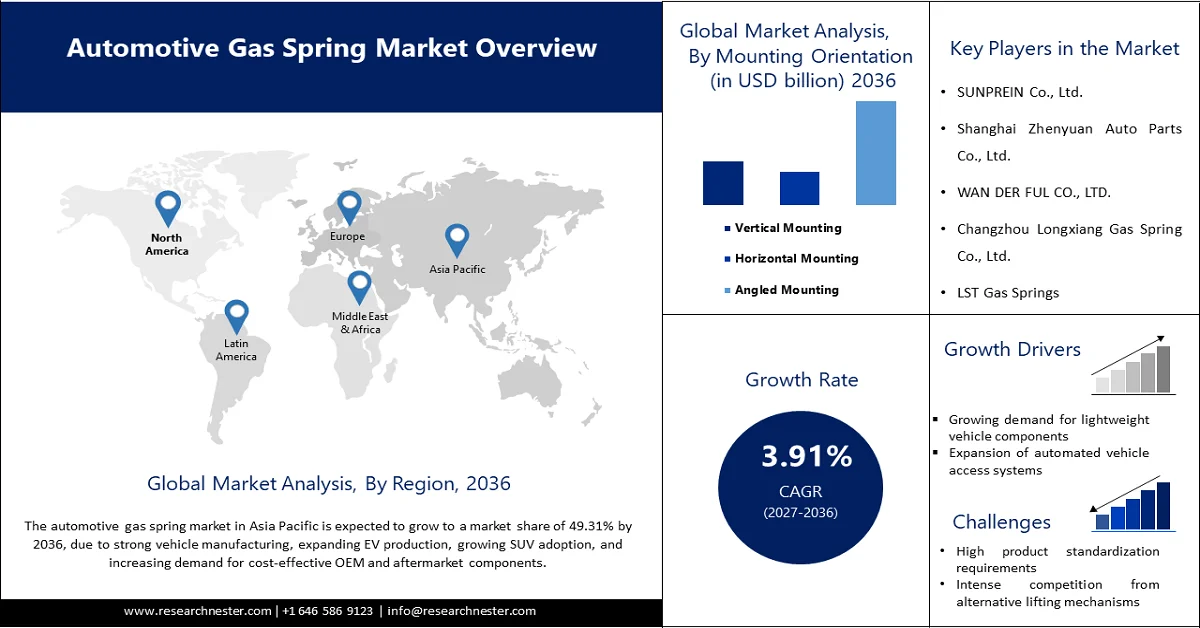
Automotive Gas Spring Market size was valued at USD 1.20 billion in 2026 and is projected to reach USD 1.78 billion by the end of 2036, registering around 3.91% CAGR during the forecast period, i.e., between 2027-2036. In 2027, the industry size of automotive gas spring is estimated at USD 1.26 billion.
The swift expansion of vehicle production and registration across the world is fueling the demand for gas spring solutions. Passenger cars, SUVs, pickup trucks, and other vehicles are mainly driving the trade of automotive springs. According to the International Energy Agency (IEA), global car sales neared 80 million in 2024, with electric and hybrid vehicles accounting for about 30% of the total. Sales growth came entirely from these vehicles, while conventional petrol and diesel car sales have dropped 30% since peaking in 2017. Electric car sales grew more than fourteenfold over this period, representing over one-fifth of worldwide car sales in 2024. Thus, the consistent growth in vehicle trade is set to double the revenues of gas spring producers during the forecast period.
Key Automotive Gas Spring Market Insights Summary:
Regional Highlights:
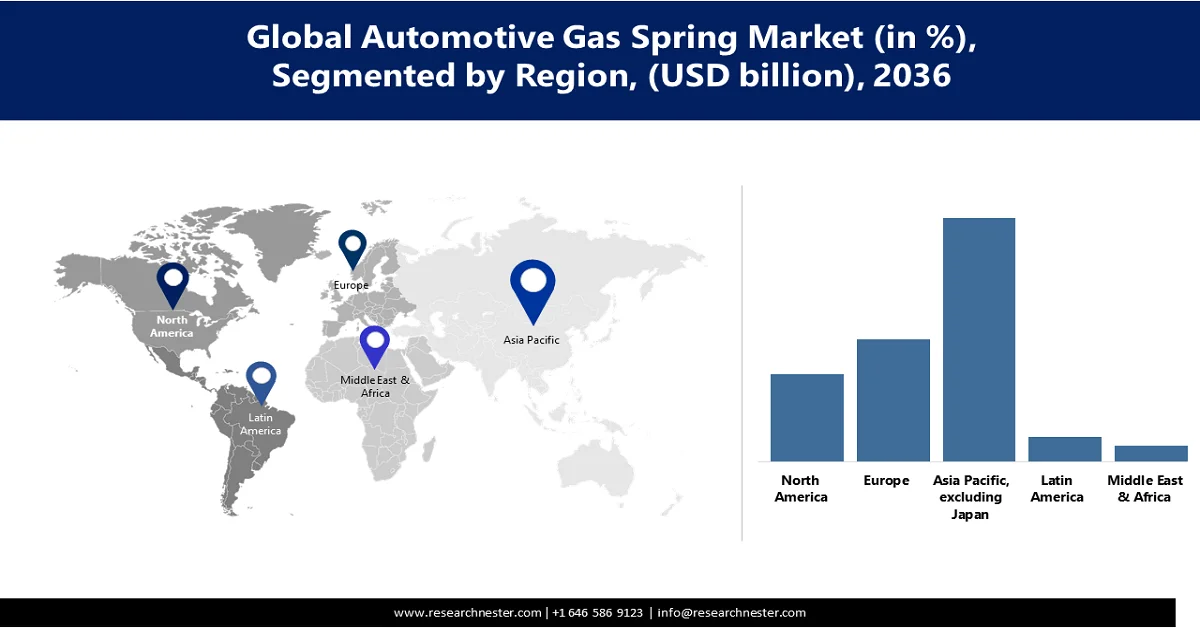
- Asia Pacific is projected to command 49.31% share by 2036 in the automotive gas spring market, supported by its large automotive manufacturing base and expanding vehicle ownership.
- Europe is anticipated to maintain 24.79% share by 2036, bolstered by established automotive manufacturing and rising electric and hybrid vehicle production.
- The U.S. is projected to account for 91.77% of the North America market share through 2036, mainly owing to the country's large automotive fleet, substantial production of light vehicles, and strong consumer preference for SUVs, pickup trucks, and crossovers.
- The Japan market volume is expected to be calculated at 19,990.23 thousand units in 2027, due to a mature vehicle industry, advanced automotive engineering capabilities, and strong emphasis on component quality, reliability, and precision.
Segment Insights:
- Compression gas springs are projected to account for 64.83% share by 2036, propelled by growing demand for convenient and ergonomic assisted-opening systems.
- Angled mounting is expected to capture 56.86% share by 2036, reinforced by its suitability for vehicles with large tailgates and uniquely shaped access panels.
Key Growth Trends:
- Development of smart gas spring systems
- Expansion in electric and hybrid vehicles
Major Challenges:
- Availability of low-cost substitutes
- Fluctuation in raw material prices
Key Players: SUNPREIN Co., Ltd. (South Korea), Shanghai Zhenyuan Auto Parts Co., Ltd. (China), WAN DER FUL CO., LTD. (Taiwan), Changzhou Longxiang Gas Spring Co., Ltd. (China), LST Gas Springs (China), OneMonroe (Monroe Engineering) (U.S.), Bansbach Easylift GmbH (Germany), SUSPA GmbH (Germany), Stabilus SE (Germany), Lucas Automotive Aftermarket (U.K.), Normont (Germany), Struts Africa (South Africa), GAYSAN Gas Springs (Turkey).
Global Automotive Gas Spring Market Forecast and Regional Outlook:
Market Size & Growth Projections:
- 2026 Market Size: USD 1.20 billion
- 2027 Market Size: USD 1.26 billion
- Projected Market Size: USD 1.78 billion by 2036
- Growth Forecasts: 3.91% CAGR (2027-2036)
Key Regional Dynamics:
- Largest Region: Asia Pacific (49.31% Share by 2036)
- Fastest Growing Region: Asia Pacific
- Dominating Countries: China, United States, Japan, Germany, South Korea
- Emerging Countries: India, Canada, United Kingdom, France, Italy
Last updated on : 21 August, 2026
Automotive Gas Spring Market - Growth Drivers and Challenges
Growth Drivers
- Development of smart gas spring systems: The ongoing research and development activities focused on the introduction of smart gas spring systems are set to be most lucrative for key producers. The increasing adoption of connected vehicle technologies is fueling the sales of smart gas springs. The development of hands-free access systems is another potential growth area.
- Expansion in electric and hybrid vehicles: The increasing adoption of electric and hybrid vehicles is creating high-earning opportunities for automotive gas spring manufacturers. Several countries are adopting zero-emission goals, which are directly pushing the registrations of electric and hybrid vehicles. According to the IEA, global electric-car sales exceeded 20 million in 2025, a 20% increase from 2024. Electrified vehicles now represent about 5% of the global car fleet and have reduced oil use by 1.2 million barrels per day. Battery-electric models accounted for 65% of electric-car sales, reversing the previous two-year trend. Thus, electrification is set to drive the sales of automotive gas spring technologies throughout the forecast period.
- Rising aftermarket demand: Rising aftermarket demand in emerging economies is set to double the revenues of key manufacturers in the years ahead. According to the Federal Reserve Bank of St. Louis, the producer price index for motor vehicle repair and maintenance services was 196.300 in July 2026. Gas springs are wear-sensitive components whose performance can gradually decline and lead to replacement. This acts as a key factor creating recurring replacement demand for gas springs.
Challenges
- Availability of low-cost substitutes: The easy availability of low-cost substitutes limits the sales of automotive gas spring solutions. In most cases, alternatives provide similar lifting or support functions, which becomes most challenging for automotive gas spring manufacturers. Some key players are entering into strategic partnerships with these alternative manufacturers to boost their product sales and also to share profits.
- Fluctuation in raw material prices: The growth of the market is often hampered by fluctuations in raw material prices. Any disruption in the supply chain influences the price of components and specialized materials. Strategic collaborations with raw material suppliers are likely to aid leading companies in overcoming this issue.
Automotive Gas Spring Market Size and Forecast:
| Report Attribute | Details |
|---|---|
|
Base Year |
2026 |
|
Forecast Period |
2027-2036 |
|
CAGR |
3.91% |
|
Base Year Market Size (2026) |
USD 1.20 billion |
|
Forecast Year Market Size (2036) |
USD 1.78 billion |
|
Regional Scope |
|
Automotive Gas Spring Market Segmentation:
Material Type Segment Analysis
The compression gas springs segment is projected to capture 64.83% of the automotive gas spring market share through 2036. Efficient, controlled, and reliable lifting assistance are prime factors that boost the sales of compression gas springs. The segment benefits further from increasing demand for convenience and ergonomic features. Modern vehicles create a consistent demand for compression-based lifting mechanisms. Primarily due to the fact that these vehicles increasingly incorporate assisted-opening hoods, tailgates, trunks, and liftgates. In June 2025, Lesjöfors launched its NitroSpring range through its online store, making high-strength, precision-engineered gas springs more accessible to customers worldwide. The continuous technological innovations are projected to double the revenues of key players in the years ahead.
Mounting Orientation Segment Analysis
The angled mounting is anticipated to account for 56.86% of the market share throughout the forecast period. Angled gas spring installation allows manufacturers to position the spring according to the panel's movement and available mounting space. This makes them most popular among key end users. SUVs, crossovers, hatchbacks, and commercial vehicles with large tailgates or uniquely shaped access panels fuel the trade of angled-mounted gas springs. According to the European Automobile Manufacturers’ Association (ACEA), global annual production of trucks, vans, and buses totals 16.7 million units. Europe accounts for 18% of this output, producing 3,079,810 vehicles.
Material Segment Analysis
The carbon steel segment is poised to hold 78.14% of the global market by the end of 2036. The strong combination of mechanical strength, durability, and cost efficiency propels the sales of carbon steel-based automotive gas springs. Cost competitiveness is one of the most important factors supporting the widespread use of carbon steel. The sustainability trend is also boosting the use of carbon steel scraps in gas spring production. According to the Federal Reserve Bank of St. Louis, the producer price index for carbon steel scrap stood at 542.296 in July 2026.
Our in-depth analysis of the automotive gas spring includes the following segments:
|
Segments |
Subsegments |
|
Product |
|
|
Force Capacity
|
|
|
Mounting Orientation |
|
|
Material |
|
|
Vehicle |
|
|
Powertrain |
|
|
Application |
|
|
Sales Channel |
|

Vishnu Nair
Head - Global Business DevelopmentCustomize this report to your requirements — connect with our consultant for personalized insights and options.
Automotive Gas Spring Market - Regional Analysis
Asia Pacific Market Insights
Asia Pacific is projected to capture 49.31% of the automotive gas spring market share through 2036. The market growth is supported by the region's large automotive manufacturing base and expanding vehicle ownership. The continued development of automotive component supply chains also contributes to overall sales. China, Japan, India, and South Korea are some of the key markets for automotive gas spring manufacturers.
The China automotive gas spring market is projected to reach USD 424.42 million by 2036. The country’s extensive vehicle manufacturing industry and large domestic vehicle fleet propel the sales of gas spring technologies. The highly developed automotive component ecosystem also acts as a key driver for the trade of modern gas springs. The country's rapidly expanding new energy vehicle industry is further expanding high-earning opportunities for key gas spring manufacturers. The IEA disclosed that China’s car output more than doubled from 2010 to 2024, when it surpassed the European Union as the world’s largest vehicle exporter. China now represents 40% of global manufacturing capacity, while Europe and North America each account for 15%.
Japan's automotive gas spring market is anticipated to increase from USD 101.55 million in 2027 to USD 139.77 million by the end of 2036. The country’s mature vehicle industry and advanced automotive engineering capabilities are boosting the sales of gas spring systems. According to the Japan Automobile Manufacturers Association (JAMA), Japan produced 630,471 motor vehicles in May 2026, including passenger cars, buses, and trucks. The strong emphasis on component quality, reliability, and precision further boosts the sales of Japan-made gas springs.
Japan Automotive Gas Spring Market Size and Forecast
|
Report Attribute |
Details |
|
Base Year Market Size (2026); Volume Size (2026) |
USD 97.04 million; 19,269.97 thousand units |
|
Forecast Year Market Size (2036); Volume Size (2036) |
USD 139.77 million; 24,281.13 thousand units |
|
CAGR (2026-2036) |
3.61% |
Europe Market Insights
Europe is anticipated to hold 24.79% of the global market share throughout the forecast period. The market growth is supported by the region's established automotive manufacturing base and strong demand for premium vehicles. Germany, the UK, France, Italy, Spain, and Central European manufacturing hubs contribute to the increasing demand for gas springs. The swift rise in electric and hybrid vehicle production also propels the sales of gas spring systems.
The Germany automotive gas spring market is projected to reach USD 131.74 million by 2036. The country’s strong automotive manufacturing ecosystem, owing to the concentration of major vehicle manufacturers and component suppliers, drives the sales of modern gas springs. The country's increasing registrations of passenger and commercial vehicles directly influence the trade of smart gas springs. According to the International Organization of Motor Vehicle Manufacturers (OICA), Germany’s motor vehicle production in Q1 2026 totaled 1,068,952 units.
The UK market is estimated to increase from USD 34.89 million in 2026 to USD 45.63 million by 2036. The sales of gas springs are supported by the country’s modern vehicle manufacturing and a large installed vehicle base. The established automotive aftermarket also contributes to the increasing sales of smart gas springs. Vehicle electrification shift is also propelling the demand for advanced gas spring systems.
North America Market Insights
North America is estimated to account for 17.68% of the global market through 2036. The sales of automotive gas springs are driven by strong vehicle production and high SUV and pickup truck penetration. The large installed vehicle base and increasing demand for convenient vehicle access systems propel the trade of modern gas springs. The EV trend is also creating high-earning opportunities for modern gas spring manufacturers.
The U.S. automotive gas spring market is anticipated to reach USD 289.64 million by the end of 2036. The country's large automotive fleet and substantial production of light vehicles propel the application of gas spring systems. According to the U.S. Environmental Protection Agency (EPA), in 2024, 34% of new vehicles were classified as cars and 66% as trucks under NHTSA rules. The report breaks vehicles into five categories such as sedan/wagon, car SUV, truck SUV, pickup truck, and minivan/van. It also notes a long-term shift away from sedans/wagons toward car and truck SUVs.
Canada's market is anticipated to increase from USD 21.95 million in 2026 to USD 25.94 million by 2036. The country’s established vehicle fleet and automotive manufacturing activities are propelling the sales of gas spring systems. The well-developed repair and replacement ecosystem also drives the trade of modern gas springs. The increasing demand for zero-emission vehicles is further set to fuel the adoption of smart gas spring systems.
Key Automotive Gas Spring Market Players:
- SUNPREIN Co., Ltd. (South Korea)
- Shanghai Zhenyuan Auto Parts Co., Ltd. (China)
- WAN DER FUL CO., LTD. (Taiwan)
- Changzhou Longxiang Gas Spring Co., Ltd. (China)
- LST Gas Springs (China)
- OneMonroe (Monroe Engineering) (U.S.)
- Bansbach Easylift GmbH (Germany)
- SUSPA GmbH (Germany)
- Stabilus SE (Germany)
- Lucas Automotive Aftermarket (U.K.)
- Normont (Germany)
- Struts Africa (South Africa)
- GAYSAN Gas Springs (Turkey)
- Company Overview
- Business Strategy
- Key Product Offerings
- Financial Performance
- Key Performance Indicators
- Risk Analysis
- Recent Development
- Regional Presence
- SWOT Analysis
- SUNPREIN Co., Ltd. is a South Korean manufacturer focused on gas springs and related lifting-support components for automotive and industrial applications. The company competes through product customization, manufacturing flexibility, and application-specific solutions. Its portfolio supports vehicle hoods, trunks, tailgates, and other access systems. SUNPREIN's competitive positioning is strengthened by its proximity to South Korea's established automotive manufacturing ecosystem, enabling it to serve OEM, replacement, and international customers.
- Shanghai Zhenyuan Auto Parts Co., Ltd. operates within China's automotive component manufacturing sector, supplying gas springs and related vehicle support components. The company competes primarily through cost-efficient manufacturing, product variety, and customized solutions for automotive applications. Its location in Shanghai provides access to China's extensive automotive supply chain and logistics infrastructure. The company can serve both domestic and international customers, with opportunities supported by China's large vehicle production and growing automotive aftermarket.
- WAN DER FUL Co., Ltd is a Taiwan-based manufacturer involved in automotive gas springs and related support products. The company emphasizes manufacturing capabilities, product reliability, and application-specific configurations to compete in international automotive component markets. Its Taiwanese manufacturing base provides access to an established network of precision engineering and automotive suppliers. The company serves replacement and OEM-related demand, with product applications spanning vehicle hoods, trunks, tailgates, and other lifting mechanisms.
- Changzhou Longxiang Gas Spring Co., Ltd. is a China-based specialist manufacturer of gas springs serving automotive and industrial applications. The company competes through production capacity, customization, competitive pricing, and a broad range of gas spring configurations. Its manufacturing location in Changzhou provides access to China's established metalworking and automotive component supply chains. Longxiang can address applications requiring different force ratings, dimensions, mounting configurations, and operating characteristics across domestic and export markets.
- LST Gas Springs is positioned as a specialist supplier of gas spring and lift-support solutions for automotive and other applications. The company competes through product customization, technical specifications, and manufacturing flexibility, supporting applications such as automotive hoods, tailgates, trunks, and access panels. Its competitive strategy is centered on providing gas springs with different stroke lengths, force ratings, and mounting arrangements. Demand from vehicle replacement markets and industrial applications provides opportunities for continued product expansion.
Below is the list of the key players, among several others, operating in the global market:
The automotive gas spring market is characterized by the presence of both regional and international players. Leading companies are investing heavily in R&D activities to introduce modern gas spring solutions. They are also collaborating with others to enhance their product offerings. Some gigantic companies are exploring opportunities in high-potential markets to earn more lucrative returns. Both the organic and inorganic marketing strategies are expected to double their revenue shares in the years ahead.
Corporate Landscape of the Global Market:
Recent Developments
- In January 2026, Valmet launched the Valvcon™ Quarterback™ QB-series, an electric actuator for quarter-turn valves and dampers. Its built-in spring mechanism automatically shifts equipment to a preset safe position if external power is lost, reducing operational and equipment risks.
- In October 2025, Smalley introduced the Nestawave™ spring, which combines compact movement with high force capacity. Made from one continuous wire, it provides more uniform load performance and improved reliability.
- Report ID: 8743
- Published Date: Aug 21, 2026
- Report Format: PDF, PPT
- Explore a preview of key market trends and insights
- Review sample data tables and segment breakdowns
- Experience the quality of our visual data representations
- Evaluate our report structure and research methodology
- Get a glimpse of competitive landscape analysis
- Understand how regional forecasts are presented
- Assess the depth of company profiling and benchmarking
- Preview how actionable insights can support your strategy
Explore real data and analysis
Frequently Asked Questions (FAQ)
About this Report
Connect with our Expert


Report, 2027-2036



Copyright @ 2026 Research Nester. All Rights Reserved.
