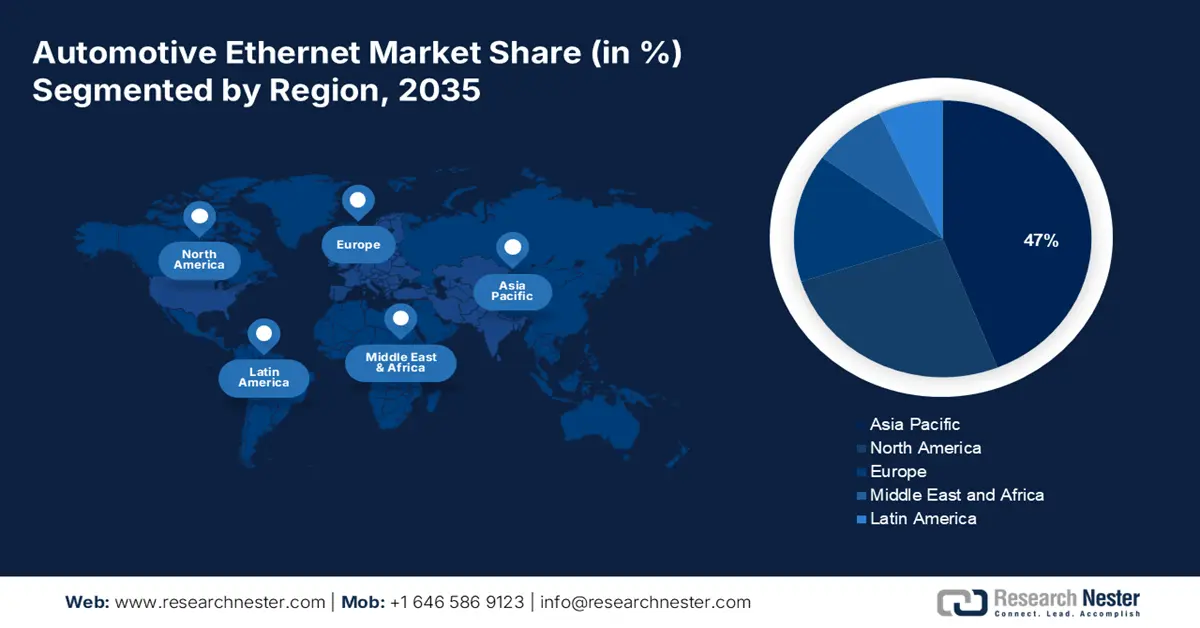
Automotive Ethernet Market Regional Analysis:
APAC Market Insights
Asia Pacific industry is predicted to account for a revenue share of 47% by the end of 2035 owing to the expansion of passenger car production and rising adoption of advanced technologies in the automotive sector. According to figures from the Organization Internationale des Constructeurs d'Automobiles (OICA), China, Indonesia, Malaysia, Taiwan, Thailand, Japan, India, and South Korea collectively produced more than 45 million automobiles in 2021. Moreover, the demand for in-car networking components is anticipated to rise throughout the projection period as vehicle manufacturing rises. By 2025, it is estimated that all automobiles will be connected, and 35% will be self-driving. This is also expected to boost the automotive ethernet market growth during the forecast period.
In India, the market is expected to expand at a rapid pace between 2026 and 2035 due to rapid adoption of advanced technologies, rising sales of different types of automobiles, and increasing demand for top-end models with advanced features such as infotainment and ADAS. In addition, several key players are focused on R&D investments and product launches. For instance, in November 2021, Elektrobit India announced the launch of Ethernet switch firmware for safe and secure in-vehicle communications.
North American Market Insights
The automotive ethernet market in North America is poised to register rapid growth during the forecast period owing to increasing vehicle production and rising investments in developing advanced technologies. In 2022, the vehicle industry produced around 10 million motor vehicles, it includes light commercial vehicles, passenger automobiles, big buses, trucks, and coaches. Moreover, stringent regulations and standards in North America have encouraged automotive giants to improve vehicle safety.
The automotive Ethernet market in the U.S. is expected to register significant growth during the forecast period owing to rising demand for ADAS, autonomous driving technologies, in-vehicle infotainment systems, and stringent safety regulations and standards in the U.S.