Automotive Electronic Control Unit Market Outlook:
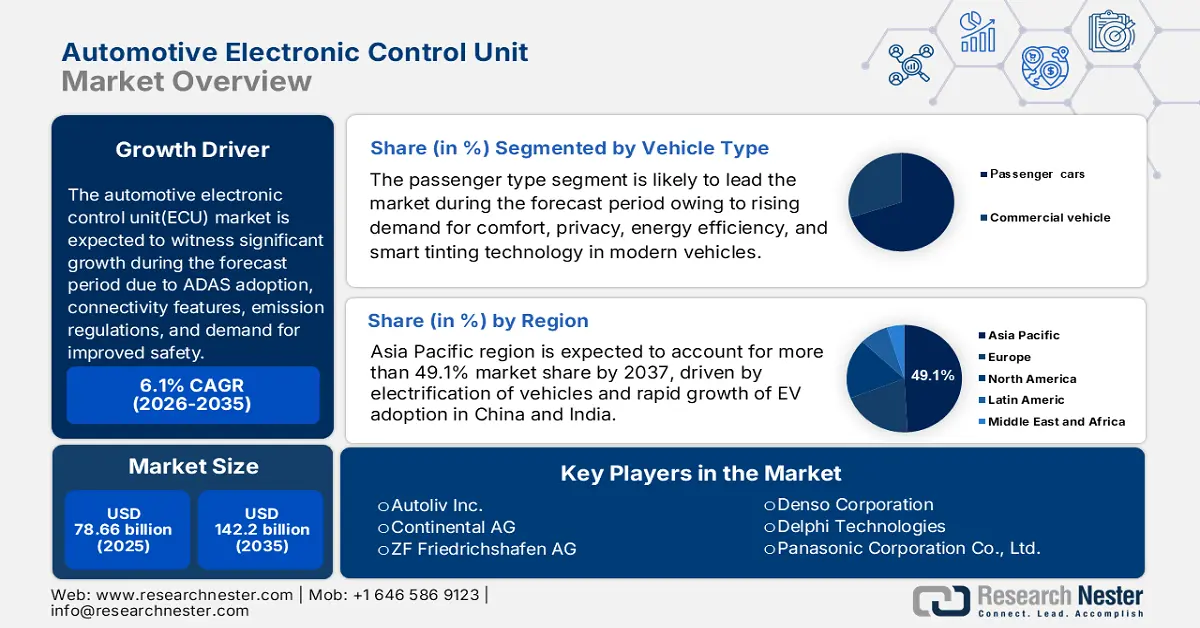
Automotive Electronic Control Unit Market size was valued at USD 78.66 billion in 2025 and is expected to reach USD 142.2 billion by 2035, registering around 6.1% CAGR during the forecast period i.e., between 2026-2035. In the year 2026, the industry size of automotive electronic control unit is evaluated at USD 82.98 billion.
Rapid innovations in autonomous driving technologies are driving an increasing need for advanced automotive electronic control units (ECUs). These ECUs are critical processors that receive sensor data from cameras, radar systems, and other sensing technologies, which aid in enabling real-time decisions for navigation, sensor fusion automation, and driving functions. The autonomous driving technology companies are implementing advanced ECUS to address the requirements for AI processing capabilities alongside real-time information handling and advanced vehicle safety solutions. For instance, in March 2024, NVIDIA introduced the DRIVE Thor system-on-chip (SoC) for managing autonomous driving requirements, AI functions, and in-car experiences. Such developments of AI-driven autonomous driving are crossing a significant threshold in their integration process.
Increasing advanced driving automation features lead to growing complexity in ECUs that handle essential vehicle operations, including safety functions, environment detection, and vehicle dynamics control. Companies such as NVIDIA, Qualcomm, and Intel are implementing advanced ECUS in self-driving system technology through their development of high-performance chips and platforms. Joint operations between technology companies and automaker firms are offering next-generation vehicles with advanced safety and efficiency features, which are directly boosting their revenue shares.