Automated Parking System Market Outlook:
Automated Parking System Market size was USD 3.2 billion in 2025 and is anticipated to surpass a total of USD 8.2 billion by the end of 2035, rising at a CAGR of 11.1% during the forecast period, i.e., 2026-2035. In 2026, the industry size of automated parking system is assessed at USD 3.5 billion.
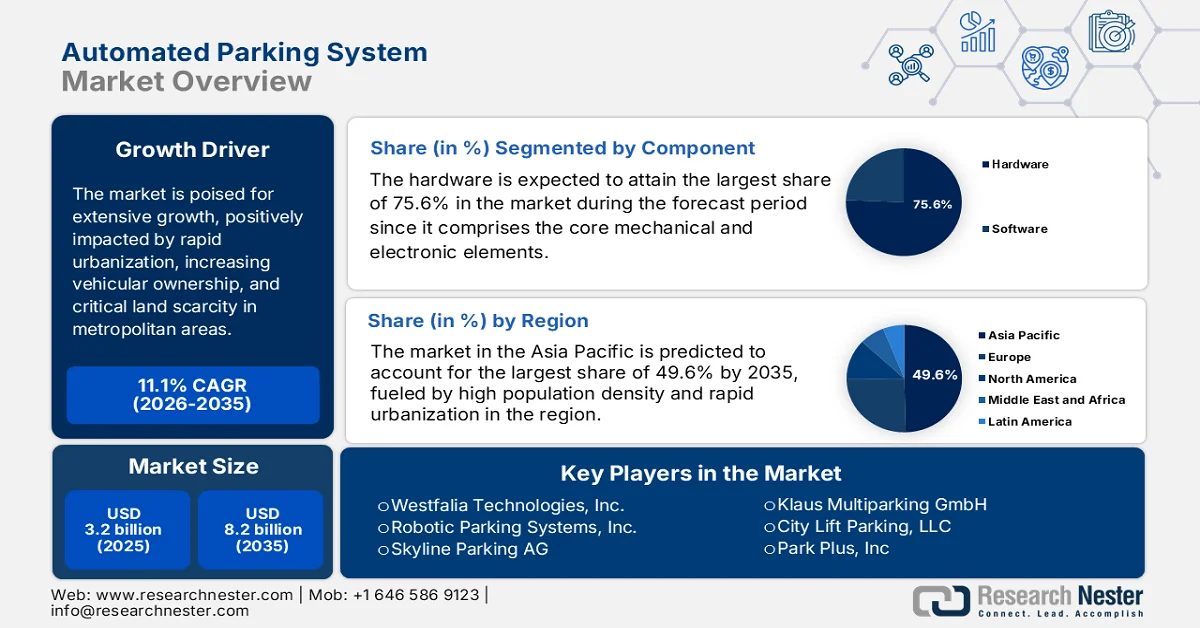
The global automated parking system market is set for significant growth in the coming years. Rapid urbanization, rising vehicle ownership, and severe land shortages in city areas are key drivers of market expansion. According to an article published by the International Transport Forum, over ten years ending in 2024, inland freight transport has increased, with Serbia rising by 98%, Lithuania by 70%, and Croatia by 49%, marking the highest growth rates. Serbia’s strong freight growth is fueled by economic development and infrastructure investments, especially along pan-European corridors. Therefore, the increasing transport activity and urban density in these regions highlight the growing need for automated parking systems to optimize space and improve traffic management.
Furthermore, the key trend reshaping the future dynamics of the automated parking system market is the expansion of global vehicle fleets, particularly heavier and less efficient vehicles such as SUVs. According to the official statistics published by the International Energy Agency (IEA) in January 2025, global passenger car fleets are expanding, wherein SUVs made up almost 46% of global sales in 2022, whereas electric vehicles accounted for 14%. Private cars and vans contributed almost 25% of global oil use. The net-zero emissions by 2050 goal requires all new car and van sales to be zero-emission by 2035. These figures indicate that urban congestion is intensifying the demand for efficient space management solutions. Moreover, the expansion of automated parking systems becomes highly essential to optimize limited urban parking space, reduce traffic delays, and improve overall energy efficiency in cities.
Key Automated Parking System Market Insights Summary:
Regional Highlights:
- Asia Pacific automated parking system market is projected to hold a dominant 49.6% share by 2035, propelled by rising urbanization, dense population clusters, and increasing smart infrastructure initiatives
- North America is expected to witness substantial expansion through 2035, fueled by growing smart city investments and integration of AI and IoT-enabled parking technologies
Segment Insights:
- The hardware segment in the automated parking system market is anticipated to command a 75.6% share by 2035, driven by continuous advancements in core mechanical and electronic components enhancing system reliability and functionality
- The tower system segment is forecasted to secure a notable share by 2035, owing to its ability to optimize vertical space utilization and adapt to diverse urban infrastructure requirements
Key Growth Trends:
- Decreasing parking space in cities
- Increase in smart city projects
Major Challenges:
- High initial cost of installation
- Apprehension of electrical and mechanical failure
Key Players: Westfalia Technologies, Inc. (U.S.), Robotic Parking Systems, Inc. (U.S.), Skyline Parking AG (Switzerland), Klaus Multiparking GmbH (Germany), City Lift Parking, LLC (U.S.), Park Plus, Inc. (U.S.), Unitronics (Israel), Wohr Parking Systems Pvt. Ltd. (India), Parkmatic (U.S.), FAAC S.p.A. (Italy), TIBA Parking Systems (Israel), HUB Parking Technology (Italy), ICO (Belgium), NYK Group (Japan), Lödige Industries (Germany), ShinMaywa Industries Ltd. (Japan), Amano Corporation (Japan), Fata Automation (Italy), MHE Demag (Singapore), AutoMotion Parking Systems (U.S.), Lodige Industries GmbH (Germany), Wipro PARI (India), SKIDATA (Austria), Dayang Parking Co. Ltd. (China).
Global Automated Parking System Market Forecast and Regional Outlook:
Market Size & Growth Projections:
- 2025 Market Size: USD 3.2 billion
- 2026 Market Size: USD 3.5 billion
- Projected Market Size: USD 8.2 billion by 2035
- Growth Forecasts: 11.1% CAGR (2026-2035)
Key Regional Dynamics:
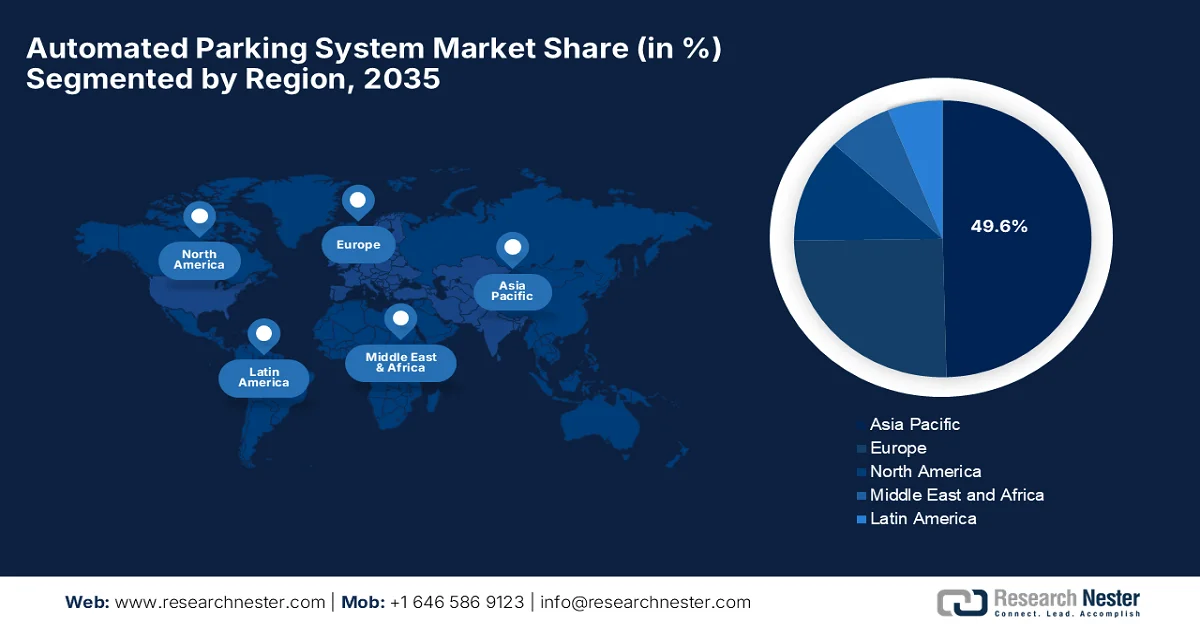
- Largest Region: Asia Pacific (49.6% Share by 2035)
- Fastest Growing Region: North America
- Dominating Countries: United States, China, Germany, Japan, South Korea
- Emerging Countries: India, Brazil, Mexico, Indonesia, United Arab Emirates
Last updated on : 31 March, 2026
Automated Parking System Market - Growth Drivers and Challenges
Growth Drivers
- Decreasing parking space in cities: Lack of parking space has become an alarming issue, causing traffic deadlocks. With tremendous pressure on roads, high emission rates, and charting out land for residences, offices, and other development projects, parking spaces in cities are rapidly declining, which is a fundamental factor driving the overall growth of the automated parking system market. Parking policies in developing cities are considered to be a influencing tool to reshape urban livability rather than just accommodate rising car ownership. As per an article published by the World Bank in February 2025, smart strategies such as charging for parking, eliminating minimum requirements, and promoting short-term rotation can balance economic activity along with sustainable mobility. Besides, combined with transit-oriented development and the 15-minute city model, adopting automated parking deliberately strengthens public transport use.
- Increase in smart city projects: There has been increased establishment of smart cities all across the globe. The increase in smart cities deliberately drives the adoption of advanced urban infrastructure, i.e., automated parking systems, to manage traffic and optimize the limited available space. According to the World Economic Forum (WEF) reports published in 2022, the G20 global smart cities alliance is establishing global standards for ethical and responsible smart city development, focusing on transparency, data privacy, and public trust. As of 2022, smart city governance initiatives have included 36 cities, and this particular alliance supported more than 80 cities worldwide in adopting IoT-enabled solutions to improve mobility, reduce pollution, enhance safety, and optimize infrastructure. These factors are readily bolstering the automated parking system market growth in the coming decade.
- Rising need for sustainable solutions: A fully automated parking system requires no drivers or attendants. By reducing waste and optimizing processes, automated parking systems help lower greenhouse gas emissions. According to the U.S. Environmental Protection Agency, in June 2025, a typical passenger vehicle emits 4.6 metric tons of CO2 per year. On average, this is equal to around 400 grams of CO2 per mile, taking 22.2 miles per gallon fuel economy and 11,500 miles driven per year. At the same time, vehicles also contribute methane, nitrous oxide, and hydrofluorocarbons, whereas these EVs avoid direct emissions. Therefore, transitioning to electric, hybrid, or hydrogen fuel cell vehicles is highly essential in order to reduce overall greenhouse gas emissions. By lessening the time that drivers spend looking for a parking space, the solutions from the automated parking system market help in remarkably reducing traffic and vehicle emissions.
Challenges
- High initial cost of installation: The cost of initial installation of these parking systems is high, which emerges as a challenge for the automated parking system market. These systems use advanced technology features that are usually of high cost, resulting in the final price of the overall system becoming exorbitant. Influenced by this, many developing and underdeveloped countries are not able to plan to deploy such parking systems. Moreover, the higher investments often require long payback periods, making it challenging for private investors or municipal authorities to justify these burgeoning expenditures. The complexity of integrating AI, robotics, and IoT-enabled monitoring also exacerbates increased engineering and operational costs.
- Apprehension of electrical and mechanical failure: Electricity shortage is a very common problem globally. Also, due to mechanical failure, the refurbishment process takes ample time. These malfunctions stop the services, causing disruptions to the upliftment of the automated parking system market. On the other hand, mechanical failures, such as conveyor jams, any concerns in the lift malfunctions, or sensor errors, necessitate certain technicians and parts, which in turn extend downtime and disrupt service. The reliance on complex electromechanical components increases the risk of cascading failures, wherein one minor fault can halt the entire system. In addition, remote monitoring and predictive maintenance tools are not uniformly implemented, which leaves some operators reactive. These reliability concerns can reduce user confidence and limit adoption in high-traffic urban centers.
Automated Parking System Market Size and Forecast:
| Report Attribute | Details |
|---|---|
|
Base Year |
2025 |
|
Forecast Year |
2026-2035 |
|
CAGR |
11.1% |
|
Base Year Market Size (2025) |
USD 3.2 billion |
|
Forecast Year Market Size (2035) |
USD 8.2 billion |
|
Regional Scope |
|
Automated Parking System Market Segmentation:
Component Segment Analysis
The hardware, which is under the component segment, is expected to attain the largest share of 75.6% in the automated parking system market during the forecast period. It comprises the core mechanical and electronic elements necessary for parking automation, allowing it to maintain a dominant position in this category. In January 2024, ZF Friedrichshafen AG introduced a new Parking ECU especially designed to make automated parking more convenient, accessible, and affordable across a wider range of vehicles. The company notes that this is equipped with up to 16 TOPS processing power, ultrasonic sensors, and 360° cameras, and it offers advanced functions such as parallel and standard parking assistance, remote park assist, and premium features such as automatic memorized parking and valet parking. Therefore, from a strategic perspective, such innovations underscore the prominence of hardware solutions in driving automated parking system market growth, enabling higher system reliability, along with deployment across vehicle types.
Structure Type Segment Analysis
Based on structure type, the tower system is predicted to grow with a significant share in the automated parking system market by the end of 2035. These tower systems are considered to be highly efficient, maximizing vertical space and minimizing horizontal footprint, which are the main factors allowing the subtype to maintain a prominent position in this sector. They can be designed in lower configurations to meet the changing height restrictions, making them suitable for different building requirements. In July 2024, the Maharashtra Fire Service published a few measures for parking structures under the UDCPR-2020. In this context, it mentions mechanized parking towers as one of the approved structures for car parking. Besides, these towers can be standalone steel structures or attached to the dead wall of a building, and are permitted up to a maximum height of 100 meters in municipal corporation areas, or up to the approved building height, hence denoting a positive outlook for the segment’s growth.
End use Segment Analysis
By the conclusion of the forecast period, the commercial segment, which is under the end use segment, is anticipated to garner a considerable revenue share in the automated parking system market. The growth of the segment is largely attributable to higher demand for efficient, space‑saving solutions in shopping malls, offices, hotels, and business districts. Stronger revenue generation is also associated with larger and more frequent installations when compared with residential deployments. In April 2025, the article published by the International Journal for Research Trends and Innovation (IJRTI) states that AI-based smart parking systems offer a transformative solution to urban traffic congestion by intelligently allocating parking spaces in real time. By leveraging machine learning, computer vision, and IoT sensors, these systems can predict availability and guide drivers directly to open spots, thereby reducing wasted time and fuel. This integration is improving overall urban mobility in commercial spaces, hence denoting a positive outlook for the segment’s growth and exposure.
Our in-depth analysis of the global automated parking system market includes the following segments:
|
Segment |
Subsegments |
|
Component |
|
|
Structure Type |
|
|
End use |
|
|
Platform |
|
|
Automation Level |
|

Vishnu Nair
Head - Global Business DevelopmentCustomize this report to your requirements — connect with our consultant for personalized insights and options.
Automated Parking System Market - Regional Analysis
APAC Market Insights
The Asia Pacific automated parking system market is forecasted to capture the largest share of 49.6% during the discussed timeframe. The region’s dominance is mainly propelled by high population density, growing urbanization, and smart infrastructure initiatives. The region’s widespread use of on-street vehicle parking results in urban mobility challenges, thus accelerating the growth of the market. In September 2025, the government of Australia reported that, as of January 2025, Australia’s vehicle fleet saw growth across multiple segments, with New South Wales, Victoria, and Queensland accounting for 76.2% of registrations. Toyota remained the top passenger and light commercial vehicle brand, whereas the petrol vehicles represented 65.6% and diesel 29.4% of the fleet. On the other hand, significant growth was observed in electric and hybrid vehicles, reflecting a huge necessity for automated parking solutions.
Australia Vehicle Fleet Statistics 2025: EV, Hybrid, Commercial & Passenger Vehicle Growth
|
Vehicle Segment |
Registered Vehicles (January 2025) |
Change Since January 2024 |
|
Battery & fuel-cell EVs |
259,690 |
+54.6% |
|
Hybrid EVs |
709,100 |
+46.0% |
|
Rigid trucks |
667,100 |
+6.2% |
|
Articulated trucks |
128,600 |
+3.3% |
|
Caravans |
834,220 |
+3.8% |
|
Trailers |
3,700,000 |
+1.1% |
|
Average vehicle age |
11.54 years |
+0.14 years |
|
Petrol vehicles |
65.6% of fleet |
-1.7% |
|
Diesel vehicles |
29.4% of fleet |
+0.5% |
Source: BITRE
The technology adoption by government traffic management systems is responsible for uplifting the automated parking system market in China. The expansion of EV charging infrastructure has effectively boosted demand for APS solutions. Based on government data published in July 2024, China accelerated the digitalization of traffic management by introducing electronic vehicle licenses in most cities, benefiting the citizens. Besides, the country had almost 440 million registered vehicles, including 24.7 million electric vehicles, and 532 million drivers, by June 2024, with e-licenses and e-driver’s licenses issued across the country’s vast geography. It mentions that the Jiaoguan 12123 app facilitates applications, renewals, and verification, reducing paperwork and processing time. In addition, these measures are supported by QR codes, encryption, and real-person verification, readily enhancing traffic management, denoting a positive outlook for automated parking systems.
In India, the automated parking system market has gained enhanced momentum, effectively fueled by the acute shortage of parking spaces in metropolitan hubs. To tackle this, the country’s government is incorporating improved technological solutions into new infrastructure projects, aiming to reduce traffic congestion and optimize land use. In November 2025, the public parking management system was opened at DHQ Kangpokpi. Besides, the system is to improve traffic management, prevent accidents, and create a cleaner, more organized town. This particular initiative represents a major step toward smarter urban management in the country, leveraging technology to efficiently streamline parking and enhance overall town infrastructure. Furthermore, the awareness about the advanced systems supports the aspect of maximizing land utilization in densely populated areas, thereby enabling cities to accommodate more vehicles, hence contributing to wider automated parking system market expansion.
North America Market Insights
The automated parking system market in North America is reaping lucrative growth opportunities from the growing emphasis on smart city infrastructure and the integration of advanced technologies. The adoption of AI and IoT-enabled smart infrastructure efficiently supports market growth across the region. In March 2026, the U.S. Department of Labor issued a request for information for the installation and management of fully automated parking systems at three garages in the Frances Perkins Building in Washington, DC. This particular initiative is part of market research to assess industry capabilities, refine project requirements, and develop an appropriate acquisition strategy in line with federal procurement regulations. Thus, this project evidences government interest in adopting automated parking solutions to enhance operational efficiency and modernize infrastructure, in turn suitable for bolstering the region’s market growth.
Supported by investments from both private and public sectors, the automated parking system market in the U.S. will grow at the highest pace of progress. Market expansion is largely fueled by consumer preference for smart, connected infrastructure and collaborations between automotive and technology companies. Based on the government data, the City of Peoria, Illinois, published a request for proposal for a smart parking system in October 2024. Besides, this project was looking for qualified vendors to design, install, and manage a system that is aimed at modernizing parking infrastructure, improving user experience, and optimizing revenue collection. Therefore, such instances in the country denote that public bodies are proactively making investments in terms of smart parking infrastructure, thereby creating strong opportunities for the adoption of automated parking systems.
Canada automated parking system market has gained increased exposure due to a focus on managing extreme land scarcity and escalating real estate costs. The commercial sector is identified as the primary adopter due to the high return on investment from space optimization. In September 2025, the country’s government reported that the Electric Vehicle Automatic Parking project, which is led by S2E Technologies Inc., was completed in London, Ontario’s West 5 community, with support from multiple partners. The article highlighted that it integrated robotics, wireless charging, autonomous vehicles, and automated parking towers to promote clean and convenient transportation. Furthermore, the initiative validated advanced charging infrastructure, explored vehicle-to-grid technologies, and improved sensor systems for autonomous EVs, hence positively impacting the country’s automated parking system market.
Europe Market Insights
Europe automated parking system market is predicted to achieve a central position in the global dynamics. The region’s growth dynamics are reshaped by the stringent sustainability regulations and dense historic urban layouts. Europe has showcased an increasing inclination toward AI-based logistics and IoT connectivity to minimize urban land footprints and reduce vehicle emissions caused by cruising for spots. In April 2024, the article published by the European Commission revealed that the Park4SUMP programme is aimed at integrating innovative parking management into sustainable urban mobility plans to improve mobility. In addition, it emphasizes shifting parking policies from reactive operations to strategic approaches to better manage traffic, congestion, and public space. The project highlights that effective, i.e., smart parking management, supported by technological innovation and policy measures, can optimize urban mobility, generate revenue, and contribute to sustainable transport development, thus suitable for bolstering the market’s growth in the region.
The engineering standards and a long-standing history of mechanical innovation are certain factors accelerating growth in the automated parking system market in Germany. The market is primarily driven by the municipalities, and private developers utilize fully automated tower and shuttle systems to maximize high-value real estate. In January 2023, Bosch and APCOA announced that together they are expanding automated valet parking technology across Germany, following its approval at Stuttgart airport. The system is based on Bosch stereo cameras and APCOA’s FLOW platform, and it enables driverless, ticketless, and cashless parking. Therefore, such innovation solidifies the country’s ecosystem with greater convenience and optimizes the use of parking space in high-traffic urban environments. Furthermore, the supportive regulatory frameworks and urban mobility policies are encouraging the integration of intelligent parking solutions within transport initiatives across Germany.
In the UK, the automated parking system market is entering a new phase of growth, influenced by major cities facing critical space shortages and extreme traffic congestion. Driven by green urban planning, the market is shifting toward fully robotic and automated valet parking to reduce the time UK drivers spend searching for spots. In May 2025, the government confirmed the rollout of the national parking platform, which is led by the British Parking Association, to simplify parking nationwide. This initiative allows drivers to use their preferred app in all participating car parks, eliminating the need for multiple downloads. In addition, the initiative is backed by industry leaders like RingGo, JustPark, and PayByPhone. The platform already handles over half a million transactions monthly across 10 local authorities, hence suitable for standard automated parking system market growth.
Key Automated Parking System Market Players:
- Westfalia Technologies, Inc. (U.S.)
- Robotic Parking Systems, Inc. (U.S.)
- Skyline Parking AG (Switzerland)
- Klaus Multiparking GmbH (Germany)
- City Lift Parking, LLC (U.S.)
- Park Plus, Inc. (U.S.)
- Unitronics (Israel)
- Wohr Parking Systems Pvt. Ltd. (India)
- Parkmatic (U.S.)
- FAAC S.p.A. (Italy)
- TIBA Parking Systems (Israel)
- HUB Parking Technology (Italy)
- ICO (Belgium)
- NYK Group (Japan)
- Lödige Industries (Germany)
- ShinMaywa Industries Ltd. (Japan)
- Amano Corporation (Japan)
- Fata Automation (Italy)
- MHE Demag (Singapore)
- AutoMotion Parking Systems (U.S.)
- Lodige Industries GmbH (Germany)
- Wipro PARI (India)
- SKIDATA (Austria)
- Dayang Parking Co. Ltd. (China)
- Company Overview
- Business Strategy
- Key Product Offerings
- Financial Performance
- Key Performance Indicators
- Risk Analysis
- Recent Development
- Regional Presence
- SWOT Analysis
- Westfalia Technologies, Inc. is identified as one of the leading pioneers in automated parking solutions that offer tower and puzzle-style systems for both commercial and residential applications. Besides, the company emphasizes modular designs and scalable technology in order to maximize parking density and minimize space requirements.
- Robotic Parking Systems, Inc. specializes in fully automated mechanical parking facilities, and it serves high-density urban centers and mixed-use developments. The firm is highly focused on high-capacity tower systems and puzzle lifts that optimize vertical space.
- Klaus Multiparking GmbH is yet another dominant force in this sector, and it offers a wide range of automated parking solutions, including multi-level car lifts, tower systems, and pallet-based puzzle parking. The company mainly concentrates on energy-efficient designs and high-precision automation to optimize space usage.
- FAAC S.p.A. is based in Italy, and it recently solidified its position in the market through the acquisition of TIBA Parking Systems. In addition, the firm specializes in terms of integrated parking management and access control solutions, combining hardware and software to deliver turnkey systems for different applications.
- ShinMaywa Industries Ltd. is a Japan-based leader in precision-engineered automated parking solutions and is focusing on compact tower systems and pallet lifts for urban residential and commercial spaces. The company deliberately emphasizes high-quality manufacturing, long service life, and energy efficiency.
Below is the list of some prominent players operating in the global automated parking system market:
The competitive landscape of the automated parking system market is rapidly evolving as established key players, automotive giants, new entrants, and the government are investing in automating parking. Major players in the market are focused on developing new technologies and products catering to the stringent regulatory norms and consumer demand. These key players are adopting several strategies, such as mergers and acquisitions, joint ventures, partnerships, and novel product launches, with the main goal of enhancing their product base and strengthening their market position. In May 2025, FAAC S.p.A. announced the acquisition of TIBA Parking Systems, which specializes in turnkey off-street parking management solutions, for a total of USD 135 million. This acquisition strengthens FAAC’s presence in North America, where TIBA held over 20% market share, and complements FAAC’s direct sales model through HUB parking technology.
Corporate Landscape of the Automated Parking System Market:
Recent Developments
- In January 2026, HUB Parking Technology announced the launch of a new multi-purpose kiosk designed to modernize car park payment systems and expand their functionality. The kiosk supports subscription renewals, voucher validation, product purchases, and digital content delivery.
- In November 2025, ICO, which is a subsidiary of the NYK Group, received approval to build Europe’s first fully automated multi-level parking system for finished vehicles at the Port of Zeebrugge, Belgium. The facility will be powered by wind-generated electricity, will add 10,000 spaces, and boost annual handling capacity from 2.5 million to 3 million units.
- In November 2025, Lödige Industries was named the 2026 world market leader for automated parking systems by WirtschaftsWoche. The company’s solutions reduce parking space needs by up to 60%, easing congestion and supporting sustainable urban development.
- Report ID: 4605
- Published Date: Mar 31, 2026
- Report Format: PDF, PPT
- Explore a preview of key market trends and insights
- Review sample data tables and segment breakdowns
- Experience the quality of our visual data representations
- Evaluate our report structure and research methodology
- Get a glimpse of competitive landscape analysis
- Understand how regional forecasts are presented
- Assess the depth of company profiling and benchmarking
- Preview how actionable insights can support your strategy
Explore real data and analysis
Frequently Asked Questions (FAQ)
About this Report
Connect with our Expert


Report, 2026-2035



Copyright @ 2026 Research Nester. All Rights Reserved.
