Global AI Virtual Assistant in Healthcare Market
- An Outline of the Global AI Virtual Assistant in Healthcare Market
- Market Definition and Segmentation
- Study Assumptions and Abbreviations
- Research Methodology & Approach
- Primary Research
- Secondary Research
- Data Triangulation
- SPSS Methodology
- Executive Summary
- Growth Drivers
- Major Roadblocks
- Opportunities
- Prevalent Trends
- Government Regulation
- Growth Outlook
- Competitive White Space Analysis – Identifying Untapped Market Gaps
- Risk Overview
- SWOT
- Technological Advancement
- Technology Maturity Matrix for AI Virtual Assistant in Healthcare
- Recent News
- Regional Demand
- Global AI Virtual Assistant in Healthcare by Geography – Strategic Comparative Analysis
- Strategic Segment Analysis: AI Virtual Assistant in Healthcare Demand Landscape
- Global AI Virtual Assistant in Healthcare Demand Trends Driven by Telehealth, Digital Health and Patient Care (2026-2035)
- Root Cause Analysis (RCA) for discovering problems of the AI Virtual Assistant in Healthcare Porter Five Forces
- PESTLE
- Comparative Positioning
- AI Virtual Assistant in Healthcare– Key Player Analysis (2035)
- Competitive Landscape: Key Suppliers/Players
- Competitive Model: A Detailed Inside View for Investors
- Company Market Share, 2035 (%)
- Business Profile of Key Enterprise
- Procore Technologies Inc
- IBM Watson Health
- Microsoft Corporation
- Google LLC
- Nuance Communications
- Amazon Web Services
- Sensely
- Babylon Health
- Infermedica
- Ada Health
- Business Profile of Key Enterprise
- Global AI Virtual Assistant in Healthcare Market Outlook
- Market Overview
- Market Revenue by Value (USD Million), Volume (Million Tons), and Compound Annual Growth Rate (CAGR)
- Global Segmentation AI Virtual Assistant in Healthcare Analysis (2026-2035)
- By Product
- Web-Based Chatbots, Market Value (USD Million), and CAGR, 2026-2035F
- Mobile Based Chatbots, Market Value (USD Million), and CAGR, 2026-2035F
- By Platform
- Solutions, Market Value (USD Million), and CAGR, 2026-2035F
- Services, Market Value (USD Million), and CAGR, 2026-2035F
- By Application
- Robot-Assisted Surgery, Market Value (USD Million), and CAGR, 2026-2035F
- Virtual Nursing Assistant, Market Value (USD Million), and CAGR, 2026-2035F
- Clinical Trials, Market Value (USD Million), and CAGR, 2026-2035F
- Diagnostics, Market Value (USD Million), and CAGR, 2026-2035F
- Others, Market Value (USD Million), and CAGR, 2026-2035F
- By End-user
- Hospitals & Clinics, Market Value (USD Million), and CAGR, 2026-2035F
- Pharmaceutical & Biotechnological Companies, Market Value (USD Million), and CAGR, 2026-2035F
- Contract Research Organization, Market Value (USD Million), and CAGR, 2026-2035F
- Others, Market Value (USD Million), and CAGR, 2026-2035F
- Regional Synopsis, Value (USD Million), 2026-2035
- North America Market Value (USD Million) and CAGR & Y-o-Y Growth Trend, 2026-2035F
- Europe Market Value (USD Million) and CAGR & Y-o-Y Growth Trend, 2026-2035F
- Asia Pacific Market Value (USD Million) and CAGR & Y-o-Y Growth Trend, 2026-2035F
- Latin America Market Value (USD Million) and CAGR & Y-o-Y Growth Trend, 2026-2035F
- Middle East and Africa Market Value (USD Million) and CAGR & Y-o-Y Growth Trend, 2026-2035F
- By Product
- Market Overview
- North America Market
- Overview
- Market Value (USD Million), Current and Future Projections, 2026-2035
- Increment $ Opportunity Assessment, 2026-2035
- Segmentation (USD Million), 2026-2035,
- By Product
- Web-Based Chatbots, Market Value (USD Million), and CAGR, 2026-2035F
- Mobile Based Chatbots, Market Value (USD Million), and CAGR, 2026-2035F
- By Platform
- Solutions, Market Value (USD Million), and CAGR, 2026-2035F
- Services, Market Value (USD Million), and CAGR, 2026-2035F
- By Application
- Robot-Assisted Surgery, Market Value (USD Million), and CAGR, 2026-2035F
- Virtual Nursing Assistant, Market Value (USD Million), and CAGR, 2026-2035F
- Clinical Trials, Market Value (USD Million), and CAGR, 2026-2035F
- Diagnostics, Market Value (USD Million), and CAGR, 2026-2035F
- Others, Market Value (USD Million), and CAGR, 2026-2035F
- By End-user
- Hospitals & Clinics, Market Value (USD Million), and CAGR, 2026-2035F
- Pharmaceutical & Biotechnological Companies, Market Value (USD Million), and CAGR, 2026-2035F
- Contract Research Organization, Market Value (USD Million), and CAGR, 2026-2035F
- Others, Market Value (USD Million), and CAGR, 2026-2035F
- Country Level Analysis, Value (USD Million)
- U.S. Market Value (USD Million) and CAGR & Y-o-Y Growth Trend, 2026-2035F
- Canada Market Value (USD Million) and CAGR & Y-o-Y Growth Trend, 2026-2035F
- By Product
- Overview
- Europe Market
- Overview
- Market Value (USD Million), Current and Future Projections, 2026-2035
- Increment $ Opportunity Assessment, 2026-2035
- Segmentation (USD Million), 2026-2035, B
- By Product
- Web-Based Chatbots, Market Value (USD Million), and CAGR, 2026-2035F
- Mobile Based Chatbots, Market Value (USD Million), and CAGR, 2026-2035F
- By Platform
- Solutions, Market Value (USD Million), and CAGR, 2026-2035F
- Services, Market Value (USD Million), and CAGR, 2026-2035F
- By Application
- Robot-Assisted Surgery, Market Value (USD Million), and CAGR, 2026-2035F
- Virtual Nursing Assistant, Market Value (USD Million), and CAGR, 2026-2035F
- Clinical Trials, Market Value (USD Million), and CAGR, 2026-2035F
- Diagnostics, Market Value (USD Million), and CAGR, 2026-2035F
- Others, Market Value (USD Million), and CAGR, 2026-2035F
- By End-user
- Hospitals & Clinics, Market Value (USD Million), and CAGR, 2026-2035F
- Pharmaceutical & Biotechnological Companies, Market Value (USD Million), and CAGR, 2026-2035F
- Contract Research Organization, Market Value (USD Million), and CAGR, 2026-2035F
- Others, Market Value (USD Million), and CAGR, 2026-2035F
- Country Level Analysis, Value (USD Million)
- UK Market Value (USD Million) and CAGR & Y-o-Y Growth Trend, 2026-2035F
- Germany Market Value (USD Million) and CAGR & Y-o-Y Growth Trend, 2026-2035F
- France Market Value (USD Million) and CAGR & Y-o-Y Growth Trend, 2026-2035F
- Italy Market Value (USD Million) and CAGR & Y-o-Y Growth Trend, 2026-2035F
- Spain Market Value (USD Million) and CAGR & Y-o-Y Growth Trend, 2026-2035F
- Netherlands Market Value (USD Million) and CAGR & Y-o-Y Growth Trend, 2026-2035F
- Russia Market Value (USD Million) and CAGR & Y-o-Y Growth Trend, 2026-2035F
- Switzerland Market Value (USD Million) and CAGR & Y-o-Y Growth Trend, 2026-2035F
- Poland Market Value (USD Million) and CAGR & Y-o-Y Growth Trend, 2026-2035F
- Belgium Market Value (USD Million) and CAGR & Y-o-Y Growth Trend, 2026-2035F
- Rest of Europe Market Value (USD Million) and CAGR & Y-o-Y Growth Trend, 2026-2035F
- By Product
- Overview
- Asia Pacific Market
- Overview
- Market Value (USD Million), Current and Future Projections, 2026-2035
- Increment $ Opportunity Assessment, 2026-2035
- Segmentation (USD Million), 2026-2035,
- By Product
- Web-Based Chatbots, Market Value (USD Million), and CAGR, 2026-2035F
- Mobile Based Chatbots, Market Value (USD Million), and CAGR, 2026-2035F
- By Platform
- Solutions, Market Value (USD Million), and CAGR, 2026-2035F
- Services, Market Value (USD Million), and CAGR, 2026-2035F
- By Application
- Robot-Assisted Surgery, Market Value (USD Million), and CAGR, 2026-2035F
- Virtual Nursing Assistant, Market Value (USD Million), and CAGR, 2026-2035F
- Clinical Trials, Market Value (USD Million), and CAGR, 2026-2035F
- Diagnostics, Market Value (USD Million), and CAGR, 2026-2035F
- Others, Market Value (USD Million), and CAGR, 2026-2035F
- By End-user
- Hospitals & Clinics, Market Value (USD Million), and CAGR, 2026-2035F
- Pharmaceutical & Biotechnological Companies, Market Value (USD Million), and CAGR, 2026-2035F
- Contract Research Organization, Market Value (USD Million), and CAGR, 2026-2035F
- Others, Market Value (USD Million), and CAGR, 2026-2035F
- Country Level Analysis, Value (USD Million)
- China Market Value (USD Million) and CAGR & Y-o-Y Growth Trend, 2026-2035F
- India Market Value (USD Million) and CAGR & Y-o-Y Growth Trend, 2026-2035F
- South Korea Market Value (USD Million) and CAGR & Y-o-Y Growth Trend, 2026-2035F
- Australia Market Value (USD Million) and CAGR & Y-o-Y Growth Trend, 2026-2035F
- Indonesia Market Value (USD Million) and CAGR & Y-o-Y Growth Trend, 2026-2035F
- Malaysia Market Value (USD Million) and CAGR & Y-o-Y Growth Trend, 2026-2035F
- Vietnam Market Value (USD Million) and CAGR & Y-o-Y Growth Trend, 2026-2035F
- Thailand Market Value (USD Million) and CAGR & Y-o-Y Growth Trend, 2026-2035F
- Singapore Market Value (USD Million) and CAGR & Y-o-Y Growth Trend, 2026-2035F
- New Zeeland Market Value (USD Million) and CAGR & Y-o-Y Growth Trend, 2026-2035F
- Rest of Asia Pacific Excluding Japan Market Value (USD Million) and CAGR & Y-o-Y Growth Trend, 2026-2035F
- By Product
- Overview
- Latin America Market
- Overview
- Market Value (USD Million), Current and Future Projections, 2026-2035
- Increment $ Opportunity Assessment, 2026-2035
- Year-on-Year Growth Forecast (%)
- Segmentation (USD Million), 2026-2035, By
- By Product
- Web-Based Chatbots, Market Value (USD Million), and CAGR, 2026-2035F
- Mobile Based Chatbots, Market Value (USD Million), and CAGR, 2026-2035F
- By Platform
- Solutions, Market Value (USD Million), and CAGR, 2026-2035F
- Services, Market Value (USD Million), and CAGR, 2026-2035F
- By Application
- Robot-Assisted Surgery, Market Value (USD Million), and CAGR, 2026-2035F
- Virtual Nursing Assistant, Market Value (USD Million), and CAGR, 2026-2035F
- Clinical Trials, Market Value (USD Million), and CAGR, 2026-2035F
- Diagnostics, Market Value (USD Million), and CAGR, 2026-2035F
- Others, Market Value (USD Million), and CAGR, 2026-2035F
- By End-user
- Hospitals & Clinics, Market Value (USD Million), and CAGR, 2026-2035F
- Pharmaceutical & Biotechnological Companies, Market Value (USD Million), and CAGR, 2026-2035F
- Contract Research Organization, Market Value (USD Million), and CAGR, 2026-2035F
- Others, Market Value (USD Million), and CAGR, 2026-2035F
- Country Level Analysis, Value (USD Million)
- Brazil Market Value (USD Million) and CAGR & Y-o-Y Growth Trend, 2026-2035F
- Argentina Market Value (USD Million) and CAGR & Y-o-Y Growth Trend, 2026-2035F
- Mexico Market Value (USD Million) and CAGR & Y-o-Y Growth Trend, 2026-2035F
- Rest of Latin America Market Value (USD Million) and CAGR & Y-o-Y Growth Trend, 2026-2035F
- By Product
- Overview
- Middle East & Africa Market
- Overview
- Market Value (USD Million), Current and Future Projections, 2026-2035
- Increment $ Opportunity Assessment, 2026-2035
- Year-on-Year Growth Forecast (%)
- By Product
- Web-Based Chatbots, Market Value (USD Million), and CAGR, 2026-2035F
- Mobile Based Chatbots, Market Value (USD Million), and CAGR, 2026-2035F
- By Platform
- Solutions, Market Value (USD Million), and CAGR, 2026-2035F
- Services, Market Value (USD Million), and CAGR, 2026-2035F
- By Application
- Robot-Assisted Surgery, Market Value (USD Million), and CAGR, 2026-2035F
- Virtual Nursing Assistant, Market Value (USD Million), and CAGR, 2026-2035F
- Clinical Trials, Market Value (USD Million), and CAGR, 2026-2035F
- Diagnostics, Market Value (USD Million), and CAGR, 2026-2035F
- Others, Market Value (USD Million), and CAGR, 2026-2035F
- By End-user
- Hospitals & Clinics, Market Value (USD Million), and CAGR, 2026-2035F
- Pharmaceutical & Biotechnological Companies, Market Value (USD Million), and CAGR, 2026-2035F
- Contract Research Organization, Market Value (USD Million), and CAGR, 2026-2035F
- Others, Market Value (USD Million), and CAGR, 2026-2035F
- Country Level Analysis, Value (USD Million)
- Saudi Arabia Market Value (USD Million) and CAGR & Y-o-Y Growth Trend, 2026-2035F
- UAE Market Value (USD Million) and CAGR & Y-o-Y Growth Trend, 2026-2035F
- Israel Market Value (USD Million) and CAGR & Y-o-Y Growth Trend, 2026-2035F
- Qatar Market Value (USD Million) and CAGR & Y-o-Y Growth Trend, 2026-2035F
- Kuwait Market Value (USD Million) and CAGR & Y-o-Y Growth Trend, 2026-2035F
- Oman Market Value (USD Million) and CAGR & Y-o-Y Growth Trend, 2026-2035F
- South Africa Market Value (USD Million) and CAGR & Y-o-Y Growth Trend, 2026-2035F
- Rest of Middle East & Africa Market Value (USD Million) and CAGR & Y-o-Y Growth Trend, 2026-2035F
- Overview
- Global Economic Scenario
- World Economic Outlook
- About Research Nester
- Our Global Clientele
- We Serve Clients Across World
AI Virtual Assistant in Healthcare Market Outlook:
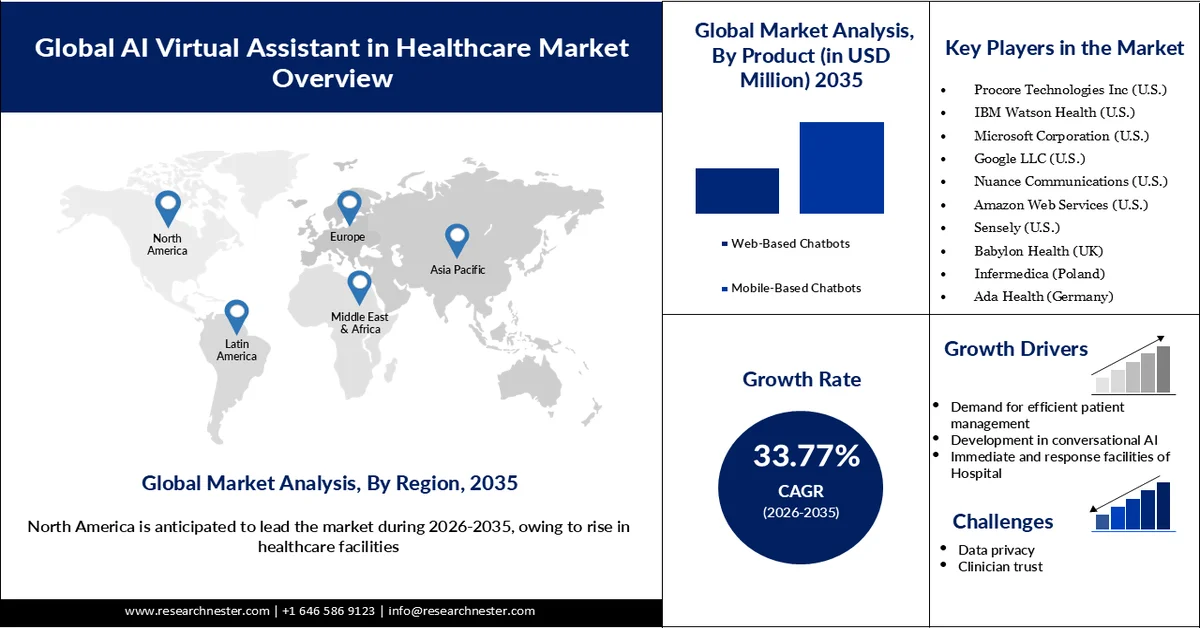
AI Virtual Assistant in Healthcare Market size is valued at USD 1.21 billion in 2025 and is expected to grow to USD 22.25 billion by 2035, registering a CAGR of 33.77% through the forecast period, i.e., 2026-2035. In 2026, the industry size of AI virtual assistant in healthcare is estimated at USD 1.62 billion.
A growing shortage of skilled healthcare workers is becoming a major driver for the adoption of AI virtual assistants in the healthcare sector. As administrative and clinical workloads increase, hospitals and clinics are turning to AI‑based systems to manage patient appointments, handle routine interactions, and streamline communication, ultimately improving patient satisfaction and reducing operational strain. The World Health Organization (WHO) projects a global shortfall of 11 million health workers by 2030, primarily affecting low‑ and lower‑middle‑income countries, due to inadequate training capacity and uneven workforce distribution. This widening labour gap is pushing healthcare facilities to rely more heavily on digital tools that can automate repetitive tasks and support clinical staff. Even in economically stronger regions where skilled professionals are available, rising demand for diagnostics and treatments places significant pressure on doctors and nurses, increasing the risk of burnout. AI virtual assistants help alleviate this burden by simplifying workflows, reducing administrative load, and minimizing dependence on overstretched healthcare personnel. As a result, the escalating workforce shortage combined with the need for efficient, patient‑centric operations is emerging as a key catalyst for the growth of AI virtual assistants in healthcare.
Key AI Virtual Assistant in Healthcare Market Insights Summary:
Regional Highlights:
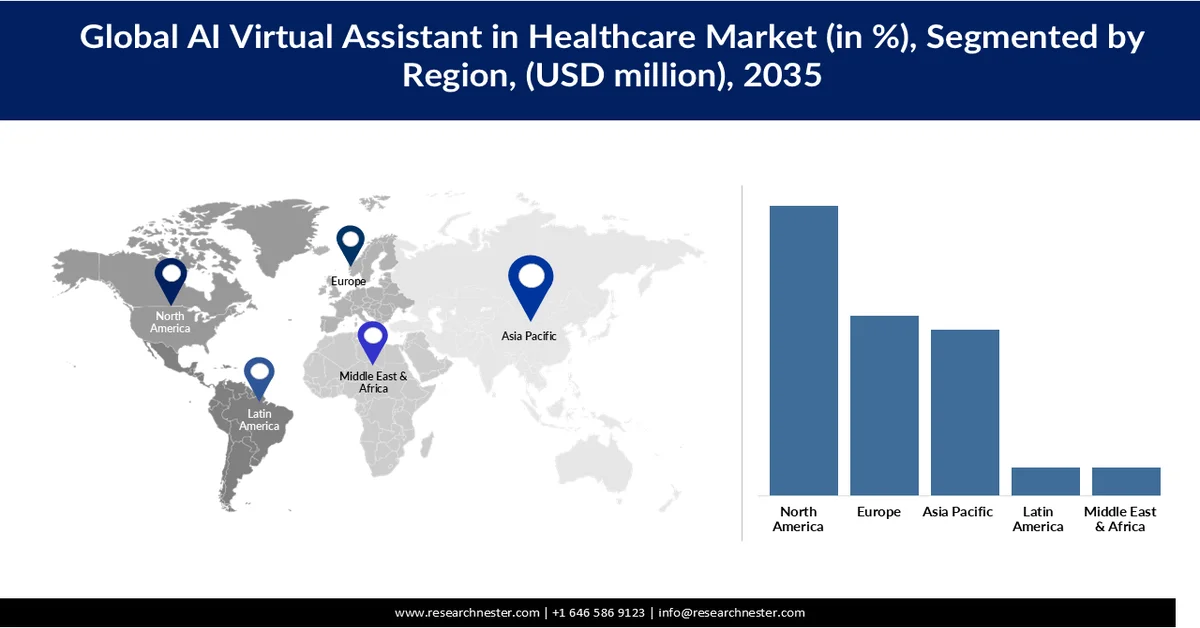
- North America is projected to account for around 42% of the ai virtual assistant in healthcare market by 2035, impelled by the rapid expansion of healthcare facilities and rising patient volumes.
- Europe is expected to capture approximately 26% share by 2035, owing to strong government initiatives promoting digital transformation and addressing clinician shortages.
Segment Insights:
- The service segment is projected to account for nearly 65% of the ai virtual assistant in healthcare market by the end of the forecast period, owing to the growing use of AI virtual assistants to support nurses with medication reminders, note‑taking, and other patient‑centric tasks.
- The mobile‑based chatbot segment is expected to capture nearly 60% share by 2035, propelled by the rapid global penetration of smartphones and the rising preference for mobile platforms during medical emergencies.
Key Growth Trends:
- Demand for efficient patient management
- Development in conversational AI
Major Challenges:
- Data privacy
- Clinician trust
Key Players: Procore Technologies Inc, IBM Watson Health, Microsoft Corporation, Google LLC, Nuance Communications, Amazon Web Services, Sensely, Babylon Health, Infermedica, Ada Health
Global AI Virtual Assistant in Healthcare Market Forecast and Regional Outlook:
Market Size & Growth Projections:
- 2025 Market Size: USD 1.21 billion
- 2026 Market Size: USD 1.62 billion
- Projected Market Size: USD 22.25 billion by 2035
- Growth Forecasts: 33.77% CAGR (2026-2035)
Key Regional Dynamics:
- Largest Region: North America (42% Share by 2035)
- Fastest Growing Region: Asia Pacific
- Dominating Countries: United States, Germany, United Kingdom, Japan, Canada
- Emerging Countries: China, India, South Korea, Australia, Singapore
Last updated on : 25 February, 2026
AI Virtual Assistant in Healthcare Market - Growth Drivers and Challenges
Growth Drivers
- Demand for efficient patient management: The growing demand for efficient patient management is a major force driving the AI virtual assistant in healthcare market in healthcare, as providers face rising patient volumes, staffing shortages, and increasing administrative burdens. AI assistants streamline workflows by automating tasks such as appointment scheduling, triage, follow‑up reminders, and basic patient inquiries, which reduces bottlenecks and frees clinicians to focus on direct care. At the same time, patients expect faster, more convenient, and more personalized interactions, and AI tools deliver 24/7 support that improves satisfaction and reduces wait times. By enhancing operational efficiency, supporting chronic disease management, and lowering overall care costs, AI virtual assistants have become essential to modern healthcare systems striving to improve both patient outcomes and organizational performance.
- Development in conversational AI: Advancements in conversational AI are transforming communication in healthcare settings, particularly for hospitals and diagnostic centres that serve diverse international populations. AI virtual assistants equipped with multilingual capabilities help eliminate language barriers by accurately interpreting patient queries and facilitating smoother interactions with healthcare staff. This enhances clarity, reduces the risk of miscommunication, and builds stronger trust between patients and providers. Such linguistic support directly contributes to more efficient care coordination and improved patient experiences. The World Health Organization’s Global Strategy on Digital Health 2020–2025 further reinforces the need for digital tools that promote patient‑centric care and strengthen diagnostic processes, highlighting the growing relevance of AI‑driven communication technologies in modern healthcare.
- Immediate response and 24/7 availability: The need for continuous availability in healthcare often clashes with high call volumes and unpredictable emergencies, making timely patient response a persistent challenge. AI‑powered virtual assistants help close this gap by conducting rapid preliminary assessments, identifying urgent cases, and initiating coordination with centralized emergency response teams. This integration enables faster stabilization efforts and reduces delays in critical situations. Their ability to streamline triage and support emergency workflows enhances operational efficiency across healthcare facilities. According to the Assistant Secretary for Technology and Policy’s 2024 report, over 71% of hospitals have incorporated AI into electronic health records, reflecting the increasing reliance on AI systems to improve diagnostic accuracy and strengthen patient management.
Challenges
- Data privacy: Growing concerns around data privacy and the risk of data breaches are slowing the adoption of AI virtual assistants in healthcare. Hospitals handle highly sensitive patient information and complex medical records, making any vulnerability in AI systems a significant threat. These risks have pushed healthcare providers to invest heavily in cybersecurity infrastructure to safeguard patient data. While this increases operational costs, it also supports the broader expansion of AI virtual assistants by creating a more secure environment for their deployment.
- Clinician trust: Clinician trust remains another major barrier to the widespread adoption of AI virtual assistants. Many healthcare professionals find these systems difficult to integrate into existing workflows and question their accuracy and reliability. Technical issues, such as poor server connectivity, can further disrupt functionality and lead to delays in responding to patient queries. These challenges reduce confidence among clinicians and hinder AI virtual assistant in healthcare market growth, highlighting the need for more robust, user‑friendly, and dependable AI solutions in healthcare.
AI Virtual Assistant in Healthcare Market Size and Forecast:
| Report Attribute | Details |
|---|---|
|
Base Year |
2025 |
|
Forecast Year |
2026-2035 |
|
CAGR |
33.77% |
|
Base Year Market Size (2025) |
USD 1.21 billion |
|
Forecast Year Market Size (2035) |
USD 22.25 billion |
|
Regional Scope |
|
AI Virtual Assistant in Healthcare Market Segmentation:
Platform Segment Analysis
The service segment is projected to account for nearly 65% of the AI virtual assistant in healthcare market by the end of the forecast period, driven by the growing use of AI virtual assistants to support nurses with medication reminders, note‑taking, and other patient‑centric tasks. These assistants also contribute to workflow mapping, helping streamline clinical processes and minimize errors in patient safety and health monitoring. By managing patient inquiries and emergency‑related questions, AI virtual assistants significantly reduce the workload on healthcare staff and contribute to improved patient outcomes. Meanwhile, the solution segment is also expected to secure a substantial share, supported by increasing adoption of predictive assistance in surgical planning and enhanced communication tools that improve coordination among clinical teams.
Product Segment Analysis
The mobile‑based chatbot segment is expected to capture nearly 60% of the AI virtual assistant in healthcare market by 2035, driven by the rapid global penetration of smartphones and the growing preference for mobile platforms during medical emergencies. Patients increasingly rely on mobile chatbots for quick resolutions and immediate responses, which strengthens the segment’s expansion. Additionally, the rise of smart wearables has further enhanced mobile‑based solutions, broadening their application in continuous health monitoring and patient engagement. Meanwhile, the web‑based chatbot segment is also projected to hold a significant share throughout the forecast period, supported by its integration into hospital websites and telehealth portals. This integration boosts patient trust and provides a reliable channel for accessing medical support, particularly during urgent care situations.
End-user Segment Analysis
The hospital and clinic segment is projected to hold around 55% of the AI virtual assistant in healthcare market by 2035, driven by the increasing adoption of AI technologies to enhance operational efficiency across healthcare facilities. These settings manage a high volume of patient inquiries related to routine appointments and emergency situations, where AI virtual assistants play a crucial role in assessing conditions and coordinating appropriate support. Meanwhile, the pharmaceutical segment is also expected to secure a significant share during the forecast period, supported by the growing use of AI virtual assistants in data analysis, patient response tracking, and clinical trial management. Their ability to streamline complex research workflows and improve data accuracy further strengthens their value within the pharmaceutical industry.
Our in-depth analysis of the global AI virtual assistant in healthcare market includes the following segments:
|
Segments |
Subsegments |
|
Product |
|
|
Platform |
|
|
Application |
|
|
End-user |
|

Vishnu Nair
Head - Global Business DevelopmentCustomize this report to your requirements — connect with our consultant for personalized insights and options.
AI Virtual Assistant in Healthcare Market - Regional Analysis
North America Market Insights
The North America AI virtual assistant in healthcare market is projected to account for around 42% of the global share by 2035, supported by the rapid expansion of healthcare facilities across the region. The rise in specialty hospitals and diagnostic centres has increased patient volumes and, consequently, the number of daily queries. To manage this growing demand, healthcare providers are gradually adopting AI virtual assistants to reduce staff workload, limit burnout, and improve operational efficiency. The region’s strong telehealth culture, particularly among older adults who frequently seek medical advice remotely, further accelerates adoption. AI‑enabled virtual assistants assist patients with medication guidance, diagnostic instructions, and general health queries, easing pressure on practitioners. Their ability to analyse patient data and recommend preventive measures also enhances the quality of care.
In the U.S., the ageing population and rising mobility challenges are driving increased reliance on telehealth services. This shift is encouraging healthcare facilities to integrate AI virtual assistants that support active consultations, medication management, and patient follow‑ups, thereby reducing the burden on clinical staff and improving response times. The rapid growth of specialty hospitals across the country is further expanding the AI virtual assistant in healthcare market. Additionally, the increasing adoption of robotic surgery—especially in oncology—has improved surgical precision and clinician productivity, contributing to better patient outcomes and reinforcing the value of AI‑driven systems.
Canada’s regulatory frameworks strongly promote the integration of digital health technologies, encouraging hospitals to adopt systems that enable continuous patient monitoring. AI virtual assistants play a key role in this shift by tracking patient health indicators and helping reduce the risk of complications. Their use in robotic‑assisted surgeries has improved success rates and accelerated recovery times, supporting wider adoption across healthcare facilities. As Canada intensifies its focus on diagnosing and managing chronic diseases such as cancer and cardiovascular conditions, AI‑enabled robotics and virtual assistants are becoming essential tools for recording clinical data, predicting procedural steps, and minimizing patient trauma.
Europe Market Insights
Europe is expected to capture around 26% of the AI virtual assistant in healthcare market by 2035, supported by strong government initiatives promoting digital transformation in healthcare. Large‑scale public and private investments are accelerating the integration of digital technologies aimed at improving patient‑centric care. According to the European Parliament, more than 20 EU countries report physician shortages, and 15 face nursing shortages, creating operational gaps that AI virtual assistants can help fill by managing patient queries and supporting clinicians in daily tasks. Additionally, Europe’s ageing population is increasingly turning to telehealth services, where virtual assistants can guide patients, provide timely advice, and reduce pressure on healthcare staff.
In the UK, regulatory support from the NHS and related agencies has strengthened the adoption of AI virtual assistant systems. The government’s focus on elderly care has driven the growth of wearable health‑tracking devices connected to centralized platforms equipped with AI virtual assistants. These systems alert practitioners to health anomalies in real time, enabling immediate intervention and improving patient safety. This structured regulatory environment has positioned the UK as a strong adopter of AI‑enabled patient monitoring solutions.
Germany’s advanced healthcare infrastructure is a major driver of AI virtual assistant adoption. The country’s well‑equipped hospitals and diagnostic centres prioritize accurate diagnosis and long‑term treatment planning, making AI‑driven tools a natural fit. Virtual assistants enhance patient‑centric care by supporting clinical workflows, improving communication, and reducing administrative burden. As healthcare costs continue to rise, AI virtual assistants offer a pathway to greater efficiency and affordability, helping the system deliver high‑quality care while easing financial pressure on both providers and the government.
Asia Pacific Market Insights
The Asia Pacific is expected to capture around 24% of the AI virtual assistant in healthcare market by 2035, driven by the rapid entry of technology companies developing cost‑effective and accurate AI‑based healthcare solutions. Many countries in the region are experiencing significant growth in medical infrastructure, attracting patients seeking specialty care, surgeries, and advanced consultations. In these settings, AI virtual assistants play a crucial role in supporting clinicians during emergencies and resuscitation by monitoring vital signs, detecting fluctuations, and recommending corrective measures in real time.
India, one of the fastest‑growing developing nations in AI virtual assistant in healthcare market and is gradually integrating modern technologies into its healthcare system to strengthen patient‑centric care. The increasing reliance on specialty hospitals valued for their clinical expertise and quality of treatment has led to a surge in patient volumes. This growing demand requires high diagnostic accuracy and minimal error, encouraging the adoption of AI virtual assistants to support clinical decision‑making. India’s ageing population and rising prevalence of chronic diseases further highlight the need for AI tools capable of assessing patient conditions and predicting potential health risks that may not be immediately detectable through conventional tests.
The AI virtual assistant in healthcare market in China has strong manufacturing capabilities and cost‑efficient production environment are accelerating the expansion of AI virtual assistant technologies. The country’s rapidly growing population and expanding healthcare infrastructure are prompting practitioners to adopt AI‑based systems to reduce dependence on manual labour and improve work balance for medical staff. High smartphone penetration across China also fuels the widespread use of mobile‑based chatbots, enabling patients to access immediate assistance from hospitals and healthcare facilities. This combination of technological readiness and large‑scale digital adoption positions China as a key contributor to the region’s AI virtual assistant in healthcare market growth.
Key AI Virtual Assistant in Healthcare Market Players:
- Procore Technologies Inc (U.S.)
- IBM Watson Health (U.S.)
- Microsoft Corporation (U.S.)
- Google LLC (U.S.)
- Nuance Communications (U.S.)
- Amazon Web Services (U.S.)
- Sensely (U.S.)
- Babylon Health (UK)
- Infermedica (Poland)
- Ada Health (Germany)
- Company Overview
- Business Strategy
- Key Product Offerings
- Financial Performance
- Key Performance Indicators
- Risk Analysis
- Recent Development
- Regional Presence
- SWOT Analysis
- IBM Watson Health is an AI and data analytics company that highly focuses on the healthcare segment. It employs its own cognitive computing, which supports various decisions of doctors and clinicians. The system is widely used in oncology, genomics and population health management.
- Microsoft Corporation is a global technological giant that is based in the U.S. and provides analytical tools such as Azure and cloud tools for various healthcare settings. The software and the tools are believed to support telehealth and enhance patient engagement. Microsoft is actively investing in the development of interoperable systems designed for healthcare partners.
- Google LLC, a global technology giant that has recently stepped into the AI frameworks for various industries, including healthcare. Google Health and DeepMind are some of the popular products on offer from the firm for healthcare partners. Google highly focuses on data analytics and patient data documentation for easier diagnosis and treatment.
- Amazon Web Services, an AI and cloud services company with a rich legacy in supporting clients from various industries and geographical areas. The NLP tool is highly offered to healthcare facilities, which enables multi-lingual chatbots. It is also responsible for holding the critical and complex hospital data at a lower cost, enhancing adoption in emerging healthcare facilities.
Below is the list of the key players operating in the AI virtual assistant in healthcare market:
The players operating in the global AI virtual assistant in healthcare market is expected to face intense competition during the forecast period. The market is associated with both established key players and new entrants. However, the AI virtual assistant in healthcare market is moderately fragmented. New entrants impose immense competition for the existing players, prohibiting them from acquiring the majority of the revenue share. Specialised manufacturers maintain a competitive landscape in the AI virtual assistant in healthcare market. Key players in the AI virtual assistant in healthcare market are significantly supported by the governments for research and innovation.
Competitive Landscape of the AI Virtual Assistant in Healthcare Market
Recent Developments
- In February 2026, FUJIFILM announced its collaboration with AWS to enhance creative solutions in radiology, cardiology, and surgery. FUJIFILM Healthcare UK is closely working with healthcare facilities to ensure disease-centric tests, ensuring higher accuracy
- In January 2026, Microsoft announced the acquisition of Osmos, an energetic engineering and data platform. The initiative will help Microsoft accelerate the autonomous data engineering and simplify ETL
- Report ID: 8405
- Published Date: Feb 25, 2026
- Report Format: PDF, PPT
- Explore a preview of key market trends and insights
- Review sample data tables and segment breakdowns
- Experience the quality of our visual data representations
- Evaluate our report structure and research methodology
- Get a glimpse of competitive landscape analysis
- Understand how regional forecasts are presented
- Assess the depth of company profiling and benchmarking
- Preview how actionable insights can support your strategy
Explore real data and analysis
Frequently Asked Questions (FAQ)
About this Report
Connect with our Expert


Report, 2026-2035



Copyright @ 2026 Research Nester. All Rights Reserved.
