Loitering Munitions Market Outlook:
Loitering Munitions Market size was valued at USD 5.7 billion in 2025 and is projected to reach USD 35.6 billion by the end of 2035, registering around 20.2% CAGR during the forecast period i.e., between 2026-2035. In 2026, the industry size of loitering munitions is evaluated at USD 6.8 billion.
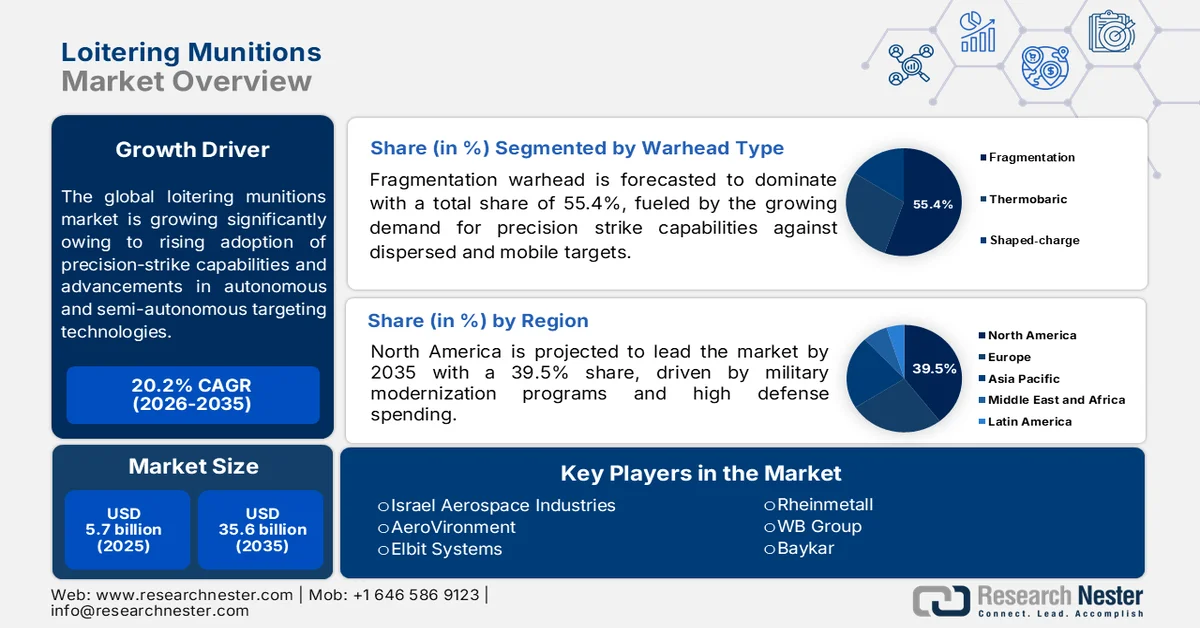
The loitering munitions market is projected to witness stable and sustained growth, which is driven by the rising adoption of precision-strike capabilities and advancements in autonomous and semi-autonomous targeting technologies. In addition, increased investments in military surveillance and reconnaissance are driving the adoption of loitering munitions in tactical operations, owing to their precision in detecting and engaging targets. The article published by the Institute for Youth in Policy in November 2025 revealed that the growing use of loitering munitions in modern warfare is driven by their precision, whereas conflicts such as the Nagorno-Karabakh war and the Russia–Ukraine war have demonstrated their effectiveness against air defense systems, armored vehicles, and critical military infrastructure, accelerating global adoption. Besides, their relatively low cost, ease of deployment, and compatibility with ground, air, and naval platforms make loitering munitions an important aspect and cost-effective capability for modern armed forces.
Furthermore, demand in the market is supported by the evolving nature of modern warfare, wherein armed forces seek flexible, rapidly deployable solutions for both offensive and defensive missions. In addition, rising procurement programs, cross-border security concerns, and the expanding use of loitering munitions across land and maritime operations are expected to create sustained opportunities for manufacturers and technology developers across the globe. In this context, AeroVironment in August 2024 stated that it secured a five-year contract with a total of USD 990 million IDIQ contract from the U.S. Army to supply its combat-proven Switchblade loitering munition systems, which is under the lethal unmanned systems program. This contract supports the army’s initiative to equip infantry battalions with man-portable precision strike capabilities for engaging armored vehicles and other beyond-line-of-sight targets.
Top Exporting Countries of Munitions of War, Ammunition and Projectile Parts (HS 93.06.90): Global Defense Supply Indicators, 2024
|
Exporting Country |
Export Value (2024) |
|
U.S. |
3.63 billion |
|
Bulgaria |
2.33 billion |
|
Poland |
1.92 billion |
|
Romania |
766 million |
|
South Korea |
548 million |
|
Spain |
348 million |
|
Norway |
266 million |
|
Israel |
237 million |
|
UK |
227 million |
|
India |
224 million |
Source: OEC
Top Importing Countries for Munitions of War, Ammunition and Projectile Parts: Global Defense Demand Indicators, 2024
|
Importing Country |
Import Value (USD) |
|
Ukraine |
2.84 billion |
|
Poland |
2.40 billion |
|
Israel |
1.37 billion |
|
Romania |
743 million |
|
UAE |
594 million |
|
U.S. |
549 million |
|
Saudi Arabia |
529 million |
|
Australia |
293 million |
|
Japan |
285 million |
|
Slovakia |
211 million |
Source: OEC
Key Loitering Munitions Market Insights Summary:
Regional Highlights:
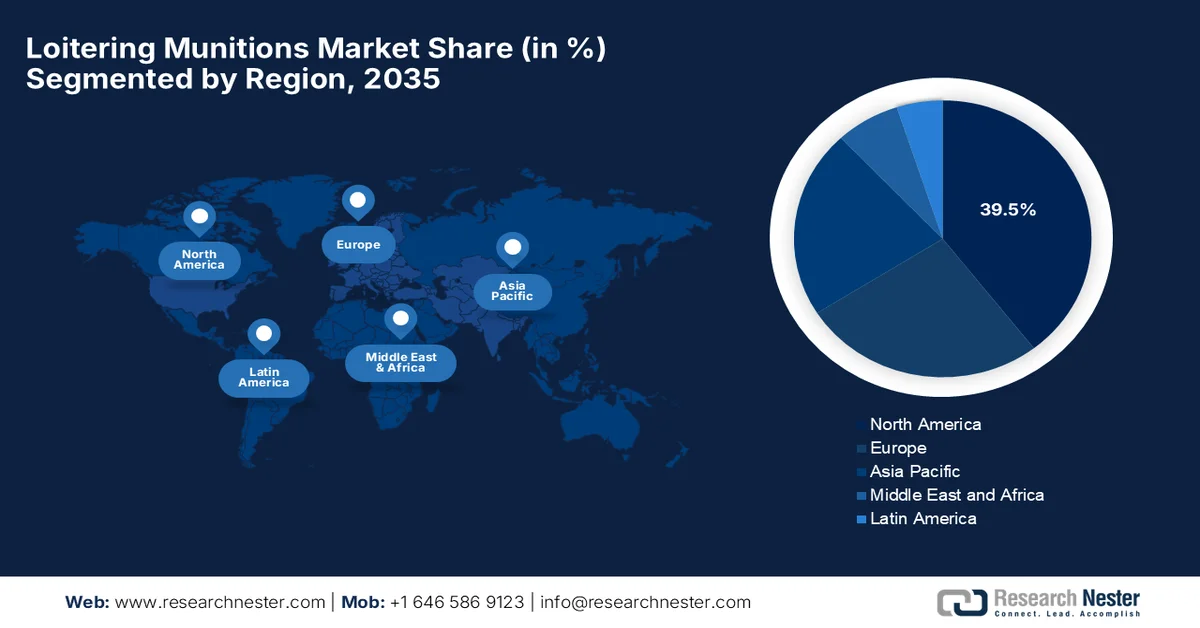
- The loitering munitions market in North America is projected to account for 39.5% of the global share by 2035, bolstered by extensive military modernization programs and robust defense budgets across the U.S. and Canada
- The Asia Pacific region is expected to witness considerable growth during 2026-2035, fueled by escalating geopolitical tensions and rising investments in asymmetric warfare strategies alongside indigenous defense capabilities
- The market in the U.S. accounts for almost 73.7% of the share in North America, which is driven by the country’s substantial defense expenditure and strong focus on integrating advanced unmanned combat systems
Segment Insights:
- The loitering munitions market fragmentation warhead segment is projected to capture 55.4% share by 2035, propelled by rising demand for precision strike capabilities against dispersed and mobile targets alongside the cost-effectiveness of fragmentation warheads
- The air forces segment is anticipated to secure a noteworthy revenue share in the 2026-2035 period, underpinned by increasing emphasis on air superiority, stand-off strike capabilities, and network-centric warfare strategies
Key Growth Trends:
- Increasing defense budgets and military modernization
- Growing adoption of unmanned warfare technologies
Major Challenges:
- High development costs and stringent procurement requirements
- Export restrictions and counter-drone defense advancements
Key Players: Israel Aerospace Industries, AeroVironment, Elbit Systems, Rheinmetall, WB Group, STM Savunma Teknolojileri Mühendislik ve Ticaret A.Ş., Baykar, EDGE Group, IAI MALAT, Ondas Inc., ZALA Aero Group.
Global Loitering Munitions Market Forecast and Regional Outlook:
Market Size & Growth Projections:
- 2025 Market Size: USD 5.7 billion
- 2026 Market Size: USD 6.8 billion
- Projected Market Size: USD 35.6 billion by 2035
- Growth Forecasts: 20.2% CAGR (2026-2035)
Key Regional Dynamics:
- Largest Region: North America (39.5% share by 2035)
- Fastest Growing Region: Asia Pacific
- Dominating Countries: United States, China, Israel, Russia, Türkiye
- Emerging Countries: Australia, India, South Korea, Poland, Spain
Last updated on : 29 July, 2026
Loitering Munitions Market - Growth Drivers and Challenges
Growth Drivers
- Increasing defense budgets and military modernization: Most of the countries are expanding their defense budgets in order to strengthen security and modernize aging military equipment. Therefore, investments in advanced unmanned systems, including loitering munitions, have become a strategic priority, prompting a favorable business environment for pioneers in the market. For instance, Textron Systems in February 2026 was selected for a U.S. Army prototype effort under the Low-Altitude Stalking & Strike Ordnance program to showcase and validate its Damocles™ loitering munition system. This VTOL-enabled Damocles system consists of an advanced GEN2 Explosively Formed Penetrator (EFP), modular open architecture, and support for multiple mission payloads, including electronic warfare, thus positively benefiting the market’s growth.
- Growing adoption of unmanned warfare technologies: The shift toward unmanned and autonomous warfare is creating strong demand in the market. These systems reduce risks to military personnel while providing persistent surveillance and rapid strike capabilities, contributing to the expansion of the market globally. In July 2023, Rheinmetall and UVision secured a major contract from Hungary, which was valued in the low three-digit million-euro range, with a main goal to supply Hero loitering munition systems. The Hero family provides autonomous reconnaissance, target tracking, and precision strike capabilities against targets including infantry, vehicles, fortifications, and air defense systems, thus indicating a long-term growth opportunity for the market.
Challenges
- High development costs and stringent procurement requirements: The development process of these loitering munitions requires huge investments in terms of R&D, autonomous navigation systems, electro-optical sensors, secure communication links, as well as precision guidance technologies. Apart from this, manufacturers need to comply with military qualification standards, reliability testing, and certification processes before products can be deployed. Since most procurements are government-led, companies often encounter prolonged acquisition cycles and complex bidding processes, which can delay commercialization and revenue realization. Besides, smaller manufacturers find it difficult to compete with established defense contractors that possess greater financial resources and long-standing government relationships, thus negatively impacting the growth of the market.
- Export restrictions and counter-drone defense advancements: The global market is being challenged by stringent export regulations and the continued evolution of counter-drone technologies. Governments across different nations impose strict export controls on advanced military systems, which are influenced by national security concerns, limiting manufacturers' ability to access international markets and delaying cross-border defense agreements. Simultaneously, armed forces are investing in counter-UAS capabilities, which include radar detection, electronic warfare, GPS jamming, directed-energy weapons, and interceptor systems to neutralize loitering munitions before they reach their targets. This is reducing their operational effectiveness and thus creating additional challenges for market growth.
Loitering Munitions Market Size and Forecast:
| Report Attribute | Details |
|---|---|
|
Base Year |
2025 |
|
Forecast Year |
2026-2035 |
|
CAGR |
20.2% |
|
Base Year Market Size (2025) |
USD 5.7 billion |
|
Forecast Year Market Size (2035) |
USD 35.6 billion |
|
Regional Scope |
|
Loitering Munitions Market Segmentation:
Warhead Type Segment Analysis
Under the warhead type segment, fragmentation warhead is forecasted to dominate with a total share of 55.4% in the loitering munitions market by the end of 2035. The segment’s dominant position is majorly fueled by the growing demand for precision strike capabilities against dispersed and mobile targets, coupled with the cost-effectiveness of fragmentation warheads when compared to more complex alternatives. Their versatility allows them to engage a wide range of threats which is from infantry and light vehicles to radar installations. In February 2026, Rheinmetall demonstrated its FV-014 loitering munition system to a potential NATO customer, showcasing its complete capabilities in reconnaissance, precision strike, and long-range operations. This FV-014 combines advanced sensors, network connectivity, and human-in-the-loop control, with a range of up to 100 km and an operational duration of 70 minutes.
End user Segment Analysis
Air forces, which are a part of end user category, are expected to grow, accounting for a noteworthy revenue share in the loitering munitions market during the discussed timeframe. The segment’s growth is largely attributable to the growing emphasis on air superiority, stand-off strike capabilities, and network-centric warfare strategies. In addition, the integration of advanced electro-optical systems, autonomous flight technologies, and enhanced communication links is improving mission flexibility, driving higher adoption of these systems among air forces globally. In September 2023, Elbit Systems secured a USD 95 million contract to supply several hundred SkyStriker loitering munitions to a country in Europe. These autonomous SkyStriker systems offer precision strike capabilities with a warhead capacity of up to 10 kg, a range of 100 km, and the ability to operate in GPS- and communication-denied environments.
Range Segment Analysis
On the basis of range, medium-range is forecasted to grow with a notable revenue share in the loitering munitions market by the conclusion of 2035. The segment’s growth is effectively propelled by the increasing demand for a balance between operational reach, precision engagement, and cost efficiency. Medium-range loitering munitions provide armed forces with enhanced battlefield flexibility by enabling strikes against targets beyond the immediate tactical zone while avoiding the higher costs associated with long-range systems. Apart from this, their suitability for infantry support, border surveillance, and counter-insurgency operations is driving extensive adoption among defense forces who are seeking versatile unmanned strike capabilities. Furthermore, advancements in terms of communication systems, navigation technologies, and payload integration are improving the effectiveness of medium-range platforms across diverse combat environments.
Our in-depth analysis of the loitering munitions market includes the following segments:
|
Segment |
Subsegments |
|
Warhead Type |
|
|
End user |
|
|
Range |
|
|
Platform |
|
|
Launch Mode |
|

Vishnu Nair
Head - Global Business DevelopmentCustomize this report to your requirements — connect with our consultant for personalized insights and options.
Loitering Munitions Market - Regional Analysis
North America Market Insights
North America loitering munitions market is anticipated to hold the highest share of 39.5% during the forecast period. The region’s dominant position is largely fueled by extensive military modernization programs and massive defense budgets of the U.S. and Canada. A strategic shift toward autonomous warfare, asymmetric combat readiness, and non-line-of-sight precision strike capabilities is allowing regional demand to transition from niche tactical procurement to mass-scale, program-backed deployment across infantry, naval, and air force units. In July 2026, the U.S. Marine Corps’ 2nd Marine Regiment reported that it conducted its first regimental‑level trial of the JUMP 20‑X Group 3 UAS, which is equipped with the Switchblade 300 Block 20 loitering munition. It also mentioned that during service-level training exercise 4‑26 at Twentynine Palms, California, the system engaged a target 25 kilometers away, thereby demonstrating long‑range precision strike capability for conventional ground forces.
The shift from traditional artillery toward autonomous precision strike systems is driving growth of the U.S. market. Technological advancement is structured around incorporating AI for autonomous target recognition, edge-computing capabilities, and secure mesh networking in order to enable swarming tactics in electronic warfare environments. In addition, domestic defense contractors are showcasing a priority towards modular payload configurations, allowing these single-use drones to seamlessly alternate between persistent ISR collection and kinetic strike missions in heavily contested domains. On the other hand, the increasing focus on multi-domain warfare capabilities is further encouraging defense investments in next-generation unmanned strike systems.
The Canada market is being efficiently reshaped by its consistent efforts to strengthen defense readiness and enhance Arctic security capabilities. The country’s market also benefits from a growing emphasis on unmanned systems, precision-strike technologies, and intelligence-based operations, which is encouraging the adoption of advanced loitering munitions for surveillance and tactical missions. Based on the government data published in June, 2026, Canada announced a substantial USD 1.9 billion agreement with the U.S. under the Foreign Military Sales program to acquire 26 HIMARS launchers, munitions, and support services. The long-range precision strike (Land) project will provide the country’s army with mobile, long‑range missile capabilities exceeding 300 km, including future anti‑ship options for coastal defense.
APAC Market Insights
Asia Pacific loitering munitions market is anticipated to grow at a considerable rate from 2026 to 2035. The region’s progress in this field is mainly propelled by escalating geopolitical tensions and territorial disputes across critical maritime choke points, which have forced regional militaries to rapidly modernize their tactical strike capabilities. The regional nations are proactively making investments in asymmetric warfare strategies, shifting from foreign military imports to establishing sovereign capabilities for cost-effective, attritable weapons. In July, 2024, the government of Australia announced the acquisition of the Switchblade 300 precision loitering munition with a main goal to enhance the country’s Defence Force’s combat edge. The acquisition reflects the government’s commitment to equipping soldiers with technologies to maintain superiority against emerging threats.
The highly centralized, state-backed military-industrial initiatives, which are aimed at establishing absolute dominance in unmanned and intelligent warfare, are propelling the growth of the market in China. Production in the country is being heavily dominated by state-owned defense conglomerates, which leverage a massive, entirely independent domestic supply chain to achieve unparalleled economies of scale. Based on government data published in September 2025, China is accelerating its military modernization by developing advanced drone swarm technologies. The PLA has conducted swarm launches of up to 200 drones, experimented with amphibious landing scenarios, and tested a drone mothership which is capable of deploying over 100 loitering munitions, positively benefiting the market’s growth.
In India, the market is undergoing profound expansion, which is driven primarily by the push for self-reliance through the Make in India and Aatmanirbhar Bharat initiatives. To secure its highly contested mountain borders and extensive coastlines, the domestic armed forces are fast-tracking the procurement of man-portable and vehicle-mounted autonomous strike systems. As stated by the Press Information Bureau (PIB) in May 2025, Operation SINDOOR showcased the country’s growing self‑reliance in defense technology, thereby integrating indigenous systems such as the Akash missile and advanced loitering munitions for precision strikes. Besides, the operation neutralized Pakistan–based drones, missiles, and air defense assets without crossing the border, underscoring India’s technological edge in the defense sector.
Europe Market Insights
The Europe loitering munitions market is expected to acquire a prominent position in the global landscape. The region’s leadership in this field is mainly propelled by the profound structural shift in continental defense strategies following the protracted conflict in Ukraine. This surging demand is fostering a decentralized and highly collaborative domestic industrial base, where established regional defense giants are partnering with agile tech startups to establish secure, localized supply chains. In January 2026, Indra Group and EDGE signed an agreement to establish a new defense manufacturing entity in Spain, which is focused on loitering munitions and smart weapons, backed by a USD 2.2 billion order pipeline. It also mentioned that production will take place at a new facility in León, along with a UAV micro‑engine plant in Valladolid to strengthen aerospace capabilities.
The consistent efforts to strengthen precision strike, autonomous warfare, and battlefield intelligence capabilities are responsibly uplifting the market in Germany. In addition, the country is also focusing on improving domestic defense industrial capabilities through collaborations between defense companies and government institutions, supporting the development of advanced unmanned platforms and reducing reliance on external suppliers. In June 2026, the country’s armed forces announced the acquisition of loitering munitions from Helsing, Stark, and Rheinmetall, which marks a major leap in precision strike capability. These kamikaze-style systems, which are designed for single-use, allow long-range target engagement with onboard sensors and operator control, thus making them suitable for standard market growth.
The UK loitering munitions market is growing at an extensive rate, which is facilitated mainly by investment shifts into uncrewed technology and autonomous systems. This market is being reshaped by procurement strategies which are prioritizing high-speed acquisition pipelines, supply chain resilience, and an expansion of domestic manufacturing capacity. For instance, in May 2026, the UK Ministry of Defense announced the deployment of a new low-cost advanced precision kill weapon system on RAF Typhoon fighter jets to counter drone threats in the Middle East and protect UK citizens and regional partners. It mentions that this system was rapidly moved from testing to operational deployment through collaboration between the MoD and industry partners, reflecting the UK’s focus on affordable precision-strike solutions and faster defense acquisition pathways.
Key Loitering Munitions Market Players:
- Israel Aerospace Industries (Israel)
- AeroVironment (U.S.)
- Elbit Systems (Israel)
- Rheinmetall (Germany)
- WB Group (Poland)
- STM Savunma Teknolojileri Mühendislik ve Ticaret A.Ş. (Turkey)
- Baykar (Turkey)
- EDGE Group (UAE)
- IAI MALAT (Israel)
- Ondas Inc.
- ZALA Aero Group (Russia)
- Company Overview
- Business Strategy
- Key Product Offerings
- Financial Performance
- Key Performance Indicators
- Risk Analysis
- Recent Development
- Regional Presence
- SWOT Analysis
- Israel Aerospace Industries is one of the leading manufacturers in the global market which is offering advanced systems. Besides, the company has established a strong international presence through defense contracts across multiple regions.
- AeroVironment is a prominent U.S.-based defense manufacturer that is recognized for its Switchblade loitering munition family. The firm is highly focused on lightweight, man-portable precision strike solutions that are especially designed for tactical military operations.
- Elbit Systems is a major global defense technology provider that has a strong presence in the loitering munitions segment through systems such as SkyStriker. In addition, the company differentiates itself through advanced electro-optical sensors and integration with broader battlefield management systems.
- Rheinmetall is yet another foundational player in this sector, which is expanding its role in the market as part of its broader unmanned systems and precision strike portfolio. The company benefits from its established defense manufacturing capabilities, strong presence in Europe, along with government relationships to develop advanced battlefield solutions.
- WB Group has long-standing experience in manufacturing unmanned systems as well as loitering munitions. The company has gained huge market traction through cost-effective tactical solutions designed for reconnaissance and precision strike missions.
Here is a list of key players operating in the global market:
The small number of established defense manufacturers focused on advanced product developments and international defense partnerships is intensifying competition in the market. Leading manufacturers such as Israel Aerospace Industries, AeroVironment, and Elbit Systems dominate this entire landscape with certain proven operational systems and geographic reach. Competition in this sector is largely driven by range, autonomy, payload capability, and integration with modern battlefield networks. In December 2025, UVision announced the acquisition of SpearUAV to broaden its loitering munition capabilities and strengthen its multi-layered autonomous strike solutions. This acquisition readily expands UVision’s capabilities by adding advanced AI-based systems that support operations across tactical battalion-level missions and broader strategic engagements.
Corporate Landscape of the Market:
Recent Developments
- In June 2026, Ondas Inc. announced more than USD 40 million in new orders for autonomous defense systems, including Counter-UAS, loitering munition systems, ground systems, and defense services, bringing its 2d quarter’s order activity above USD 150 million.
- In October 2025, AeroVironment expanded its Switchblade® loitering munition family with three new systems: Switchblade 600 Block 2, Switchblade 400, and Switchblade 300 Block 20 with an EFP payload. These new variants provide enhanced range, AI-enabled targeting, improved command-and-control, and scalable precision strike capabilities.
- Report ID: 8706
- Published Date: Jul 29, 2026
- Report Format: PDF, PPT
- Explore a preview of key market trends and insights
- Review sample data tables and segment breakdowns
- Experience the quality of our visual data representations
- Evaluate our report structure and research methodology
- Get a glimpse of competitive landscape analysis
- Understand how regional forecasts are presented
- Assess the depth of company profiling and benchmarking
- Preview how actionable insights can support your strategy
Explore real data and analysis
Frequently Asked Questions (FAQ)
About this Report
Connect with our Expert


Report, 2026-2035



Copyright @ 2026 Research Nester. All Rights Reserved.
