Global Hydrotalcite Market
1. An Outline of the Global Hydrotalcite Market
1.1. Market Definition and Segmentation
1.2. Study Assumptions and Abbreviations
2. Research Methodology & Approach
2.1. Primary Research
2.2. Secondary Research
2.3. Data Triangulation
2.4. SPSS Methodology
3. Executive Summary
4. Growth Drivers
5. Major Roadblocks
6. Opportunities
7. Prevalent Trends
8. Government Regulation
9. Growth Outlook
10. Competitive White Space Analysis – Identifying Untapped Market Gaps
11. Risk Overview
12. SWOT
13. Technological Advancement
14. Technology Maturity Matrix for the Hydrotalcite Market: Recent News
15. Regional Demand
16. Global Hydrotalcite by Geography – Strategic Comparative Analysis
17. Strategic Segment Analysis: Hydrotalcite Demand Landscape
18. Hydrotalcite Demand Trends Driven by rising polymer production, increasing PVC stabilization needs, growing pharmaceutical applications, and expanding adoption of environmentally friendly and non-toxic additive systems across industrial sectors. (2026-2036)
19. Root Cause Analysis (RCA) for discovering problems of the Hydrotalcite Market
20. Porter Five Forces
21. PESTLE
22. Comparative Positioning
23. Global Hydrotalcite – Key Player Analysis (2036)
24. Competitive Landscape: Key Suppliers/Players
25. Competitive Model: A Detailed Inside View for Investors
26. Company Market Share, 2036 (%)
26.1. Akdeniz Chemson (OYAK Group)
26.2. BELIKE Chemical Company Ltd.
26.3. CLARIANT
26.4. DOOBON
26.5. DS DANSUK CO., LTD.
26.6. GCH TECHNOLOGY CO., LTD.
26.7. Hubei Benxing New Material Co., LTD
26.8. Kyowa Chemical Industry Co., Ltd.
26.9. Par Drugs and Chemical Limited
26.10. Saekyung Chemical Co., Limited
26.11. Saekyung (Hengshui) New Material Co., Ltd.
26.12. SAKAI CHEMICAL INDUSTRY CO., LTD.
26.13. Sasol Germany GmbH
26.14. SINWON INDUSTRIAL CO., LTD.
26.15. TODA KOGYO CORP.
27. Global Hydrotalcite Market Outlook
27.1. Market Overview
27.1.1. Market Revenue by Value (USD Thousand), by Volume (Thousand Tons), and Compound Annual Growth Rate (CAGR)
27.2. Hydrotalcite Market Segmentation Analysis (2026-2036)
27.2.1. By Type
27.2.1.1. Synthetic Hydrotalcite, Market Value (USD Thousand), and CAGR, 2026-2036F
27.2.1.2. Natural (Mineral) Hydrotalcite, Market Value (USD Thousand), and CAGR, 2026-2036F
27.2.1.3. Modified / Functional Hydrotalcite, Market Value (USD Thousand), and CAGR, 2026-2036F
27.2.2. By Form
27.2.2.1. Powder, Market Value (USD Thousand), and CAGR, 2026-2036F
27.2.2.2. Granules, Market Value (USD Thousand), and CAGR, 2026-2036F
27.2.2.3. Liquid Dispersions, Market Value (USD Thousand), and CAGR, 2026-2036F
27.2.2.4. Pellets, Market Value (USD Thousand), and CAGR, 2026-2036F
27.2.3. By Grade
27.2.3.1. Industrial Grade, Market Value (USD Thousand), and CAGR, 2026-2036F
27.2.3.2. Pharmaceutical & Healthcare Grade, Market Value (USD Thousand), and CAGR, 2026-2036F
27.2.3.3. Cosmetic Grade, Market Value (USD Thousand), and CAGR, 2026-2036F
27.2.3.4. Food Grade, Market Value (USD Thousand), and CAGR, 2026-2036F
27.2.3.5. Others, Market Value (USD Thousand), and CAGR, 2026-2036F
27.2.4. By End user
27.2.4.1. Plastics & Polymer Industry, Market Value (USD Thousand), and CAGR, 2026-2036F
27.2.4.2. Chemical, Market Value (USD Thousand), and CAGR, 2026-2036F
27.2.4.3. Pharmaceutical & Healthcare, Market Value (USD Thousand), and CAGR, 2026-2036F
27.2.4.4. Electrical & Electronics, Market Value (USD Thousand), and CAGR, 2026-2036F
27.2.4.5. Construction, Market Value (USD Thousand), and CAGR, 2026-2036F
27.2.4.6. Packaging, Market Value (USD Thousand), and CAGR, 2026-2036F
27.2.4.7. Energy & Power, Market Value (USD Thousand), and CAGR, 2026-2036F
27.2.4.8. Others, Market Value (USD Thousand), and CAGR, 2026-2036F
27.2.5. Regional Synopsis, Value (USD Thousand), 2026-2036
27.2.5.1. North America Market Value (USD Thousand) and CAGR & Y-o-Y Growth Trend, 2026-2036F
27.2.5.2. Europe Market Value (USD Thousand) and CAGR & Y-o-Y Growth Trend, 2026-2036F
27.2.5.3. Asia Pacific, excluding Japan Market Value (USD Thousand) and CAGR & Y-o-Y Growth Trend, 2026-2036F
27.2.5.4. Latin America Market Value (USD Thousand) and CAGR & Y-o-Y Growth Trend, 2026-2036F
27.2.5.5. Middle East and Africa Market Value (USD Thousand) and CAGR & Y-o-Y Growth Trend, 2026-2036F
28. North America Market
28.1. Overview
28.1.1. Market Value (USD Thousand), Current and Future Projections, 2026-2036
28.1.2. Increment $ Opportunity Assessment, 2026-2036
28.2. Segmentation (USD Thousand), 2026-2036, By
28.2.1. By Type
28.2.1.1. Synthetic Hydrotalcite, Market Value (USD Thousand), and CAGR, 2026-2036F
28.2.1.2. Natural (Mineral) Hydrotalcite, Market Value (USD Thousand), and CAGR, 2026-2036F
28.2.1.3. Modified / Functional Hydrotalcite, Market Value (USD Thousand), and CAGR, 2026-2036F
28.2.2. By Form
28.2.2.1. Powder, Market Value (USD Thousand), and CAGR, 2026-2036F
28.2.2.2. Granules, Market Value (USD Thousand), and CAGR, 2026-2036F
28.2.2.3. Liquid Dispersions, Market Value (USD Thousand), and CAGR, 2026-2036F
28.2.2.4. Pellets, Market Value (USD Thousand), and CAGR, 2026-2036F
28.2.3. By Grade
28.2.3.1. Industrial Grade, Market Value (USD Thousand), and CAGR, 2026-2036F
28.2.3.2. Pharmaceutical & Healthcare Grade, Market Value (USD Thousand), and CAGR, 2026-2036F
28.2.3.3. Cosmetic Grade, Market Value (USD Thousand), and CAGR, 2026-2036F
28.2.3.4. Food Grade, Market Value (USD Thousand), and CAGR, 2026-2036F
28.2.3.5. Others, Market Value (USD Thousand), and CAGR, 2026-2036F
28.2.4. By End user
28.2.4.1. Plastics & Polymer Industry, Market Value (USD Thousand), and CAGR, 2026-2036F
28.2.4.2. Chemical, Market Value (USD Thousand), and CAGR, 2026-2036F
28.2.4.3. Pharmaceutical & Healthcare, Market Value (USD Thousand), and CAGR, 2026-2036F
28.2.4.4. Electrical & Electronics, Market Value (USD Thousand), and CAGR, 2026-2036F
28.2.4.5. Construction, Market Value (USD Thousand), and CAGR, 2026-2036F
28.2.4.6. Packaging, Market Value (USD Thousand), and CAGR, 2026-2036F
28.2.4.7. Energy & Power, Market Value (USD Thousand), and CAGR, 2026-2036F
28.2.4.8. Others, Market Value (USD Thousand), and CAGR, 2026-2036F
28.2.5. Country Level Analysis, Value (USD Thousand)
28.2.5.1. U.S. Market Value (USD Thousand) and CAGR & Y-o-Y Growth Trend, 2026-2036F
28.2.5.2. Canada Market Value (USD Thousand) and CAGR & Y-o-Y Growth Trend, 2026-2036F
29. Europe Market
29.1. Overview
29.1.1. Market Value (USD Thousand), Current and Future Projections, 2026-2036
29.1.2. Increment $ Opportunity Assessment, 2026-2036
29.2. Segmentation (USD Thousand), 2026-2036, By
29.2.1. By Type
29.2.1.1. Synthetic Hydrotalcite, Market Value (USD Thousand), and CAGR, 2026-2036F
29.2.1.2. Natural (Mineral) Hydrotalcite, Market Value (USD Thousand), and CAGR, 2026-2036F
29.2.1.3. Modified / Functional Hydrotalcite, Market Value (USD Thousand), and CAGR, 2026-2036F
29.2.2. By Form
29.2.2.1. Powder, Market Value (USD Thousand), and CAGR, 2026-2036F
29.2.2.2. Granules, Market Value (USD Thousand), and CAGR, 2026-2036F
29.2.2.3. Liquid Dispersions, Market Value (USD Thousand), and CAGR, 2026-2036F
29.2.2.4. Pellets, Market Value (USD Thousand), and CAGR, 2026-2036F
29.2.3. By Grade
29.2.3.1. Industrial Grade, Market Value (USD Thousand), and CAGR, 2026-2036F
29.2.3.2. Pharmaceutical & Healthcare Grade, Market Value (USD Thousand), and CAGR, 2026-2036F
29.2.3.3. Cosmetic Grade, Market Value (USD Thousand), and CAGR, 2026-2036F
29.2.3.4. Food Grade, Market Value (USD Thousand), and CAGR, 2026-2036F
29.2.3.5. Others, Market Value (USD Thousand), and CAGR, 2026-2036F
29.2.4. By End user
29.2.4.1. Plastics & Polymer Industry, Market Value (USD Thousand), and CAGR, 2026-2036F
29.2.4.2. Chemical, Market Value (USD Thousand), and CAGR, 2026-2036F
29.2.4.3. Pharmaceutical & Healthcare, Market Value (USD Thousand), and CAGR, 2026-2036F
29.2.4.4. Electrical & Electronics, Market Value (USD Thousand), and CAGR, 2026-2036F
29.2.4.5. Construction, Market Value (USD Thousand), and CAGR, 2026-2036F
29.2.4.6. Packaging, Market Value (USD Thousand), and CAGR, 2026-2036F
29.2.4.7. Energy & Power, Market Value (USD Thousand), and CAGR, 2026-2036F
29.2.4.8. Others, Market Value (USD Thousand), and CAGR, 2026-2036F
29.2.5. Country Level Analysis, Value (USD Thousand)
29.2.5.1. UK Market Value (USD Thousand) and CAGR & Y-o-Y Growth Trend, 2026-2036F
29.2.5.2. Germany Market Value (USD Thousand) and CAGR & Y-o-Y Growth Trend, 2026-2036F
29.2.5.3. France Market Value (USD Thousand) and CAGR & Y-o-Y Growth Trend, 2026-2036F
29.2.5.4. Italy Market Value (USD Thousand) and CAGR & Y-o-Y Growth Trend, 2026-2036F
29.2.5.5. Spain Market Value (USD Thousand) and CAGR & Y-o-Y Growth Trend, 2026-2036F
29.2.5.6. Netherlands Market Value (USD Thousand) and CAGR & Y-o-Y Growth Trend, 2026-2036F
29.2.5.7. Russia Market Value (USD Thousand) and CAGR & Y-o-Y Growth Trend, 2026-2036F
29.2.5.8. Switzerland Market Value (USD Thousand) and CAGR & Y-o-Y Growth Trend, 2026-2036F
29.2.5.9. Poland Market Value (USD Thousand) and CAGR & Y-o-Y Growth Trend, 2026-2036F
29.2.5.10. Belgium Market Value (USD Thousand) and CAGR & Y-o-Y Growth Trend, 2026-2036F
29.2.5.11. Rest of Europe Market Value (USD Thousand) and CAGR & Y-o-Y Growth Trend, 2026-2036F
30. Asia Pacific, excluding Japan Market
30.1. Overview
30.1.1. Market Value (USD Thousand), Current and Future Projections, 2026-2036
30.1.2. Increment $ Opportunity Assessment, 2026-2036
30.2. Segmentation (USD Thousand), 2026-2036, By
30.2.1. By Type
30.2.1.1. Synthetic Hydrotalcite, Market Value (USD Thousand), and CAGR, 2026-2036F
30.2.1.2. Natural (Mineral) Hydrotalcite, Market Value (USD Thousand), and CAGR, 2026-2036F
30.2.1.3. Modified / Functional Hydrotalcite, Market Value (USD Thousand), and CAGR, 2026-2036F
30.2.2. By Form
30.2.2.1. Powder, Market Value (USD Thousand), and CAGR, 2026-2036F
30.2.2.2. Granules, Market Value (USD Thousand), and CAGR, 2026-2036F
30.2.2.3. Liquid Dispersions, Market Value (USD Thousand), and CAGR, 2026-2036F
30.2.2.4. Pellets, Market Value (USD Thousand), and CAGR, 2026-2036F
30.2.3. By Grade
30.2.3.1. Industrial Grade, Market Value (USD Thousand), and CAGR, 2026-2036F
30.2.3.2. Pharmaceutical & Healthcare Grade, Market Value (USD Thousand), and CAGR, 2026-2036F
30.2.3.3. Cosmetic Grade, Market Value (USD Thousand), and CAGR, 2026-2036F
30.2.3.4. Food Grade, Market Value (USD Thousand), and CAGR, 2026-2036F
30.2.3.5. Others, Market Value (USD Thousand), and CAGR, 2026-2036F
30.2.4. By End user
30.2.4.1. Plastics & Polymer Industry, Market Value (USD Thousand), and CAGR, 2026-2036F
30.2.4.2. Chemical, Market Value (USD Thousand), and CAGR, 2026-2036F
30.2.4.3. Pharmaceutical & Healthcare, Market Value (USD Thousand), and CAGR, 2026-2036F
30.2.4.4. Electrical & Electronics, Market Value (USD Thousand), and CAGR, 2026-2036F
30.2.4.5. Construction, Market Value (USD Thousand), and CAGR, 2026-2036F
30.2.4.6. Packaging, Market Value (USD Thousand), and CAGR, 2026-2036F
30.2.4.7. Energy & Power, Market Value (USD Thousand), and CAGR, 2026-2036F
30.2.4.8. Others, Market Value (USD Thousand), and CAGR, 2026-2036F
30.2.5. Country Level Analysis, Value (USD Thousand)
30.2.5.1. China Market Value (USD Thousand) and CAGR & Y-o-Y Growth Trend, 2026-2036F
30.2.5.2. India Market Value (USD Thousand) and CAGR & Y-o-Y Growth Trend, 2026-2036F
30.2.5.3. South Korea Market Value (USD Thousand) and CAGR & Y-o-Y Growth Trend, 2026-2036F
30.2.5.4. Australia Market Value (USD Thousand) and CAGR & Y-o-Y Growth Trend, 2026-2036F
30.2.5.5. Indonesia Market Value (USD Thousand) and CAGR & Y-o-Y Growth Trend, 2026-2036F
30.2.5.6. Malaysia Market Value (USD Thousand) and CAGR & Y-o-Y Growth Trend, 2026-2036F
30.2.5.7. Vietnam Market Value (USD Thousand) and CAGR & Y-o-Y Growth Trend, 2026-2036F
30.2.5.8. Thailand Market Value (USD Thousand) and CAGR & Y-o-Y Growth Trend, 2026-2036F
30.2.5.9. Singapore Market Value (USD Thousand) and CAGR & Y-o-Y Growth Trend, 2026-2036F
30.2.5.10. New Zealand Market Value (USD Thousand) and CAGR & Y-o-Y Growth Trend, 2026-2036F
30.2.5.11. Rest of Asia Pacific Excluding Japan Market Value (USD Thousand) and CAGR & Y-o-Y Growth Trend, 2026-2036F
31. Latin America Market
31.1. Overview
31.1.1. Market Value (USD Thousand), Current and Future Projections, 2026-2036
31.1.2. Increment $ Opportunity Assessment, 2026-2036
31.1.3. Year-on-Year Growth Forecast (%)
31.2. Segmentation (USD Thousand), 2026-2036, By
31.2.1. By Type
31.2.1.1. Synthetic Hydrotalcite, Market Value (USD Thousand), and CAGR, 2026-2036F
31.2.1.2. Natural (Mineral) Hydrotalcite, Market Value (USD Thousand), and CAGR, 2026-2036F
31.2.1.3. Modified / Functional Hydrotalcite, Market Value (USD Thousand), and CAGR, 2026-2036F
31.2.2. By Form
31.2.2.1. Powder, Market Value (USD Thousand), and CAGR, 2026-2036F
31.2.2.2. Granules, Market Value (USD Thousand), and CAGR, 2026-2036F
31.2.2.3. Liquid Dispersions, Market Value (USD Thousand), and CAGR, 2026-2036F
31.2.2.4. Pellets, Market Value (USD Thousand), and CAGR, 2026-2036F
31.2.3. By Grade
31.2.3.1. Industrial Grade, Market Value (USD Thousand), and CAGR, 2026-2036F
31.2.3.2. Pharmaceutical & Healthcare Grade, Market Value (USD Thousand), and CAGR, 2026-2036F
31.2.3.3. Cosmetic Grade, Market Value (USD Thousand), and CAGR, 2026-2036F
31.2.3.4. Food Grade, Market Value (USD Thousand), and CAGR, 2026-2036F
31.2.3.5. Others, Market Value (USD Thousand), and CAGR, 2026-2036F
31.2.4. By End user
31.2.4.1. Plastics & Polymer Industry, Market Value (USD Thousand), and CAGR, 2026-2036F
31.2.4.2. Chemical, Market Value (USD Thousand), and CAGR, 2026-2036F
31.2.4.3. Pharmaceutical & Healthcare, Market Value (USD Thousand), and CAGR, 2026-2036F
31.2.4.4. Electrical & Electronics, Market Value (USD Thousand), and CAGR, 2026-2036F
31.2.4.5. Construction, Market Value (USD Thousand), and CAGR, 2026-2036F
31.2.4.6. Packaging, Market Value (USD Thousand), and CAGR, 2026-2036F
31.2.4.7. Energy & Power, Market Value (USD Thousand), and CAGR, 2026-2036F
31.2.4.8. Others, Market Value (USD Thousand), and CAGR, 2026-2036F
31.2.5. Country Level Analysis, Value (USD Thousand)
31.2.5.1. Brazil Market Value (USD Thousand) and CAGR & Y-o-Y Growth Trend, 2026-2036F
31.2.5.2. Argentina Market Value (USD Thousand) and CAGR & Y-o-Y Growth Trend, 2026-2036F
31.2.5.3. Mexico Market Value (USD Thousand) and CAGR & Y-o-Y Growth Trend, 2026-2036F
31.2.5.4. Rest of Latin America Market Value (USD Thousand) and CAGR & Y-o-Y Growth Trend, 2026-2036F
32. Middle East & Africa Market
32.1. Overview
32.1.1. Market Value (USD Thousand), Current and Future Projections, 2026-2036
32.1.2. Increment $ Opportunity Assessment, 2026-2036
32.1.3. Year-on-Year Growth Forecast (%)
32.2. Segmentation (USD Thousand), 2026-2036, By
32.2.1. By Type
32.2.1.1. Synthetic Hydrotalcite, Market Value (USD Thousand), and CAGR, 2026-2036F
32.2.1.2. Natural (Mineral) Hydrotalcite, Market Value (USD Thousand), and CAGR, 2026-2036F
32.2.1.3. Modified / Functional Hydrotalcite, Market Value (USD Thousand), and CAGR, 2026-2036F
32.2.2. By Form
32.2.2.1. Powder, Market Value (USD Thousand), and CAGR, 2026-2036F
32.2.2.2. Granules, Market Value (USD Thousand), and CAGR, 2026-2036F
32.2.2.3. Liquid Dispersions, Market Value (USD Thousand), and CAGR, 2026-2036F
32.2.2.4. Pellets, Market Value (USD Thousand), and CAGR, 2026-2036F
32.2.3. By Grade
32.2.3.1. Industrial Grade, Market Value (USD Thousand), and CAGR, 2026-2036F
32.2.3.2. Pharmaceutical & Healthcare Grade, Market Value (USD Thousand), and CAGR, 2026-2036F
32.2.3.3. Cosmetic Grade, Market Value (USD Thousand), and CAGR, 2026-2036F
32.2.3.4. Food Grade, Market Value (USD Thousand), and CAGR, 2026-2036F
32.2.3.5. Others, Market Value (USD Thousand), and CAGR, 2026-2036F
32.2.4. By End user
32.2.4.1. Plastics & Polymer Industry, Market Value (USD Thousand), and CAGR, 2026-2036F
32.2.4.2. Chemical, Market Value (USD Thousand), and CAGR, 2026-2036F
32.2.4.3. Pharmaceutical & Healthcare, Market Value (USD Thousand), and CAGR, 2026-2036F
32.2.4.4. Electrical & Electronics, Market Value (USD Thousand), and CAGR, 2026-2036F
32.2.4.5. Construction, Market Value (USD Thousand), and CAGR, 2026-2036F
32.2.4.6. Packaging, Market Value (USD Thousand), and CAGR, 2026-2036F
32.2.4.7. Energy & Power, Market Value (USD Thousand), and CAGR, 2026-2036F
32.2.4.8. Others, Market Value (USD Thousand), and CAGR, 2026-2036F
32.2.5. Country Level Analysis, Value (USD Thousand)
32.2.5.1. Saudi Arabia Market Value (USD Thousand) and CAGR & Y-o-Y Growth Trend, 2026-2036F
32.2.5.2. UAE Market Value (USD Thousand) and CAGR & Y-o-Y Growth Trend, 2026-2036F
32.2.5.3. Israel Market Value (USD Thousand) and CAGR & Y-o-Y Growth Trend, 2026-2036F
32.2.5.4. Qatar Market Value (USD Thousand) and CAGR & Y-o-Y Growth Trend, 2026-2036F
32.2.5.5. Kuwait Market Value (USD Thousand) and CAGR & Y-o-Y Growth Trend, 2026-2036F
32.2.5.6. Oman Market Value (USD Thousand) and CAGR & Y-o-Y Growth Trend, 2026-2036F
32.2.5.7. South Africa Market Value (USD Thousand) and CAGR & Y-o-Y Growth Trend, 2026-2036F
32.2.5.8. Rest of Middle East & Africa Market Value (USD Thousand) and CAGR & Y-o-Y Growth Trend, 2026-2036F
33. Japan Market
33.1. Overview
33.1.1. Market Value (USD Thousand), Current and Future Projections, 2026-2036
33.1.2. Increment $ Opportunity Assessment, 2026-2036
33.1.3. Year-on-Year Growth Forecast (%)
33.2. Segmentation (USD Thousand), 2026-2036, By
33.2.1. By Type
33.2.1.1. Synthetic Hydrotalcite, Market Value (USD Thousand), and CAGR, 2026-2036F
33.2.1.2. Natural (Mineral) Hydrotalcite, Market Value (USD Thousand), and CAGR, 2026-2036F
33.2.1.3. Modified / Functional Hydrotalcite, Market Value (USD Thousand), and CAGR, 2026-2036F
33.2.2. By Form
33.2.2.1. Powder, Market Value (USD Thousand), and CAGR, 2026-2036F
33.2.2.2. Granules, Market Value (USD Thousand), and CAGR, 2026-2036F
33.2.2.3. Liquid Dispersions, Market Value (USD Thousand), and CAGR, 2026-2036F
33.2.2.4. Pellets, Market Value (USD Thousand), and CAGR, 2026-2036F
33.2.3. By Grade
33.2.3.1. Industrial Grade, Market Value (USD Thousand), and CAGR, 2026-2036F
33.2.3.2. Pharmaceutical & Healthcare Grade, Market Value (USD Thousand), and CAGR, 2026-2036F
33.2.3.3. Cosmetic Grade, Market Value (USD Thousand), and CAGR, 2026-2036F
33.2.3.4. Food Grade, Market Value (USD Thousand), and CAGR, 2026-2036F
33.2.3.5. Others, Market Value (USD Thousand), and CAGR, 2026-2036F
33.2.4. By End user
33.2.4.1. Plastics & Polymer Industry, Market Value (USD Thousand), and CAGR, 2026-2036F
33.2.4.2. Chemical, Market Value (USD Thousand), and CAGR, 2026-2036F
33.2.4.3. Pharmaceutical & Healthcare, Market Value (USD Thousand), and CAGR, 2026-2036F
33.2.4.4. Electrical & Electronics, Market Value (USD Thousand), and CAGR, 2026-2036F
33.2.4.5. Construction, Market Value (USD Thousand), and CAGR, 2026-2036F
33.2.4.6. Packaging, Market Value (USD Thousand), and CAGR, 2026-2036F
33.2.4.7. Energy & Power, Market Value (USD Thousand), and CAGR, 2026-2036F
33.2.4.8. Others, Market Value (USD Thousand), and CAGR, 2026-2036F
34. Global Economic Scenario
34.1. World Economic Outlook
35. About Research Nester
35.1. Our Global Clientele
35.2. We Serve Clients Across World
Hydrotalcite Market Outlook:
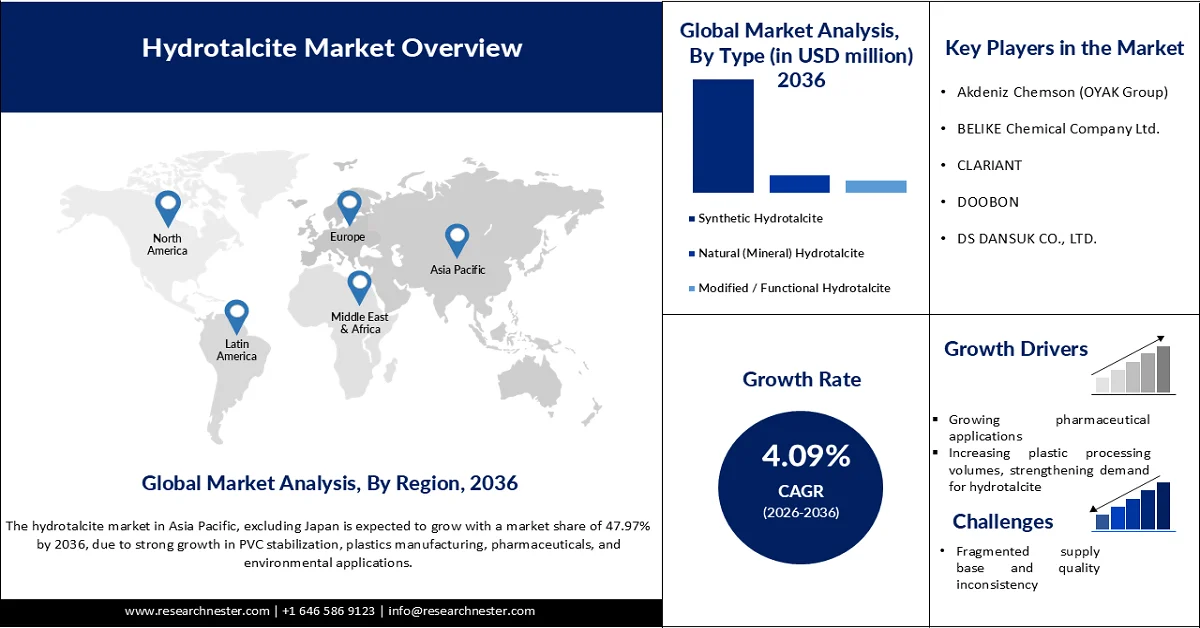
Hydrotalcite Market size was valued at USD 339.76 million in 2025 and is projected to reach USD 533.80 million by the end of 2036, growing at a CAGR of 4.09% during the forecast period, i.e., 2026-2036. In 2026, the industry size of hydrotalcite is estimated at USD 357.51 million.
Rising polymer consumption across automotive, construction, and consumer goods industries is driving demand for advanced stabilization systems, thereby supporting the growth of hydrotalcite market. In polymer processing, especially for PVC and polyolefins, hydrotalcite acts as an acid scavenger and co-stabilizer, neutralizing degradation by-products formed under high-temperature and high-shear processing conditions. As manufacturers increasingly prioritize higher processing efficiency, improved durability, and extended product lifecycles, maintaining polymer stability, color consistency, and mechanical integrity has become essential, strengthening the adoption of hydrotalcite in stabilizer formulations.
According to the International Energy Agency, global electric vehicle sales exceeded 17 million units in 2024, accounting for more than 20% of total automotive sales, and are expected to surpass 20 million units in 2025, representing over 25% of worldwide car sales. This accelerating EV adoption is significantly increasing polymer usage in the automotive sector, as electric vehicles depend heavily on lightweight plastics for applications such as battery enclosures, insulation systems, wiring, and interior components. In addition, the elevated thermal demands and extended performance expectations associated with EV applications intensify the need for enhanced polymer stability during both processing and end-use operations, further boosting demand for hydrotalcite-based stabilization solutions.
Key Hydrotalcite Market Insights Summary:
Regional Highlights:
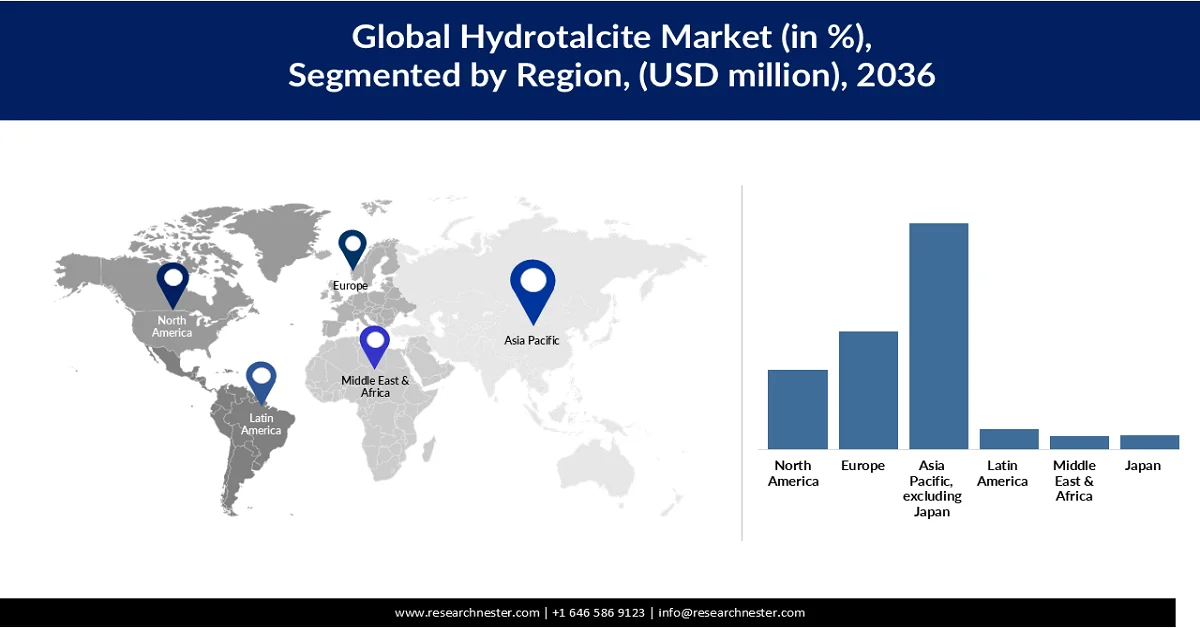
- Asia Pacific, excluding Japan hydrotalcite market is projected to capture 47.97% share by 2036, propelled by expanding PVC stabilization, plastics manufacturing, pharmaceutical production, and environmental applications
- Europe is anticipated to account for 24.99% of the market during 2026-2036, reinforced by stringent environmental regulations and the accelerating adoption of non-toxic stabilizers in plastics and healthcare applications
Segment Insights:
- The synthetic hydrotalcite segment is forecast to dominate with a 77.61% hydrotalcite market share by 2036, fueled by its superior phase purity, structural uniformity, and customizable performance across PVC stabilization, pharmaceuticals, and advanced polymer systems
- The powder form segment is expected to secure 63.17% share by 2036, stimulated by its high surface area, strong dispersion capability, formulation flexibility, and cost-efficient integration across industrial applications
Key Growth Trends:
- Growing pharmaceutical applications
- Increasing plastic processing volumes, strengthening demand for hydrotalcite
Major Challenges:
- Fragmented supply base and quality inconsistency
- Complex manufacturing process
Key Players: Akdeniz Chemson (OYAK Group) (Turkey), BELIKE Chemical Company Ltd. (China), CLARIANT (Switzerland), DOOBON (South Korea), DS DANSUK CO., LTD. (South Korea), GCH TECHNOLOGY CO., LTD. (Taiwan), Hubei Benxing New Material Co., LTD (China), Kyowa Chemical Industry Co., Ltd. (Japan), Par Drugs and Chemical Limited (India), Kisuma Chemicals (Netherlands), Saekyung Chemical Co., Limited (China), Saekyung (Hengshui) New Material Co., Ltd. (China), SAKAI CHEMICAL INDUSTRY CO., LTD. (Japan), Sasol Germany GmbH (Germany), SINWON INDUSTRIAL CO., LTD. (South Korea), TODA KOGYO CORP. (Japan).
Global Hydrotalcite Market Forecast and Regional Outlook:
Market Size & Growth Projections:
- 2025 Market Size: USD 339.76 million
- 2026 Market Size: USD 357.51 million
- Projected Market Size: USD 533.80 million by 2035
- Growth Forecasts: 4.09% CAGR (2026-2036)
Key Regional Dynamics:
- Largest Region: Asia Pacific, excluding Japan (47.97% Share by 2036)
- Fastest Growing Region: Europe
- Dominating Countries: United States, China, Germany, Japan, South Korea
- Emerging Countries: India, Brazil, Vietnam, Thailand, Indonesia
Last updated on : 29 May, 2026
Hydrotalcite Market - Growth Drivers and Challenges
Growth Drivers
- Growing pharmaceutical applications: Owing to its established antacid properties and effectiveness in controlled drug delivery applications, hydrotalcite is increasingly used in gastrointestinal therapies and sustained-release formulations. As pharmaceutical manufacturers place greater emphasis on formulation stability, product safety, and consistent therapeutic performance, the use of hydrotalcite is expanding across a broad range of drug formulations. This increasing integration is strengthening hydrotalcite market demand and reinforcing hydrotalcite’s importance as a critical pharmaceutical additive.
- Increasing plastic processing volumes, strengthening demand for hydrotalcite: Rising global plastic production is driving demand for advanced polymer stabilization systems, positioning hydrotalcite as an essential functional additive. As output expands across high-growth industries such as packaging and construction, polymers are exposed to increasingly demanding processing conditions and higher performance standards, elevating the risk of thermal degradation and material instability. Hydrotalcite helps address these challenges by functioning as an efficient acid scavenger and co-stabilizer, improving thermal stability, preserving mechanical performance, and supporting consistent product quality. At the same time, increasingly stringent environmental and safety regulations are accelerating the shift toward non-toxic and lead-free stabilizer systems, further strengthening the role of hydrotalcite in modern polymer formulations.
Global plastic production is projected to rise from approximately 449 million tons in 2020 to more than 516 million tons by 2025, creating a stable and expanding demand base for polymer additives such as hydrotalcite. As production volumes grow, processors encounter greater thermal and mechanical stress during manufacturing, increasing the need for effective stabilization solutions to minimize degradation and maintain material performance. This trend is driving broader adoption of hydrotalcite, particularly in high-volume applications across packaging, construction, and consumer goods industries. - Demand for high-performance catalysts: Rising demand for efficient and highly selective catalytic processes in the petrochemical and specialty chemicals industries is driving the adoption of hydrotalcite as a catalyst support and precursor material. Its layered structure, adjustable composition, and high surface area enable the development of catalysts with improved activity, selectivity, and thermal stability. Upon calcination, hydrotalcite transforms into mixed metal oxides with strong basicity and uniformly dispersed active sites, making them well-suited for applications such as hydrogenation, reforming, and environmental catalysis. As industries increasingly prioritize process optimization, lower energy consumption, and compliance with stringent emission regulations, the demand for advanced catalyst systems incorporating hydrotalcite continues to grow.
Challenges
- Fragmented supply base and quality inconsistency: Fragmented supply and inconsistent hydrotalcite quality amplify the cost of poor product data, which can erode up to 25% of annual revenue through lost sales, inefficiencies, and rework. Variability in purity, particle size, and composition often stems from incomplete or inconsistent technical data across suppliers, making it difficult for end-users to validate specifications and ensure formulation reliability. This lack of standardized, high-quality product data increases the risk of processing errors, compliance failures, and product recalls, particularly in sensitive applications such as polymers and pharmaceuticals. As a result, businesses face higher operational costs, longer qualification cycles, and reduced customer trust, reinforcing the critical need for consistent product quality and accurate data transparency in the hydrotalcite market.
- Complex manufacturing process: The production of hydrotalcite market requires tight control over composition, crystallinity, and particle size distribution, making manufacturing highly complex and process-sensitive. Small deviations in synthesis conditions, such as pH, temperature, and reactant ratios, significantly impact product quality and performance consistency. This complexity increases operational costs, requires specialized equipment, and limits the ability of manufacturers to scale production quickly. As demand rises, these constraints can lead to supply bottlenecks and longer lead times. Additionally, maintaining uniform quality across large batches becomes challenging, particularly for high-purity applications, restricting broader adoption and slowing hydrotalcite market expansion.
Hydrotalcite Market Size and Forecast:
| Report Attribute | Details |
|---|---|
|
Base Year |
2025 |
|
Forecast Period |
2026-2036 |
|
CAGR |
4.09% |
|
Base Year Market Size (2025) |
USD 339.76 million |
|
Forecast Year Market Size (2036) |
USD 533.80 million |
|
Regional Scope |
|
Hydrotalcite Market Segmentation:
Type Segment Analysis
The synthetic hydrotalcite segment is significantly driving the growth of the type segment and is expected to grow at a hydrotalcite market share of 77.61% by 2036. Synthetic hydrotalcite is the most commercially advanced segment, engineered through controlled chemical synthesis to deliver high phase purity, structural uniformity, and reproducible performance. Its ability to fine-tune metal ratios, particle morphology, and anion exchange capacity makes it indispensable across PVC stabilization, pharmaceuticals, and advanced polymer systems. Furthermore, synthetic variants support functional customization, such as enhanced thermal resistance or adsorption efficiency, positioning them as the backbone of high-performance, regulation-intensive end-use markets. Prominent hydrotalcite manufacturers such as SINWON INDUSTRIAL CO., LTD., GCH Technology Co., Ltd., and Saekyung Chemical are actively developing synthetic hydrotalcite-based solutions tailored for polymer applications.
Form Segment Analysis
The powder form remains the most widely used form and is expected to hold a share of 63.17% by 2036 due to its high surface area, excellent dispersion properties, and strong formulation versatility. It is readily incorporated into PVC compounds, pharmaceutical products, and chemical processing systems where consistent and uniform mixing is essential. Its widespread adoption is further supported by cost-effectiveness and ease of manufacturing, making it the preferred option across industrial supply chains. Although powder handling requires effective dust control measures, especially in large-scale operations, this limitation is generally outweighed by its performance advantages. As a result, powdered hydrotalcite continues to serve as the industry standard for applications that demand fast reactivity and homogeneous distribution.
Grade Segment Analysis
Cosmetic-grade hydrotalcite is engineered for non-toxicity, dermal compatibility, and functional stability in personal care formulations. It is increasingly used in skin care, anti-aging products, and formulation stabilization systems, where it enhances texture and absorbs impurities. The segment is shaped by clean-label trends and consumer demand for safe, mineral-based ingredients, driving steady adoption in premium cosmetic lines. Its value lies in combining functional performance with regulatory safety alignment. US20130331497A1 discloses a process to produce nano-sized, surface-modified hydrotalcite particles with improved dispersion stability, primarily intended for polymer and industrial applications. The patent also mentions that hydrotalcite materials may be used in general-purpose formulated products, such as cosmetics, due to their properties as inorganic adsorbents and stabilizing agents.
Our in-depth analysis of the hydrotalcite market includes the following segments:
|
Segments |
Subsegments |
|
Type |
|
|
Form |
|
|
Grade |
|
|
End user |
|

Vishnu Nair
Head - Global Business DevelopmentCustomize this report to your requirements — connect with our consultant for personalized insights and options.
Hydrotalcite Market - Regional Analysis
Asia Pacific excluding Japan Market Insights
Asia Pacific, excluding Japan (APEJ), is driving the growth of the global hydrotalcite market and is expected to hold a share of 47.97% by 2036 due to strong growth in PVC stabilization, plastics manufacturing, pharmaceuticals, and environmental applications. Rising industrialization in countries such as China, India, and Southeast Asian nations is driving demand for cost-effective additives and specialty chemicals. Increasing investments in infrastructure, packaging, and automotive production are also supporting consumption across polymer processing industries. In addition, regional manufacturers benefit from lower production costs and expanding domestic chemical supply chains, strengthening hydrotalcite market growth momentum.
China hydrotalcite market is expanding strongly due to rising demand from PVC stabilization, petrochemicals, pharmaceuticals, and advanced chemical manufacturing industries. The country continues to invest heavily in industrial infrastructure and logistics modernization; for example, the Asian Infrastructure Investment Bank approved the Yingkou Green Smart Trade Zone Development Project with proposed financing of USD 200 million, including the expansion of the Liaohe Economic Development Zone to strengthen industrial and trade capacity. Such large-scale industrial and chemical infrastructure developments are increasing downstream demand for polymer additives and specialty materials such as hydrotalcite. In addition, China’s continued focus on low-carbon manufacturing, smart industrial zones, and environmentally safer PVC stabilizers is further accelerating the adoption of hydrotalcite across high-performance applications.
India hydrotalcite market is witnessing strong growth alongside the rapid expansion of the country’s chemical processing, plastics, packaging, and e-commerce sectors. According to the India Brand Equity Foundation (IBEF), India’s e-commerce industry was valued at approximately USD 125 billion in 2024 and is projected to reach USD 345 billion by 2030, reflecting rising demand for packaging materials, PVC products, and polymer additives used across logistics and consumer goods industries. The report also states that India’s online retail penetration is expected to increase from 8% in 2024 to 14% by 2028, while the online shopper base may grow to 420–440 million by 2030, accelerating consumption of plastics and specialty chemical materials. This expanding industrial and consumer ecosystem is consequently driving higher demand for hydrotalcite-based stabilizers and functional additives in packaging, construction, automotive, and pharmaceutical applications.
Japan hydrotalcite market is growing steadily and is expected to reach USD 15,800.58 thousand by 2036 due to increasing demand for environmentally friendly PVC stabilizers, specialty polymer additives, and sustainable plastics processing technologies. According to the Plastic Waste Management Institute Japan, Japan’s domestic resin product consumption reached 8.43 million tons in 2023, while total plastic waste generation stood at 7.69 million tons, demonstrating the scale of the country’s plastics and polymer processing industry. The same source reported an effective plastic utilization rate of 89% in 2023, reflecting Japan’s strong focus on recycling efficiency and circular material use. These sustainability initiatives, along with growing adoption of lead-free and low-toxicity stabilizers, are increasing hydrotalcite consumption across PVC, packaging, electronics, and advanced industrial applications.
Japan Hydrotalcite Market Size and Forecast
|
Report Attribute |
Details |
|
Base Year Market Size and Volume (2025) |
USD 12,509.81 thousand; 6.60 thousand tons |
|
Forecast Year Market Size and Volume (2036) |
USD 15,800.58 thousand; 7.21 thousand tons |
|
CAGR (2026-2036) |
2.03% |
Europe Market Insights
The hydrotalcite market in Europe is expected to hold a share of 24.99% between 2026 and 2036, supported by stringent environmental regulations and rising adoption of non-toxic stabilizers in plastics and healthcare applications. Demand is particularly strong in sustainable PVC processing, where manufacturers are replacing heavy metal-based stabilizers with environmentally compliant alternatives. The region’s advanced pharmaceutical and specialty chemical industries also contribute to consistent consumption of high-purity hydrotalcite grades. Furthermore, ongoing innovation in green materials and circular economy initiatives continues to create opportunities for premium and functional hydrotalcite products.
Germany hydrotalcite market is expanding steadily, driven by strong demand from its well-established PVC processing, automotive, and construction industries. Growth is largely supported by strict EU chemical regulations (REACH), which are accelerating the replacement of heavy-metal stabilizers with safer, non-toxic alternatives like hydrotalcite. The country also benefits from high adoption of eco-friendly PVC stabilizer systems, especially in wire & cable, profiles, and durable construction materials. In addition, Germany’s advanced chemical manufacturing base and focus on circular economy practices are increasing the use of hydrotalcite in recyclable and low-emission polymer formulations.
The UK hydrotalcite market is growing at a steady pace, supported by demand from construction, electrical, and automotive PVC applications. Market expansion is closely linked to the shift toward low-toxicity and environmentally compliant stabilizers, driven by stricter environmental and safety standards. Increasing use of PVC in infrastructure upgrades and building renovation projects is also supporting the consumption of hydrotalcite-based additives. Furthermore, the UK’s focus on sustainable materials and improved recycling of plastics is encouraging wider adoption of advanced stabilizer technologies, including hydrotalcite, in polymer processing industries.
North America Market Insights
The North America hydrotalcite market is witnessing stable growth and is projected to hold a share of 16.97% during the forecast years, driven by increasing usage in polymers, pharmaceuticals, flame retardants, and environmental remediation applications. The region benefits from mature chemical manufacturing infrastructure and strong demand for high-performance additives in packaging, automotive, and construction sectors. Growing emphasis on sustainable and low-toxicity materials is encouraging the adoption of hydrotalcite as an alternative stabilizing agent in PVC and specialty formulations. In addition, research and development activities focused on advanced materials and drug delivery systems are further supporting hydrotalcite market expansion.
The U.S. hydrotalcite market is growing steadily and is expected to reach USD 79,864.48 thousand by 2036 with a CAGR of 3.51%, driven by strong demand from PVC processing, pharmaceuticals, and specialty chemical manufacturing. Growth is closely linked to the wider PVC additives industry, which is expanding due to rising construction activity, packaging demand, and infrastructure investment. Within this, stabilizers represent a key growth segment, as manufacturers shift toward non-toxic and heavy-metal-free stabilizer systems, where hydrotalcite plays an important role as an acid scavenger and thermal stabilizer.
In addition, regulatory pressure from agencies such as the EPA is encouraging the replacement of conventional stabilizers with more environmentally compliant alternatives, further supporting adoption. The U.S. also benefits from a large domestic plastics output base, accounting for a significant share of North American plastic production, which directly sustains demand for hydrotalcite-based additives in PVC and polyolefin applications.
Canada hydrotalcite market is growing at a stable pace, supported by its construction, infrastructure, and industrial plastics sectors. Similar to the U.S., growth is being driven by increasing use of PVC pipes, cables, and profiles, where hydrotalcite-based stabilizers are used to improve thermal stability and processing performance. The country’s emphasis on environmental regulations and sustainable materials management is also encouraging the adoption of low-toxicity stabilizer systems in polymer manufacturing. In addition, Canada’s alignment with broader North American regulatory frameworks and its focus on reducing hazardous additives in plastics are supporting the gradual substitution of traditional stabilizers. While the market is smaller than the U.S., it is benefiting from steady industrial demand and increasing integration of advanced PVC additive technologies in construction and packaging applications.
Key Hydrotalcite Market Players:
- Akdeniz Chemson (OYAK Group) (Turkey)
- BELIKE Chemical Company Ltd. (China)
- CLARIANT (Switzerland)
- DOOBON (South Korea)
- DS DANSUK CO., LTD. (South Korea)
- GCH TECHNOLOGY CO., LTD. (Taiwan)
- Hubei Benxing New Material Co., LTD (China)
- Kyowa Chemical Industry Co., Ltd. (Japan)
- Par Drugs and Chemical Limited (India)
- Kisuma Chemicals (Netherlands)
- Saekyung Chemical Co., Limited (China)
- Saekyung (Hengshui) New Material Co., Ltd. (China)
- SAKAI CHEMICAL INDUSTRY CO., LTD. (Japan)
- Sasol Germany GmbH (Germany)
- SINWON INDUSTRIAL CO., LTD. (South Korea)
- TODA KOGYO CORP. (Japan)
- Company Overview
- Business Strategy
- Key Product Offerings
- Financial Performance
- Key Performance Indicators
- Risk Analysis
- Recent Development
- Regional Presence
- SWOT Analysis
- Clariant is a major global specialty chemicals player with strong involvement in hydrotalcite-based additives used in PVC stabilization. It focuses on developing high-performance, eco-friendly alternatives that comply with strict environmental regulations. The company invests heavily in R&D to improve the thermal stability and processing efficiency of polymers. Its global presence helps it serve construction, packaging, and industrial applications.
- Akdeniz Chemson is one of the leading PVC stabilizer producers, where hydrotalcite plays a key role as a co-stabilizer. The company emphasizes lead-free and sustainable stabilizer systems aligned with global regulatory shifts. It benefits from strong manufacturing integration under the OYAK Group, ensuring cost efficiency and supply reliability. Its products are widely used in construction, wires, and rigid PVC applications.
- Sakai Chemical Industry Co., Ltd. is a Japanese manufacturer specializing in high-purity inorganic materials, including hydrotalcite compounds. The company focuses on precision production and material consistency for industrial-grade applications. Its hydrotalcite products are used in plastics, environmental protection, and functional filler applications. Strong technical expertise supports its niche positioning in advanced materials.
- TODA KOGYO CORP. is a global inorganic materials leader known for advanced functional compounds, including hydrotalcite-related applications. The company emphasizes innovation in high-performance materials for plastics, electronics, and industrial use. It leverages strong R&D capabilities to develop customized material solutions. Its global distribution network supports diverse industrial demand.
- Sasol Germany GmbH operates within the broader Sasol Group, contributing chemical intermediates used in additive and stabilizer systems linked to hydrotalcite applications. It focuses on process efficiency, sustainability, and compliance with strict European chemical regulations. The company supports downstream industries through high-quality chemical inputs. Its European base ensures a stable supply for polymer and industrial hydrotalcite markets.
Below is the list of the key players operating in the global hydrotalcite market:
Key players in the hydrotalcite market are driving growth by expanding their use as eco-friendly PVC stabilizers and performance additives in polymers. Companies like Clariant and Akdeniz Chemson are focusing on lead-free, regulation-compliant formulations to meet strict environmental standards. Manufacturers such as Sakai Chemical Industry Co., Ltd. and TODA KOGYO CORP. are enhancing product quality through advanced inorganic material technologies and R&D. At the same time, global supply expansion and application-specific innovations are increasing adoption across construction, automotive, and packaging industries.
Corporate Landscape of the Global Hydrotalcite Market:
Recent Developments
- In October 2025, Kisuma Chemicals, a global leader in magnesium-based additives, officially launched two breakthrough solutions at K 2025 aimed at halogen-free flame retardant (HFFR) polymer applications. The first product, KISUMA™ X, is a next-generation synthetic magnesium hydroxide flame retardant engineered to deliver high-performance flame resistance at significantly reduced dosage levels across polyolefin, EVA, and nylon (PA) compounds. The second product line, Zenthos™ FR, is a newly developed flame-retardant family designed to enable partial or full replacement of antimony trioxide (ATO) in flexible PVC formulations. Together, these innovations strengthen Kisuma’s flame retardancy portfolio by improving performance efficiency while supporting safer and more sustainable polymer formulations.
- Report ID: 8592
- Published Date: May 29, 2026
- Report Format: PDF, PPT
- Explore a preview of key market trends and insights
- Review sample data tables and segment breakdowns
- Experience the quality of our visual data representations
- Evaluate our report structure and research methodology
- Get a glimpse of competitive landscape analysis
- Understand how regional forecasts are presented
- Assess the depth of company profiling and benchmarking
- Preview how actionable insights can support your strategy
Explore real data and analysis
Frequently Asked Questions (FAQ)
About this Report
Connect with our Expert


Report, 2026-2036



Copyright @ 2026 Research Nester. All Rights Reserved.
