Hydrogen Compressors Market Outlook:
Hydrogen Compressors Market size was over USD 2.2 billion in 2025 and is anticipated to reach USD 3.9 billion by the end of 2035, growing at around 6.1% CAGR during the forecast period i.e., between 2026-2035. In 2026, the industry size of hydrogen compressors is evaluated at USD 2.3 billion.
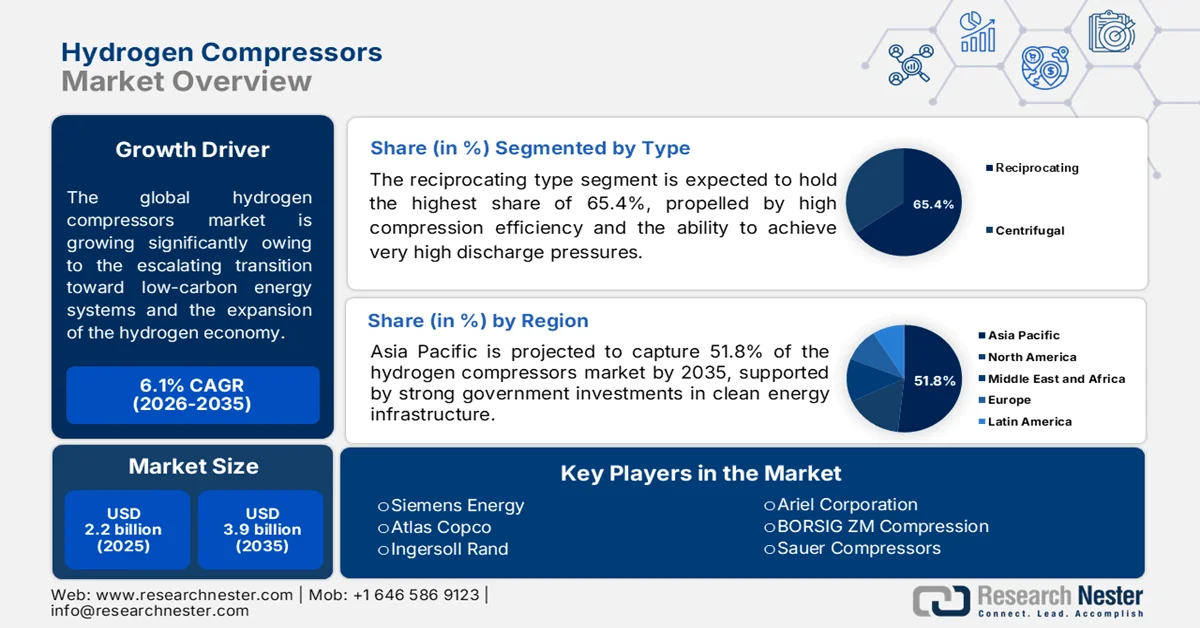
The global hydrogen compressors market is experiencing dynamic expansion owing to the escalating transition toward low-carbon energy systems and the expansion of the hydrogen economy. The market is primarily propelled by the continued rollout of hydrogen refueling infrastructure for commercial fleets and passenger vehicles, along with heavy industrial decarbonization efforts in steel, refining, and chemical production. As per the International Energy Agency's 2026 review, global hydrogen demand surpassed a total of 100 million metric tons (Mt) in 2025, whereas production of low-emissions hydrogen grew by 20% year-over-year to nearly 1 Mt, and is expected to account for just over 1% of total global production by the end of 2026. It also mentioned that global installed electrolysis capacity surpassed 4 GW in 2025, and China contributed nearly 75% of new installations, highlighting its dominant role in hydrogen technology deployment, thus positively contributing to the market’s expansion.
Global Hydrogen Trade and Infrastructure Development: Key Statistics, Projects, and 2050 Net Zero Outlook
|
Indicator |
Statistical Data |
Year |
|
Interregional trade in hydrogen and hydrogen-based fuels |
>70 Mt H₂-eq |
2050 (NZE Scenario) |
|
Export-oriented announced hydrogen projects |
16 Mtpa H₂-eq |
2030 |
|
Projects at very early development stages |
11 Mtpa H₂-eq |
2030 announced projects |
|
Projects undergoing feasibility studies |
5 Mtpa H₂-eq |
2030 announced projects |
|
Share of announced trade projects involving ammonia |
85% |
2030 announced projects |
|
Potential exports from Australia and United States combined |
10 Mtpa H₂-eq |
2030 |
|
Announced projects targeting Europe as import market |
75% of projects |
2030 |
|
Announced hydrogen pipeline length |
Nearly 40,000 km |
By 2035 |
|
Pipeline projects reaching Final Investment Decision (FID) |
2% |
Current announced projects |
|
New hydrogen and ammonia terminals/port infrastructure projects |
>100 projects |
By end of 2030 |
|
Share of new terminals that are ammonia export terminals |
>50% |
By end of 2030 |
|
Planned underground hydrogen storage capacity |
10 TWh |
2035 |
|
Required hydrogen storage capacity (NZE Scenario) |
>230 TWh |
2035 |
|
Planned underground hydrogen storage capacity |
40 TWh |
2050 |
|
Hydrogen storage requirement (NZE Scenario) |
410 bcm |
2050 |
Source: IEA
Furthermore, the supportive government mandates, cross-border clean energy partnerships, and substantial investments in green hydrogen production facilities are creating a highly favorable environment for the market expansion. According to the article published by Press Information Bureau (PIB) in March 2026, India has awarded 3,000 MW per year of electrolyzer manufacturing capacity to 15 companies and 862,000 metric tons per annum (MTPA) of green hydrogen production capacity to 18 companies under the National Green Hydrogen Mission. In addition, the government has also facilitated the supply of 724,000 MTPA of green ammonia to 13 fertilizer units and awarded 20,000 tons per annum of green hydrogen supply for major public-sector refineries, with an additional 10,000 tons per annum allocated to Numaligarh Refinery. The article also outlined that five hydrogen pilot projects in the steel sector and five mobility pilot projects involving 37 hydrogen-powered vehicles and 9 hydrogen refueling stations have been sanctioned to accelerate hydrogen adoption across India.
Global Hydrogen Imports 2023: Top Importing Countries, Trade Value, Import Volume, and Market Analysis
|
Country |
Import Value (USD Thousand) |
Import Volume (m³) |
|
Netherlands |
89,997.08 |
245,278,000 |
|
U.S. |
68,099.91 |
- |
|
France |
20,813.08 |
33,934,700 |
|
Germany |
9,121.95 |
6,399,850 |
|
Mexico |
6,957.21 |
35,828 |
|
Canada |
6,710.15 |
- |
|
Malaysia |
5,572.75 |
- |
|
Czech Republic |
4,771.14 |
4,192,850 |
|
UK |
4,639.28 |
- |
|
Belgium |
4,363.23 |
- |
Source: WITS
Key Hydrogen Compressors Market Insights Summary:
Regional Highlights:
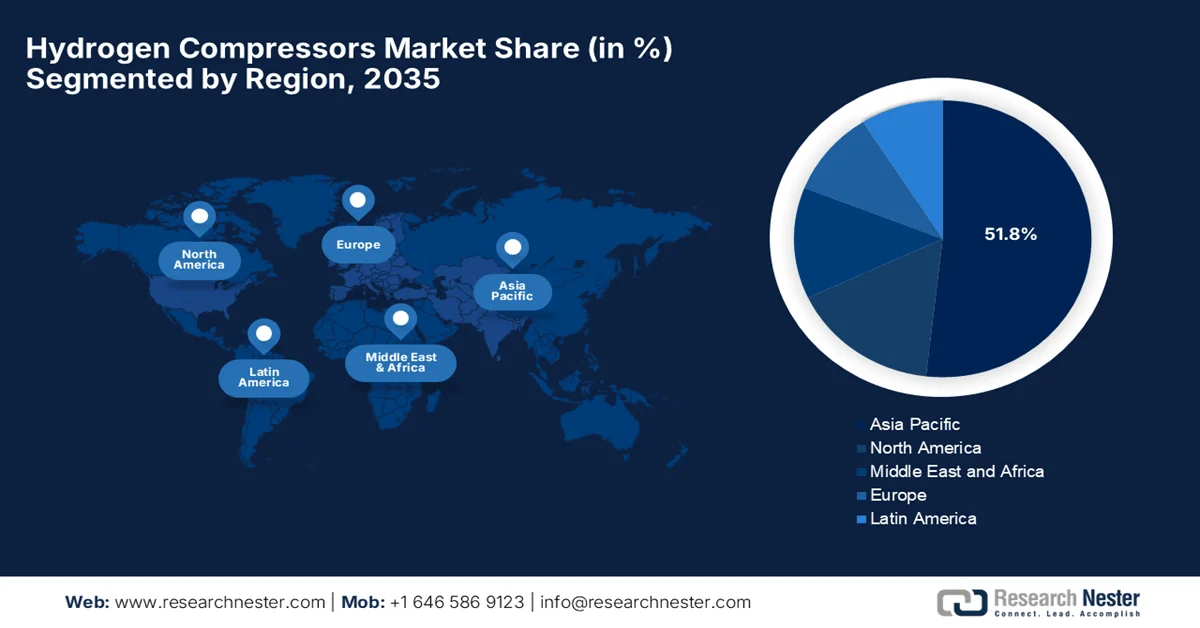
- The hydrogen compressors market in Asia Pacific is projected to secure 51.8% market share by 2035, stimulated by government investments in clean energy infrastructure, aggressive national hydrogen roadmaps, and accelerating industrial growth across major economies.
- North America is poised for considerable expansion throughout 2026-2035, supported by robust federal funding and the development of regional clean hydrogen hubs.
- The market in the U.S. accounts for 73.3% of the share in North America owing to the high demand from oil refining, petrochemical processing, and strong government support for clean energy and fuel cell infrastructure.
Segment Insights:
- The hydrogen compressors market reciprocating type segment is projected to account for 65.4% market share by 2035, attributed to high compression efficiency, the ability to achieve very high discharge pressures, and proven reliability in handling hydrogen across different industrial applications.
- By 2035, the petrochemical & chemical segment is anticipated to capture a notable market share, encouraged by the extensive use of hydrogen as a critical process feedstock in petroleum refining, ammonia production, methanol synthesis, hydrocracking, hydrodesulfurization, and numerous chemical manufacturing processes.
Key Growth Trends:
- Heavy industry decarbonization
- Technological advancements in compressor systems
Major Challenges:
- Material degradation and embrittlement
- Low volumetric density and high leakage risks
Key Players: Siemens Energy (Germany) ,Atlas Copco (Sweden) ,Ingersoll Rand (U.S.) ,Ariel Corporation (U.S.) ,BORSIG ZM Compression (Germany) ,Sauer Compressors (Germany) ,HydroXcel (China).
Global Hydrogen Compressors Market Forecast and Regional Outlook:
Market Size & Growth Projections:
- 2025 Market Size: USD 2.2 billion
- 2026 Market Size: USD 2.3 billion
- Projected Market Size: USD 3.9 billion by 2035
- Growth Forecasts: 6.1% CAGR (2026-2035)
Key Regional Dynamics:
- Largest Region: Asia Pacific (51.8% Share by 2035)
- Fastest Growing Region: North America
- Dominating Countries: China, United States, Japan, Germany, South Korea
- Emerging Countries: India, Australia, Saudi Arabia, Canada, Netherlands
Last updated on : 5 August, 2026
Hydrogen Compressors Market - Growth Drivers and Challenges
Growth Drivers
- Heavy industry decarbonization: Governments and administrative bodies in both emerging and established nations are imposing certain mandates on decarbonization, which are heightening the market demand. Industries such as steel manufacturing, chemical processing, and petroleum refining are making a shift from fossil fuels to clean hydrogen. This necessitates high-capacity compressor fleets to handle large-scale flow production and feedstock processing. In August 2024, the HYBRIT partnership between SSAB, LKAB, and Vattenfall completed a six-year research program, and it confirmed that fossil-free hydrogen can replace coal in semi-industrial ironmaking. This particular project showed that hydrogen-based direct reduced iron possesses favorable properties, also offering the potential to reduce Sweden’s total carbon dioxide emissions by more than 10%, thus positively contributing to the market expansion.
- Technological advancements in compressor systems: Pioneers across the globe are highly focused on innovations in compressor design, improving efficiency and safety, thereby reducing maintenance requirements. Oil-free compressors, advanced sealing, and smart monitoring in high-pressure hydrogen operations are efficiently driving market growth. In October 2025, Burckhardt Compression secured an order from Gasunie to deploy its UP! Detect digital condition monitoring system along with a high-pressure, oil-free hydrogen compressor for the H2CAST Etzel hydrogen storage project in Germany. The company notes that this cloud-based solution provides real-time performance monitoring and early anomaly detection, thus enabling predictive maintenance and enhanced operational safety.
Challenges
- Material degradation and embrittlement: The major obstacle in this industry is hydrogen embrittlement, which affects system durability as well as mechanical integrity. Hydrogen molecules are extremely small, and they easily permeate metal components such as valves, cylinders, and pistons. This infiltration alters the metal's structure, causing severe cracking, premature fatigue, and catastrophic equipment failures, thereby negatively impacting the growth of the market. To withstand extreme pressures, manufacturers are forced to shift from standard industrial metals to highly specialized, expensive alloys and advanced protective coatings. On the other hand, implementing these high-grade materials complicates the design process, thereby escalating engineering costs.
- Low volumetric density and high leakage risks: Hydrogen possesses a low volumetric energy density, due to which it occupies a large volume at ambient pressure. Compressing it requires multi-stage units with massive first-stage cylinders, which makes the systems structurally complex and power-intensive. In addition, hydrogen’s low molecular weight and low viscosity allow it to escape through microscopic gaps that would contain other industrial gases, causing hindrance to market adoption. Meanwhile, this high diffusivity requires ultra-tight sealing mechanisms and sophisticated buffering systems. Exacerbating this is the reverse Joule-Thomson effect; not like most gases, hydrogen heats up when expanding through a leak, causing sharp temperature spikes, thus elevating the risk of ignition.
Hydrogen Compressors Market Size and Forecast:
| Report Attribute | Details |
|---|---|
|
Base Year |
2025 |
|
Forecast Year |
2026-2035 |
|
CAGR |
6.1% |
|
Base Year Market Size (2025) |
USD 2.2 billion |
|
Forecast Year Market Size (2035) |
USD 3.9 billion |
|
Regional Scope |
|
Hydrogen Compressors Market Segmentation:
Type Segment Analysis
The reciprocating type segment is expected to hold the highest share of 65.4% in the hydrogen compressors market during the forecast period. The segment’s leading position is majorly attributable to high compression efficiency, ability to achieve very high discharge pressures, and proven reliability in handling hydrogen across different industrial applications. Apart from this, compressors are extensively deployed in hydrogen production, storage, transportation, and refueling infrastructure. In March 2025, EWE chose NEUMAN & ESSER to supply hydrogen compressors for its Clean Hydrogen Coastline project, which involves transforming a natural gas cavern in Huntorf into a large-scale hydrogen storage facility. The project underscores the rising use of reciprocating compressors in utility-scale hydrogen storage applications.
Application Segment Analysis
By the end of 2035, the petrochemical & chemical segment is anticipated to capture a notable market share. The segment growth in the hydrogen compressors market is supported by the extensive use of hydrogen as a critical process feedstock in petroleum refining, ammonia production, methanol synthesis, hydrocracking, hydrodesulfurization, and numerous chemical manufacturing processes. In addition, the industry's increasing investments in low-carbon hydrogen, green ammonia, e-methanol, and sustainable chemical production are accelerating the deployment. In June 2024, ExxonMobil entered into a partnership with Air Liquide to advance its Baytown, Texas, low-carbon hydrogen project by integrating hydrogen distribution through Air Liquide’s existing pipeline network and securing oxygen and nitrogen supply from new air separation units. This planned facility is designed to produce up to 1 billion cubic feet of low-carbon hydrogen per day, thus indicating a positive outlook for the segment’s growth.
Lubrication Type Segment Analysis
By the end of 2035, oil-based is predicted to hold a substantial share in the hydrogen compressors market. The segment’s growth is effectively propelled by the superior lubrication, cooling, and sealing capabilities of these compressors, which enable proper operation under high-pressure conditions. In addition, oil-based hydrogen compressors are being adopted in industrial applications such as petroleum refining, chemical processing, hydrogen pipeline transmission, bulk hydrogen storage, and gas filling. Apart from this, when compared with oil-free alternatives, oil-lubricated compressors generally offer higher load-bearing capacity, longer component life, lower maintenance frequency, and reduced operating costs in applications where ultra-high hydrogen purity is not mandatory.
Our in-depth analysis of the hydrogen compressors market includes the following segments:
|
Segment |
Subsegments |
|
Type |
|
|
Application |
|
|
Lubrication |
|

Vishnu Nair
Head - Global Business DevelopmentCustomize this report to your requirements — connect with our consultant for personalized insights and options.
Hydrogen Compressors Market - Regional Analysis
APAC Market Insights
Asia Pacific hydrogen compressors market is projected to capture the highest share of 51.8% during the stipulated timeframe. The region’s leadership is effectively propelled by government investments in clean energy infrastructure. In addition, aggressive national hydrogen roadmaps and accelerating industrial growth across major economies such as China, Japan, India, and South Korea are positioning the region for extensive growth. In this context, Hyundai Motor Group inaugurated HTWO ENERGY Cheongju in July 2026, which is its first Group-operated waste-to-hydrogen (W2H) production and refueling facility. This facility currently produces approximately 500 kilograms of hydrogen per day, with plans to increase capacity to 2 metric tons per day, and it integrates biogas upgrading, hydrogen production, and compression systems.
Government decarbonization goals and investments in green infrastructure are fueling the market in China. This domestic growth is especially concentrated around the exponential rollout of hydrogen refueling stations in major industrial corridors to support a growing fleet of commercial fuel cell vehicles. Based on government data published in March 2026, China introduced a 2026 - 2028 action plan with a collective goal to accelerate the development of advanced energy-saving equipment, in which water electrolysis hydrogen production is one of its key strategic priorities. In addition, this plan is highly focused on improving core technologies, integrating AI, and enhancing the overall efficiency of critical equipment to support the country's carbon neutrality goals, thus making it suitable for standard market growth.
In India, the market is growing remarkably, which is fueled by the government's strategic policies aimed at transforming the country into a global clean energy hub. Market growth is heavily driven by massive investments from major public and private energy conglomerates that are developing large-scale green hydrogen production plants and blending infrastructure. As stated by FCHEA in September 2025, India reaffirmed its strong focus on becoming a global green hydrogen hub through the National Green Hydrogen Mission, targeting 5 million metric tons of green hydrogen production by 2030 on a yearly basis while expanding renewable energy capacity to support this objective. The country is witnessing huge investments and collaborations across hydrogen production, storage, transportation, and green ammonia projects, thus making it suitable for standard market growth.
North America Market Insights
North America hydrogen compressors market is growing at a considerable rate owing to robust federal funding and the development of regional clean hydrogen hubs. The region’s market is also being fueled by investments from the industrial sector, i.e., in petroleum refining, ammonia production, and long-duration grid energy storage, which are generating substantial demand for compression technologies. The U.S. Library of Congress in April 2025 stated that hydrogen fuel cell medium- and heavy-duty vehicles are emerging as a proper zero-emission solution for freight and commercial transportation, which offers high efficiency and produces only water and heat during operation. The article also outlined that government funding, demonstration projects, and supportive policies are expected to accelerate commercialization, thus heightening demand for hydrogen compressors.
In the U.S. market, demand is heavily concentrated in the transportation sector, where the buildup of high-capacity refueling infrastructure for heavy-duty commercial trucks is driving the need for reliable compression systems. In addition, the continuously expanding hydrogen hub projects and ongoing technological advancements in compressor design are strengthening market development. In April 2026, the U.S. Government Accountability Office disclosed that hydrogen energy technologies have the complete potential to enhance energy security, enable long-duration energy storage, reduce emissions, and support clean transportation and power generation. It also mentioned that continued policy support, infrastructure expansion, research, and technological advancements are expected to play a key role in accelerating commercialization.
In Canada, the hydrogen compressors market is supported by government initiatives that are promoting low-carbon hydrogen and strong public-private partnerships that are accelerating hydrogen technology adoption. Also, the country’s strong renewable energy resources are creating favorable conditions for the expansion of the hydrogen compressors industry. Based on government data published in September 2025, the country’s hydrogen sector is expanding as clean energy initiatives accelerate, with new production projects, transportation infrastructure, and storage capacity under development all over Canada. Hydrogen is expected to play an important role in the country's energy mix by 2050, which is supported by advancements in production technologies such as electrolysis, steam methane reforming with carbon capture, and biomass-based processes.
Europe Market Insights
Europe hydrogen compressors market is anticipated to command a noteworthy share from 2026 to 2035. The region benefits from stringent mandates to decarbonize heavy industry. Market growth is also being driven by the widespread establishment of cross-border hydrogen corridors, which require high-capacity, continuous-flow compression systems. In April 2024, Cordis Europa stated that the development of centrifugal hydrogen compressor technology aims to deliver reliable, energy-efficient, and cost-effective compression systems that are capable of handling large industrial hydrogen volumes at high pressures. Its technology is highly focused on designs that are specifically optimized for hydrogen’s unique physical properties, incorporating suitable materials and operating conditions.
The large-scale electrolysis projects and hydrogen pipeline expansion are responsibly uplifting Germany market. In addition, continued technological innovation in compressor design and collaborations between industrial equipment manufacturers and energy companies are creating favorable opportunities for the deployment of hydrogen compressors in this country. In July 2024, Siemens Energy secured a contract to supply a large-scale PEM electrolyzer for EWE’s hydrogen production project in Emden, Germany, which supports the expansion of green hydrogen for industrial applications. This project includes hydrogen production infrastructure such as compressors, cooling systems, and a long-term service agreement, thus positively contributing to the market’s expansion.
In the UK, the market is being propelled by the country's consistent efforts to establish a low-carbon hydrogen economy, supported by the expansion of hydrogen production, transport, and storage infrastructure. In addition, booming government initiatives to strengthen domestic supply chains and encourage innovation in hydrogen equipment are fostering positive growth opportunities for these compressor technologies. In April 2025, government of UK announced that 27 hydrogen projects have been shortlisted under the UK's Second Hydrogen Allocation Round in order to expand low-carbon hydrogen production. It also stated that these projects aim to reduce industrial emissions and support the UK's clean energy transition by deliberately promoting hydrogen use in sectors such as power generation, manufacturing, transport, and sustainable aviation fuel production.
Key Hydrogen Compressors Market Players:
- Siemens Energy (Germany)
- Atlas Copco (Sweden)
- Ingersoll Rand (U.S.)
- Ariel Corporation (U.S.)
- BORSIG ZM Compression (Germany)
- Sauer Compressors (Germany)
- HydroXcel (China)
- PanGeng Gas Compressor (China)
- CATAGEN (UK)
- Kawasaki Heavy Industries (Japan)
- CMN Compressor (China)
- Company Overview
- Business Strategy
- Key Product Offerings
- Financial Performance
- Key Performance Indicators
- Risk Analysis
- Recent Development
- Regional Presence
- SWOT Analysis
- Siemens Energy is a dominant player in the market which is offering reciprocating and centrifugal hydrogen compressor systems. The company is maintaining such a position propelled by its expertise in energy infrastructure to deliver integrated compression solutions for large-scale electrolysis plants, hydrogen pipeline networks, and power-to-X projects.
- Atlas Copco is a prominent manufacturer of hydrogen compressors which is providing high-pressure oil-free compression systems. Through its gas and process division, the firm provides reliable hydrogen compression technologies that prioritize operational efficiency, safety, and low lifecycle costs.
- Ingersoll Rand is yet another key participant in this industry, which manufactures advanced reciprocating hydrogen compressors for hydrogen production, storage, and dispensing applications. The company is highly focused on high-pressure compression technology, energy-efficient system design, and customized engineering solutions.
- Ariel Corporation is identified as one of the world's leading manufacturers of reciprocating gas compressors and has established a strong presence in hydrogen compression applications. In addition, the firm's reputation for durable equipment, operational reliability, and extensive aftermarket support has enabled it to secure a central position in this industry.
- BORSIG ZM Compression is a specialist player in manufacturing reciprocating process gas compressors, which includes customized hydrogen compressor systems for industrial and energy applications. The company has decades of experience in process gas compression and strong engineering expertise with a strong focus on delivering compressor packages that meet stringent safety requirements.
Here is a list of key players operating in the global market:
The well-established industrial compressor manufacturers that possess extensive knowledge in reciprocating, diaphragm, centrifugal, and oil-free compression technologies are driving the competitive landscape of the hydrogen compressors market. Global leaders in this field are making a differentiation through high-pressure hydrogen compression capabilities, compliance with stringent safety standards, and integrated solutions for hydrogen production, storage, refueling, and pipeline applications. For example, in October 2025, HOERBIGER announced that it secured a contract to supply three HCP 500 hydrogen compressor packages for the Hamburg Green Hydrogen Hub in Germany, which supports the development of a 105 MW green hydrogen production facility. The compressor systems, which were ordered through Kraftanlagen Energies & Services, are designed to deliver efficient, safe, and high-capacity hydrogen compression for large-scale applications.
Corporate Landscape of the Market:
Recent Developments
- In March 2026, Kawasaki Heavy Industries began demonstrating its KM Comp-H₂ centrifugal hydrogen compressor at its Harima Works facility in Japan, which is considered to be a world-first trial for hydrogen liquefaction plants. This compact system can compress large volumes of hydrogen and reduces power consumption by around 3% to 4%.
- In September 2025, CATAGEN introduced its ClimaHtech Hydrogen Compressor at Gastech 2025 in Milan with both static and mobile models designed to improve hydrogen refuelling and distribution. This patented liquid piston technology delivers an average of 28% energy savings, thereby reducing total ownership costs by up to 30%.
- Report ID: 8724
- Published Date: Aug 05, 2026
- Report Format: PDF, PPT
- Explore a preview of key market trends and insights
- Review sample data tables and segment breakdowns
- Experience the quality of our visual data representations
- Evaluate our report structure and research methodology
- Get a glimpse of competitive landscape analysis
- Understand how regional forecasts are presented
- Assess the depth of company profiling and benchmarking
- Preview how actionable insights can support your strategy
Explore real data and analysis
Frequently Asked Questions (FAQ)
About this Report
Connect with our Expert


Report, 2026-2035



Copyright @ 2026 Research Nester. All Rights Reserved.
