Smoke Detector Market Outlook:
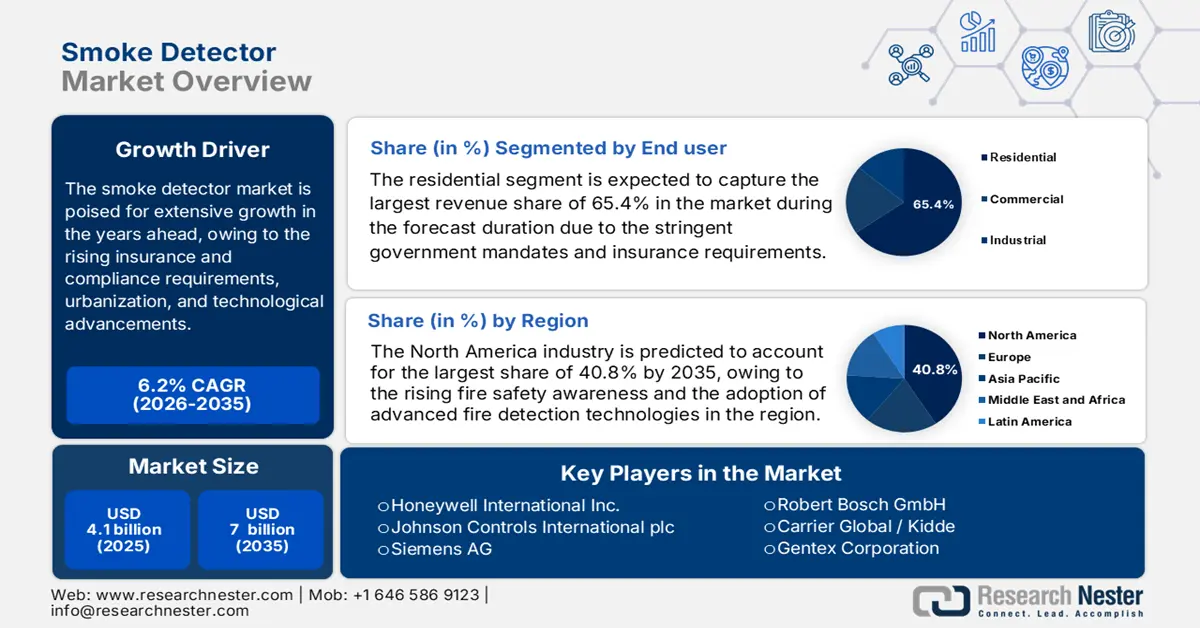
Smoke Detector Market size was valued at USD 4.1 billion in 2025 and is projected to reach USD 7 billion by the end of 2035, rising at a CAGR of 6.2% during the forecast period, i.e., 2026-2035. In 2026, the industry size of smoke detector is estimated at USD 4.3 billion.
International trade flows and defined tariff classifications heavily influence the supply chain for smoke-detector systems in developed economies, creating encouraging opportunities for manufacturers in the smoke detector market. Based on the analysis of the 2025 Harmonized Tariff Schedule of the U.S. (HTSUS), smoke detectors are specifically described within subheading 8531.10.00, which covers burglar or fire alarms as well as similar apparatus. The data also mentioned that the general duty rate for these safety devices is set at 1.3%, though they are eligible for duty-free entry under special trade programs with a wide range of partner countries, which include Australia, Canada, and Mexico, among others. Hence, this low-tariff regime helps minimize supply chain costs, thereby supporting competitive pricing and potentially higher margins within the highly competitive markets.
Furthermore, the article published by the U.S. Department of Homeland Security through NOFO 2024 disclosed that all residential smoke and carbon monoxide detectors are funded under the program, and they must be installed in accordance with the most recent NFPA 72 National Fire Alarm and Signaling Code, specifically citing sections 29.8.1 for smoke detectors and 29.7.1 for carbon monoxide detectors from the 2022 update. Hence, this mandate ensures that all smoke and carbon monoxide detector installations funded by the FP&S grant program are bound to nationally recognized safety and performance standards. In addition, the NFPA 72 code provides critical specifications for the placement, spacing, and interconnection of alarms to guarantee they function as an integrated system within a dwelling, thereby drawing the interest of more players to operate in the smoke detector market.
Key smoke detector Market Insights Summary:
Regional Insights:
- By 2035, North America is anticipated to secure a 40.8% share in the smoke detector market, supported by heightened fire safety awareness and expanding adoption of interconnected smart detection technologies.
- Asia Pacific is projected to witness the fastest advancement through 2035, underpinned by rapid urbanization, industrial growth, and accelerating uptake of modern residential and commercial fire safety systems.
Segment Insights:
- The residential segment in the smoke detector market is forecast to command a 65.4% share by 2035, bolstered by stringent government mandates and rising insurance-driven emphasis on home fire safety.
- Photoelectric smoke detectors are projected to represent 52.4% of the segment by 2035, supported by evolving safety advisories and regulatory shifts favoring multi-criteria alarm technologies.
Key Growth Trends:
- Technological advancements & domestic production boosting
- Insurance and compliance requirements
Major Challenges:
- Supply chain volatility
- Regulatory fragmentation
Key Players: Honeywell International Inc. (U.S.), Johnson Controls International plc (Ireland / U.S.), Siemens AG (Germany), Robert Bosch GmbH (Germany), Carrier Global / Kidde (U.S.), Gentex Corporation (U.S.), Halma plc (U.K.), Hochiki Corporation (Japan), Schneider Electric SE (France), NEC Corporation (Japan), SECOM Co., Ltd. (Japan), Mircom Group (Canada), Minimax GmbH & Co. KG (Germany), Gent / Honeywell Gent (U.K.), Xtralis (VESDA) (Australia).
Global smoke detector Market Forecast and Regional Outlook:
Market Size & Growth Projections:
- 2025 Market Size: USD 4.1 billion
- 2026 Market Size: USD 4.3 billion
- Projected Market Size: USD 7 billion by 2035
- Growth Forecasts: 6.2% CAGR (2026-2035)
Key Regional Dynamics:
- Largest Region: North America (40.8% Share by 2035)
- Fastest Growing Region: Asia Pacific
- Dominating Countries: United States, China, Germany, Japan, United Kingdom
- Emerging Countries: India, South Korea, Brazil, Australia, United Arab Emirates
Last updated on : 26 November, 2025
Smoke Detector Market - Growth Drivers and Challenges
Growth Drivers
-
Technological advancements & domestic production boosting: Innovations in terms of multi-criteria sensors, smart home integration, wireless connectivity, and low-frequency alarms and domestic production capabilities are prompting a profitable business environment for the smoke detector market. In this regard, Bosch Building Technologies in June 2024 reported that it has launched its first assembly line in India at Naganathapura, producing the domestically made AVENAR fire detectors to meet growing demand in the region and support the Make in India initiative. The press release also underscored that the facility enhances supply chain efficiency, strengthens local production capabilities, and leverages the country’s skilled workforce, thereby catering to infrastructure, healthcare, manufacturing, and residential sectors. It has almost seven variants of AVENAR detectors now manufactured locally.
Notable Fire Safety Technology Advancements and Market Opportunities
|
Company |
Year |
Details |
Market Opportunity |
|
Honeywell (Li-ion Tamer Acquisition) |
2025 |
Honeywell acquires Li-ion Tamer to enhance early thermal-runaway and fire detection capabilities for lithium-ion battery systems. |
Expanding demand for advanced fire detection in battery energy storage, EV infrastructure, and data centers. |
|
Heiman Technology (S1 Series ETL UL217 9th Ed. Certification) |
2024 |
Heiman S1 smoke alarms receive ETL certification under UL217 9th edition and CAN/ULC S531, improving accuracy and reducing cooking-related false alarms. |
Strengthens access to U.S. and Canadian markets seeking high-precision, low-false-alarm residential and smart-home detectors. |
Source: Company Official Press Releases
- Insurance and compliance requirements: There has been a growing emphasis on insurance compliance, property protection, and building safety certifications, which is readily contributing to the smoke detector market growth. Most of the insurers and certification agencies require functional smoke detectors, which motivates property owners to install or upgrade their existing alarms. As per an article published by ULSE in January 2024, from January 1, 2025, NFPA 72 requires smoke alarms and detectors near cooking appliances to be in accordance with UL 217 or UL 268 standards for nuisance alarm resistance, making sure that they do not trigger any false alarms during normal cooking. It also mentioned that the UL standards mandate a cooking test where alarms should remain silent while food cooks at full power until smoke reaches a critical level, which reduces the likelihood that residents disable alarms due to false alerts, hence suitable market expansion.
- Urbanization and construction growth: The large-scale residential, commercial, and industrial construction projects are creating a strong demand in the smoke detector market. The newly constructed buildings increasingly integrate advanced fire safety systems during construction or renovation, making smoke alarms a standard requirement. According to the United Nations reports 55% of the worldwide population currently lives in urban areas, wherein proportion expected to surpass 68% by the end of 2050, adding around 2.5 billion urban residents, mainly in Asia and Africa. It also stated that this rapid urbanization, concentrated in countries such as India, China, and Nigeria, will drive consistent growth of megacities and smaller urban settlements, highlighting the need for sustainable infrastructure, housing, and basic services such as smoke detectors.
Challenges
- Supply chain volatility: The smoke detector market faces severe challenges in terms of supply chain across manufacturing, compliance, distribution, and lifecycle management. The volatility, particularly high around electronic components such as semiconductors, photodiodes, microcontrollers, and RF modules used in connected detectors. Also, the fluctuations in terms of lead time and uncertainty are increasing the inventory costs, which also delays the production planning for OEMs and contract manufacturers. In addition, the variability in terms of availability of plastics, housings, and sensing elements also affects consistent output quality, especially for producers relying on offshore component suppliers. Furthermore, these factors are coupled with increased logistics costs and extended transit times, which complicate the orders in projects, hence hindering market growth.
- Regulatory fragmentation: The building codes, fire safety standards, and certification pathways are different across most regions. Therefore, manufacturers must navigate separate approval systems, which are increasing product-testing costs and ultimately slowing smoke detector market entry. This affects both hardware development and software-enabled devices that require cybersecurity, connectivity, and data-handling certifications. In addition, price sensitivity in terms of procurement cycles, especially in institutional and public-sector bids, limits manufacturers’ ability to pass rising production costs to end users. On the other hand, lifecycle challenges also persist, wherein the periodic maintenance, battery replacement, and system testing create operational burdens for facility managers.
Smoke Detector Market Size and Forecast:
| Report Attribute | Details |
|---|---|
|
Base Year |
2025 |
|
Forecast Year |
2026-2035 |
|
CAGR |
6.2% |
|
Base Year Market Size (2025) |
USD 4.1 billion |
|
Forecast Year Market Size (2035) |
USD 7 billion |
|
Regional Scope |
|
Smoke Detector Market Segmentation:
End user Segment Analysis
The residential segment is expected to capture the largest revenue share of 65.4% in the smoke detector market by the end of 2035. The stringent government mandates and insurance requirements are the key factors solidifying this leadership. Most of the prominent organizations are proactively promoting residential smoke alarm installations, directly augmenting the segment’s dominance of this subtype. According to the NFPA article published in June 2024, it was observed that smoke alarms were present in 74% of U.S. home fires between 2018 and 2022, yet nearly 59% of home fire deaths occurred in properties with no alarms or non-functioning alarms. It also mentioned that hardwired alarms operated more reliably 94% when compared to battery-powered units (85%), and associated deaths were lower in homes with working alarms. Hence, the study highlights the crucial role of properly maintained smoke alarms in reducing fire-related deaths, thereby creating a heightened demand for smoke detectors.
Death Rate per 1,000 Reported Home Fires by Smoke Alarm Status (2018-2022)
|
Smoke Alarm Status |
Death Rate per 1,000 Home Fires |
|
No smoke alarm or alarm-operated |
14.4 |
|
Smoke alarm present and operating |
5.8 |
Source: NFPA
Product Type Segment Analysis
By the end of the forecast duration, photoelectric smoke detectors are expected to lead this segment with a share of 52.4% owing to the safety advisories. These detectors are highly effective and most common in residential settings, which has influenced both consumer choice and regulatory guidance. In this regard, IAFF revealed that the UL217 8th Edition, which came into force on January 2023, introduces multi-criteria smoke alarms, which also include photoelectric technology, which are designed to reduce cooking nuisance false alarms, whereas non-8th edition alarms are allowed until January 1, 2025. Also, NFPA 72 and IAFF recommend documenting alarm type, location, and performance, especially if injuries occur due to disabled or late-operating alarms, and reporting to the CPSC. It further underscored that proper installation is highly essential: alarms should be photoelectric or multi-criteria, hence suitable for the smoke detector market expansion.
Power Source Segment Analysis
The hardwired subsegment is expected to grab lucrative growth opportunities in the smoke detector market during the forecast period. The configuration is considered to be most reliable, which eliminates the risk of dead batteries while providing strong protection during power outages, which is a combination that has become a benchmark for life safety both in construction and major renovations. When compared to most of the battery-only units, the hardwired smoke detectors are directly connected to a building’s electrical system, which ensures a continuous power supply and minimizes the risk of device failure caused by dead or disconnected batteries. Also, many models include battery backups, which maintain functionality during power outages, providing an extra layer of security. Therefore, this combination of consistent operation and backup support has made hardwired smoke detectors a highly preferred choice in most projects, establishing a strong revenue scope.
Our in-depth analysis of the smoke detector market includes the following segments:
|
Segment |
Subsegments |
|
End user |
|
|
Product Type |
|
|
Power Source |
|
|
Distribution Channel |
|
|
Service |
|

Vishnu Nair
Head - Global Business DevelopmentCustomize this report to your requirements — connect with our consultant for personalized insights and options.
Smoke Detector Market - Regional Analysis
North America Market Insights
The smoke detector market in North America is predicted to hold the highest share of 40.8% throughout the discussed tenure. The region’s market is effectively propelled by rising fire safety awareness and the adoption of advanced fire detection technologies. On the other hand, most of the projects in this region mandate hardwired and interconnected smoke alarms that are integrated with smart home systems. In this regard, at CES 2025, Amazon highlighted key innovations across smart home, entertainment, and automotive technologies, which include updates to its Ring and Fire TV portfolios. Ring and Kidde introduced smart smoke and carbon monoxide alarms, which have real-time alerts through the Ring app, for faster and more precise detection, and an optional 24/7 monitoring subscription. This enhances home fire safety and reinforces North America’s position in the global landscape.
The U.S. has a huge opportunity to capitalize on the smoke detector market owing to the heightened public safety awareness, fire prevention regulations, and insurance compliance requirements. The country’s market also benefits from NFPA standards, which are encouraging the installation of hardwired, battery backed and interconnected alarms across residential and commercial properties. NFPA in September 2024 highlighted the vital role of smoke alarms, with nearly all households reporting at least one alarm, wherein 61% test them less frequently than recommended, and a third never test theirs. These surveys also noted that working smoke alarms reduce the risk of dying in a home fire by over half, but many alarms are non-functional due to dead batteries or age, highlighting widespread misconceptions about maintenance and safety. Furthermore, the Prevention Week 2024 emphasizes the theme called smoke alarms: make them work for you encourages monthly testing and timely replacement to which ensures maximum home fire protection and saves lives.
Canada is portraying immense growth in the smoke detector market, facilitated by strong government fire safety regulations and workplace fire hazards. The country’s market also benefits from smart home integration, in which these smoke detectors offer real-time alerts as well as remote monitoring through mobile applications. In September 2024, LaSalle Fire Service announced that it had received 144 DETECT smoke alarms from Kidde Canada, in partnership with the Fire Marshal’s Public Fire Safety Council, to support Fire Prevention Week 2025 and a door-to-door Smoke Alarm Canvass in October. It also stated that these alarms feature advanced technology and a 10-year lithium battery, promoting long-term safety while firefighters educate residents on the importance of working smoke alarms and fire escape plans. This is reported to be a part of Kidde’s cause for alarm campaign, which aims to improve fire safety awareness in at-risk communities.
APAC Market Insights
The smoke detector market in the Asia Pacific is likely to showcase the fastest growth over the forecasted years. This rapid upliftment is readily propelled by increasing urbanization, industrialization, and residential construction. Countries such as China, India, Japan, and South Korea are adopting advanced fire safety systems, which also include photoelectric, multi-criteria, and smart detectors, to mitigate rising fire risks in densely populated areas. On the other hand, government regulations, building codes, and awareness campaigns are encouraging both residential and commercial adoption. In addition, investments in terms of industrial facilities, hospitals, and educational institutions are expanding the demand for hardwired and wireless interconnected systems. Furthermore, companies in the region are establishing local production facilities, leveraging technology, and collaborating with governments to provide cost-effective, reliable, and standards-compliant smoke detection solutions.
China has acquired a dominant position in the regional smoke detector market as a result of the modernization of residential and commercial infrastructure. Government regulations, such as mandatory fire alarm installation in new constructions, have created a strong demand for smoke alarms. For instance, in October 2024, UL Solutions announced that it had expanded its smoke‑detection sensitivity testing capability at its Suzhou, China. The facility now supports full UL 217 (smoke alarms) as well as UL 268 (smoke detectors) standard testing, helping domestic manufacturers in the country to innovate and certify their products more efficiently under the updated UL standards, which address nuisance‑alarm resistance and modern fire‑environment sensitivities. Hence, such instances position China as the crucial revenue generator in the regional smoke detector market.
India’s smoke detector market is expected to experience extensive growth in the upcoming years due to the presence of large-scale residential and commercial construction and rising awareness of fire hazards. The country also benefits from leading national and international manufacturers who are readily making investments in local production facilities, such as Bosch’s AVENAR detectors, to improve supply chain efficiency, provide affordable safety solutions. In July 2024, HFI, under the Halma Safety Sector, announced the launch of Veiga, which is a fire alarm and detection system entirely designed and manufactured in India to enhance fire safety across residential, commercial, and industrial sectors. The company also mentioned that this system is EN‑54 and IS standards certified, which integrates advanced sensors, real-time monitoring, and proven technology to detect fire hazards quickly and accurately. Veiga represents the company’s commitment to domestic innovation and reliability to meet the country’s fire safety needs while leveraging collaborations with fire safety experts and worldwide technology partners.
Europe Market Insights
Europe has a huge scope in the worldwide smoke detector market owing to the stronger adoption of advanced fire detection technologies. Market players in this region focus on compliance with the EU as well as national standards, product certification, and energy-efficient solutions. For instance, in June 2025, Hager Group announced that it had sold its smoke detector business unit, Hager Safety, to QCP Quantum Capital Partners GmbH, which marks a strategic shift to focus on energy distribution and management solutions. It also mentioned that the unit will continue as Sieben-S GmbH, specializing in terms of high-performance smoke detectors for OEMs, service providers, and wholesalers across the region’s vast geography, with existing employees and leadership retained to ensure stability. Furthermore, QCP plans to grow Sieben-S as an independent market leader, thereby enhancing product innovation and reliability while expanding its presence in this region, including through the new Evergreen platform.
The smoke detector market in Germany is large, which is positively influenced by national building codes that necessitate the installation of smoke alarms in residential as well as commercial buildings. The emergence of technology-advanced detectors with wireless interconnectivity, smart home integration, and nuisance alarm resistance is propelling a profitable business environment for the market. In January 2023, Siemens announced the launch of its two new digitalized aspirating smoke detectors, called FDA261 and FDA262, which are designed for large-scale and critical infrastructure applications such as data centers, warehouses, and industrial sites. The company also underscored that each detector can cover up to 6,700 m², with high-sensitivity class A coverage up to 2,000 m², making them suitable for expansive protection areas. Furthermore, the detectors feature the ASD Connect app and allow intuitive and automated digital commissioning, reducing installation time and effort.
The U.K. is one of the most prominent players in the regional smoke detector market, which is leveraging building code enforcement. The country’s market imposes mandates in the installation of smoke alarms in all new and renovated homes, particularly in sleeping areas and escape routes, in turn increasing adoption in this field. On the other hand, photoelectric and multi-sensor smoke detectors, along with smart, interconnected systems, are gaining popularity in the country since they are capable of reducing nuisance alarms and providing real-time alerts. Urban housing projects, commercial developments, as well as renovations are readily driving adoption. Furthermore, manufacturers emphasize compliance with BS 5839-6 standards, local distribution partnerships, and technological innovation to meet demand, hence supporting market growth in the UK.

Key Smoke Detector Market Players:
- Honeywell International Inc. - U.S.
- Company Overview
- Business Strategy
- Key Product Offerings
- Financial Performance
- Key Performance Indicators
- Risk Analysis
- Recent Development
- Regional Presence
- SWOT Analysis
- Johnson Controls International plc - Ireland / U.S.
- Siemens AG - Germany
- Robert Bosch GmbH - Germany
- Carrier Global / Kidde - U.S.
- Gentex Corporation - U.S.
- Halma plc - U.K.
- Hochiki Corporation - Japan
- Schneider Electric SE - France
- NEC Corporation - Japan
- SECOM Co., Ltd. - Japan
- Mircom Group - Canada
- Minimax GmbH & Co. KG - Germany
- Gent / Honeywell Gent - U.K.
- Xtralis (VESDA) - Australia
- Honeywell’s fire‑safety business is a cornerstone of its building technologies division, which is offering a wide range of smoke detectors, notification devices, as well as integrated fire‑alarm systems. The company’s digitalization effort helps facility managers reduce maintenance burden and improve compliance. Furthermore, Honeywell benefits from its scale, global distribution, and strong relationships in commercial and industrial safety, hence maintaining strong dominance in this field.
- Johnson Controls International plc is one of the most prominent brand names in this field through its building technologies & solutions division, which integrates fire detection deeply into building-management ecosystems. The company has a broader portfolio of fire detection systems, which includes scalable addressable systems, smoke and CO detectors, and life-safety services. Also, the business emphasizes networked smoke sensors, self-testing devices, along remote diagnostics, underpinned by its OpenBlue digital infrastructure.
- Siemens is a major player in fire‑detection systems, which has a strong smart infrastructure unit, offering multi-sensor detectors, addressable panels, and building‑automation integration. The company’s detection solutions are coupled with building‑management and energy‑efficiency platforms, which give it a strong foothold in large commercial, industrial, and critical installations. On the other hand, strategic investments in smart building and IoT allow the company to differentiate on reliability, network capability, and cross-domain integration.
- Robert Bosch GmbH, its Building Technologies division, develops both conventional smoke detectors as well as advanced video-based fire-detection systems. The company has a broader product portfolio that uses AI-powered algorithms to distinguish smoke and flames in challenging settings such as semi-open areas or dusty environments. The company leverages strong expertise in sensor technology, edge computing, as well as AI to push the fire‑safety industry toward more intelligent and adaptive solutions.
- Hochiki Corporation is one of the oldest independent fire‑safety firms in the world, which has grown into a worldwide manufacturer of smoke detectors, addressable panels, aspirating detection systems, and emergency lighting. On the other hand, its product lines are built around high reliability, in-house quality control, and global standards compliance, and it maintains manufacturing and technical support operations in Japan, the U.S., and Europe. Hochiki’s long-term presence and OEM partnerships make it a trusted supplier in high-integrity installations.
Below is the list of some prominent players operating in the global market:
The global smoke detector market is a mix of diversified technology conglomerates and specialized fire safety firms. Prominent players in the firm, such as Honeywell, Johnson Controls, and Siemens who are leveraging their broad building-automation platforms to bundle smoke detection with HVAC, security, and IoT services. Meanwhile, the specialist firms such as Apollo and Hochiki are competing in terms of reliability, certification, and long-standing presence in safety-critical installations. In March 2023, Honeywell introduced a NOTIFIER INSPIRE fire alarm system, which comprises an UL-approved self-testing smoke detector, automating testing and maintenance to enhance building safety and regulatory compliance. The system is integrated with the firm’s connected life safety services cloud platform, and it provides real-time monitoring, remote diagnostics, and digitized inspection reports, reducing on-site maintenance time, thereby improving first-time fix rates.
Corporate Landscape of the Smoke Detector Market:
Recent Developments
- In June 2025, Gentex Corporation announced the launch of PLACE, which is a smart home safety system featuring multi-function smoke and carbon monoxide alarms for room-specific protection. The system integrates Wi-Fi connectivity, environmental sensing, motion detection, and localized voice alerts, with specialized units for nurseries, garages, and kitchens.
- In April 2024, Resideo Technologies introduced its first alert precision detection smoke alarms, comprising an advanced sensing designed to deliver earlier warning and reduce nuisance alarms while meeting new Underwriters Laboratories manufacturing standards.
- Report ID: 102
- Published Date: Nov 26, 2025
- Report Format: PDF, PPT
- Explore a preview of key market trends and insights
- Review sample data tables and segment breakdowns
- Experience the quality of our visual data representations
- Evaluate our report structure and research methodology
- Get a glimpse of competitive landscape analysis
- Understand how regional forecasts are presented
- Assess the depth of company profiling and benchmarking
- Preview how actionable insights can support your strategy
Explore real data and analysis
Frequently Asked Questions (FAQ)
About this Report
Connect with our Expert


Report, 2026-2035



Copyright @ 2026 Research Nester. All Rights Reserved.
