Nanosensors Market Outlook:
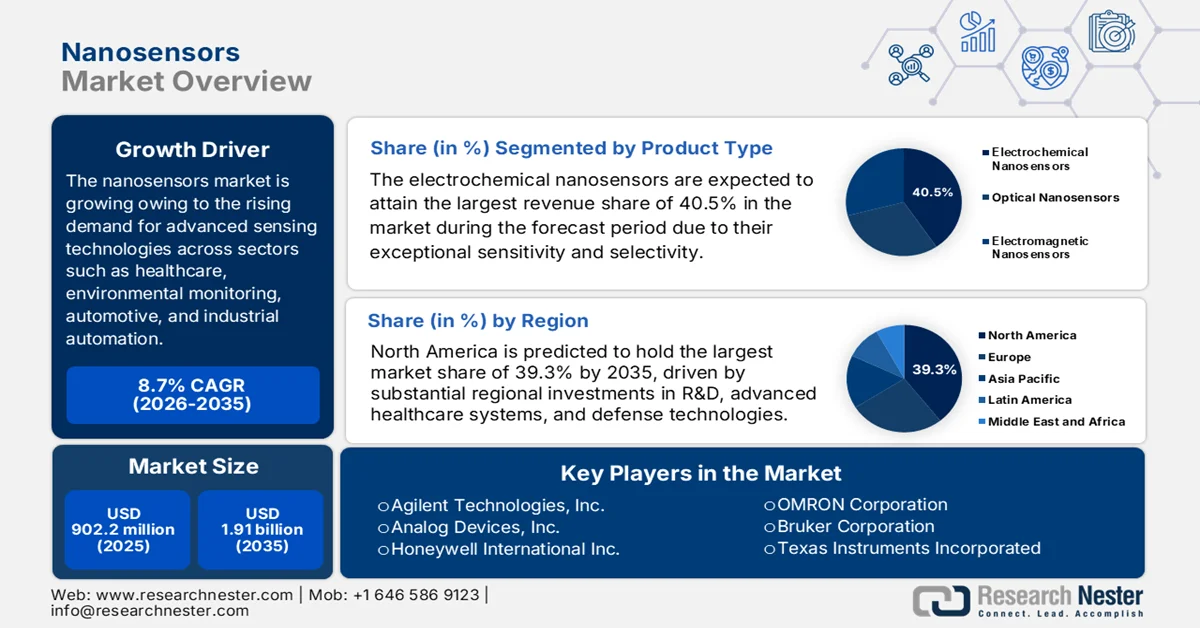
Nanosensors Market which was valued at USD 902.2 million in 2025, is anticipated to grow to USD 1.91 billion by 2035, at a compound annual growth rate CAGR of 8.7% during the forecast period from 2026 to 2035. In 2026, the industry size of nanosensors is assessed at USD 980.6 million.
The nanosensors market is witnessing dynamic growth that is fueled by the heightened demand for advanced sensing technologies across diverse sectors such as healthcare, environmental monitoring, automotive, and industrial automation. In this context, administrative bodies across different nations are making generous investments to strengthen the sector’s growth and exposure. In February 2026, the U.S. National Science Foundation (NSF) announced a total of USD 100 million investment in the National Quantum and Nanotechnology Research Infrastructure (NSF NQNI) program to establish a network of up to 16 open-access research facilities over five years. It also stated that these sites will provide students, researchers, and industry with access to advanced fabrication, characterization tools, and expertise, supporting regional innovation ecosystems, including community colleges and small businesses, hence positively impacting the market’s growth in the upcoming years.
Furthermore, the aspect of increased federal grants in nanotechnology research and development is creating increased growth opportunities for the nanosensors market. National Nanotechnology Initiative Supplement in March 2024 stated that the Biden-Harris Administration emphasizes leveraging nanotechnology to advance science and technology for all citizens in the U.S., wherein the applications are aerospace, agriculture, clean energy, healthcare, and microelectronics. It also underscored that the 2024 President’s Budget requests USD 2.16 billion for the National Nanotechnology Initiative (NNI), making the total funding over USD 43 billion to support foundational research, devices, systems, and infrastructure. Moreover, the NNI investments aim to strengthen the country’s leadership in semiconductors, microelectronics, and emerging technologies such as AI, quantum science, and biotechnology.
Key Nanosensors Market Insights Summary:
Regional Highlights:
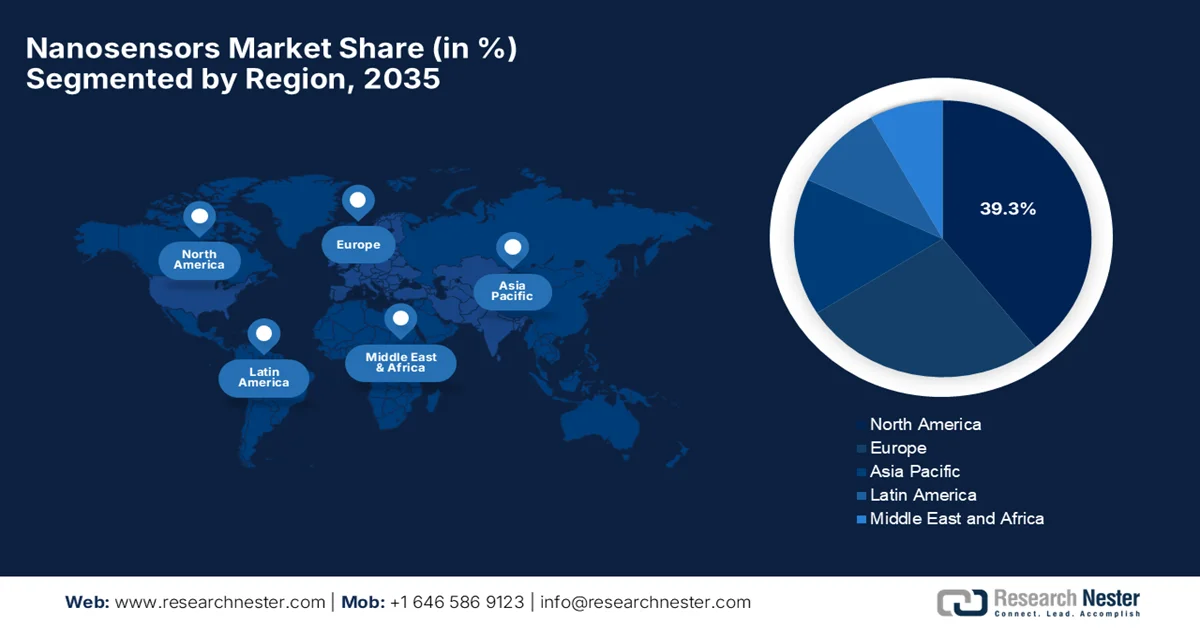
- North America is projected to command a 39.3% share of the nanosensors market, underpinned by rising R&D investments, strong defense and agriculture sectors, and growing adoption of advanced diagnostics.
- Asia Pacific is anticipated to witness the fastest expansion in the market, spurred by increasing integration of nanosensors across manufacturing and agriculture sectors alongside rising demand for precise diagnostic technologies.
Segment Insights:
- The electrochemical nanosensors segment is projected to capture a 40.5% share of the nanosensors market by 2035, propelled by exceptional sensitivity and selectivity for detecting chemical and biological analytes at extremely low concentrations.
- The biomedical & healthcare segment is anticipated to dominate the application landscape through 2035, stimulated by expanding utilization of nanosensors in disease diagnostics and early cancer detection technologies.
Key Growth Trends:
- Rising demand in healthcare & diagnostics
- Environmental monitoring & sustainability initiatives
Major Challenges:
- Integration with existing systems
- Sensitivity to environmental factors
Key Players: Agilent Technologies, Inc. (U.S.), Analog Devices, Inc. (U.S.), Honeywell International Inc. (U.S.), OMRON Corporation (Japan), Bruker Corporation (U.S.), Texas Instruments Incorporated (U.S.), Lockheed Martin Corporation (U.S.), Samsung Electronics Co., Ltd. (South Korea), Biosensors International Group Ltd. (Singapore), Kleindiek Nanotechnik GmbH (Germany), Altair Nanotechnologies Inc. (U.S.), Micro-Tech Scientific Inc. (U.S.), Nanowear Inc. (U.S.), Oxonica Limited (UK), Applied Nanotech Inc. (U.S.), Nanomix Inc. (U.S.), Nanosensors Limited (UK), Nanodevices Inc. (U.S.), Toshniwal Industries Pvt. Ltd. (India), Sensirion AG (Switzerland), Avalon GloboCare Corp (U.S.)
Global Nanosensors Market Forecast and Regional Outlook:
Market Size & Growth Projections:
- 2025 Market Size: USD 902.2 million
- 2026 Market Size: USD 980.6 million
- Projected Market Size: USD 1.91 billion by 2035
- Growth Forecasts: 8.7% CAGR (2026-2035)
Key Regional Dynamics:
- Largest Region: North America (39.3% Share by 2035)
- Fastest Growing Region: Asia Pacific
- Dominating Countries: United States, China, Japan, Germany, South Korea
- Emerging Countries: India, Singapore, Brazil, Canada, United Arab Emirates
Last updated on : 11 March, 2026
Nanosensors Market - Growth Drivers and Challenges
Growth Drivers
- Rising demand in healthcare & diagnostics: The nanosensors have been strongly adopted by healthcare monitoring, early disease detection, personalized medicine, and point-of-care diagnostics. Nanosensors enable monitoring and highly sensitive detection of biomarkers at the molecular level. Besides, integration into wearable health devices fuels demand in the nanosensors market, especially in terms of chronic disease management. The 2025 article published by the Royal Society of Chemistry reported that nanosensors in healthcare are revolutionizing real-time monitoring and disease management with the presence of the unique properties of nanomaterials such as carbon nanotubes, graphene, and quantum dots. It also stated that they enable extremely sensitive detection of biochemical, physiological, and molecular changes, incorporating them into wearable, implantable devices for personalized treatment.
- Environmental monitoring & sustainability initiatives: The rising focus on environmental protection propels demand for nanosensors, which are used in air quality, water quality, pollutant detection, and ecological monitoring solutions. Testifying to this, the U.S. Environmental Protection Agency (EPA) in August 2025 revealed that it allocated a total of USD 1.5 million to Clarkson University to develop a multimodal nanosensor for detecting and degrading PFAS in groundwater and wastewater to address the limitations of conventional detection and treatment methods. Besides, this technology combines electrochemical and Raman-based sensing with nanocatalysts to provide portable, cost-effective, and selective in situ monitoring of environmental pollutants. Therefore, environmental protection priorities are efficiently driving the demand in the nanosensors market in ecological and water quality monitoring.
- IoT and smart devices expansion: Growth of IoT ecosystems in terms of smart cities, smart agriculture, healthcare, industrial automation, and consumer electronics significantly increases the need for highly accurate nanosensors. Also, wireless and IoT-connected nanosensors provide data collection and integration into larger intelligent systems. In this context, the article by the National Institute of Health (NIH) in May 2025 reported that recent improvements in nanosensors and microsensors have enabled real-time monitoring of body fluids through wearable, implantable, and lab-on-a-chip devices, thereby providing continuous, non-invasive health data. In addition, the report notes that integration with IoT platforms allows wireless transmission of sensor data to cloud or medical databases, thereby supporting remote patient monitoring and personalized healthcare. These miniaturized sensors enhance early disease detection, and timely clinical intervention positively impacting nanosensors market growth.
Challenges
- Integration with existing systems: This is the major barrier that is restricting the expansion of the nanosensors market. These sensors need to interface with existing electronic or IoT systems, which can be challenging due to the existence of differences in signal formats, power requirements, and data protocols. Besides, most of the traditional systems are not designed to handle the high-resolution output of nanosensors. Therefore, it raises the development costs and requires custom electronics or software solutions. The issues of integration are particularly critical in healthcare devices or industrial monitoring, where regulatory compliance and system reliability are paramount. Hence, without compatibility, there will be a slower adoption as customers hesitate to overhaul existing infrastructure or invest in additional integration tools.
- Sensitivity to environmental factors: Many nanosensors are extremely sensitive, but this sensitivity can also make them vulnerable to environmental changes such as temperature, humidity, or electromagnetic interference. Even any type of minor fluctuations can affect readings, in turn leading to inaccuracies or false positives. For example, electrochemical nanosensors may degrade or drift in high-humidity conditions, whereas the optical nanosensors may require stable light sources. This aspect limits the usability of nanosensors in harsh industrial, outdoor, or wearable applications. Therefore, manufacturers in the nanosensors market need to incorporate protective coatings, shielding, or calibration routines to maintain performance, which adds huge complexity and cost to the sensor design.
Nanosensors Market Size and Forecast:
| Report Attribute | Details |
|---|---|
|
Base Year |
2025 |
|
Forecast Year |
2026-2035 |
|
CAGR |
8.7% |
|
Base Year Market Size (2025) |
USD 902.2 million |
|
Forecast Year Market Size (2035) |
USD 1.91 billion |
|
Regional Scope |
|
Nanosensors Market Segmentation:
Product Type Segment Analysis
The electrochemical nanosensors segment, which is a part of the product type, is expected to attain the largest revenue share of 40.5% in the nanosensors market during the forecast period. The subtype offers exceptional sensitivity and selectivity for chemical and biological analytes at very low concentrations due to high surface-to-volume ratios, making them highly suitable for medical diagnostics and environmental detection. In this context, the journal of the American Chemical Society (ACS) in June 2024 reported that it has developed a flexible wearable electrochemical sensor by using gold nanorods (AuNRs) and PEDOT: PSS for non-enzymatic detection of levodopa and uric acid in human sweat. The sensor demonstrated high sensitivity, broad detection range, and low detection limits, thereby enabling simultaneous real-time monitoring of multiple biomarkers, hence denoting a wider scope for the segment’s dominance.
Application Segment Analysis
The biomedical & healthcare subtype is expected to lead the application segment with a considerable share by the conclusion of the forecast timeline. The subtype’s growth in the nanosensors market is mainly propelled by its usage in disease diagnostics. In January 2026, the article published by Memorial Sloan Kettering Cancer Center states that its researchers have developed an ultrasensitive liquid biopsy test using carbon nanotube nanosensors combined with artificial intelligence to detect brain tumors from blood samples. It underscores that the nanosensors analyze fluorescent patterns created by interactions with protein biomarkers, enabling detection and classification of tumor types with up to 98% accuracy. This approach reflects the higher potential of nanosensor technology for early cancer diagnosis and non-invasive disease monitoring, indicating a positive outlook for the segment’s growth.
Technology Segment Analysis
Bottom-up assembly is predicted to grab a significant share in the nanosensors market by 2035, supported by its capability to construct highly controlled nanostructures through atomic or molecular-level synthesis. Besides, this approach enables proper manipulation of materials, resulting in sensors with improved uniformity, structural stability, and functional performance. Bottom-up fabrication also allows the incorporation of nanomaterials such as graphene, quantum dots, and nanowires into complex sensing architectures. In addition, this particular technique supports scalable manufacturing methods such as chemical vapor deposition and self-organized growth processes, which can facilitate large-scale production of nanosensors. Furthermore, its compatibility with emerging nanofabrication techniques and capability to create highly specialized sensing structures make bottom-up assembly highly suitable for applications in biomedical diagnostics, environmental sensing, and smart electronic systems.
Our in-depth analysis of the nanosensors market includes the following segments:
|
Segment |
Subsegments |
|
Product Type |
|
|
Application |
|
|
Technology |
|
|
End user |
|

Vishnu Nair
Head - Global Business DevelopmentCustomize this report to your requirements — connect with our consultant for personalized insights and options.
Nanosensors Market - Regional Analysis
North America Market Insights
The North America nanosensors market is expected to lead the industry with a total of 39.3% of revenue share by 2035. Burgeoning R&D investments, strong defense, agriculture sectors, and adoption of advanced diagnostics are the main factors that are fueling the region’s leadership in this sector. The region’s strong technological ecosystem and continuous funding for innovation also support the expansion and adoption of nanosensor technologies across multiple sectors. In July 2023, the U.S. EPA reported it allocated USD 1.3 million to the University of Wisconsin-Madison to develop nanosensor technology that is capable of detecting, monitoring, and degrading pesticides in drinking water. Besides, the project is called I-PRENS, and it integrates portable Raman and electrochemical nanosensors for rapid, onsite detection and remediation of neonicotinoid-contaminated water, especially in rural communities in Alabama, hence suitable for standard nanosensors market growth.
Driven by heightened demand for advanced technologies and supportive regulatory policies, the U.S. nanosensors market is poised for extensive growth in the years ahead. The presence of numerous universities and research institutions and substantial funding grants from both the public and private entities is also responsible for boosting the country’s market growth. In 2024, Nanodiagnostic Technology, LLC received a Phase II STTR award of USD 1,119,219 from the U.S. NIH to develop an integrated smartphone-nanosensor platform for rapid onsite detection of organophosphate pesticide exposure by using a tiny drop of finger-stick blood. The project aims to create a sensitive, multiplex nanosensing system that is capable of measuring biomarkers like acetylcholinesterase and butyrylcholinesterase, with real-time data processing, display, storage, and sharing through a mobile app.
The nanosensors market in Canada is witnessing solid growth due to strong government backing and adoption in healthcare, i.e., diagnostics, wearables, automotive, and industrial IoT sectors. The rising demand for pressure sensors, nano-magnetic devices for medical imaging, and smart environmental monitoring tools are certain visible trends in the country. In December 2023, the University of Ottawa received a total of USD 280,500 grant from the National Research Council Canada under the Collaborative Science, Technology, and Innovation Program. This project is mainly focused on developing quantum nanomaterial sensor arrays using graphene and carbon nanotubes for the selective detection of airborne chemicals, with applications in health, environment, and security. Therefore, such projects are likely to foster stronger collaborations in the short term, disruptive technologies in the medium term, and long-term innovation systems in order to address public policy challenges.
APAC Market Insights
The Asia Pacific nanosensors market is projected to register the fastest growth from 2026 to 2035. The region’s growth is highly propelled by the manufacturing and agriculture sectors, which are integrating nanosensors to enhance operational efficiency, whereas densely populated countries face heightened demand for precise diagnostic tools. The strong research ecosystem and adoption of nanosensors for soil and crop monitoring to improve agricultural efficiency also fuel the regional market growth. In June 2025, the Massachusetts Institute of Technology (MIT) reported that researchers from the DiSTAP and Singapore-MIT Alliance for Research and Technology (SMART) developed the world’s first near-infrared fluorescent nanosensor, which is capable of monitoring the plant growth hormone indole-3-acetic acid without damaging the plant. The sensor uses single-walled carbon nanotubes wrapped in a specialized polymer to detect hormone fluctuations through changes in near-infrared fluorescence, thereby denoting an optimistic outlook for the market’s growth in the region.
The national push for self-reliance and digital transformation is the responsible factor for uplifting the nanosensors market in China. The market is efficiently fueled by the massive integration of sensors into IoT ecosystems, 5G infrastructure, and smart city developments. Healthcare remains considered to be a critical vertical in the country, in which the advances in graphene-based and biocompatible materials are enabling personalized medicine for an aging population. In March 2025, researchers at the Health Electronics R&D Center, Institute of Microelectronics, China Academy of Sciences, reported that they had developed a nanoforest humidity sensor that is capable of detecting subtle changes in exhaled breath. This sensor is supported by the National Natural Science Foundation of China and the National Key R&D Program, and it integrates temperature compensation and machine learning to achieve high accuracy in recognizing nine different motion states. Such an environment represents the country’s increased growth potential in the nanosensors market.
The heavy focus on healthcare and biotechnology is driving the nanosensors market in India. The country is gradually entering into a transformative phase, which is influenced by the government's support in the form of financial backing, research, and awareness programs. Meanwhile, agriculture is also identified as another vital pillar, with increasing adoption of sensors for soil health monitoring, pesticide detection, and smart irrigation to enhance crop yields. In August 2024 Press Information Bureau (PIB) stated that the Institute of Nano Science and Technology (INST) developed electrochemical and optical sensors by using metal-organic frameworks and 2D nanomaterials such as MoS2 and MXenes. These sensors enable rapid, low-cost detection of health markers, food toxins such as Aflatoxins and Zearaloene, and environmental contaminants, to achieve nano- to pico-molar sensitivity through robust integration with biorecognition molecules. Therefore, with such consistency in developments, the country’s market is gradually gaining increased exposure.
Europe Market Insights
A strong importance for sustainability and regulatory compliance is boosting the nanosensors market in Europe. The market benefits from the region’s automotive industry, in which nanosensors are highly essential for emissions control, engine efficiency, and the development of autonomous vehicle systems. Environmental monitoring is also an asset for this landscape as strict directives on air and water quality necessitate the detection of pollutants and hazardous gases. The European Commission funded the NEOGAS project, which is mainly focused on developing nanosensors for simultaneous electrical and optical monitoring of greenhouse gases, and it ran from November 2021 to January 2024. Besides, this project received a total EU contribution of around USD 185,000 under the EU Horizon programme, and these advanced sensor prototypes, based on metal‑organic framework materials, are designed for IoT integration to enable widespread, efficient environmental monitoring.
Germany nanosensors market maintains a strong position in the regional landscape, effectively fueled by research-led innovation, a well-established healthcare sector, and Industry 4.0 strategies. The country’s leading pioneers are integrating nanosensors into smart manufacturing lines for real-time vibration and pressure monitoring and into autonomous vehicle systems for enhanced safety and driver assistance. In February 2024, Fraunhofer Institute for Microelectronic Circuits and Systems (IMS) reported that its researchers, along with Ruhr University Bochum, have developed luminescent single-walled carbon nanotube nanosensors that enhance diagnostic tests by shifting signals into the near-infrared range, increasing sensitivity, and reducing material use. These sensors can monitor enzymatic reactions, potentially improving detection limits for low-level disease markers such as cancer, and are adaptable to various substrates and complex environments, hence denoting a positive outlook for the market’s expansion and exposure.
A strong foundation in terms of academic research and an increased application in healthcare, defense, and environmental monitoring are responsible for driving the UK nanosensors market. The market is witnessing incremental demand positively influenced by the country’s leadership in advanced materials, particularly graphene and carbon nanotubes. The UK also maintains a strong position in security and aerospace, utilizing nanosensors for trace-explosive detection and structural health monitoring of critical infrastructure. In November 2025, Innovate UK invested more than 20 million across 14 projects with a main goal to advance quantum and nanosensor technologies in the country, thereby supporting applications in healthcare, transport, energy, and defence. Projects include ultra-sensitive quantum sensors for medical diagnostics, brain imaging, precision navigation, and environmental monitoring, enabling real-world deployment and enhancing critical infrastructure.
Key Nanosensors Market Players:
- Agilent Technologies, Inc. (U.S.)
- Analog Devices, Inc. (U.S.)
- Honeywell International Inc. (U.S.)
- OMRON Corporation (Japan)
- Bruker Corporation (U.S.)
- Texas Instruments Incorporated (U.S.)
- Lockheed Martin Corporation (U.S.)
- Samsung Electronics Co., Ltd. (South Korea)
- Biosensors International Group Ltd. (Singapore)
- Kleindiek Nanotechnik GmbH (Germany)
- Altair Nanotechnologies Inc. (U.S.)
- Micro‑Tech Scientific Inc. (U.S.)
- Nanowear Inc. (U.S.)
- Oxonica Limited (UK)
- Applied Nanotech Inc. (U.S.)
- Nanomix Inc. (U.S.)
- Nanosensors Limited (UK)
- Nanodevices Inc. (U.S.)
- Toshniwal Industries Pvt. Ltd. (India)
- Sensirion AG (Switzerland)
- Avalon GloboCare Corp (U.S.)
- Zymosense (U.S.)
- Company Overview
- Business Strategy
- Key Product Offerings
- Financial Performance
- Key Performance Indicators
- Risk Analysis
- Recent Development
- Regional Presence
- SWOT Analysis
- Agilent Technologies, Inc. is a global leader in analytical instruments and nanoscale sensing solutions. The company is mainly focused on high-precision chemical and biosensing nanosensors for healthcare, life sciences, and environmental monitoring. In addition, Agilent benefits from a strong global distribution network and regulatory-compliant product offerings.
- Analog Devices, Inc. is a specialist player in terms of high-performance sensors and signal processing technologies, which include nanosensors for industrial, automotive, and medical applications. Besides, the company also strengthens its position through MEMS technology, AI integration, and miniaturized sensor platforms with a prime focus on enhancing precision and efficiency.
- Honeywell International Inc. is yet another prominent player in this field that develops a wide array of chemical, environmental, and industrial nanosensors, highly focusing on safety, automation, and aerospace applications. The company deliberately integrates nanosensors with IoT-enabled monitoring and predictive analytics, thereby driving process optimization and regulatory compliance.
- OMRON Corporation is a leading provider of automation, healthcare, and environmental nanosensors and specializes in precise measurement and wearable diagnostic devices. Besides, the company’s strategic initiatives include collaboration with healthcare institutions, continuous product innovation, and regional expansion.
- Bruker Corporation leads in terms of nanoscale measurement and sensor solutions for life sciences, materials research, and industrial applications. The company’s nanosensors are mostly integrated with high-resolution microscopy and spectroscopy systems for enhanced analytical accuracy.
Below is the list of some prominent players operating in the global market:
The major players in the global nanosensors market are focusing on R&D, product innovation, strategic partnerships, and geographic expansion with the main goal to strengthen their market positions. U.S. companies such as Agilent, Analog Devices, and Honeywell are making investments in advanced sensor technologies and cross-sector deployments for healthcare, industrial, and defense applications. Meanwhile, firms from the Asia Pacific, such as OMRON and Samsung, emphasize integration of nanosensors into consumer electronics and industrial automation. On the other hand, Europe-specific players such as Kleindiek Nanotechnik and Oxonica specialize in nanostructured sensor components. In February 2024, Bruker Corporation announced the acquisition of Nanophoton Corporation, which is a leader in terms of advanced Raman microscopy, to expand its molecular microscopy portfolio for life sciences, semiconductors, nanomaterials, and clinical research.
Corporate Landscape of the Nanosensors Market:
Recent Developments
- In January 2026, Avalon GloboCare Corp. reported the FDA registration renewal for its KetoAir device, which is a handheld nanosensor-based breathalyzer for monitoring ketogenic health by measuring breath acetone.
- In November 2025, Zymosense launched the Nanoassay, which is an enzyme measurement platform using single-walled carbon nanotubes. The system replaces traditional workflows with a dilute-add-scan protocol, thereby enabling more accurate and mobile enzyme analysis suitable for field and high-throughput applications.
- Report ID: 3083
- Published Date: Mar 11, 2026
- Report Format: PDF, PPT
- Explore a preview of key market trends and insights
- Review sample data tables and segment breakdowns
- Experience the quality of our visual data representations
- Evaluate our report structure and research methodology
- Get a glimpse of competitive landscape analysis
- Understand how regional forecasts are presented
- Assess the depth of company profiling and benchmarking
- Preview how actionable insights can support your strategy
Explore real data and analysis
Frequently Asked Questions (FAQ)
About this Report
Connect with our Expert


Report, 2026-2035



Copyright @ 2026 Research Nester. All Rights Reserved.
