Data Center SSD Market Outlook:
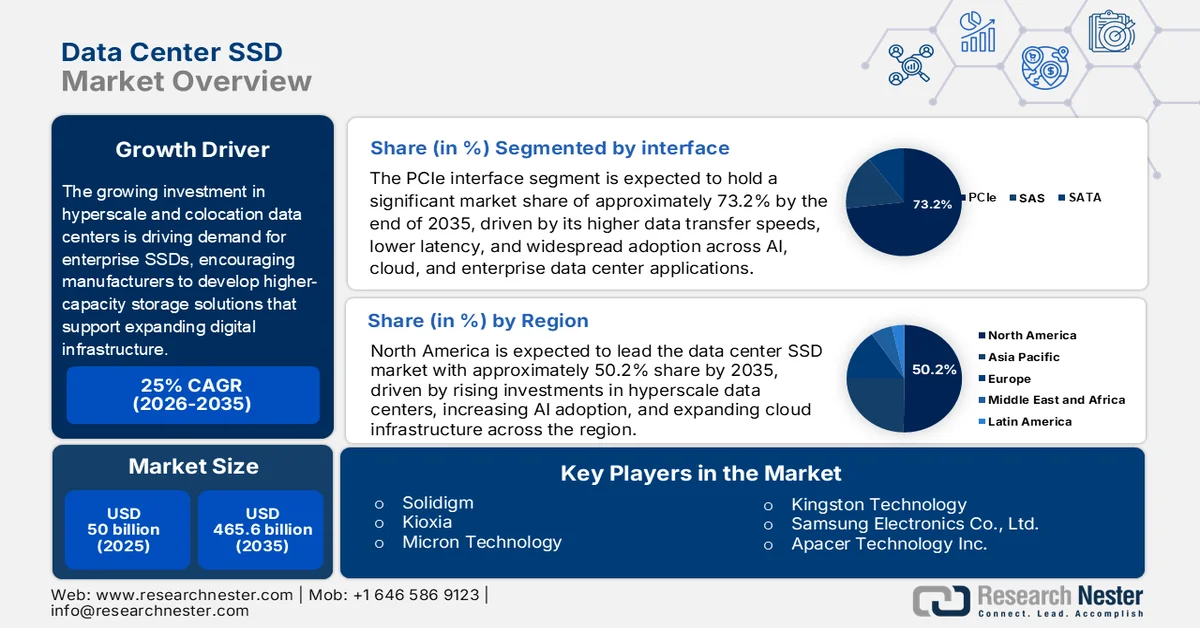
Data Center SSD Market size was valued at USD 50 billion in 2025 and is expected to reach USD 465.6 billion by the end of 2035, registering around 25% CAGR during the forecast period i.e., between 2026-2035. In 2026, the industry size of data center SSD is estimated at USD 62.5 billion.
The data center SSD market is registering strong growth due to the rising use of artificial intelligence across enterprise and hyperscale data centers. This shift is also supported by the continued use of cloud platforms and digital services, which require faster and more reliable storage across modern data centers. As AI workloads become more common, data center operators are slowly replacing traditional hard disk drives with SSDs for managing increasing amounts of data more efficiently.
The market is also benefiting from continued investment in data center development among several companies. New facilities are being built while many existing sites are enhancing their storage capacity to meet future demand. As more facilities become operational and existing ones increase their storage capacity, the demand for enterprise SSDs continues to grow. According to the Open Compute Project (OCP), the industry continues to develop data center storage technologies that support modern infrastructure.
The increasing focus on improving data center efficiency and performance is expected to create additional opportunities for enterprise SSD adoption during the forecast period. Data center operators are prioritizing storage solutions that offer higher speed, lower latency, and improved power efficiency to support advanced workloads. Additionally, the growing need for real-time data processing in applications such as AI, analytics, and cloud-based services is encouraging the transition toward advanced SSD technologies. These factors are expected to strengthen the role of enterprise SSDs in next-generation data center environments.
Key Data Center SSD Market Insights Summary:
Regional Highlights:
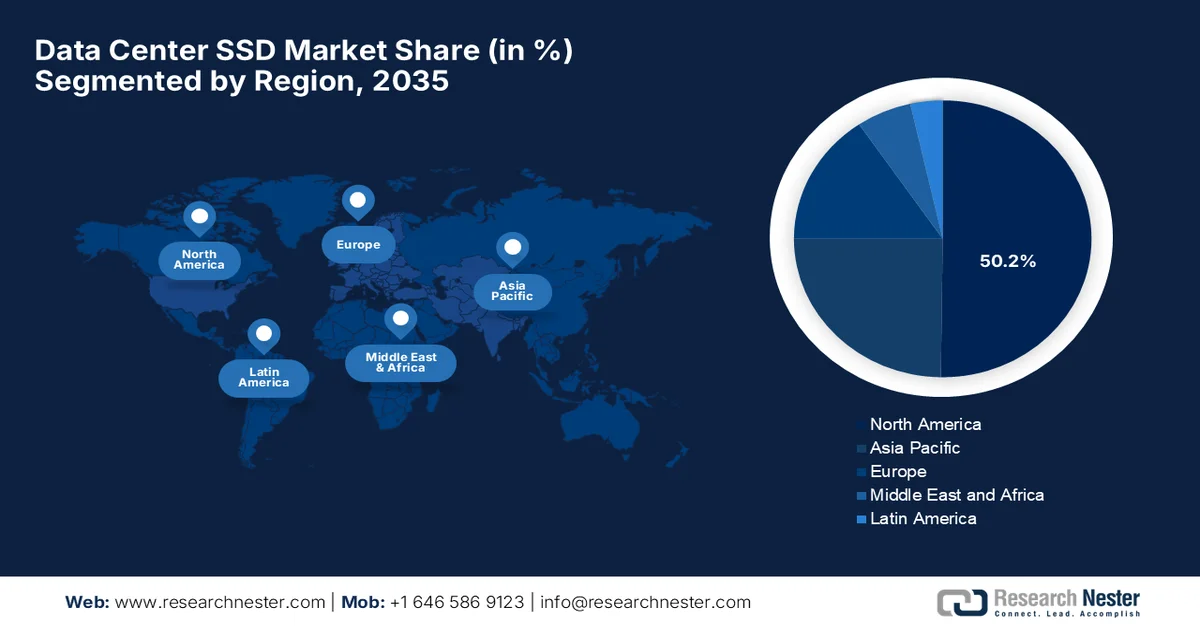
- The data centre ssd market in North America is projected to command 50.2% share by 2035, reinforced by rising investments in hyperscale data centers, AI applications, and cloud computing infrastructure
- Europe is expected to witness steady growth in the forecast period, underpinned by the modernization of existing data center facilities and increasing deployment of colocation infrastructure
Segment Insights:
- The PCIe sub-segment of the data centre ssd market is anticipated to capture 73.2% share by 2035, propelled by its higher speed and lower latency for AI and cloud applications
- The Hyperscale Data Center sub-segment is expected to maintain its leading position throughout 2026–2035, driven by the rising adoption of cloud platforms and AI-based applications
Key Growth Trends:
- Expansion of colocation data centers
- Growing demand for longer equipment lifecycles
Major Challenges:
- High initial cost of enterprise SSD deployment
- Supply chain disruptions and NAND flash price volatility
Key Players: Solidigm (U.S.),Kioxia (Japan),Micron Technology (U.S.),Kingston Technology (U.S.),Samsung Electronics Co., Ltd.(South Korea),Apacer Technology Inc. (Taiwan).
Global Data Center SSD Market Forecast and Regional Outlook:
Market Size & Growth Projections:
- 2025 Market Size: USD 50 billion
- 2026 Market Size: USD 62.5 billion
- Projected Market Size: USD 465.6 billion by 2035
- Growth Forecasts: 25% CAGR (2026-2035)
Key Regional Dynamics:
- Largest Region: North America (50.2% share by 2035)
- Fastest Growing Region: Asia Pacific
- Dominating Countries: United States, China, Japan, Germany, South Korea
- Emerging Countries: India, Singapore, Indonesia, Malaysia, Vietnam
Last updated on : 5 August, 2026
Data Center SSD Market - Growth Drivers and Challenges
Growth Drivers
- Expansion of colocation data centers: The increasing number of colocation centers is creating new opportunities for the market. This is encouraging the large use of SSDs as data centers continue to enhance their services. Rather than building their own data centers, many businesses are choosing colocation facilities so that they can store and manage their digital operations more easily. The continued expansion of these facilities is expected to support demand for data center SSDs. According to the Uptime Institute, colocation facilities continue to play an important role in supporting the increasing use of digital infrastructure globally. The growing adoption of colocation services is encouraging operators to upgrade their storage infrastructure, creating further demand for high-performance SSD solutions.
- Growing demand for longer equipment lifecycles: Several organizations are looking for data center infrastructure that can be adapted as business requirements change. Meanwhile operators are paying more attention to flexible systems that can support future increases without major operational changes, rather than just depending on fixed storage environments. This approach is encouraging large use of SSDs, as they can be integrated more easily into modern storage environments. As businesses continue to improve the flexibility of their data center operations, the demand for enterprise SSDs is anticipated to remain steady during the forecast period.
- Growing demand for disaster recovery and backup data centers: Many companies are getting their backup data centers so that their operations can continue even if their main facilities experience any unexpected interruptions. This is encouraging data center operators to raise the use of SSDs while enhancing backup facilities to support growing business needs. The increasing focus on maintaining operational continuity and strengthening data protection strategies is expected to support the adoption of advanced storage technologies during the forecast period.
Challenges
- High initial cost of enterprise SSD deployment: The higher cost of enterprise SSDs is one of the major challenges for the market. Many businesses are interested in using SSDs, but completely replacing existing storage systems requires additional spending, which makes their use more expensive. Hence, companies often upgrade their storage in stages instead of making a complete replacement. This can slow the use of enterprise SSDs, especially among companies that are carefully managing their budgets while expanding their data center operations.
- Supply chain disruptions and NAND flash price volatility: Changes in the supply of NAND flash memory continue to create challenges for the market. These changes can make market conditions delay purchasing decisions and affect the availability of enterprise SSDs. Therefore, both manufacturers and data center operators often need to adjust their plans according to market conditions. Manufacturers may face difficulties in maintaining a stable supply, while fluctuating prices can make it more challenging for businesses to plan their storage investments.
Data Center SSD Market Size and Forecast:
| Report Attribute | Details |
|---|---|
|
Base Year |
2025 |
|
Forecast Year |
2026-2035 |
|
CAGR |
25% |
|
Base Year Market Size (2025) |
USD 50 billion |
|
Forecast Year Market Size (2035) |
USD 465.6 billion |
|
Regional Scope |
|
Data Center SSD Market Segmentation:
Interface Segment Analysis
Based on the interface segment, the PCIe sub-segment is expected to hold the largest share of the data center SSD market, accounting for approximately 73.2% by the end of 2035. This makes it well-suited for modern data center workloads, specifically for AI and cloud applications that require fast data access. Its adoption is also supported by the fact that most new servers are now designed with PCIe as the standard interface, further making its use across storage systems more widely used. Here, PCIe dominates mainly because it delivers much higher speed and lower latency than older interfaces. As a result, it has become the preferred choice for high-performance storage solutions.
End user Segment Analysis
Based on the end-user segment, the hyperscale data center sub-segment is expected to hold the largest share in the market over the forecast period. This growth is mainly driven by the rising adoption of cloud platforms and AI-based applications, which are generating huge volumes of data that need to be stored and processed quickly. Hyperscale operators, in particular, are increasing their data center capacity and upgrading their storage infrastructure to handle rising traffic and workload pressure across global networks. Therefore, the continuous expansion of digital services and data-heavy applications is further strengthening the dominance of this segment. Owing to this, companies are gradually shifting from traditional storage systems to flash-based SSD solutions that offer better speed and reliability.
Form Factor Segment Analysis
As storage requirements continue to increase, many organizations still choose this form factor because it offers a familiar and economical solution. Based on the form factor segment, the 2.5-inch SSD sub-segment continues to lead the market, which is supported by its widespread use across data centers market. While newer form factors are slowly entering the market, their adoption is still developing, which allows the 2.5-inch SSD segment to maintain a strong presence. This trend is anticipated to continue throughout the forecast period.
Our in-depth analysis of the data center SSD market includes the following segments:
|
Segment |
Sub-segment |
|
Interface |
|
|
Form-Factor |
|
|
Drive Architecture |
|
|
NAND Technology |
|
|
Capacity Range |
|
|
End user |
|

Vishnu Nair
Head - Global Business DevelopmentCustomize this report to your requirements — connect with our consultant for personalized insights and options.
Data Center SSD Market - Regional Analysis
North America Market Insights
The North America data center SSD market is anticipated to register 50.2% by the end of 2035. It plays a crucial role as more businesses in the region are increasing their digital operations and storing larger volumes of data. Several companies are changing hard disk drives to SSDs in order to improve data access speed and lower energy use. At the same time, more hyperscale and colocation data centers are being developed across the region, creating a stable demand for SSDs. According to the U.S. Environmental Protection Agency, data centers can improve energy efficiency by adopting more efficient IT equipment and technologies. The increasing use of AI applications, cloud computing, and online services is rising the need for faster storage solutions. This growth is further supported by the presence of leading technology companies and ongoing investments in new data center facilities, helping North America strengthen its position in the market.
The U.S. market continues to be the largest contributor to the North American data center SSD market because of the rapid growth of hyperscale data centers across the country. This is boosting the need for high-capacity and high-speed SSDs that can manage a large volume of data with lower latency. The country also has some of the leading SSD manufacturers and storage technology companies, which creates a strong ecosystem for product innovation. According to the Open Compute Project (OCP), hyperscale operators continue to advance storage and data center infrastructure to support increasing use of AI workloads and large-scale cloud services. Several cloud manufacturers are continuing to invest in new facilities and upgrade existing ones to support increasing demand for AI computing, enterprise applications, and digital services.
Canada market is playing an important role as more companies choose the country for new data center projects, because of its cooler climate, which helps in reducing price and makes data centers easier to operate over the long term. The country is also registering more investment in cloud facilities, creating a stable demand for faster and more reliable storage devices. These factors are helping Canada strengthen its role in the North American market. Moreover, ongoing support for technology development and new data center projects is encouraging the use of SSDs across modern facilities.
Europe Market Insights
The data center SSD market, Europe is taking different approach by paying greater attention on upgrading existing facilities rather than relying only on large-scale expansion. Rather than focusing only on new developments, many operators are replacing older storage equipment as facilities are updated to handle increasing digital workloads. Additionally, colocation providers are increasing their presence, contributing to the adoption of SSDs across both existing and newly developed facilities. According to the Climate Neutral Data Centre Pact, many leading operators have committed to improving the efficiency of their data centers. These developments are helping maintain stable demand for data center SSDs across Europe.
Germany’s market continues to play an important role in Europe, supported by its well-established data center infrastructure and growing digital activities. This is reassuring operators to increase their storage capacity and upgrade existing facilities to manage growing volumes of business and cloud data. Frankfurt remains one of Europe's leading data center locations, which attracts continuous investment because of its strong connectivity and position as a major internet exchange hub. Many companies are also investing in data center modernization to improve operational efficiency and to support future digital demand. These ongoing developments continue to manage stable opportunities for SSD manufacturers across Germany.
The U.K market plays an important part, while London serves as one of the region's leading colocation hubs. Ongoing investment in data center facilities is also creating new opportunities for SSD suppliers, helping them to maintain their position in the European market. The city showcases a strong presence of financial institutions, technology companies, and international businesses, which is creating stable demand for secure and high-performance data storage. Some of the organizations move their workloads to cloud environments, and data center operators are increasing their storage capacity to meet business needs.
APAC Market Insights
The Asia Pacific data center SSD market is registering a strong growth as countries across the region continue to invest in cloud infrastructure, AI, and hyperscale data centers. In the region, governments are also supporting digital infrastructure development, while cloud service providers and technology companies are increasing their data center capacity to meet increasing demand. As digital activity continues to enhance across the region, data centers are handling larger volumes of information, which increases the need for faster SSDs. This continues to create new opportunities for the Asia Pacific market.
In Japan market, there is growing investment as businesses across the country depend more on digital services and data-driven technologies. The growing use of AI technologies is emerging as one of the major factors driving additional investments in data center infrastructure. As more industries move their operations online, the demand for SSDs continues to grow, which helps Japan remain an important market for data center storage in the Asia Pacific. Instead of only building new facilities, many operators are upgrading existing data centers with faster storage to support changing business needs.
China data center SSD market continues to be enhanced through the development of large-scale projects across different parts of the country. As new facilities become operational, there is more use of SSDs to manage larger volumes of data more efficiently. These ongoing developments are helping China to make its position in the Asia Pacific market. The government's "East Data, West Computing" initiative is encouraging the construction of data centers in regions with better resources while supporting increasing digital demand.
Key Data Centre SSD Market Players:
- Solidigm (U.S.)
- Kioxia (Japan)
- Micron Technology (U.S.)
- Kingston Technology (U.S.)
- Samsung Electronics Co., Ltd.(South Korea)
- Apacer Technology Inc. (Taiwan)
- Company Overview
- Business Strategy
- Key Product Offerings
- Financial Performance
- Key Performance Indicators
- Risk Analysis
- Recent Development
- Regional Presence
- SWOT Analysis
- Solidigm is one of the notable suppliers of enterprise SSDs, with products designed for AI, cloud computing, and hyperscale data center applications.
- Samsung Electronics Co., Ltd. offers a broad portfolio of enterprise SSDs that are largely used in data centers for fast data processing, reliable storage, and take lower power consumption.
- Here Kioxia Corporation is focusing on developing enterprise NVMe SSDs that support increasing data center requirements by offering higher storage performance and better scalability for increasing workloads.
- Micron Technology (U.S.) offers enterprise SSD solutions designed for data-intensive applications, supporting data centers with high performance, improved reliability, and efficient storage capabilities.
- Apacer Technology Inc. (Taiwan) develops industrial and enterprise SSD solutions focused on improving storage performance, durability, and reliability for data center and embedded applications.
Here is a list of key players operating in the global market:
The data center SSD market is highly competitive, where companies pay attention to improving storage performance, capacity, and reliability to meet the changing needs of modern data centers. Some notable players are enhancing their enterprise storage portfolios and increasing product capabilities for cloud service providers, hyperscale data centers, and enterprise customers. Where manufacturers are continuously introducing new enterprise SSDs that support faster data processing, lower latency, and higher energy efficiency. Their continued investment in new products and enhancing business activities is expected to help them strengthen their position in the market as demand for data center SSDs continues to grow.
Corporate Landscape of the Market:
Recent Developments
- In July 2024, Micron Technology started volume production of its latest NAND flash technology to strengthen its enterprise SSD portfolio. The development supports the increasing demand for storage solutions across AI, cloud, and enterprise data centers.
- In January 2025, Solidigm extended its partnership with Broadcom to support the development of high-capacity enterprise SSDs. The collaboration reflects the company's continued focus on meeting the rising storage requirements of AI and hyperscale data centers.
- In February 2026, Samsung Electronics Co., Ltd. introduced new enterprise SSD solutions for AI and data center applications. The launch highlights the company's efforts to increase its storage portfolio in response to the growing demand for high-performance storage.
- Report ID: 8717
- Published Date: Aug 05, 2026
- Report Format: PDF, PPT
- Explore a preview of key market trends and insights
- Review sample data tables and segment breakdowns
- Experience the quality of our visual data representations
- Evaluate our report structure and research methodology
- Get a glimpse of competitive landscape analysis
- Understand how regional forecasts are presented
- Assess the depth of company profiling and benchmarking
- Preview how actionable insights can support your strategy
Explore real data and analysis
Frequently Asked Questions (FAQ)
About this Report
Connect with our Expert


Report, 2026-2035



Copyright @ 2026 Research Nester. All Rights Reserved.
