Global Data Center Infrastructure Management (DCIM) Market
1. Introduction
1.1. Study Objective
1.2. Scope of the report
1.3. Market Taxonomy
1.4. Study Assumptions and Abbreviations
2. Research Methodology
2.1. Secondary Research
2.2. Primary Research
2.3. SPSS Approach
2.4. Data Triangulation
3. Executive Summary
4. Global Industry Overview
4.1. Market Overview
4.2. Regional Synopsis
4.3. Industry Supply Chain Analysis
4.4. DROT
4.4.1. Driver
4.4.2. Restraint
4.4.3. Opportunities
4.4.4. Trends
4.5. Government Regulation: How they would Aid the Business?
4.6. Competitive Landscape
4.6.1. Hewlett Packard Enterprise Limited
4.6.2. Schneider Electric SE
4.6.3. Stulz GmbH
4.6.4. Vertiv Group Corp.
4.6.5. Delta Electronics, Inc.
4.6.6. CommScope Inc.
4.6.7. Siemens AG
4.6.8. Nlyte Software Limited
4.6.9. FNT GmbH
4.6.10. Eaton Corporation plc
4.7. Recent Development Analysis
4.8. Industry Risk Assessment
4.9. SWOT Analysis
5. Global Outlook and Projections
5.1. Global Overview
5.1.1. Market Value (USD Thousand) Current and Future Projections, 2026-2036
5.1.2. Increment $ Opportunity Assessment, 2026-2036
5.1.3. Year-on-Year Growth Forecast (%)
5.2. Global Segmentation (USD Thousand), 2026-2036, By
5.2.1. Component, Value (USD Thousand)
5.2.1.1. Solution
5.2.1.2. Services
5.2.2. Type, Value (USD Thousand)
5.2.2.1. Hyperscale Data Center
5.2.2.2. Enterprise Data Center
5.2.2.3. Colocation Data Center
5.2.2.4. Edge Data Center
5.2.2.5. Managed Data Center
5.2.3. Component, Value (USD Thousand)
5.2.3.1. Solution
5.2.3.2. Service
5.2.4. Deployment Type, Value (USD Thousand)
5.2.4.1. On-Premise
5.2.4.2. Cloud
5.2.5. Enterprise Type, Value (USD Thousand)
5.2.5.1. Large Enterprises
5.2.5.2. Small and Medium-sized Enterprises
5.2.6. Application, Value (USD Thousand)
5.2.6.1. Asset Management
5.2.6.2. Capacity Planning
5.2.6.3. Environmental Monitoring
5.2.6.4. Infrastructure Monitoring
5.2.6.5. Others
5.2.7. End user, Value (USD Thousand)
5.2.7.1. BFSI
5.2.7.2. Energy
5.2.7.3. Healthcare
5.2.7.4. Retail
5.2.7.5. Telecommunication
5.2.7.6. Others
5.2.8. Regional Synopsis Value (USD Thousand) 2026-2036
5.2.8.1. North America
5.2.8.2. Europe
5.2.8.3. Asia Pacific
5.2.8.4. Latin America
5.2.8.5. Middle East and Africa
6. North America Market
6.1. Overview
6.1.1. Market Value (USD Thousand), Current and Future Projections, 2026-2036
6.1.2. Increment $ Opportunity Assessment, 2026-2036
6.1.3. Year-on-Year Growth Forecast (%)
6.2. Segmentation (USD Thousand), 2026-2036, By
6.2.1. Component, Value (USD Thousand)
6.2.1.1. Solution
6.2.1.2. Services
6.2.2. Type, Value (USD Thousand)
6.2.2.1. Hyperscale Data Center
6.2.2.2. Enterprise Data Center
6.2.2.3. Colocation Data Center
6.2.2.4. Edge Data Center
6.2.2.5. Managed Data Center
6.2.3. Component, Value (USD Thousand)
6.2.3.1. Solution
6.2.3.2. Service
6.2.4. Deployment Type, Value (USD Thousand)
6.2.4.1. On-Premise
6.2.4.2. Cloud
6.2.5. Enterprise Type, Value (USD Thousand)
6.2.5.1. Large Enterprises
6.2.5.2. Small and Medium-sized Enterprises
6.2.6. Application, Value (USD Thousand)
6.2.6.1. Asset Management
6.2.6.2. Capacity Planning
6.2.6.3. Environmental Monitoring
6.2.6.4. Infrastructure Monitoring
6.2.6.5. Others
6.2.7. End user, Value (USD Thousand)
6.2.7.1. BFSI
6.2.7.2. Energy
6.2.7.3. Healthcare
6.2.7.4. Retail
6.2.7.5. Telecommunication
6.2.7.6. Others
6.2.8. Country Level Analysis Value (USD Thousand), 2026-2036
6.2.8.1. U.S.
6.2.8.2. Canada
7. Europe Market
7.1. Overview
7.1.1. Market Value (USD Thousand), Current and Future Projections, 2026-2036
7.1.2. Increment $ Opportunity Assessment, 2026-2036
7.1.3. Year-on-Year Growth Forecast (%)
7.2. Segmentation (USD Thousand), 2026-2036, By
7.2.1. Component, Value (USD Thousand)
7.2.1.1. Solution
7.2.1.2. Services
7.2.2. Type, Value (USD Thousand)
7.2.2.1. Hyperscale Data Center
7.2.2.2. Enterprise Data Center
7.2.2.3. Colocation Data Center
7.2.2.4. Edge Data Center
7.2.2.5. Managed Data Center
7.2.3. Component, Value (USD Thousand)
7.2.3.1. Solution
7.2.3.2. Service
7.2.4. Deployment Type, Value (USD Thousand)
7.2.4.1. On-Premise
7.2.4.2. Cloud
7.2.5. Enterprise Type, Value (USD Thousand)
7.2.5.1. Large Enterprises
7.2.5.2. Small and Medium-sized Enterprises
7.2.6. Application, Value (USD Thousand)
7.2.6.1. Asset Management
7.2.6.2. Capacity Planning
7.2.6.3. Environmental Monitoring
7.2.6.4. Infrastructure Monitoring
7.2.6.5. Others
7.2.7. End user, Value (USD Thousand)
7.2.7.1. BFSI
7.2.7.2. Energy
7.2.7.3. Healthcare
7.2.7.4. Retail
7.2.7.5. Telecommunication
7.2.7.6. Others
7.2.8. Country Level Analysis Value (USD Thousand), 2026-2036
7.2.8.1. UK
7.2.8.2. Germany
7.2.8.3. France
7.2.8.4. Italy
7.2.8.5. Spain
7.2.8.6. NORDIC
7.2.8.7. Russia
7.2.8.8. Rest of Europe
8. Asia Pacific Market
8.1. Overview
8.1.1. Market Value (USD Thousand), Current and Future Projections, 2026-2036
8.1.2. Increment $ Opportunity Assessment, 2026-2036
8.1.3. Year-on-Year Growth Forecast (%)
8.2. Segmentation (USD Thousand), 2026-2036, By
8.2.1. Component, Value (USD Thousand)
8.2.1.1. Solution
8.2.1.2. Services
8.2.2. Type, Value (USD Thousand)
8.2.2.1. Hyperscale Data Center
8.2.2.2. Enterprise Data Center
8.2.2.3. Colocation Data Center
8.2.2.4. Edge Data Center
8.2.2.5. Managed Data Center
8.2.3. Component, Value (USD Thousand)
8.2.3.1. Solution
8.2.3.2. Service
8.2.4. Deployment Type, Value (USD Thousand)
8.2.4.1. On-Premise
8.2.4.2. Cloud
8.2.5. Enterprise Type, Value (USD Thousand)
8.2.5.1. Large Enterprises
8.2.5.2. Small and Medium-sized Enterprises
8.2.6. Application, Value (USD Thousand)
8.2.6.1. Asset Management
8.2.6.2. Capacity Planning
8.2.6.3. Environmental Monitoring
8.2.6.4. Infrastructure Monitoring
8.2.6.5. Others
8.2.7. End user, Value (USD Thousand)
8.2.7.1. BFSI
8.2.7.2. Energy
8.2.7.3. Healthcare
8.2.7.4. Retail
8.2.7.5. Telecommunication
8.2.7.6. Others
8.2.8. Country Level Analysis Value (USD Thousand), 2026-2036
8.2.8.1. China
8.2.8.2. Japan
8.2.8.3. India
8.2.8.4. Indonesia
8.2.8.5. Australia
8.2.8.6. South Korea
8.2.8.7. Vietnam
8.2.8.8. Malaysia
8.2.8.9. Rest of Asia Pacific
9. Latin America Market
9.1. Overview
9.1.1. Market Value (USD Thousand), Current and Future Projections, 2026-2036
9.1.2. Increment $ Opportunity Assessment, 2026-2036
9.1.3. Year-on-Year Growth Forecast (%)
9.2. Segmentation (USD Thousand), 2026-2036, By
9.2.1. Component, Value (USD Thousand)
9.2.1.1. Solution
9.2.1.2. Services
9.2.2. Type, Value (USD Thousand)
9.2.2.1. Hyperscale Data Center
9.2.2.2. Enterprise Data Center
9.2.2.3. Colocation Data Center
9.2.2.4. Edge Data Center
9.2.2.5. Managed Data Center
9.2.3. Component, Value (USD Thousand)
9.2.3.1. Solution
9.2.3.2. Service
9.2.4. Deployment Type, Value (USD Thousand)
9.2.4.1. On-Premise
9.2.4.2. Cloud
9.2.5. Enterprise Type, Value (USD Thousand)
9.2.5.1. Large Enterprises
9.2.5.2. Small and Medium-sized Enterprises
9.2.6. Application, Value (USD Thousand)
9.2.6.1. Asset Management
9.2.6.2. Capacity Planning
9.2.6.3. Environmental Monitoring
9.2.6.4. Infrastructure Monitoring
9.2.6.5. Others
9.2.7. End user, Value (USD Thousand)
9.2.7.1. BFSI
9.2.7.2. Energy
9.2.7.3. Healthcare
9.2.7.4. Retail
9.2.7.5. Telecommunication
9.2.7.6. Others
10. Middle East & Africa Market
10.1. Overview
10.1.1. Market Value (USD Thousand), Current and Future Projections, 2026-2036
10.1.2. Increment $ Opportunity Assessment, 2026-2036
10.1.3. Year-on-Year Growth Forecast (%)
10.2. Segmentation (USD Thousand), 2026-2036, By
10.2.1. Component, Value (USD Thousand)
10.2.1.1. Solution
10.2.1.2. Services
10.2.2. Type, Value (USD Thousand)
10.2.2.1. Hyperscale Data Center
10.2.2.2. Enterprise Data Center
10.2.2.3. Colocation Data Center
10.2.2.4. Edge Data Center
10.2.2.5. Managed Data Center
10.2.3. Component, Value (USD Thousand)
10.2.3.1. Solution
10.2.3.2. Service
10.2.4. Deployment Type, Value (USD Thousand)
10.2.4.1. On-Premise
10.2.4.2. Cloud
10.2.5. Enterprise Type, Value (USD Thousand)
10.2.5.1. Large Enterprises
10.2.5.2. Small and Medium-sized Enterprises
10.2.6. Application, Value (USD Thousand)
10.2.6.1. Asset Management
10.2.6.2. Capacity Planning
10.2.6.3. Environmental Monitoring
10.2.6.4. Infrastructure Monitoring
10.2.6.5. Others
10.2.7. End user, Value (USD Thousand)
10.2.7.1. BFSI
10.2.7.2. Energy
10.2.7.3. Healthcare
10.2.7.4. Retail
10.2.7.5. Telecommunication
10.2.7.6. Others
10.2.8. Country Level Analysis Value (USD Thousand), 2026-2036
10.2.8.1. GCC
10.2.8.2. Israel
10.2.8.3. South Africa
10.2.8.4. Rest of Middle East & Africa
11. Global Economic Scenario
11.1. World Economic and Risk Outlook for 2024
12. About Research Nester
12.1. Our Global Clientele
12.2. We Serve Clients Across World
Data Center Infrastructure Management Market Outlook:
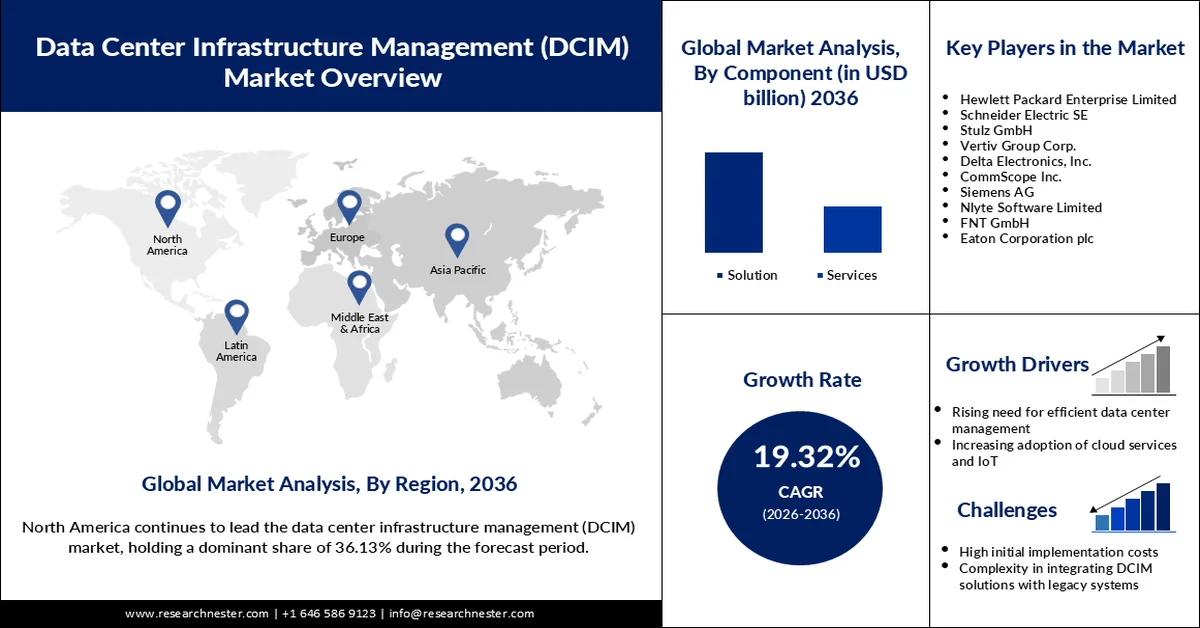
Data Center Infrastructure Management Market size was valued at USD 3.94 billion in 2025 and is projected to reach USD 23.09 billion by 2036, growing at a CAGR of 19.32% during the forecast period, 2026-2036. In 2026, the industry size of data center infrastructure management is estimated at USD 3.35 billion.
The primary growth driver of the global DCIM market is the rapid expansion of data-intensive digital services, especially cloud computing, AI workloads, and digital government platforms, which are sharply increasing data center scale and operational complexity. This forces operators to adopt DCIM tools for real-time monitoring, optimization, and energy control across power, cooling, and IT systems. Government and public-sector data also highlight this structural shift in demand. For instance, the U.S. Department of Energy reports that data centers accounted for about 4.4% of total U.S. electricity consumption in 2023, and this is expected to rise significantly as AI and computing demand grow.
Similarly, the DOE notes that data center electricity use is projected to increase substantially through 2028, driven largely by AI applications and expanding digital infrastructure needs. From a governance and infrastructure perspective, India’s National Informatics Centre (NIC) also emphasizes that the growth of e-governance services and digital demand is leading to exponentially increasing requirements for scalable, high-availability data centers. Together, these trends show that rising compute demand, energy pressure, and infrastructure scaling requirements are the core drivers pushing DCIM adoption worldwide.
Key Data Center Infrastructure Management (DCIM) Market Insights Summary:
Regional Highlights:
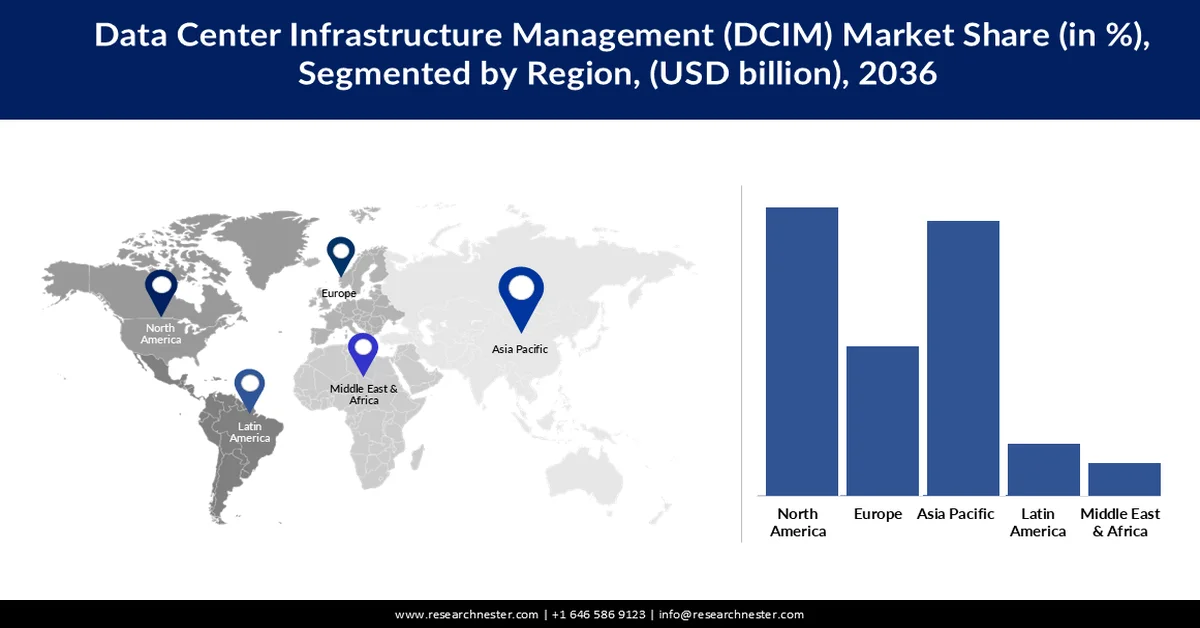
- The data center infrastructure management (dcim) market in North America is projected to retain a leading 36.13% share by 2036, attributed to the region’s advanced technological ecosystem, strong sustainability focus, and supportive regulatory framework promoting energy-efficient data center operations
- Asia Pacific is poised to capture 34.42% of the market by 2036, buoyed by rapid digital transformation and substantial investments in data center infrastructure across major economies such as India and China
Segment Insights:
- In the data center infrastructure management (dcim) market, the solution segment is anticipated to command a 68% revenue share by 2036, underpinned by the growing shift toward automated and AI-driven platforms delivering real-time data insights for efficient decision-making and resource allocation
- The hyperscale data center segment is expected to register a CAGR of 20.61% during 2026–2036, catalyzed by the rapid expansion of hyperscale facilities requiring advanced DCIM capabilities for infrastructure visibility, operational efficiency, and predictive maintenance
Key Growth Trends:
- Sustainability and energy efficiency requirements
- Emerging trends in IoT and edge computing
Major Challenges:
- Increasing cyber threats
- Energy consumption and sustainability regulations
Key Players: Hewlett Packard Enterprise (HPE), Schneider Electric SE, Stulz GmbH, Vertiv Group Corp., Delta Electronics, Inc., CommScope Inc., Siemens AG, Nlyte Software Limited, FNT GmbH, Eaton Corporation plc.
Global Data Center Infrastructure Management (DCIM) Market Forecast and Regional Outlook:
Market Size & Growth Projections:
- 2025 Market Size: USD 3.94 billion
- 2026 Market Size: USD 3.35 billion
- Projected Market Size: USD 23.09 billion by 2036
- Growth Forecasts: 19.32% CAGR (2026-2036)
Key Regional Dynamics:
- Largest Region: North America (36.13% Share by 2036)
- Fastest Growing Region: Asia Pacific
- Dominating Countries: United States, China, Germany, Japan, United Kingdom
- Emerging Countries: India, Singapore, South Korea, United Arab Emirates, Indonesia
Last updated on : 3 June, 2026
Data Center Infrastructure Management Market - Growth Drivers and Challenges
Growth Drivers
- Sustainability and energy efficiency requirements: Data centers from all over the world are facing growing pressure to meet the energy efficiency threshold and goals related to sustainability. According to the International Energy Agency, data centers use about 1% of the total global demand for electricity in 2022. However, consumption is expected to surge immensely due to increased demand for digital services. As a result, the data center infrastructure management market is poised to grow as companies seek solutions that can streamline energy management and minimize their carbon footprint.
- Emerging trends in IoT and edge computing: With the increased use of edge computing and IoT in enterprises continuously growing, there is a developing need for DCIM solutions that will support such technologies. In this respect, IoT devices and edge infrastructures are using DCIM platforms to manage huge volumes of data with respect to operational efficiency and connectivity. In September 2023, Modius Inc. announced AI capabilities for the OpenData platform to recognize typical behavior in the data center and extend IoT integration, further reinforcing its capacity to support edge computing applications.
Challenges
- Increasing cyber threats: As these data centers get connected, the chances of a cyberattack on such infrastructure have increased. This has highlighted cybersecurity as one of the key issues, and with that concern, the vendors of DCIM ensure that their offerings are protected from any foreseeable risk. Initiatives to counter this have also been launched by governments around the globe, including the U.S. Department of Energy’s 2022 report, which is developing robust cybersecurity measures for energy management and data management. This focus has increased the demand for secure DCIM solutions that protect data center operations from cyber threats.
- Energy consumption and sustainability regulations: There is growing scrutiny of energy consumption in data centers as global sustainability goals become more mainstream. Due to outdated infrastructure and high demand for operations, many data centers are not well-positioned to operate within regulations that demand a reduction in energy usage.
Data Center Infrastructure Management Market Size and Forecast:
| Report Attribute | Details |
|---|---|
|
Base Year |
2025 |
|
Forecast Period |
2026-2036 |
|
CAGR |
19.32% |
|
Base Year Market Size (2025) |
USD 3.94 billion |
|
Forecast Year Market Size (2036) |
USD 23.09 billion |
|
Regional Scope |
|
Data Center Infrastructure Management Market Segmentation:
Component Segment Analysis
The solution segment is likely to dominate the data center infrastructure management market, with a revenue share of 68% during the forecast period. This is largely because automated and AI-driven solutions are increasingly transitioning and providing real-time data insights, thus presenting effective decision-making and resource allocation. For example, Schneider Electric and Planon in July 2024 announced to extend their digital transformation strategy for smart buildings and understand how the solution segment can support operational efficiency through integrated data insights.
Type Segment Analysis
The hyperscale data center segment is a key driver of growth in the global data center infrastructure management (DCIM) market and is projected to expand at a CAGR of 20.61% from 2026 to 2036. This growth is fueled by the rapid expansion of hyperscale facilities by cloud service providers and large enterprises to support increasing demand for artificial intelligence (AI), big data analytics, high-performance computing, and data-intensive digital services. As these large-scale environments become more complex, organizations are increasingly adopting DCIM solutions to enhance infrastructure visibility, optimize power and cooling resources, improve operational efficiency, and ensure reliable uptime. These facilities require advanced DCIM solutions to monitor and optimize power consumption, cooling systems, asset utilization, and network performance across thousands of servers and devices. The increasing focus on operational efficiency, uptime, and sustainability is further accelerating DCIM adoption in hyperscale environments. Additionally, the growing complexity of managing large-scale infrastructure and the need for real-time visibility and predictive maintenance are encouraging hyperscale operators to invest in sophisticated DCIM platforms, making this segment a key contributor to overall market growth.
Deployment Type Segment Analysis
On-premises data centers are driving DCIM growth as organizations retain critical workloads in-house to meet strict data sovereignty, security, and compliance requirements. Unlike cloud environments, on-prem setups demand direct control over power, cooling, and IT assets, pushing enterprises to deploy DCIM platforms for centralized visibility and operational precision. Increasing adoption of AI, high-performance computing, and latency-sensitive applications within local infrastructure is further raising rack densities and energy consumption, making real-time monitoring and capacity optimization essential.
Our in-depth analysis of the data center infrastructure management (DCIM) market includes the following segments:
|
Segment |
Subsegments |
|
Component |
|
|
Type |
|
|
Deployment Type |
|
|
Enterprise Type |
|
|
Application |
|
|
End user |
|

Vishnu Nair
Head - Global Business DevelopmentCustomize this report to your requirements — connect with our consultant for personalized insights and options.
Data Center Infrastructure Management Market - Regional Analysis
North America Market Insights
North America continues to lead the data center infrastructure management (DCIM) market, holding a dominant share of 36.13% during the forecast period. This is due to the region’s technical orientation, apart from its strong emphasis on sustainable infrastructure and enabling regulatory environment. The U.S. has been at the forefront of innovations in data centers, with programs aimed at energy efficiency and the reduction of carbon emissions.
The U.S. data center infrastructure management market is also fueled by substantial investments in green data centers, where both public and private sectors are working together to enhance sustainability. This is due to the objectives of the companies to adhere to environmental regulations so that operational costs may be cut down. This kind of supportive regulatory environment is boosting the adoption of DCIM solutions throughout the country, thereby propelling the market growth through 2036.
In Canada, cloud computing and colocation data centers are growing at high speed, which is driving the adoption of DCIM to keep operations efficient. A thriving technology sector and government incentives toward energy-efficient data centers support this demand for DCIM solutions in Canada. As a result, companies in Canada are investing in DCIM technologies to support their cloud infrastructure and optimize data center performance.
Asia Pacific Market Insights
The Asia Pacific data center infrastructure management market is likely to hold a share of 34.42% by 2036, owing to rapid digital transformation and expansion of data center infrastructure. This is also being propelled by countries like India and China, making heavy investments in data centers to support rapidly increasing digital economies. A key example is an acquisition by Equinix of two data centers in Mumbai, India, for USD 161 million back in August 2020, showing the rising importance of DCIM solutions as data infrastructure in the region expands. This move also reflects the trend in Asia Pacific as international companies enter local markets to meet the growing demand.
The market in China is experiencing strong growth, driven by the country's rapid digital transformation, expanding cloud computing industry, and increasing investments in large-scale data center infrastructure. The widespread adoption of artificial intelligence (AI), big data analytics, 5G networks, and Internet of Things (IoT) applications has significantly increased demand for efficient data center operations, prompting operators to deploy advanced DCIM solutions for real-time monitoring, power management, asset tracking, and capacity planning. Government initiatives promoting digital infrastructure development and the construction of new data centers in major technology hubs are further supporting market expansion. The growing presence of hyperscale and colocation data centers operated by leading cloud providers and technology companies has also increased the need for sophisticated infrastructure management tools to optimize energy consumption and maintain operational reliability. Additionally, rising emphasis on energy efficiency and carbon reduction goals is encouraging data center operators to adopt DCIM platforms that improve resource utilization, support predictive maintenance, and help meet sustainability targets.
The data center infrastructure management market in Japan is growing steadily, driven by increasing investments in digital infrastructure, cloud computing, and data-intensive technologies such as AI, IoT, and 5G. The country's strong focus on technological innovation and the expansion of hyperscale and colocation data centers are boosting demand for DCIM solutions that enable efficient monitoring, power management, cooling optimization, and asset tracking. Additionally, Japan's emphasis on energy efficiency and sustainability is encouraging data center operators to adopt advanced DCIM platforms to reduce operational costs and meet environmental targets. The growing need for business continuity, disaster resilience, and high service uptime further supports the adoption of DCIM solutions across the country's expanding data center ecosystem.
Japan DCIM Market Size and Forecast
|
Report Attribute |
Details |
|
Base Year Market Size (2025) |
USD 1,62,474.84 thousand |
|
Forecast Year Market Size (2036) |
USD 13,75,399.74 thousand |
|
CAGR (2026-2036) |
21.55% |
Europe Market Insights
The data center infrastructure management (DCIM) market in Europe is growing steadily due to increasing investments in cloud computing, colocation facilities, and hyperscale data centers. Rising adoption of AI, edge computing, and digital transformation initiatives across industries is driving demand for advanced infrastructure monitoring and management solutions. Additionally, stringent sustainability regulations and energy-efficiency targets are encouraging operators to deploy DCIM platforms that optimize power and cooling resources. The region's strong focus on operational resilience and regulatory compliance continues to support market expansion.
The DCIM market in Germany is expanding as enterprises accelerate digitalization and increase reliance on cloud-based services and data-driven technologies. Germany's position as a major data center hub, particularly in the Frankfurt region, is driving demand for solutions that enhance infrastructure visibility, asset management, and energy efficiency. Growing investments in hyperscale and colocation facilities are further boosting adoption of DCIM platforms. Additionally, the country's emphasis on sustainability and reducing carbon emissions is encouraging operators to implement intelligent infrastructure management systems.
The data center infrastructure management market in the UK is witnessing robust growth, supported by the rapid expansion of cloud services, digital transformation projects, and increasing data generation across sectors. The growing concentration of data centers in and around London is creating strong demand for DCIM solutions to improve operational efficiency, uptime, and capacity planning. Organizations are increasingly adopting these platforms to manage complex IT environments and optimize energy consumption. Furthermore, rising investments in AI, fintech, and edge computing infrastructure are expected to sustain market growth in the coming years.
Key Data Center Infrastructure Management Market Players:
- Hewlett Packard Enterprise (HPE) (U.S.)
- Schneider Electric SE (France)
- Stulz GmbH (Germany)
- Vertiv Group Corp. (U.S.)
- Delta Electronics, Inc. (Taiwan)
- CommScope Inc. (U.S.)
- Siemens AG (Germany)
- Nlyte Software Limited (the UK)
- FNT GmbH (Germany)
- Eaton Corporation plc (Ireland)
- Company Overview
- Business Strategy
- Key Product Offerings
- Financial Performance
- Key Performance Indicators
- Risk Analysis
- Recent Development
- Regional Presence
- SWOT Analysis
Below is the list of the key players operating in the global data center infrastructure management market:
The DCIM market is very competitive and includes several leading players like Schneider Electric, Eaton, Vertiv, and Modius, among others. These firms are committed to the strengthening of their offerings in a bid to overcome data center challenges that range from energy efficiency to regulatory compliance. Several companies are integrating AI, IoT, and edge computing capabilities to offer comprehensive DCIM solutions around the world. For example, the strategic partnership between Ballard Power Systems and Vertiv in June 2024, in which Ballard's hydrogen fuel cells are paired with Vertiv's Liebert EXL S1 UPS for emission-free backup power. Such a development not only suggests the industry's commitment to sustainability but also how companies are coming together to fulfill the growing demand for data centers worldwide.
Recent Developments
- In February 2024, KAYTUS introduced KSManage, a data center management platform that enhances operational intelligence and efficiency. The platform offers full lifecycle maintenance, precise fault diagnosis, and advanced energy management. It is specifically designed for the dynamic and evolving needs of modern data centers.
- In January 2024, Amazon Web Services (AWS) announced a USD 14.4 billion investment to expand its cloud infrastructure in Tokyo and Osaka by 2027. This investment aims to meet increasing customer demand for cloud services in Japan. It reflects AWS’s commitment to supporting digital transformation across the region.
- Report ID: 4169
- Published Date: Jun 03, 2026
- Report Format: PDF, PPT
- Explore a preview of key market trends and insights
- Review sample data tables and segment breakdowns
- Experience the quality of our visual data representations
- Evaluate our report structure and research methodology
- Get a glimpse of competitive landscape analysis
- Understand how regional forecasts are presented
- Assess the depth of company profiling and benchmarking
- Preview how actionable insights can support your strategy
Explore real data and analysis
Frequently Asked Questions (FAQ)
About this Report
Connect with our Expert


Report, 2026-2036



Copyright @ 2026 Research Nester. All Rights Reserved.
