Automotive 48V System Market Outlook:
Automotive 48V System Market size was over USD 8.6 billion in 2026 and is anticipated to reach USD 76.33 billion by the end of 2036, expanding at around 24.4% CAGR during the forecast period, i.e., 2027-2036. In 2027, the industry size of automotive 48V system is evaluated at USD 10.7 billion.
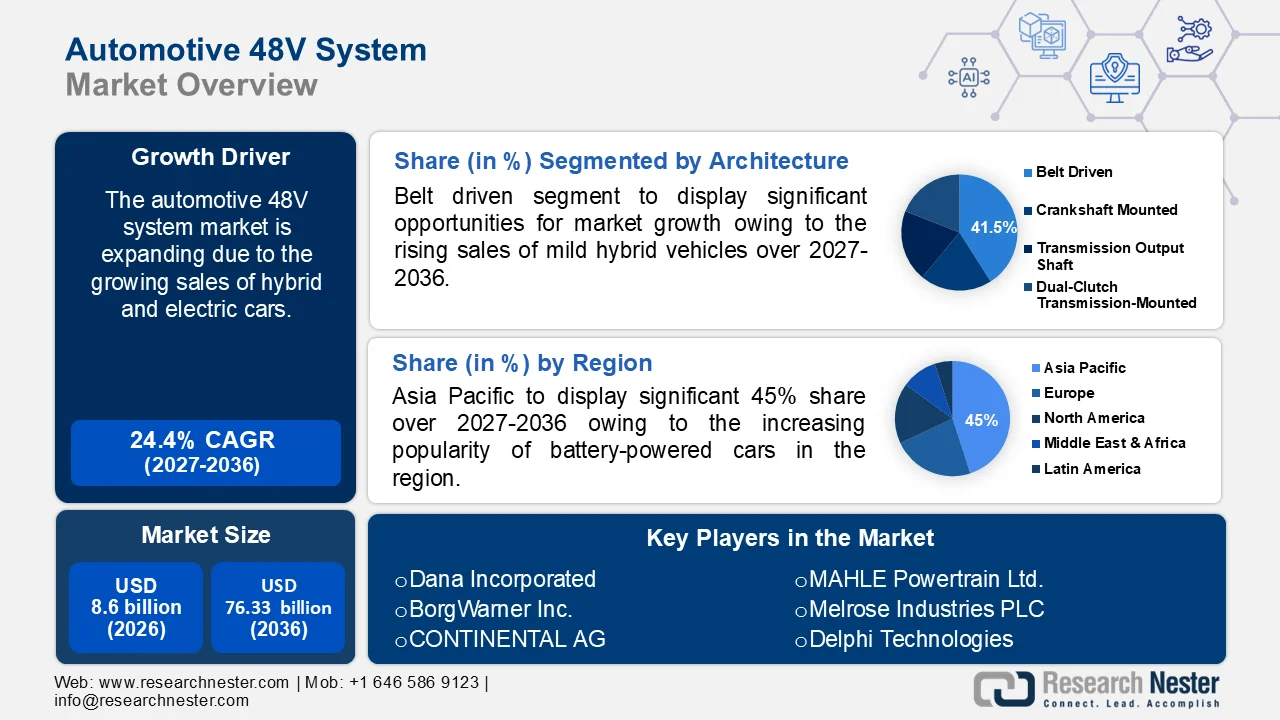
The growing sales of hybrid and electric cars are likely to drive the demand for automotive 48V systems since it has been determined as the ideal voltage for hybrid vehicles due to their power balance and energy efficiency. According to the International Energy Agency, sales of electric vehicles increased by 3.5 million in 2023 compared to 2022, a 35% annual rise. As the automotive industry shifts towards greater electrification, there is an increasing need for technologies that bridge the gap between traditional internal combustion engines (ICEs) and fully electric vehicles (EVs).
Automotive 48V systems are particularly in the context of mild-hybrid vehicles, which are becoming more popular as a transitional technology. These systems help improve fuel efficiency and reduce emissions in ICE vehicles, which complement the broader trend towards electrification. Additionally, advancements in 48V technology can support certain features in hybrid and electric vehicles such as enhanced energy recovery and efficient power management.
Key Automotive 48V System Market Insights Summary:
Regional Highlights:
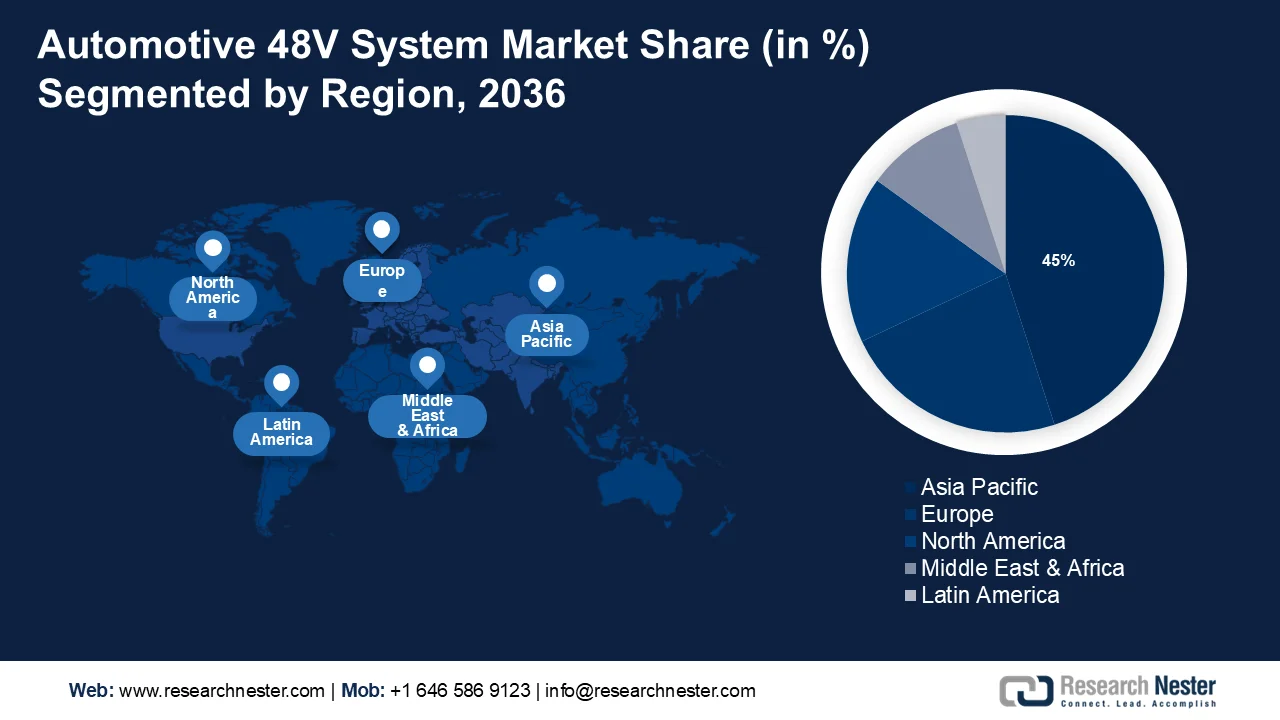
- Asia Pacific is projected to command 45% share of the automotive 48V system market by 2036, propelled by rising battery-powered vehicle adoption and expanding automotive manufacturing capacity.
- Europe is expected to witness substantial growth in the forecast period of 2027–2036, stimulated by accelerating EV penetration and supportive decarbonization initiatives.
Segment Insights:
- The belt driven segment in the automotive 48V system market is anticipated to secure 41.5% share by 2036, driven by rising sales of mild hybrid vehicles fueled by growing environmental awareness and shifting consumer preference toward eco-friendly transportation.
- The mid vehicle class segment is projected to generate significant revenue by 2036, attributed to broader integration of 48V systems to enhance fuel efficiency while maintaining competitive pricing.
Key Growth Trends:
- Rising adoption of Advanced Driver Assistance Systems (ADAS)
- Stringent emission regulations
Major Challenges:
- High cost
- Consumer acceptance
Key Players: AliveCor, Inc., Apple Inc., Baxter, Cardiac, Insight, Inc., Cardiotrack, EviCore Healthcare, Garmin, GE Healthcare, HeartFlow.
Global Automotive 48V System Market Forecast and Regional Outlook:
Market Size & Growth Projections:
- 2026 Market Size: USD 8.6 billion
- 2027 Market Size: USD 10.7 billion
- Projected Market Size: USD 76.33 billion by 2036
- Growth Forecasts: 24.4% CAGR (2027-2036)
Key Regional Dynamics:
- Largest Region: Asia Pacific (45% Share by 2036)
- Fastest Growing Region: Asia Pacific
- Dominating Countries: China, Germany, United States, Japan, South Korea
- Emerging Countries: China, India, Japan, South Korea, Mexico
Last updated on : 31 August, 2026
Automotive 48V System Market - Growth Drivers and Challenges
Growth Drivers
-
Rising adoption of Advanced Driver Assistance Systems (ADAS): ADAS features such as adaptive cruise control, lane-keeping assist, and automated parking, rely on various sensors, cameras, and electronic control units (ECUs) that demand additional electrical power. The 48V systems provide the necessary power to support these technologies effectively. Moreover, implementing 48V systems allows automakers to support the power needs of ADAS without significantly increasing vehicle costs or complexity, making it an attractive option for integrating advanced technologies.
- Stringent emission regulations: As governments around the world implement stricter emission standards to reduce environmental pollution, automakers are increasingly turning to 48V electrical systems. These systems enable mild hybrid technologies that enhance fuel efficiency, reduce CO2 emissions, and support advanced features such as regenerative breaking and start-stop systems. By incorporating 48V systems, manufacturers can meet regulatory requirements more effectively while also offering improved performance and better fuel economy, thus boosting automotive 48V system market growth.
Challenges
-
High cost: 48V systems require additional components such as specialized batteries, alternators, and power electronics, which can increase the overall cost of the vehicle. Modifying existing vehicle architectures to incorporate 48V systems involves additional engineering and integration efforts, further driving up costs.
- Consumer acceptance: There may be limited awareness about 48V systems among consumers or they may not clearly understand or appreciate the benefits of the technology. Moreover, consumers accustomed to traditional 12V systems or existing hybrid and electronic vehicle technologies might be resistant to adopting new technologies.
Automotive 48V System Market Size and Forecast:
| Report Attribute | Details |
|---|---|
|
Base Year |
2026 |
|
Forecast Period |
2027-2036 |
|
CAGR |
24.4% |
|
Base Year Market Size (2026) |
USD 8.6 billion |
|
Forecast Year Market Size (2036) |
USD 76.33 billion |
|
Regional Scope |
|
Automotive 48V System Market Segmentation:
Architecture Segment Analysis
The belt driven segment in the automotive 48V system market is estimated to gain the largest revenue share of 41.5% by 2036 on account of the rising sales of mild hybrid vehicles led by rising environmental awareness and a shift in customer preferences toward more environmentally friendly modes of transportation. According to Deloitte Group's 2023 Global Automobile Consumer Survey, Japan has the highest preference for hybrid cars (48%), followed by Korea (40%), and India (32%). The United States has a preference for hybrid automobiles with 28%, while Germany and China both have 26%.
A mild hybrid setup includes a belt-driven alternator/starter, with start-stop technology, regenerative braking, and power assist features, which helps increase mild hybrid capabilities at a minimal cost. An MGU, or motor generator unit a key component in hybrid systems, may be part of a hybrid car's belt-driven generator starter system, which includes a second pulley and functions as both an electric motor and a generator to charge a battery while the car's engine is running. The internal combustion engine of the mild hybrid automobile models is started by belt drive via the motor generator unit or MGU that helps the vehicle's engine accelerate.
Vehicle Class Segment Analysis
By the end of 2036, the mid vehicle class segment in the automotive 48V system market is predicted to register a significant revenue due to its widespread adoption of 48V systems.as fuel efficiency and emissions become more critical across all vehicle classes, mid-range vehicles equipped with 48V systems can meet regulatory requirements more effectively while maintaining competitive pricing.
48V is also capable of more than just modest hybridization in mid-sized cars as it can accommodate a large number of devices, including sophisticated driver aid systems and electric power steering. The power output of a 48 V system is far higher than that of a 12 V system which was mostly used to power starting batteries and electric parts such as infotainment, lighting, and safety systems in the past. In light of recent advancements, businesses are increasingly incorporating 48V technology into their new car systems, including Mercedes-Benz, and Fiat Chrysler Automobiles (FCA).
Our in-depth analysis of the automotive 48V system market includes the following segments:
|
Vehicle Class |
|
|
Architecture |
|

Vishnu Nair
Head - Global Business DevelopmentCustomize this report to your requirements — connect with our consultant for personalized insights and options.
Automotive 48V System Market - Regional Analysis
APAC Market Insights
Automotive 48V system market in Asia Pacific industry is anticipated to dominate majority revenue share of 45% by 2036. The market growth in the region is expected on account of the increasing popularity of battery-powered cars and the expansion of automotive manufacturing facilities. Moreover, customers in the region are placing a higher priority on fuel efficiency, which has led to the development and adoption of the low-cost 48V system. The market for fuel-efficient automobiles has experienced significant expansion, mostly due to rising gasoline prices in key Asian economies.
The governments of China and India have subsidized the purchase of electric vehicles, which may drive the demand for automotive 48V systems. Additionally, an upfront subsidy from the federal or state governments lowers the overall cost of electric vehicles, making them more affordable for individuals. China spent roughly USD 72 billion in subsidies to support the new energy-vehicle sector, which encompasses electric and plug-in hybrid vehicles, between 2009 and 2022.
Europe Market Insights
Europe will encounter enormous growth in the automotive 48V system market during the forecast period. In Europe, electric cars (EVs) have emerged as the driving force in the quickly changing landscape of sustainable transportation due to rising social demand and public awareness of decarbonization. A shift towards a broader EV uptake may augment the demand for automotive 48V systems. Moreover, Europe is unquestionably leading the 48-volt movement as by 2025 more than 10% of vehicles produced will be 48-volt systems.
The Automotive 48V system is a cutting-edge innovation that is gaining immense attention in Germany as the German federal government offers financial advantages to anyone who wants to buy plug-in hybrid or all-electric cars.
The automotive 48V system market in Italy for plug-in hybrid electric vehicles is expected to expand, therefore manufacturers and suppliers will need to create fuel-efficient 48V systems. In Italy, BEV adoption is growing well owing to the growing partnerships, collaborations among automotive 48V system market players, and new product releases.
Key Automotive 48V System Market Players:
- Robert Bosch GmbH
- Company Overview
- Business Strategy
- Key Product Offerings
- Financial Performance
- Key Performance Indicators
- Risk Analysis
- Recent Development
- Regional Presence
- SWOT Analysis
- Dana Incorporated
- BorgWarner Inc.
- CONTINENTAL AG
- MAHLE Powertrain Ltd.
- Melrose Industries PLC
- Delphi Technologies
- Magna International Inc.
- Lear Corporation
The automotive 48V system market consists of many key players who are launching various strategic initiatives to expand their market position in the industry.
Recent Developments
- In August 2023, BorgWarner Inc. announced the integration of Silicon-Carbide Technology from STMicroelectronics into the Viper Power Module for Volvo Cars' Next-Generation Electric Vehicles that will enable Volvo Cars to enhance the appeal of their electrical vehicles by extending their range and will also control essential components.
- In October 2019, Dana Incorporated partnered with Valeo to equip electric and hybrid cars with complete 48V systems that will aid in the rise of electrification of vehicles at reasonable prices.
- Report ID: 6322
- Published Date: Aug 31, 2026
- Report Format: PDF, PPT
- Explore a preview of key market trends and insights
- Review sample data tables and segment breakdowns
- Experience the quality of our visual data representations
- Evaluate our report structure and research methodology
- Get a glimpse of competitive landscape analysis
- Understand how regional forecasts are presented
- Assess the depth of company profiling and benchmarking
- Preview how actionable insights can support your strategy
Explore real data and analysis
Frequently Asked Questions (FAQ)
About this Report
Connect with our Expert


Report, 2027-2036



Copyright @ 2026 Research Nester. All Rights Reserved.
